


 Call Us



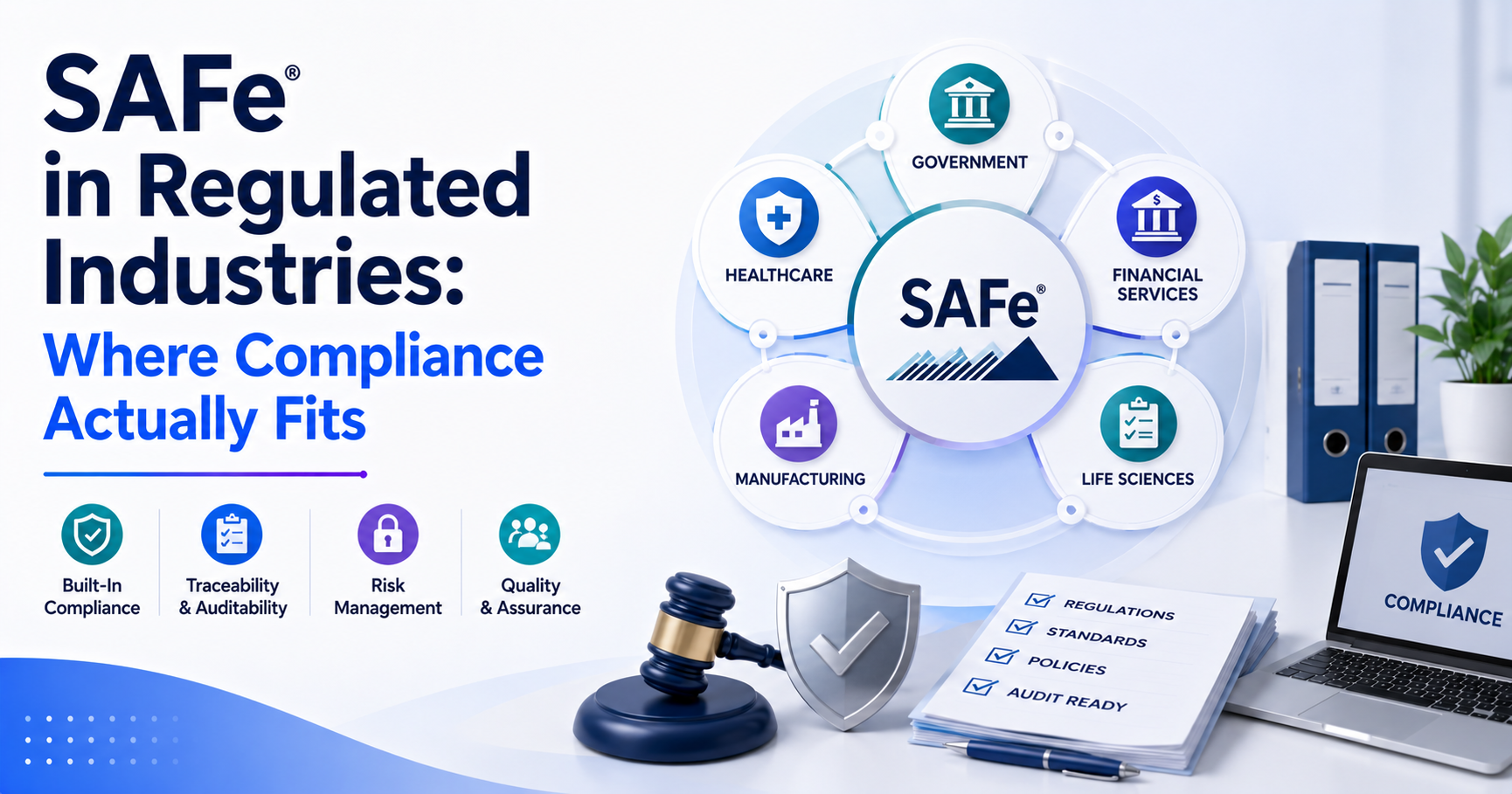
Regulated organisations adopt SAFe more readily than most people expect, and they frequently run it better. The reason is not enthusiasm. It is that regulation supplies an external deadline for work that internal discipline usually fails to protect, so compliance activity, quality standards and the Innovation and Planning Iteration all survive pressures that would erode them elsewhere. The framework's real difficulty in these environments is not the ceremonies. It is where approval authority sits.
Key Highlights
- Scaled Agile's published customer stories include heavily regulated organisations in banking, healthcare, energy and government, so the framework is demonstrably applied in these environments.
- Compliance work maps to Enablers, which are backlog items that extend the architectural runway or improve the development value stream, so it is planned rather than handled outside the system.
- Built-in Quality means quality practices throughout the process of creating value, which aligns closely with how regulators expect evidence to be produced.
- The genuine friction is governance: regulated organisations centralise approval, and the framework decentralises decisions inside guardrails.
- Regulation tends to protect the Innovation and Planning Iteration and quality standards better than internal commitment does, because an external deadline enforces them.
- Adding SAFe ceremonies underneath unchanged approval gates produces the worst outcome available: full framework cost with no decision-speed benefit.
Why regulated organisations adopt it at all
The published adopter list is instructive. Scaled Agile's customer stories include Handelsbanken and Nordea in banking, CVS Health and FRED IT in healthcare, Petrobras in energy, and Tracasa working on justice system modernisation. These are not lightly regulated environments.
The reason is the same as everywhere else and sharper. Regulated organisations typically have many teams whose work must integrate before anything can be released, plus a compliance function that has to engage with the change before it ships. That is the coordination problem the framework addresses, with an additional participant.
What makes it more urgent is that the conventional answer, applying oversight to every individual release, creates a bottleneck that scales badly. Ten teams releasing independently means ten compliance engagements. The framework's alternative is to move that engagement to the plan and the train rather than to each release.
Whether that actually happens is the question that decides the adoption, and our piece on SAFe Agilist salary data covers what the published stories do and do not tell you.
Where compliance work lives
The framework does not have a compliance construct, which causes unnecessary confusion. Compliance work is Enabler work.
Enablers are backlog items that extend the architectural runway or improve the performance of the development value stream, and they exist as a type across Epic, Capability, Feature and Story. Regulatory evidence, validation activity, security assurance and audit trails all fit that definition: they build capability required for the solution to be releasable rather than delivering customer-visible functionality.
That placement matters practically. It means compliance work sits in the backlog, ordered alongside Features, visible in planning, and consuming capacity that everyone can see. Our piece on the SAFe DevOps certification covers the Enabler categories in more detail.
The alternative, which many organisations default to, is handling compliance outside the backlog as a parallel activity. That makes its capacity consumption invisible, which means planning systematically over-commits and the compliance work is perpetually late.
The advantage regulated organisations have
Counterintuitive and worth stating, because it reframes regulation as an asset for adoption rather than an obstacle.
Several parts of the framework degrade under delivery pressure in ordinary organisations. Quality standards get suspended when a date is at risk. The Innovation and Planning Iteration gets consumed by carryover. Improvement items lose to Feature work.
In regulated environments, a good deal of that work cannot be deferred, because an external body will ask for it and the consequences of not having it are not internal. The deadline is real and it belongs to someone outside the organisation.
The practical effect is that regulated organisations often maintain better framework discipline than unregulated ones, not through superior culture but because the erosion is blocked externally. Our piece on the the Leading SAFe curriculum covers why that construct survives here and disappears elsewhere.
What regulators generally want, and what they do not
Worth separating, because a great deal of internal process exists on assumptions about regulatory expectation that nobody has tested.
Regulators typically want evidence that a decision was made competently, by someone qualified, with the reasoning recorded, and that controls exist and operate. That is a requirement about competence and traceability.
What they generally do not specify is the organisational mechanism. A regulation requiring that changes are reviewed before release does not usually require that a particular committee meets fortnightly to do it. The committee is an internal implementation of the requirement, and it is frequently one of several possible implementations.
That gap is where the decision-speed benefit lives. An organisation that can demonstrate competent, traceable, controlled decision-making inside a value stream may well satisfy the requirement without routing every change through a central body.
Establishing that is legal and compliance work rather than delivery work, and it cannot be done by a transformation function guessing. But it is worth doing, because the alternative is inheriting a control model designed for a different delivery approach and assuming it is mandatory.
Evidence as a by-product rather than an exercise
The strongest practical argument for the framework in a regulated setting, and the one that persuades compliance functions.
Under the conventional model, audit evidence is assembled. Someone gathers documents, reconstructs decisions, and produces a pack before an inspection. That process is expensive, it happens under time pressure, and the evidence is retrospective, which is precisely the weakest kind.
Under continuous quality practices, the evidence is generated as the work happens. Automated test results, review records, deployment logs and traceable decisions accumulate contemporaneously. Nothing is assembled because nothing needs to be.
The compliance benefit is substantial and it is rarely how the framework is pitched. Where it is pitched on delivery speed, a compliance audience reasonably suspects corner-cutting. Where it is pitched on better evidence, produced closer to the work, with less effort at audit time, the same audience is considerably more receptive.
Making that case well requires understanding what Built-in Quality actually requires, which is the material Leading SAFe certification training covers, and the free Leading SAFe practice test is a quick check on whether your grounding is solid enough to hold the conversation.
The genuine friction: approval authority
This is where regulated adoptions actually struggle, and it is not about ceremonies at all.
The framework decentralises decisions inside guardrails. A value stream operates within defined spending and governance policies and decides within them without seeking approval. That is the mechanism producing the speed benefit.
Regulated organisations centralise approval, deliberately and often lawfully. Certain decisions must be made by named individuals, documented, and evidenced. That is not bureaucratic inertia; it is frequently the actual requirement.
The two are in genuine tension and pretending otherwise helps nobody. What resolves it is precision about which decisions genuinely require central approval and which have accumulated there through habit. In most regulated organisations the second category is considerably larger than the first, and separating them is the highest-value work available in the adoption.
Separating real constraints from inherited ones
A method, since this is the practical crux.
List the approvals a change passes through. All of them, with who approves and how long it typically takes.
For each, ask what specifically requires it. A named regulation, a licence condition, a contractual term, or an internal policy. Write down which.
Where the answer is internal policy, ask when it was written and why. A substantial proportion will predate the current regulatory regime, or exist because of an incident that has since been addressed differently.
Where the answer is a regulation, ask what it actually requires. Frequently the regulation requires evidence that a decision was made competently, not that a particular committee made it. Those are different, and the second is often an internal interpretation.
This exercise is uncomfortable and it is where the decision-speed benefit comes from. It also requires compliance and legal in the room, which is why it belongs in the value stream identification work rather than being attempted afterwards.
Bringing compliance into the cadence
The structural change that works is moving compliance engagement from per-release to per-increment.
Under the conventional model, compliance reviews each release. With many teams, that produces a queue and the queue becomes the constraint.
The alternative is compliance engaging at PI Planning, where the whole train's intent is visible at once, and then at defined points within the increment rather than at every release. Compliance sees more, earlier, and in context.
For this to work, compliance has to attend planning. That is a real ask on people who are usually stretched, and it is the single most useful thing a regulated organisation can do for its adoption. A compliance representative in the room during breakouts prevents more rework than any amount of subsequent review.
Where compliance cannot attend, the fallback is a defined engagement point in the first iteration, which is worse and considerably better than reviewing at release.
Built-in Quality and the evidence question
Regulators generally want evidence that quality was produced systematically rather than assessed at the end, which aligns unusually well with the framework's position.
Built-in Quality means practices ensuring outputs meet appropriate standards throughout the process of creating customer value. Our piece on Built-in Quality covers what that requires in practice.
The alignment is genuine. An organisation with continuous quality practices, an enforced Definition of Done, and traceable automated evidence is in a stronger regulatory position than one with a testing phase at the end, because the evidence is continuous and contemporaneous rather than assembled retrospectively.
The argument worth making to a sceptical compliance function is exactly that: this produces better evidence, more of it, closer to the work. That lands considerably better than an argument about delivery speed, which sounds to a compliance audience like a request to go faster with less scrutiny.
What goes wrong most often
Four failure patterns specific to regulated environments.
Ceremonies added underneath unchanged gates. The train plans on a twelve-week cadence and still waits eleven weeks for approval. Full framework cost, no benefit. This is the dominant failure.
Compliance treated as a downstream reviewer. Engaged after the plan is set, so their input arrives as rework rather than as design input.
Compliance work outside the backlog. Invisible capacity consumption, chronic lateness, and planning that is systematically optimistic.
Regulation used as a reason not to change anything. Every proposed change meets the response that regulation prevents it, without anyone checking whether that is true. This is where the approvals audit above earns its cost.
This fourth pattern deserves particular attention because it is difficult to challenge without appearing to argue for weaker controls. The productive framing is not that a control should be removed, but that its regulatory basis should be established. Where it is genuinely required, it stays and everyone now knows why. Where it turns out to be internal policy from a previous operating model, that is a finding compliance can act on. Asking the question is not a challenge to the control; it is a request for its provenance, and framing it that way keeps the conversation open.
The common thread is that all four preserve the existing governance while adding the framework's overhead, which is the worst available combination and the most common one.
What good looks like here
Five signals, applicable to any regulated organisation running SAFe.
Compliance attends PI Planning. Not a report afterwards. Present in the room.
Compliance work is in the backlog as Enablers. Visible, ordered, consuming acknowledged capacity.
Someone can name which approvals are regulatory and which are internal policy. The distinction has been made deliberately.
At least one approval has been removed or delegated since the adoption started. Evidence the governance actually moved.
The Innovation and Planning Iteration still exists and contains compliance work. Protected, and used for what it is for.
An organisation meeting four of five is running a genuine adoption. One meeting none has added ceremonies to unchanged governance, which our piece on SAFe certification requirements covers as the general case.
The argument for the compliance function
Worth preparing, because compliance is usually the group with the most reason to be sceptical and the most power to slow things.
They see more, earlier. PI Planning shows the whole train's intent at once, twelve weeks ahead. That is more visibility than a release-by-release review provides.
Evidence improves. Continuous quality practices produce contemporaneous evidence rather than a retrospective assembly exercise before an audit.
Their capacity is used better. Engaging once per increment with the full picture is less total effort than engaging with every release separately.
Nothing is being removed without agreement. The approvals audit is a joint exercise, and where a control is genuinely required it stays.
The framing that fails is speed. A compliance function hearing that the adoption will make delivery faster reasonably assumes something is being skipped, and their instinct is correct often enough to justify the suspicion.
Starting the approvals audit
Practical, since this is the highest-value work available and it is easy to stall before beginning.
Pick one change type. Not all of them. One kind of change that happens often enough to matter, and trace its full approval path with dates.
Do it with compliance in the room from the start. An audit conducted by delivery and presented to compliance afterwards will be resisted, correctly, because it looks like a case being built rather than a question being asked.
Record the basis for each approval, not just its existence. Named regulation, licence condition, contract, or internal policy. The distribution is usually informative on its own.
Change one thing. The smallest approval with a purely internal basis. Removing or delegating it produces evidence and it demonstrates that the exercise leads somewhere, which is what makes the second one easier.
Understanding what the framework actually requires of governance, so that you can tell which controls are genuinely in tension with it, is what Leading SAFe certification training is for in this context.
Working with an external auditor
A practical note, since audits are where the adoption meets an outside opinion and the framework vocabulary is not shared.
Auditors assess against the regulation and the organisation's own stated controls. They are not assessing whether SAFe was implemented correctly, and framing anything in framework terminology invites confusion rather than credit.
The useful translation is straightforward. A Definition of Done is a documented control. Automated test evidence is continuous control operation. PI Planning is a documented planning and approval point with attendance recorded. Inspect and Adapt is a documented review with actions.
Every one of those maps onto something an auditor already recognises, and describing them in those terms is considerably more effective than explaining the framework.
The organisations that handle audits well under SAFe generally did one thing early: they mapped their framework practices to their stated control set, in writing, before anyone asked. That document is cheap to produce while the adoption is being designed and expensive to reconstruct under audit pressure.
The short version
Regulation is not the obstacle to a SAFe adoption that people assume. In several respects it helps, because it enforces discipline that unregulated organisations lose under pressure.
What regulation does do is concentrate the difficulty in one place: who is allowed to decide what without asking. That is the same constraint every adoption faces, arriving with more force and more legitimacy.
The organisations that succeed here do one specific piece of work early. They separate the approvals genuinely required by regulation from the ones that accumulated through habit, with compliance in the room, and they change the second category. Everything else follows from that, and skipping it produces an adoption with full ceremony cost and unchanged decision speed.
Leading SAFe certification training covers the governance and funding changes this depends on, across two days including the exam attempt. Current certification costs are listed separately, and the free Leading SAFe practice test is a quick check on your framework grounding first.








 Lowest-Price Challenge











 Personalized Path


.webp)


 USA
USA  Canada
  India
India  UK
UK  Australia
  Singapore


