


 Call Us



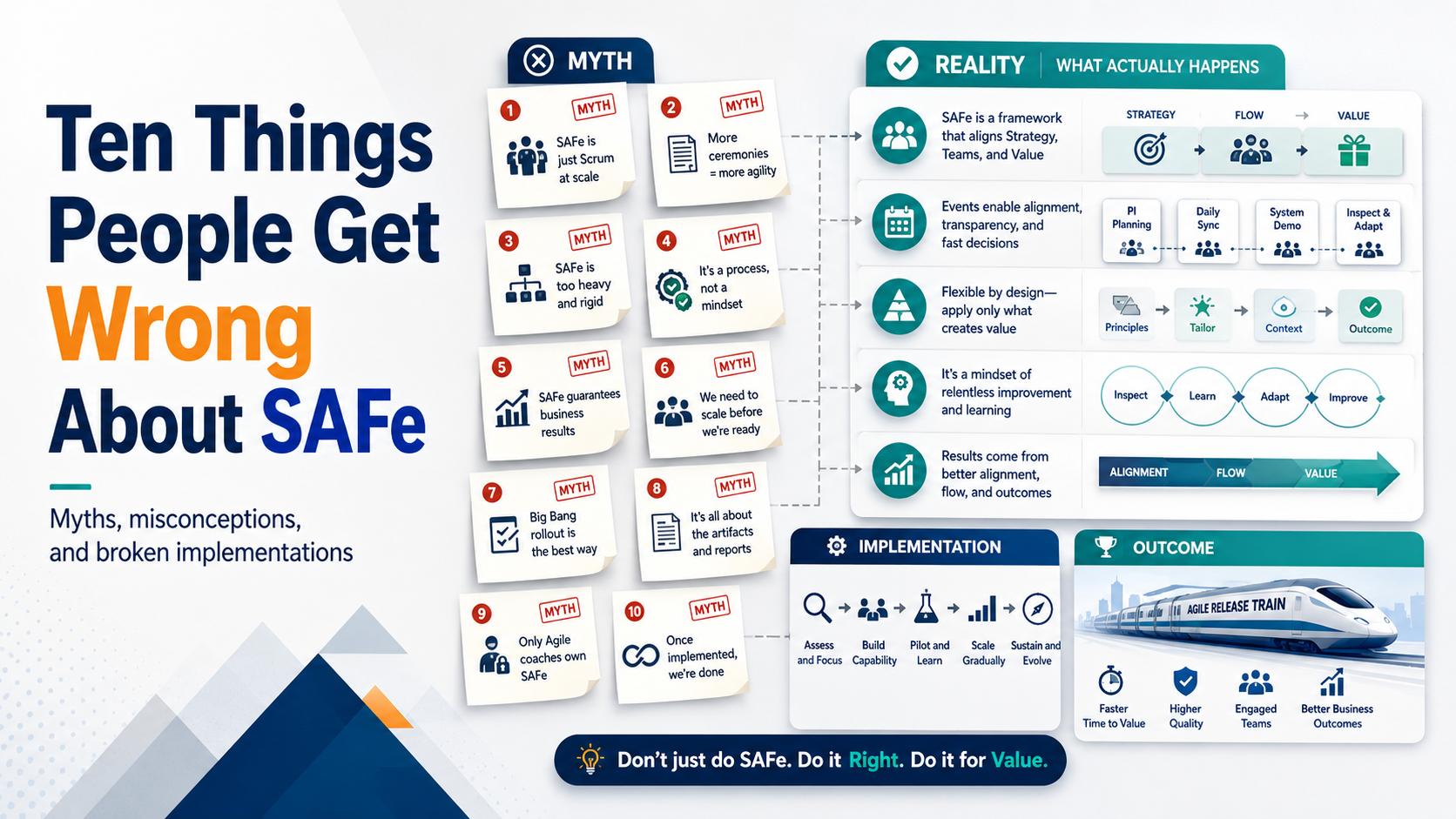
Most criticism of SAFe describes a bad implementation rather than the framework, and most defence of it describes the framework rather than any implementation anyone has seen. Both are unhelpful. What follows separates the misconceptions that are genuinely wrong from the ones that are fair criticisms people mistake for misconceptions, because a SAFe Agilist needs to be able to tell the difference in a room.
Key Highlights
- SAFe does not prescribe a testing phase, a project manager role, or fixed annual scope, though many implementations reintroduce all three.
- The framework is presented in configurations of increasing scope, so adopting the smallest and staying there is supported rather than a compromise.
- Enabler is a type of backlog item rather than a level in the hierarchy, which is the single most common technical misconception and an exam favourite.
- Some common criticisms are accurate: the framework is heavy, it is poorly suited below a certain scale, and the certification market around it is large.
- Scaled Agile classifies SAFe Agilist as foundational with no prerequisites, so treating it as evidence of experience is a genuine error.
- The most damaging misconception is that SAFe is a delivery framework, when the changes that determine success are to funding and governance.
Myth: SAFe is just waterfall with Agile vocabulary
The most common criticism and the one that is usually describing a real implementation rather than the framework.
The framework does not specify fixed annual scope, phase gates, or a plan that cannot change. Program Increments are planning timeboxes that repeat, plans are expected to change, and the distinction between committed and uncommitted objectives exists specifically so teams can adjust.
What is true is that organisations frequently implement it as waterfall in new clothes. They keep annual project funding, keep the approval gates, keep percentage-complete reporting, and add PI Planning underneath. The result genuinely is waterfall with Agile vocabulary, and the person saying so is describing their organisation accurately.
The productive response is to agree that the description fits their implementation and to name what would have to change. Defending the framework at this point loses the room, because the person is not making a theoretical claim.
Myth: SAFe requires the full framework
The framework is presented in configurations of increasing scope, from the smallest upward. Adopting the smallest and never progressing beyond it is supported.
The misconception matters because it makes SAFe look far heavier than it needs to be for most organisations. A single Agile Release Train, running the essential events, without a portfolio layer, is a legitimate implementation rather than a partial one.
Where this goes wrong is in the opposite direction: organisations adopting the full framework because it is the complete version, then carrying portfolio machinery they have no use for. Our breakdown of the four levels of the Scaled Agile Framework covers what each configuration adds and when it is warranted.
Myth: there is a testing phase
There is not, and the framework is explicit in the other direction. Built-in Quality means quality practices throughout the process of creating value rather than assessed at the end.
The misconception persists because implementations reintroduce testing phases, usually because the existing QA function needed somewhere to go and a hardening period was the path of least resistance.
The framework's position is that at train scale, defects found after many teams have integrated are disproportionately expensive, which is why quality has to be intrinsic. Our piece on SAFe DevOps certification covers the reasoning and where the practice actually breaks.
Myth: Enabler is a level in the hierarchy
The most common technical misconception and a reliable exam question.
The work item hierarchy runs Epic, Capability, Feature, Story. Enabler is not a fifth tier below Story. It is a type that can exist at any of those four levels, classifying work that extends the architectural runway or improves the development value stream.
The organisational version of this error is worse than the exam version. Treating Enablers as a separate category produces a separate technical backlog, which removes architectural work from the prioritisation conversation entirely and means it competes for capacity invisibly, which it loses.
Myth: the Release Train Engineer is a project manager
The RTE facilitates ART events and processes and coaches the teams. What they do not have is line authority over anyone on the train, which is the defining difference.
A project manager has a plan, resources and the authority to direct them. An RTE has a cadence, a programme board and influence. Everything gets achieved by making dependencies and impediments visible and getting people to act voluntarily.
Organisations that appoint an existing project manager to the role without changing the authority model get a project manager running planning events, which produces plans that are assigned rather than committed to. The role is covered properly in our SAFe RTE certification programme.
Myth: SAFe eliminates middle management
It does not eliminate the people. It does reduce the coordinating component of many of those roles, which is a real change and is usually handled dishonestly.
Most transformation material asserts that managers become coaches and leaders. Sometimes true, not automatic, and stating it as though it were settled insults people who can read the situation.
The honest version is that a genuine adoption moves some coordination into the events and the train structure, that this changes what those roles contain, and that the conversation about what they become has to be explicit and early. Evading it produces a layer of people with influence over the adoption and no incentive to help it, which our piece on who the Leading SAFe course is for covers.
Fair criticism: it is heavy
This one is accurate and should be conceded rather than argued.
SAFe is a substantial framework with defined roles, events, artefacts and a vocabulary that takes weeks to absorb. Applied to an organisation that does not have the coordination problem it solves, it is overhead with no return.
The correct response is not to defend the weight but to establish whether the problem is present. Do teams have to integrate. Is there a shared date that matters. If teams can genuinely ship independently, the framework costs more than it returns and saying so is better than persuading someone to adopt it.
A SAFe Agilist who can say when not to use SAFe is considerably more credible on when to use it.
Fair criticism: the certification market is large
Also accurate. There is a substantial commercial ecosystem around SAFe training and credentials, and people are right to notice that a framework with a certification path has incentives that a framework without one does not.
The useful distinction is between the framework's technical content and the commercial apparatus around it. The first can be sound while the second is aggressive, and both observations can be held at once.
Where this becomes a real issue is when credentials substitute for capability, as they do when an organisation certifies several hundred people and changes no funding or governance. Our piece on SAFe certification requirements covers that pattern, which is the expensive version of the criticism.
Myth: SAFe Agilist certification proves experience
It does not, and Scaled Agile does not claim it does. The certification is classified as foundational, has no prerequisites, and the training course is not required in order to sit the exam.
That makes it a knowledge credential rather than an experience one. Employers generally read it correctly, as evidence that a candidate understands the framework, and then interview for the experience separately.
The people who get this wrong are candidates, who occasionally present a two-day class as though it evidenced running a transformation. That is transparent to anyone who has, and it costs credibility in the first ten minutes. Our piece on SAFe Agilist salary covers what interviewers are actually assessing.
Myth: SAFe is a delivery framework
The most consequential misconception on this list, and the one that produces the most expensive failures.
SAFe is usually adopted by delivery organisations, run by delivery people, and measured by delivery outcomes. That framing is natural and it is wrong in a specific way: the changes that determine whether an adoption works are to funding, decision authority and reporting, none of which sit in delivery.
An organisation that treats it as a delivery framework will train teams, launch trains, run events, and change nothing above the team. Eighteen months later delivery has not improved, because the constraint was never the teams.
This is why the SAFe implementation roadmap sequences leadership before teams, and why the material sits in a leadership course. Getting this one wrong invalidates everything else.
Myth: PI Planning is just a big meeting
Two days with the whole train in a room does look like an expensive meeting, and the objection is reasonable until you know what the event produces.
The output is not a plan document. It is commitment, plus a programme board showing dependencies between teams, plus PI Objectives with business value assigned by Business Owners in the room. None of those can be produced any other way, and the last one in particular depends on the conversation happening in person.
The genuine test is whether any team's plan changes during the event. Where plans are presented and confirmed, the objection is correct and the event has become a briefing. Where teams renegotiate, discover dependencies and adjust, something is happening that a status meeting cannot replicate.
The cost is real and worth stating honestly: a train of a hundred people over two days is four hundred person-days per Program Increment. The argument is not that this is cheap. It is that the coordination cost was already being paid, invisibly, in dependencies discovered at integration.
Myth: teams lose autonomy
Partly true and worth being precise about, because the imprecise version loses the argument with engineers.
SAFe constrains when teams plan, integrate and demonstrate. Those are fixed by cadence and they are genuinely non-negotiable, because synchronisation is the mechanism that lets many teams integrate.
SAFe does not constrain how teams build. Technical decisions, practices, tooling and internal working agreements remain with the team.
Where an implementation has extended the constraint into technical choices, mandating tools or dictating design, the objection is accurate and the implementation has overreached. That happens often enough that engineers raising it are usually describing something real rather than resisting the framework.
The honest framing is that teams trade some scheduling autonomy for the ability to deliver something integrated. Whether that trade is worth it depends entirely on whether integration is actually required, which is the question our piece on companies using SAFe works through.
Myth: you need to be technical to lead a SAFe adoption
Not true, and the opposite is closer to correct.
The changes that determine whether an adoption works are to funding, decision authority and reporting. Those are business decisions. An engineering leader can advocate for them; a finance director or chief operating officer can make them.
Scaled Agile lists no prerequisites for SAFe Agilist certification and does not require the training course to sit the exam, and the syllabus weights portfolio funding and organisational change heavily. Two of the six exam domains cover product development flow and Lean Portfolio Management, and neither requires engineering knowledge.
The genuine barrier for non-technical leaders is vocabulary rather than concepts, and it lasts about a fortnight. Our piece on Leading SAFe for non-engineering leaders covers what the class actually assumes.
How to handle these in a room
Practical, since a SAFe Agilist will meet most of these within the first month.
Separate the myth from the criticism. Enabler being a level is a factual error. SAFe being heavy is a fair point. Treating both as misconceptions to be corrected loses the argument on the second.
Concede the accurate ones immediately. Agreeing that the framework is heavy, that the certification market is large, and that their implementation looks like waterfall costs nothing and buys the credibility to be believed on the rest.
Check whether they are describing your implementation. Most criticisms are. If they are right, the conversation is about fixing something rather than about the framework.
Do not evangelise. Enthusiasm about the model marks you as inexperienced to anyone who has watched an adoption struggle, and it disqualifies you from the conversation that matters. The people worth persuading have generally seen a framework introduced before and are listening for whether you will acknowledge what it costs.
Why these misconceptions persist
Worth understanding, because it changes how you address them.
Most people meet SAFe through a bad implementation. Their impression is formed by what they experienced, which was frequently waterfall with ceremonies. Telling them the framework is different does not change what they lived through.
The framework is large. There is a great deal of it, which means most people hold a partial and slightly wrong model. That is not a failure of attention; it is a predictable consequence of size.
Marketing overstates it. Material claiming transformation and business agility without naming the funding change sets expectations the framework cannot meet, and the gap between promise and outcome produces cynicism that attaches to the framework rather than to the marketing.
Nobody publishes failures. Case studies describe organisations that succeeded and chose to talk about it. The absent cases would be more instructive and they do not exist in the literature.
The practical consequence is that correcting a misconception rarely works as an isolated act. What works is being visibly honest about the framework's limits, at which point people extend enough credibility to reconsider the parts they had wrong.
That posture is most of what Leading SAFe certification training is trying to develop, and testing your own factual grounding first with the free Leading SAFe practice test is a reasonable place to start. Current certification costs are listed separately.
A note on where these come from
Most of the misconceptions above arrive by a predictable route, and knowing it helps.
Someone joins an organisation mid-adoption. They are told the framework requires something, and they believe it, because the person telling them is senior and has been certified. What they were told is frequently an internal decision rather than a framework requirement, and it gets passed on as though it were prescribed.
Three or four transmissions later, the organisation holds a set of beliefs about what SAFe requires that includes several things it does not, and correcting them means contradicting people who have been repeating them for years.
The practical defence is checking the source. The framework is published, the glossary is public, and the exam blueprint is documented. Where somebody says the framework requires something, it is usually possible to establish whether it does in a few minutes, and doing so occasionally is worth more than any amount of general scepticism. Our the Leading SAFe course curriculum covers the terms most often misused, and Leading SAFe certification training establishes the reasoning behind them.
The one to correct first
If you can only address one of these in an organisation, address the last one: that SAFe is a delivery framework.
It is the most consequential because it determines where effort goes. An organisation holding that belief will invest in training teams, launching trains and running events, and will leave funding, decision authority and reporting untouched. Eighteen months later it will conclude the framework does not work, and every other misconception on this list will have been irrelevant to that outcome.
Correcting it is uncomfortable, because the people best positioned to hear it are usually not the people running the adoption. Delivery leadership cannot change portfolio funding, so telling them their framing is wrong gives them a problem they cannot solve.
The productive version is to reach the person who can. That is generally someone in finance or portfolio leadership, and the argument is not about SAFe at all. It is that decisions currently wait, that waiting is the constraint, and that the delivery changes already made cannot produce a return until it moves.
The short version
The useful skill is not defending SAFe. It is being able to say, quickly and honestly, which category a given objection falls into.
Factual errors get corrected. Fair criticisms get conceded. And descriptions of a broken implementation get agreed with, because the person raising them is usually right and is telling you something you need to know.
A SAFe Agilist who concedes the accurate criticisms is trusted on the rest. One who defends everything is treated as an advocate, and advocates do not get told what is actually going wrong.
If you are working out where the framework genuinely applies, Leading SAFe certification training covers the reasoning across two days including the exam attempt, and the free Leading SAFe practice test is a quick check on whether the factual points above are solid.


-Training---Blog-Banner_1741781597.jpg)





 Lowest-Price Challenge











 Personalized Path


.webp)


 USA
USA  Canada
  India
India  UK
UK  Australia
  Singapore


