


 Call Us




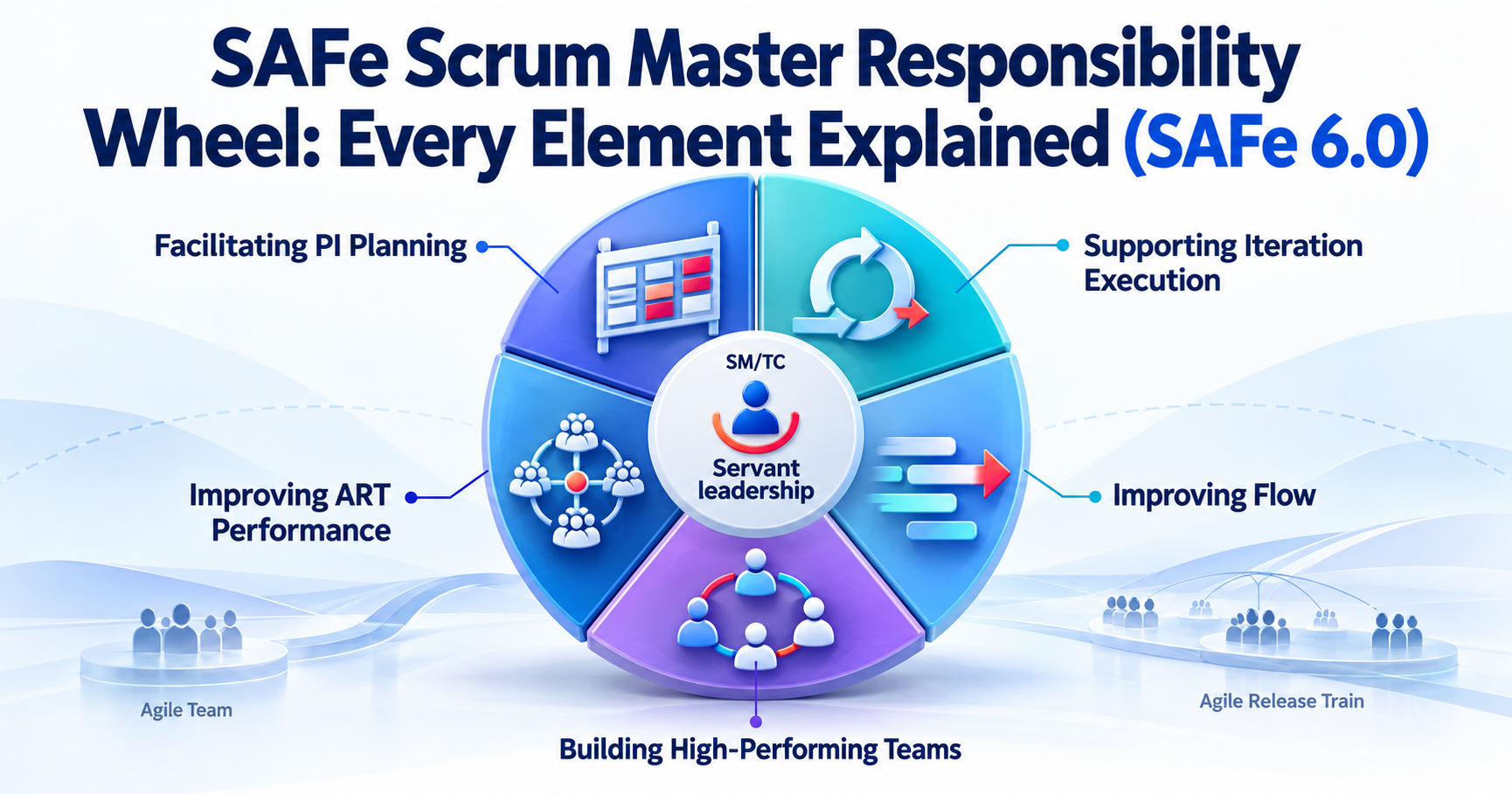
The SAFe Scrum Master responsibility wheel is the diagram Scaled Agile uses to show what a Scrum Master/Team Coach (SM/TC) does in a SAFe enterprise. In SAFe 6.0, the wheel has five official responsibility areas: Facilitating PI Planning, Supporting Iteration Execution, Improving Flow, Building High-Performing Teams, and Improving ART Performance. Together, they describe a servant leader who coaches one Agile Team while helping the whole Agile Release Train deliver value.
Key Highlights of SAFe Scrum Master responsibility wheel
- SAFe 6.0 renamed the role to Scrum Master/Team Coach (SM/TC) to show it covers coaching beyond Scrum, including SAFe Team Kanban, flow, and built-in quality.
- The official wheel has five responsibility areas. Topics such as team events, Product Owner support, and Communities of Practice sit inside those five areas rather than standing as separate slices.
- The SM/TC works at two levels at once: inside the team and across the Agile Release Train (ART), alongside the Release Train Engineer (RTE) and other SM/TCs.
- Servant leadership is the thread running through every element. The SM/TC influences instead of directing.
- In the SSM 6.0 exam, the domain that covers the role and its responsibilities carries roughly 26–30% of the questions, making the wheel one of the highest-value topics to study.
Introduction
If you have worked as a Scrum Master on a single team, SAFe can feel like stepping onto a much bigger stage. You still run the team's events and clear blockers. But now your team is one of many on an Agile Release Train, planning together every Program Increment and depending on each other to ship.
That shift is exactly what the SAFe Scrum Master/Team Coach responsibility wheel captures. It is a simple picture of a fairly complex job. Each slice shows one area where the SM/TC adds value, from PI Planning to the Inspect and Adapt event at the end of every PI.
In this guide, we walk through each element of the wheel in plain language. You will see what the SM/TC actually does in each area, how the role compares with a traditional Scrum Master, and how the wheel shows up in the SAFe Scrum Master (SSM) exam. If you are new to the role, you may also want to read our overview of the Role of a SAFe Scrum Master alongside this article.
What Is the SAFe Scrum Master/Team Coach Responsibility Wheel?
The SAFe Scrum Master/Team Coach responsibility wheel is a circular diagram from the official Scaled Agile Framework guidance. It groups everything the SM/TC does into a handful of responsibility areas, so you can see the whole role at a glance.
Scaled Agile defines the SM/TC as a servant leader and coach for an Agile Team. The SM/TC facilitates team events and processes and supports both the team and the ART in delivering value. The wheel turns that one-line definition into concrete areas of work.
In SAFe 6.0, the five official areas on the wheel are:
- Facilitating PI Planning
- Supporting Iteration Execution
- Improving Flow
- Building High-Performing Teams
- Improving ART Performance
Under each area, the framework lists specific activities. For example, Supporting Iteration Execution includes facilitating team events and collaborating with the Product Owner. Improving ART Performance includes cross-team collaboration, coaching the Innovation and Planning (IP) Iteration, and helping the team prepare for Inspect and Adapt. For a broader list of duties beyond the wheel, see our guide to SAFe Scrum Master roles and responsibilities.
Why SAFe 6.0 Renamed the Role to Scrum Master/Team Coach
In earlier versions of SAFe, the role was simply called the SAFe Scrum Master. SAFe 6.0 changed the title to Scrum Master/Team Coach for a practical reason: not every SAFe team uses Scrum.
Many teams on an Agile Release Train work with SAFe Team Kanban, especially those handling operations, support, or continuous flow work. A title tied only to Scrum did not fit them. The new name makes it clear that the person in this role coaches whatever way of working the team uses.
The rename also reflects a shift in emphasis. Scaled Agile describes the SM/TC as someone who educates the team on methods beyond Scrum, including SAFe, Kanban, flow, and built-in quality. In other words, the role is less about running ceremonies and more about coaching the team to run them well on its own.
The job itself did not disappear or split into two. One person still holds one role. "Team Coach" simply describes the coaching half of the job more honestly.
How to Read the Wheel
The easiest way to read the wheel is to think of it in two rings of influence.
- Team-focused areas: Supporting Iteration Execution, Improving Flow, and Building High-Performing Teams. These are about the day-to-day health and performance of your own Agile Team.
- Train-focused areas: Facilitating PI Planning and Improving ART Performance. These connect your team to the wider Agile Release Train, the RTE, and other teams.
The circular shape matters too. None of the areas comes "first." A healthy team plans better at PI Planning; good PI plans make iteration execution smoother, and smoother execution gives you the data to improve flow. Each slice feeds the next.
Finally, read the wheel as a set of outcomes, not a task list. Scaled Agile is clear that the SM/TC can facilitate events or let the team facilitate its own. What matters is that events happen, stay productive, and stay within the timebox. That is servant leadership in practice: you are accountable for the result, not for doing every task yourself.
The SAFe Scrum Master Responsibility Wheel, Element by Element
The first four headings below match the official wheel areas one-for-one. The last four zoom in on responsibilities that Scaled Agile places inside those areas, because they come up constantly in real work and in the exam. Here is how they map:
| Section in this guide | Where it sits on the official SAFe 6.0 wheel |
| Facilitating PI Planning | Official area |
| Supporting Iteration Execution | Official area |
| Improving Flow | Official area |
| Building High-Performing Teams | Official area |
| Improving Agile Team Events | Inside Supporting Iteration Execution (facilitate team events) |
| Coaching the Lean-Agile Mindset | Inside Building High-Performing Teams (serve as Lean-Agile leaders) |
| Supporting the Product Owner | Inside Supporting Iteration Execution (collaborate with the PO) |
| Coordinating With Other Teams and Communities of Practice | Inside Improving ART Performance and Building High-Performing Teams |
Keep this mapping in mind for the exam. If a question asks for the official responsibility areas, the answer is the five areas listed earlier.
Facilitating PI Planning
PI Planning is the face-to-face (or virtual) event where every team on the Agile Release Train plans the next Planning Interval together. The SM/TC works with other SM/TCs and the Release Train Engineer to make it a success. According to Scaled Agile, this includes:
- Preparing the team: Making sure the team has heard about upcoming features from Product Management and Business Owners, and helping the team and Product Owner identify local work such as defects, maintenance, and tech debt.
- Drafting PI plans: Helping the team work out its capacity, map work to iterations, and spot risks and dependencies.
- Coordinating with other teams: Bringing in subject matter experts and talking with other teams to agree on how shared features will get built.
- Writing team PI objectives: Making sure objectives are ready before the draft plan review, with a healthy mix of committed and uncommitted objectives.
- Reviewing final plans: Checking that objectives are SMART and clear to everyone, and often facilitating the conversation where Business Owners assign business value.
Example: On day one of PI Planning, your team discovers that a reporting feature depends on an API another team plans to build in iteration four. The SM/TC flags this on the ART planning board, sets up a quick conversation between the two teams, and helps your team adjust its plan so the reporting work lands in iteration five.
Supporting Iteration Execution
Once the PI starts, most of the SM/TC's time goes into helping the team deliver iteration by iteration. The goal is to raise the odds of hitting both iteration goals and PI objectives.
Scaled Agile groups three activities here. The SM/TC facilitates team events, helps the team apply Scrum or Kanban within the ART's shared cadence, and collaborates closely with the Product Owner. The cadence point is easy to miss. Your team cannot pick its own iteration length in isolation, because synchronized cadence is what lets the ART integrate work and manage dependencies.
Removing impediments also lives here. If a test environment is down for three days, the SM/TC does not just log it. They chase it, escalate it through the right channel, and help the team find a workaround so the iteration goal stays reachable.
Improving Flow
Flow is about how smoothly work moves from idea to done. The SM/TC helps the team find and remove bottlenecks, delays, and waste. The framework names three main activities:
- Establish the team Kanban board: The SM/TC guides the whole team in designing a board that fits the type of work it does, rather than copying a template.
- Measure and optimize flow: The team sets work-in-progress (WIP) limits and tracks flow metrics. When a column keeps piling up or keeps running empty, that is a signal to adjust the process.
- Build quality in: The SM/TC coaches built-in quality practices so the team can release often without sacrificing reliability.
Example: Your team's board shows six stories stuck in "Testing" while developers keep pulling new work. The SM/TC brings this to the retrospective. The team agrees on a WIP limit of three for testing and has developers pair on test automation when that limit is hit. Within two iterations, flow time drops noticeably.
Building High-Performing Teams
SAFe builds many ingredients of good teams into its design. Teams are small, cross-functional, and self-organizing. The SM/TC's job is to strengthen those foundations so the team keeps getting better.
This area covers several activities in the official guidance. The SM/TC fosters team attributes such as ownership, trust, open communication, and healthy conflict. They resolve conflicts, often using Patrick Lencioni's five dysfunctions as a lens. They coach with powerful questions instead of handing out answers, and they help team members build T-shaped skills through pairing and learning.
The SM/TC also works on themselves. Scaled Agile specifically mentions joining the SM/TC Community of Practice and supporting the organization's SAFe Practice Consultants (SPCs).
This is where the "agile team coach" side of the role is most visible. A good SM/TC asks "What are we not seeing here?" far more often than they say "Here's what you should do."
Improving Agile Team Events
Team events sit within Supporting Iteration Execution, but they deserve their own spotlight. Every SAFe team, whether it uses Scrum or Kanban, needs to plan, sync, review, and reflect. In SAFe Scrum, that means iteration planning, the team sync, backlog refinement, the iteration review, and the iteration retrospective.
The SM/TC is accountable for making sure these events happen, stay positive and productive, and respect the timebox. That does not mean the SM/TC must run every event. Scaled Agile actually encourages rotating facilitation so the team becomes more self-managing.
Example: Your daily team sync has crept up to 30 minutes and turned into status reporting to the SM/TC. Instead of policing it, the SM/TC asks the team to rotate facilitators weekly and to move detailed problem-solving into a short follow-up with only the people involved. The sync drops back to 15 minutes, and the team owns it.
Coaching the Lean-Agile Mindset
Under Building High-Performing Teams, Scaled Agile asks SM/TCs to serve as Lean-Agile leaders. That means leading by example, living the SAFe Lean-Agile Principles, and modeling the mindset for others.
In practice, this shows up in small, daily choices:
- Treating a missed goal as a learning opportunity, not a reason to blame someone.
- Encouraging small experiments over big upfront plans.
- Keeping work and problems visible, since transparency is one of SAFe's core values.
- Coaching stakeholders and non-agile teams on how to work effectively with Agile Teams.
Servant leadership is the heart of this element; it is why the Scrum Master is a servant leader rather than a manager. The SM/TC persuades rather than commands, and measures success by how capable the team becomes. If you want to strengthen these abilities, our article on SAFe Scrum Master skills covers the soft and technical skills that help most.
Supporting the Product Owner
The Product Owner is accountable for maximizing the value of the team's work. Supporting the PO is listed inside Supporting Iteration Execution, and it is one of the most practical parts of the role. According to Scaled Agile, the SM/TC helps by:
- Coaching the team on customer-centricity and design thinking, so it builds the right thing at the right time.
- Helping the team keep backlog items clear and concise, and aligned with the ART's capacity allocation.
- Encouraging empirical planning, where progress is judged by working increments rather than paperwork.
- Facilitating stakeholder collaboration when the PO needs it.
Example: A new PO keeps adding large, vague stories to the backlog mid-iteration. The SM/TC sets up a regular refinement session, coaches the team and PO on splitting stories, and agrees with the PO on how urgent requests will enter the backlog. Iteration goals become more stable, and the PO gets better input from the team.
Coordinating With Other Teams and Communities of Practice
This element answers a common search question: the SAFe Scrum Master role includes responsibilities to which other group? The answer is the Agile Release Train. The SM/TC is responsible not only to their own team but also to the wider ART and the other teams on it.
Under Improving ART Performance, the SM/TC facilitates cross-team collaboration. This includes representing the team in the Coach Sync, which SAFe 6.0 uses in place of the older Scrum of Scrums name. The SM/TC may also join PO Syncs and ART Syncs, attend other teams' demos, and take part in the System Demo and Inspect and Adapt events.
The same area includes coaching the IP Iteration. The SM/TC helps make sure no feature work is planned for it during PI Planning, so the team keeps that time for innovation, learning, planning, and Inspect and Adapt. During Inspect and Adapt, the SM/TC helps the team prepare and coaches root cause tools such as the five whys and Pareto analysis in the problem-solving workshop.
Communities of Practice (CoPs) connect SM/TCs across the train and the wider organization. Joining the SM/TC CoP is how you share what works, borrow ideas from peers, and stay aligned with the RTE on train-level improvements.
Responsibility Wheel vs. a Traditional Scrum Master Role
The biggest difference is scope. A traditional Scrum Master serves one Scrum Team. A SAFe SM/TC serves one team too, but also carries responsibilities to the Agile Release Train. The core values stay the same: servant leadership, transparency, and helping the team improve.
| Area | Traditional Scrum Master | SAFe Scrum Master/Team Coach |
| Scope | One Scrum Team and its organization | One Agile Team plus the wider Agile Release Train |
| Planning | Sprint Planning for the next sprint | Iteration planning plus PI Planning with all teams on the ART |
| Ways of working | Scrum | SAFe Scrum or SAFe Team Kanban |
| Cadence | Team sets its own sprint length | Team works within the ART's shared cadence |
| Cross-team work | As needed, often informal | Built in: Coach Sync, System Demo, Inspect and Adapt |
| Improvement | Sprint Retrospective | Iteration retrospective plus the ART-level problem-solving workshop |
| Key partners | Product Owner, Developers | Product Owner, team, Release Train Engineer, other SM/TCs |
| Special timebox | None | Innovation and Planning (IP) Iteration |
A traditional Scrum Master moving into SAFe will find the team-level work familiar. What takes practice is the train-level work: managing dependencies with other teams, working with the RTE, and thinking in PI-sized increments.
One more point is worth noting. The SM/TC is a team-level role, while the Release Train Engineer is the servant leader for the whole ART. The two work closely together, but the RTE coordinates the train and the SM/TC coaches a team within it. Many experienced SM/TCs later grow into the RTE role.
How the Wheel Shows Up in the SAFe Scrum Master Exam
The responsibility wheel is one of the most heavily tested topics in the SSM exam. According to Scaled Agile's SSM 6.0 exam study guide, the exam has 45 single-select multiple-choice questions, a 90-minute timebox, and a 80% passing score. Exam details can change, so always check the study guide for your course version. Scaled Agile also offers a newer AI-Empowered SAFe Scrum Master exam with its own outline and passing score.
The SSM 6.0 study guide splits the exam into four domains:
| Exam domain | Weight | How the wheel connects |
| Introducing Scrum in SAFe | 10–12% | |
| Characterizing the role of the Scrum Master | 21–23% | |
| Participating in PI Planning | 14–16% | |
| Facilitating the Iteration Execution | 21–23% | |
| Finishing the PI | 14-16% | |
| Augmenting the Scrum Master Role with AI | 12-14% |
In practice, almost every domain touches the wheel. Here is how questions tend to approach it:
- Recall questions: You may be asked to pick which option is a responsibility area of the SM/TC. Know the five official names exactly.
- Scenario questions: These describe a situation, such as a team planning feature work for the IP Iteration, and ask what the SM/TC should do. Look for the answer that coaches the team toward the SAFe practice, not the one where the SM/TC takes over.
- Role-boundary questions: Expect options that mix up the SM/TC, Product Owner, and Release Train Engineer. Remember: the PO owns backlog content, the RTE facilitates ART events, and the SM/TC coaches the team.
Study tips that work:
- Learn the five areas, then attach two or three activities to each one.
- When in doubt on a scenario, choose the servant leadership answer: ask, coach, and facilitate before you direct.
- Use the official workbook from your course as your main source. It is what the exam is written from.
- Take practice tests under timed conditions. Our Free SAFe Scrum Master practice test is a good way to find weak spots before exam day.
How to Grow Into the Team Coach Side of the Role
Most new SM/TCs are comfortable with facilitation. The coaching side takes longer to build. Here are practical ways to grow into it.
Talk less, ask more: Start every retrospective or problem discussion with a question instead of a suggestion. Questions like "What options haven't we tried?" or "What would success look like here?" push the team to think for itself.
Step back from events on purpose: Pick one event per iteration and hand facilitation to a team member. Offer feedback afterwards. Over time, the team needs you less for logistics and more for coaching.
Learn flow, not just Scrum: Study Kanban basics, WIP limits, and flow metrics. Teams on an ART increasingly mix Scrum and Kanban, and the Team Coach title expects you to support both.
Get closer to built-in quality: You do not need to be an engineer, but you should understand practices such as test automation, pairing, and a shared definition of done well enough to coach them.
Join your Community of Practice: Swapping stories with other SM/TCs is one of the fastest ways to learn. Bring a real problem to each session and leave with ideas to try.
Work on your conflict skills: Scaled Agile highlights empathy and conflict navigation as core SM/TC traits. Practice turning tense disagreements into productive debate, rather than smoothing them over.
Get certified and keep learning: Formal training gives you the full SAFe picture and the shared vocabulary your ART uses. Simpliaxis offers SAFe Scrum Master Certification Training led by experienced trainers. From there, many SM/TCs move on to advanced Scrum Master, agile team coach, or Release Train Engineer roles.
Conclusion
The SAFe Scrum Master responsibility wheel turns a broad role into five clear areas: Facilitating PI Planning, Supporting Iteration Execution, Improving Flow, Building High-Performing Teams, and Improving ART Performance. Inside those areas sits the day-to-day work of running effective team events, supporting the Product Owner, modeling the Lean-Agile mindset, and working with other teams across the train.
The SAFe 6.0 title, Scrum Master/Team Coach, sums it up well. You still facilitate, but your real job is to coach a team until it can plan, deliver, and improve with less and less help, while keeping it connected to the rest of the Agile Release Train.
If you are preparing for the SSM exam, learn the five areas by name and practice applying them to scenarios. If you are already in the role, pick one slice of the wheel where your team is weakest and focus your coaching there next PI.








 Lowest-Price Challenge












 Personalized Path



.webp)


 USA
 Canada
 India
 UK
 Australia
 Singapore


