


 Call Us



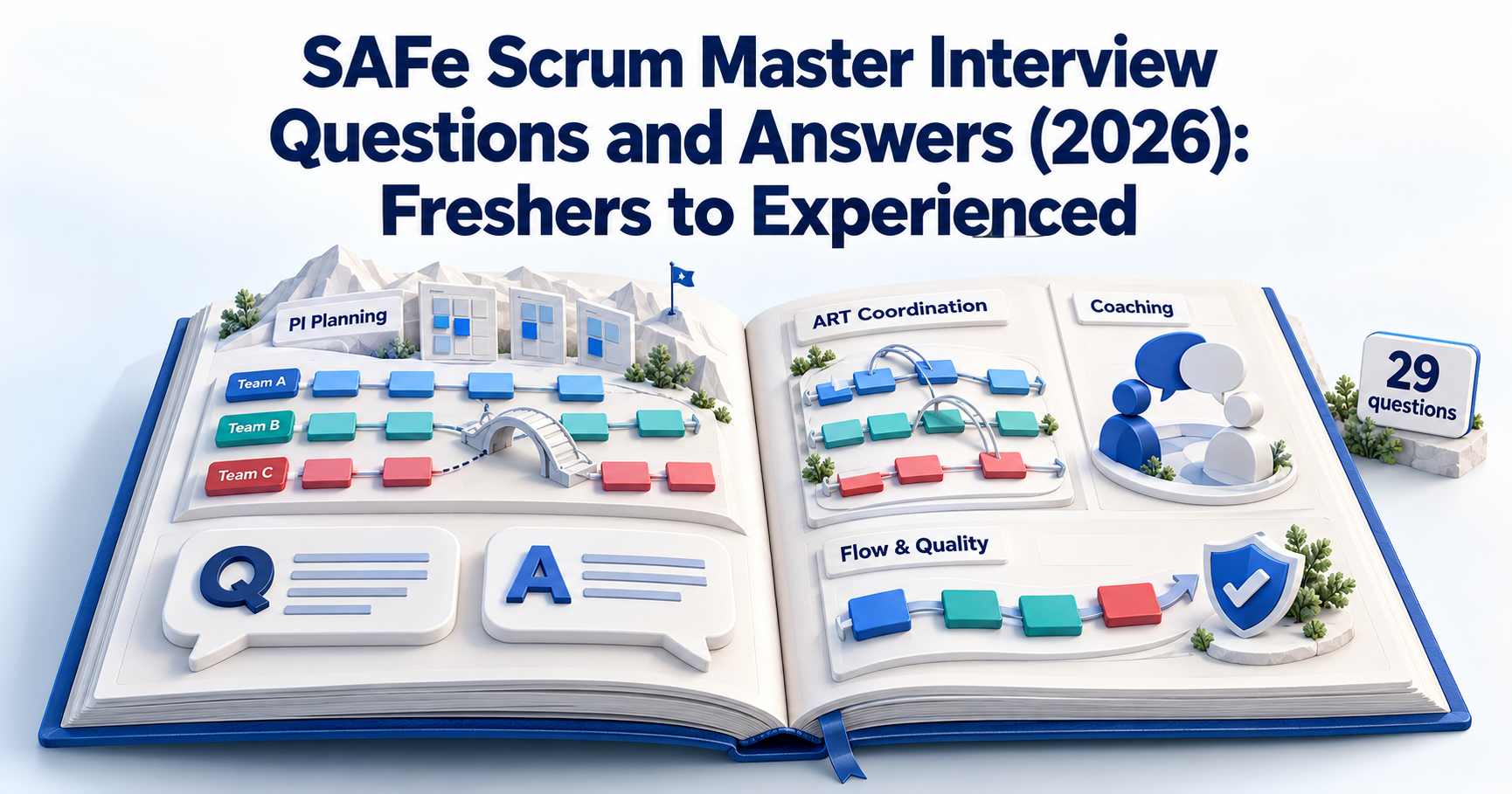
SAFe Scrum Master interview questions test whether you can coach one Agile Team while keeping it in step with the whole Agile Release Train. Expect questions on PI Planning, WSJF, the Coach Sync, Inspect and Adapt, flow metrics and servant leadership, plus scenario rounds on missed PI objectives and slipping dependencies.
Answer in SAFe 6.0 language (Scrum Master/Team Coach, Planning Interval, Team Sync) and back every answer with a real example from your team.
Key Highlights: SAFe scrum master interview questions
- SAFe 6.0 renamed the role Scrum Master/Team Coach (SM/TC). Expect at least one question on what changed and why.
- The SAFe Scrum Master interview questions here run from basics like the ART and WSJF up to PI Planning, coaching and flow.
- Freshers, experienced candidates and scenario rounds each get their own set.
- Most answers come with a quick note on what the panel is listening for.
- A few names have changed: Planning Interval (was Program Increment), Coach Sync (was Scrum of Scrums) and Team Sync (the daily stand-up).
- You'll also find prep tips you can act on this week.
Introduction
SAFe Scrum Master interviews rarely stop at the Scrum Guide. Sure, you'll get asked about roles and events. But the questions that separate candidates are about the train. How would you keep your team in step with six or seven others? What do you actually do in a PI Planning breakout? And what happens when the confidence vote comes back as a row of twos?
We've pulled together the SAFe Scrum Master interview questions that keep coming up in 2026, with answers written in current SAFe 6.0 language. They're grouped by topic first, then by experience level, with a separate set of scenario questions near the end.Looking for broader prep? See our SAFe Agile interview questions for framework-level questions.
One tip before you start. Don't memorize these SAFe Scrum Master interview questions and answers word by word. Read each answer, get the idea, then swap our example for something that happened on your own team. And if you're still deciding whether the move is worth it, have a look at our SAFe Scrum Master salary guide.
What Interviewers Actually Look for in a SAFe Scrum Master
Knowing the definitions will get you through a screening call. After that, it's mostly about judgment. Interview questions for SAFe Scrum Master roles tend to check whether you understand SAFe past its vocabulary and can coach when a whole train is involved. Panels also want proof that you've dealt with real problems, not just read about them.
They'll be listening for SAFe Scrum Master skills that don't show up on a certificate. Facilitation is the obvious one. Coaching, handling conflict and being comfortable with flow data come close behind.
How the SSM Role Differs from a Traditional Scrum Master
On a standalone Scrum team, the Scrum Master's world is mostly the team and its Product Owner. SAFe widens that. Your team now sits on an Agile Release Train (ART), typically 50 - 125 people planning and shipping on the same cadence. So your iteration goals feed PI objectives. Your dependencies hold up other teams. And some impediments won't budge until the Release Train Engineer (RTE) steps in.
SAFe 6.0 also changed the title to Scrum Master/Team Coach. The idea was to put coaching ahead of meeting admin, and the role now covers SAFe Team Kanban teams too. You'll probably be asked to describe the Role of a SAFe Scrum Master in your own words. If your answer never leaves the team room, most panels will notice.
The SSM and Team Coach Responsibilities They Will Probe
Scaled Agile describes the SM/TC as a servant leader and coach who facilitates team events and helps both teams and ARTs deliver value. In an interview, expect that to get unpacked into five areas:
- Building high-performing teams, which covers self-management, working agreements and psychological safety
- Improving flow, meaning visible work, WIP limits and flow metrics
- Facilitating PI Planning, from prep and breakouts to an honest confidence vote
- Supporting iteration execution through iteration planning, Team Sync, review and retro
- Improving ART performance via the Coach Sync, Inspect and Adapt and cross-team problem solving
Follow-up questions tend to get personal. Which of these are most of your week? Where did you get stuck? It's worth going through the full list of SAFe Scrum Master roles and responsibilities beforehand and jotting down one real example for each.
SAFe Scrum Master Interview Questions and Answers by Topic
These twelve make up the core of most SAFe Agile Scrum Master interview questions. We've written the answers in the first person so they're easy to adapt.
SAFe Fundamentals and Lean-Agile Mindset
Q1. What is SAFe and why do organizations adopt it?
SAFe, the Scaled Agile Framework, applies Lean and Agile practices at enterprise scale.Its basic unit is the Agile Release Train, where several teams plan,build and deliver together on one cadence so value arrives predictably.
Now let's understand why do companies adopt it? Mostly to align strategy with execution, improve flow and quality, and deliver faster across large programs. Picture a bank with eight teams on one mobile app. Releases clash, and integration bugs turn up a week before launch. Put those teams on a single ART with joint PI Planning and a System Demo every iteration, and the same problems surface weeks earlier.
Q2. What is the Lean-Agile mindset and how does a Scrum Master model it?
It's Lean thinking, captured in SAFe's House of Lean, combined with the Agile Manifesto. The House of Lean covers value, flow, respect for people, innovation and relentless improvement, sitting on a foundation of leadership.
How do I model it? Mostly through small daily habits. I push for small batches. I treat retros as the place where improvement actually gets decided. And I try hard not to slip into command and control. When a developer asks me how to split a story, I'll ask a couple of questions and let the team work it out. They own the decision more that way, and next time they won't need me.
The Scrum Master Role on an Agile Release Train
Q3. How is the SAFe Scrum Master role different from a traditional Scrum Master?
In SAFe 6.0 the title is Scrum Master/Team Coach, and the role lives inside an ART. I still run team events and clear impediments. The difference is that I'm coaching the team as one part of a bigger system.
In practice, that means a lot of cross-team coordination through ART Sync and the Scrum of Scrums (SAFe 6.0 now calls it the Coach Sync), plus supporting PI Planning and Inspect and Adapt. A traditional Scrum Master mainly asks whether their team is healthy. I ask that too. I also ask whether my team is helping the train hit its PI objectives.
Q4. How do you coordinate with other teams on the ART?
Mostly through ART Sync, which combines the Coach Sync and the PO Sync. The Coach Sync, which plenty of people still call the Scrum of Scrums, is where Scrum Masters/Team Coaches and the RTE go over progress, dependencies and blockers. The PO Sync deals with scope and priorities.
Between syncs, I keep dependencies on the ART planning board so there are no surprises. Say we're waiting on an API from another team and their date slips. I'll bring it up at the next Coach Sync rather than sit on it until the iteration review. If the two teams can't sort it out themselves, it goes to the RTE.
What a strong answer signals: Names ART Sync mechanics and the RTE relationship.
PI Planning and Program Increment Execution
Q5. What is your role during PI Planning?
My prep starts before the event. I make sure the team knows its capacity and has seen the features coming up. During PI Planning, which usually runs over two days,I facilitate the team's planning: capacity and load, estimation, spotting and visualizing dependencies and risks, drafting and refining PI objectives, and the confidence vote.
In breakouts I keep things moving and time-boxed. Sometimes that means walking over with the Product Owner to another team's area to agree a dependency date on the spot. I also help out when Business Owners sit with the team to assign business value to objectives.
What a strong answer signals: Concrete facilitation duties, not just "I attend."
Q6. How do you handle a low confidence vote at the end of PI Planning?
Honestly, a low vote is useful information. Teams usually vote first of five, and a handful of ones and twos means somebody can see a problem the plan doesn't account for.
So I ask what's behind the low scores. Then I facilitate the team to rework sc, load or dependencies, deal with the specific concerns, and vote again, until the team genuinely believes in the plan. What I won't do is push a commitment the team doesn't believe in. A forced plan doesn't remove the risk. It just moves the failure a few weeks down the line.
Facilitating Events, ART Sync, Scrum of Scrums, Inspect and Adapt
Q7. Which events does the SAFe Scrum Master facilitate?
At team level: iteration planning, the daily stand-up (Team Sync in SAFe 6.0), the iteration review and the retrospective. Once a team is comfortable, I rotate facilitation. SAFe recommends this, and it's a good test of whether the team can run without me.
At ART level, I help facilitate ART Sync, which includes the Coach Sync and PO Sync. I support my team's part in the System Demo after every iteration and contribute to Inspect and Adapt each PI. The RTE runs these ART events. My part is making sure my team turns up ready.
Q8. What is Inspect and Adapt and what happens there?
I&A happens at the end of every PI, in three parts. It opens with the PI System Demo, where the ART shows every feature it built during the PI. Next comes a quantitative and qualitative measurement review covering things like predictability and flow. Last is a retrospective and structured problem-solving workshop. Teams use root cause analysis there, often a fishbone diagram and the 5 Whys, and leave with improvement backlog items.
Those items go into the ART backlog for the next PI Planning. That's what makes I&A the ART's relentless improvement engine. Every PI closes with specific changes queued up, rather than a long conversation that goes nowhere.
Coaching, Impediment Removal, and Servant Leadership
Q9. How do you remove impediments outside the team's control?
First I make it visible. Then I coordinate with the other team's Scrum Master through ART Sync. If it doesn't clear quickly, I escalate to the RTE or whoever owns the problem, and I keep tracking it until it's gone.
Here's an example. Our team once needed a test environment run by a shared infrastructure group. Two days, no reply. I added it to the ART risk list, raised it at the Coach Sync and asked the RTE to take it to the infrastructure manager. It was sorted that week. Logging an issue doesn't help anyone on its own. Unblocking flow does.
What a strong answer signals: Shows an escalation path and ownership.
Q10. What does servant leadership mean to you as a Scrum Master?
For me, servant leadership means serving the team’s ability to deliver. I do that by coaching, facilitating, removing obstacles and building safety and continuous improvement. I'm not there to direct people or hand out tasks.
Day to day, I ask more than I tell. If iteration goals keep slipping, I'll bring the data to the retro and help the team find the cause themselves instead of announcing a fix. I know it's working when the team grows more capable and self-organizing over time and needs me less for routine facilitation.
Flow Metrics, Built-in Quality, and Continuous Improvement
Q11. How do you help a team improve flow?
I coach the team to limit work in process, cut batch and story size, make work visible, and go after the bottlenecks when a cumulative flow diagram shows up. Smaller batches and lower WIP shorten cycle time. They make the team more predictable, too.
SAFe 6.0 has six flow metrics: flow distribution, flow velocity, flow time, flow load, flow efficiency and flow predictability. Here's how they help in practice. If flow load keeps climbing while flow velocity stays flat, flow time is going to grow. That's my cue to suggest the team stops starting new stories and finishes what's already open.
Q12. How do you promote built-in quality?
I push for practices that build quality into every iteration. A strong Definition of Done is the base. On top of that come test-first development, continuous integration, pairing, peer reviews and automation. Quality doesn't get parked for some later phase.
Built-in quality is one of SAFe's core values, so I coach the idea that everyone owns it. It isn't a gate someone else guards. Take a team that keeps rolling defects into the next iteration. I'd help them tighten the Definition of Done and agree that a story with failing tests isn't done, however good the demo looked.
SAFe Scrum Master Interview Questions for Freshers
New to SAFe? Then the panel mostly wants to see that you know how the pieces fit together and use the right names. Keep your answers short and accurate, and add one example where you can.
Q13. What are the roles on a SAFe Agile Team?
There are three: the Product Owner, the Scrum Master/Team Coach and the team members. The PO owns the team backlog and accepts stories. The SM/TC coaches and facilitates. The team builds and tests the increment. SAFe teams are small and cross-functional, usually ten people or fewer, so they don't rely on handoffs to other groups.
Q14. What is an Agile Release Train?
An ART is a long-lived team of Agile teams, usually 50- 125 people, that plans, commits and delivers together on a shared cadence and Program Increment. Besides the teams themselves, it has train-level roles like the Release Train Engineer, Product Management, the System Architect and Business Owners.
Q15. What is a Program Increment?
A PI is a timebox, usually 8 to 12 weeks, in which an ART delivers value across several iterations. It starts with PI Planning and ends with Inspect and Adapt. A common setup is four development iterations followed by one Innovation and Planning (IP) iteration. Worth knowing: current SAFe guidance calls it a Planning Interval. Same abbreviation, new name.
Q16. What is the difference between the team backlog and the ART backlog?
The team backlog holds stories owned by the Product Owner, while the ART backlog holds features owned by Product Management. Features get broken down into stories small enough to finish in one iteration. Take a feature like "customers can pay with a saved card." It might become separate stories for saving the card, picking it at checkout and handling expired cards.
Q17. What is WSJF used for?
Weighted Shortest Job First is a prioritization method, Cost of Delay divided by job size, used to sequence work for the best economic outcome. Job size stands in for how long the job will take. Cost of Delay adds up three relative scores: user and business value, time criticality, and risk reduction or opportunity enablement. In practice, Product Management mostly uses WSJF to rank features in the ART backlog.
Q18. Which SAFe cadences should a Scrum Master know?
Start with the iteration, usually two weeks, and the Program Increment, with PI Planning at the start. Then there's the System Demo each iteration and Inspect and Adapt at the end of the PI. I'd also mention the IP iteration, since that's where innovation, I&A and prep for the next PI Planning happen.
SAFe Scrum Master Interview Questions for Experienced Professionals
Once you've got a few years behind you, Scrum Master SAFe interview questions shift from "what is" to "tell me about a time." The STAR format (situation, task, action, result) keeps your stories tight. Bring a number or two if you can.
Q19. Tell me about a time you improved a struggling team or ART.
I'd walk through how I found the real constraint, what I changed and what happened next. Something like this: one team's velocity was all over the place from one iteration to the next. When I looked at the board, most stories were too big to finish within an iteration, and WIP was high. I coached the team to limit WIP and split stories, and we tightened the Definition of Done. Retros kept the change going, and we raised it as an improvement item at I&A. By the next PI, flow time had come down and the team was hitting more of its PI objectives.
Q20. How do you handle a Product Owner who is unavailable during the iteration?
First I coach the PO on what their absence does to flow, because stories waiting for acceptance or answers stack up fast. Then we agree on availability expectations up front, along with clear acceptance criteria or a proxy who can make day-to-day calls. If it keeps happening, I escalate through the PO Sync or to leadership. The team needs decisions to keep moving, and protecting that is part of my job.
Q21. How do you manage cross-team dependencies that keep slipping?
I make them explicit on the ART planning board and coordinate through the Scrum of Scrums. I'll negotiate sequencing directly between the teams, and anything still unresolved goes to the RTE and the management review. Longer term, I coach teams to cut dependencies at the source through better story slicing and enough architectural runway.
Q22. How do you measure your own effectiveness as a Scrum Master?
By team outcomes. I look at how predictably we meet PI objectives, flow metrics like cycle time and WIP, quality trends, and whether the team is becoming more self-organizing and engaged. Output and velocity on their own don't tell me much. SAFe's predictability measure compares the business value a team actually delivered against what it planned, which makes it a fair check on whether my coaching is working.
Q23. How do you coach leaders and stakeholders, not just the team?
A good part of my work goes upward. I help leaders understand Lean-Agile principles and shield the team from disruptive mid-iteration changes. I make flow and impediments visible to them. I also coach Business Owners on their part in PI Planning and I&A, such as assigning business value and joining the problem-solving workshop. Scaling only works if leadership behavior changes along with the teams.
Q24. How do you handle conflict between two team members or two teams?
I bring the people involved together for a direct, respectful conversation that starts from the goal they share. From there I help surface what each side actually needs, and we agree on a way forward. I only escalate if it starts blocking delivery. Throughout, I try to model respect for people and keep it psychologically SAFe to disagree.
Scenario-Based and Behavioral Questions With Sample Answers
Scenario rounds often decide who gets the offer. Panels use some of the top SAFe Scrum Master interview questions here to see how you think on your feet: who you'd pull in, and what you'd refuse to do.
Q25. A team consistently misses its PI objectives. How do you respond?
I'd start by looking for root causes with the team before changing anything. Usually it's some mix of oversized objectives, dependencies nobody managed, too much WIP, or quality problems eating capacity. From there we plan to use historical capacity instead of hopeful capacity, cut WIP and batch size, and push improvement items through retros and I&A. I'd focus on predictability over pressure. Pushing harder on a broken plan rarely changes the outcome.
Q26. During PI Planning two teams find a dependency that risks a committed objective. What do you do?
I'd get it onto the ART planning board straight away so everyone can see the link and the date. Next, I'd pull both teams and their Product Owners into a quick breakout to renegotiate sequence or scope. If they can't solve it there, it goes to the management review with the RTE and Business Owners, who can adjust the plan to protect the objective.
Q27. A stakeholder pushes a high-priority change mid-iteration. How do you handle it?
I protect the iteration goals. The request goes into the backlog, where the Product Owner and Product Management can prioritize it with WSJF for a future iteration. I'd also talk to the stakeholder about why stable iterations make delivery more predictable for them too. Real emergencies are different, say a production outage or a compliance deadline. In that case we disrupt committed work, and the PO decides what comes out to make room.
Q28. Your team resists Agile practices and prefers the old way. How do you coach them?
I'd start with the why and look for small wins. The team should have a say in how they work, so I involve them and take friction out of whichever practices feel heaviest. Better results build trust on their own. A team that hates the daily Team Sync, for instance, may come round once it's shorter and only about blockers. Retros are where each change becomes the team's own instead of something imposed on them.
Q29. The RTE asks you to increase the team's velocity. How do you respond?
I'd explain that velocity is a planning tool, not a target. Push on it and you tend to get lower quality, inflated estimates and more WIP. What I'd offer instead is a focus on flow, quality and clearing impediments. I'd also ask the RTE what they actually need. Maybe it's an earlier date for one feature, and we can work on that directly. That's how you get real, sustainable throughput and predictability.
How to Prepare for a SAFe Scrum Master Interview
Knowing the answers is half of it. The other half is making them sound like you lived them.
Map Your Answers to SAFe 6.0 Responsibilities
Go back to the five SM/TC responsibility areas above and write down one real example for each. Use current SAFe 6.0 terms where they fit, like Scrum Master/Team Coach, Team Sync, Coach Sync, ART backlog and Planning Interval. If your last company still said Scrum of Scrums or Program Increment, that's fine. Just mention it.
Prepare Metrics and Real Examples from Your ART
Have two or three numbers you can explain without notes. Flow time before and after a change works well. So does PI objective achievement, or the number of defects that escaped to production. Then prepare one story each about a PI Planning you facilitated, an impediment you escalated, and something that changed because of Inspect and Adapt. No ART experience yet? Use a college project, an internship or a regular Scrum team, and explain how you'd apply the same thinking on a train.
Mock Practice and Certification Signal
Better still, get a colleague to play a tough interviewer who keeps asking "why?" After that, take a Free SAFe Scrum Master practice test to find gaps in topics like WSJF or I&A.
A certification also helps your CV stand out, and plenty of SAFe employers mention it in job ads. If you're planning to get certified, Simpliaxis runs SAFe Scrum Master Certification Training with experienced trainers and scenario-based practice close to the questions in this guide.
Conclusion
SAFe Scrum Master interview questions reward people who can link concepts to what they've actually done. Knowing that Inspect and Adapt has three parts is fine. Explaining how an I&A finding changed the way your team works is what lands the job.
So rehearse these, swap in your own stories, and stick to SAFe 6.0 language. Honest examples will take you further than perfect definitions.






 Lowest-Price Challenge












 Personalized Path



.webp)


 USA
 Canada
 India
 UK
 Australia
 Singapore


