


 Call Us



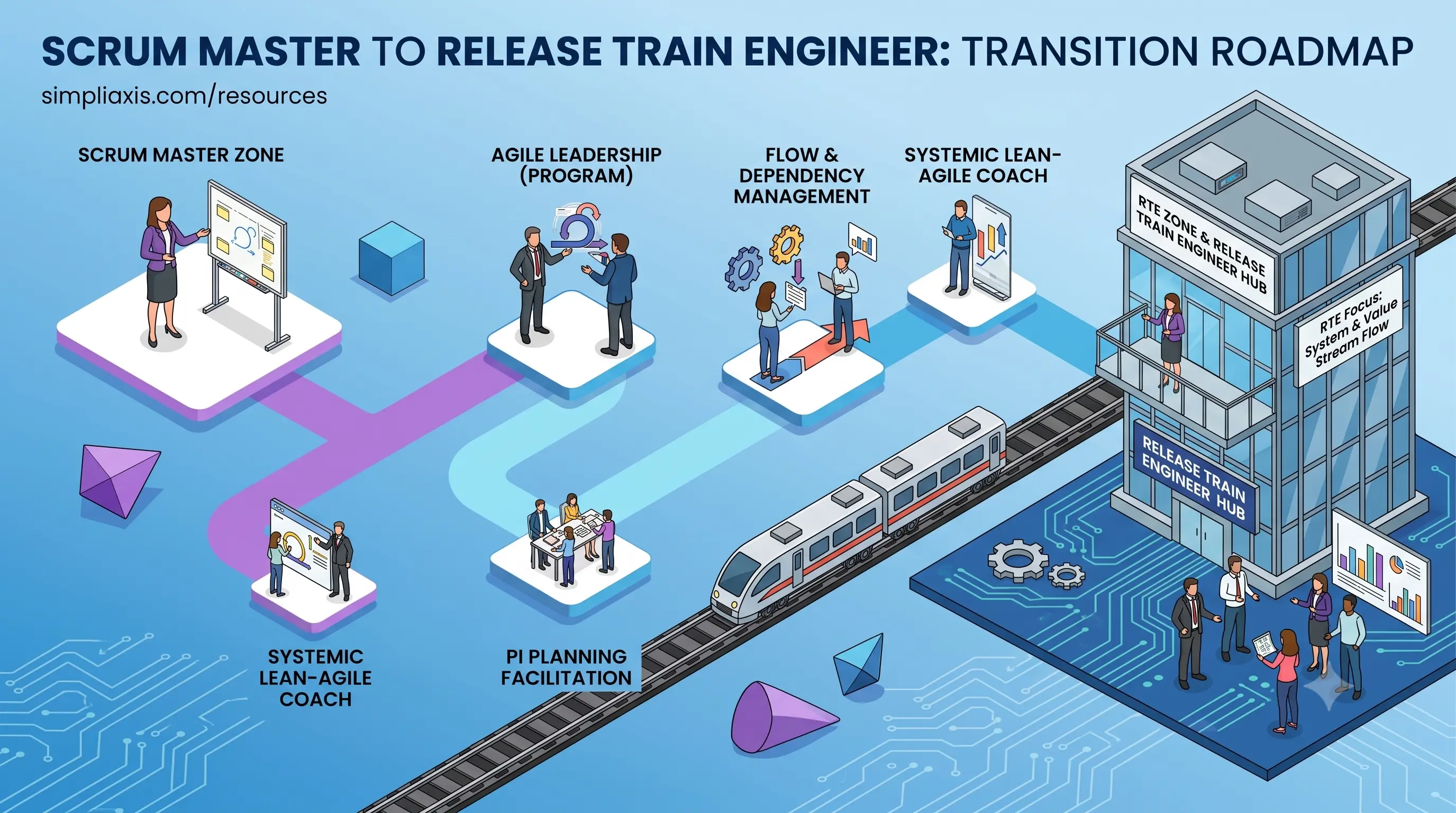
Yes, Scrum Master is the most common feeder role into RTE, and your facilitation and servant-leadership skills transfer directly. What does not transfer automatically is program-level scope: coordinating 50 to 125 people across a full Agile Release Train instead of one team. Tom Boswell, an Enterprise Agile Coach and certified SPC, documented his own path: roughly two years as a Scrum Master in SAFe enterprises, then six months working as an RTE in practice before he sat the certification exam. Certification followed readiness. It did not create it.
Key Highlights
- Facilitation, servant leadership, and impediment management carry over directly from Scrum Master to RTE. What changes is scale, not the underlying skill.
- Four specific skill areas separate a ready RTE candidate from an unready one: large-scale facilitation, value stream mapping, team topologies, and lean product development.
- Scaled Agile's own guidance recommends having "launched or participated in at least one ART and one PI" before taking RTE training, though this is a recommendation, not a hard prerequisite.
- One named, documented case shows the reverse of the usual advice: the practitioner worked as an RTE for six months before certifying, not the other way around.
- The transition is a scope change, not a tools change: RTEs facilitate a team of teams, typically 50 to 125 people, not new software or a new methodology.
If you are a Scrum Master wondering whether you are ready for an RTE role, the honest answer depends less on how long you have held the Scrum Master title and more on whether you have already touched program-level work. This roadmap covers what actually changes, how to build that evidence while you are still in your current role, and when certification fits into the sequence.
Do you need certification first, or experience first?
Tom Boswell's own account inverts the order most people assume. He spent two years in SAFe enterprises, first as a Scrum Master, then worked as an RTE for six months before sitting the certification exam. Scaled Agile's guidance supports this sequencing: it recommends candidates have already "launched or participated in at least one ART and one PI" before the RTE course, treating the certification as confirmation of readiness rather than the thing that creates it.
If you have no program-level exposure yet, that does not disqualify you, but it does mean certification alone will not close the gap. Build the evidence first, described below, and treat the exam as the last step, not the first.
The four skill areas that actually separate Scrum Masters from RTEs
Boswell's own transition guidance names four specific areas to build, not a vague "think bigger" instruction.
| Skill areaa | What it means in practice |
| Large-scale facilitation | Running events for 50 to 125 people across multiple teams, not a single team's ceremonies. |
| Value stream mapping | Seeing how work flows across the entire train, not just through your one team's backlog. |
| Team topologies | Understanding how teams should be structured and interact at scale, beyond your own team's internal dynamics. |
| Lean product development | Program-level flow and value delivery thinking, not sprint-level velocity thinking. |
Notice that none of these are new tools or new certifications. They are the same Agile thinking you already use, applied at a scale you likely have not practiced yet.
How to build program-level evidence while you are still a Scrum Master
You do not need to wait for a title change to start building the track record that gets you one.
- Volunteer for PI Planning support roles. Offer to help facilitate breakout sessions or manage the program board during Program Increment Planning, even if you are not running the whole event.
- Ask to shadow your current RTE. Sit in on ART Sync and Scrum of Scrums meetings as an observer. This is the fastest way to see program-level facilitation up close before you are responsible for it.
- Take ownership of one cross-team dependency. Managing a single dependency between two teams, end to end, is a small, provable version of what an RTE does constantly across many teams.
- Document outcomes, not activities. "I facilitated a PI Planning breakout" is an activity. "I resolved a cross-team dependency that was blocking two teams' PI objectives" is evidence. Keep a running list of the second kind.
- Study the four skill areas above deliberately. Value stream mapping and team topologies are learnable from existing SAFe framework material before you ever sit a course.
If you are earlier than this and have not yet worked directly with an Agile Release Train, start with how to become a Release Train Engineer for the fuller entry path.
A realistic timeline, and why there is no fixed number
The only independently documented timeline found for this guide is Boswell's: roughly two years as a Scrum Master in a SAFe environment, then six months functioning as an RTE before certifying. Treat that as one real data point, not a universal rule. Your own timeline depends on how much program-level exposure your current organization already gives you, not on a fixed number of years in the Scrum Master title.
What is more predictive than tenure is exposure: someone who has spent one year deliberately building the evidence in the previous section will likely be more ready than someone who has spent three years doing only team-level Scrum Master work with no ART-level involvement.
When to actually get certified
Once you have real program-level evidence, not before. If you are still deciding whether the certification is worth the cost at that point, see is SAFe RTE certification worth it for the full cost-versus-payoff breakdown. If you are ready to move forward, SAFe RTE Certification Training covers the official exam domains directly.
What changes day to day, beyond the title
This roadmap focuses on how to make the move. For the full day-to-day comparison between the two roles, including how responsibilities, meetings, and stakeholder scope differ, see RTE vs Scrum Master. Once you are ready to see what the market actually pays and which companies are hiring for the role you are moving toward, Release Train Engineer jobs and career path covers both.

_1738228533.jpg)

_1738229179.jpg)



 Lowest-Price Challenge











 Personalized Path


.webp)


 USA
USA  Canada
  India
India  UK
UK  Australia
  Singapore


