


 Call Us



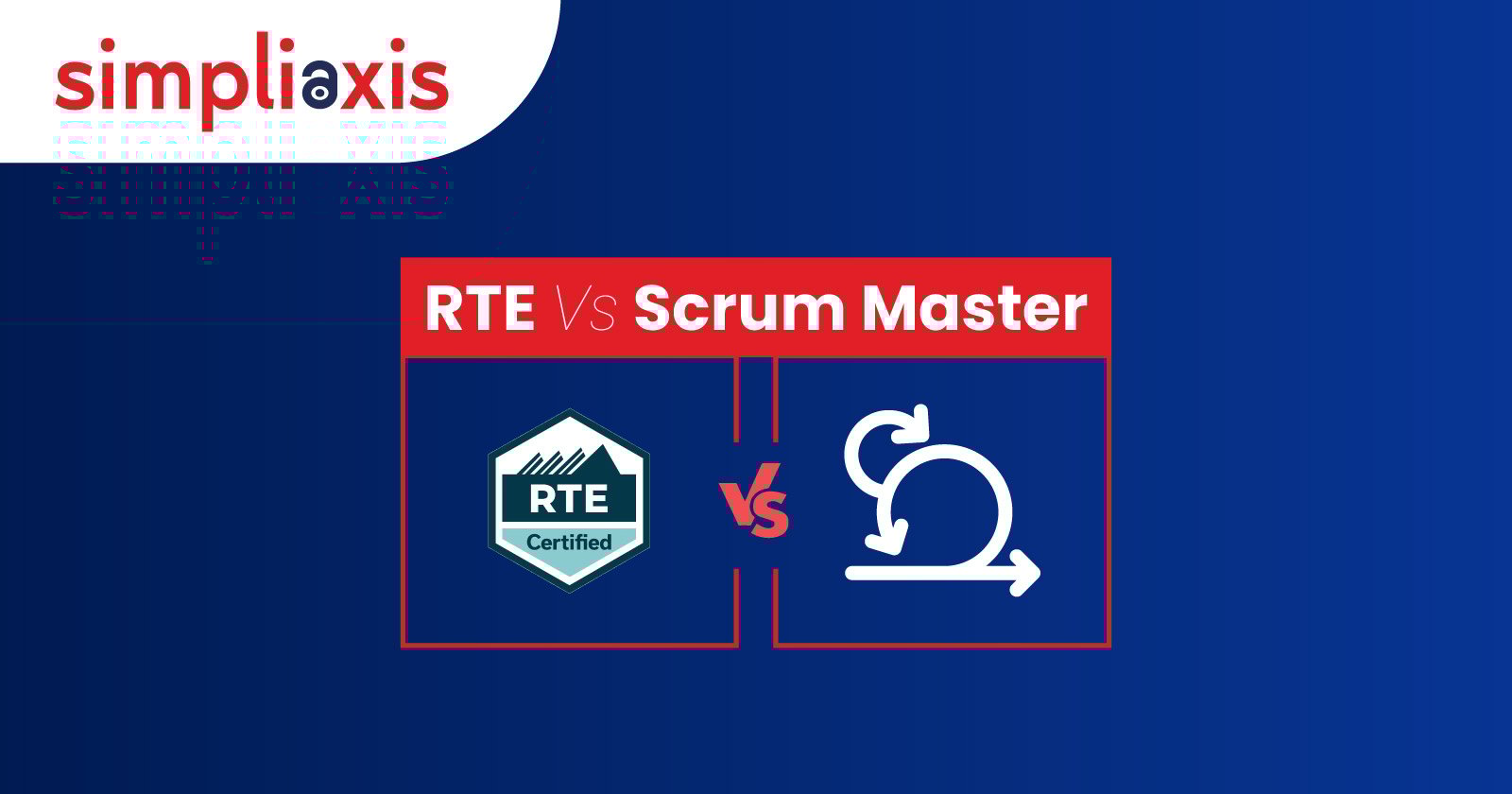
A Scrum Master serves one team. A Release Train Engineer serves an Agile Release Train, which is typically five to twelve teams working together on a shared cadence. The roles share a servant leadership mindset and almost nothing else about the daily work, and moving from one to the other is a change of job rather than a promotion within the same one.
Key Highlights
- Scope is the core difference. One team against fifty to a hundred and twenty five people, and everything else follows from that.
- The RTE is often described as the Chief Scrum Master of the train, which is useful shorthand and slightly misleading, because the work is closer to programme facilitation than to running Scrum events.
- PI Planning is the RTE's defining responsibility. Preparing, facilitating and following up on it dominates the calendar in a way no Scrum Master event does.
- The move from Scrum Master to RTE usually needs SAFe experience at team level first, not just a certification.
- RTE roles pay more, though the gap reflects a larger and more political job rather than a straightforward step up.
- Not every organisation running SAFe needs an RTE per train, and in smaller setups the role sometimes collapses back into programme management.
The Core Difference
A Scrum Master works with one Scrum Team. They facilitate the Sprint events, coach the team on Scrum, remove impediments, and work with the Product Owner on backlog health. The unit of concern is the team and the Sprint.
A Release Train Engineer works with an Agile Release Train, which is a long lived group of teams delivering against a shared Programme Increment. The unit of concern is the train and the PI, which usually runs eight to twelve weeks.
That difference in scope changes almost everything downstream. The Scrum Master spends most of their time with people they see daily. The RTE spends most of their time on coordination between groups that do not naturally talk to each other, on dependencies that cross team boundaries, and on the risks that only become visible when you look at the whole train at once.
The comparison people reach for is that the RTE is the Chief Scrum Master of the train. It is a helpful starting point and it undersells one thing: a Scrum Master coaches, whereas an RTE spends a significant share of their week on programme mechanics, reporting and stakeholder management. Those are real parts of the job, not distractions from it.
If you are earlier in this journey and want to check your Scrum grounding, our free CSM practice test takes a few minutes and shows where the gaps are.
Side by Side
| Dimension | Scrum Master | Release Train Engineer |
| Scope | One Scrum Team, typically 5 to 9 people | One ART, typically 5 to 12 teams |
| Planning horizon | One Sprint, one to four weeks | One PI, usually 8 to 12 weeks |
| Defining event | Sprint Planning and the Sprint events | PI Planning |
| Framework | Scrum | SAFe |
| Main impediments | Team level blockers | Cross team dependencies and programme risk |
| Coaching focus | The team and the Product Owner | Scrum Masters, Product Management, the train |
| Stakeholder exposure | Low to moderate | High and constant |
| Typical entry route | Team member or project background | Several years as a Scrum Master in a SAFe setting |
The row worth dwelling on is stakeholder exposure. Scrum Masters who dislike meetings with senior stakeholders often find the RTE role uncomfortable, because that exposure is not an occasional feature of the job, it is a large part of it.
What an RTE Actually Does
Descriptions of this role tend toward the abstract, so here is the concrete version.
Runs PI Planning. The two day event where the whole train plans the next increment together. The RTE prepares it, facilitates it, and manages the follow up. For a train of a hundred people this is a substantial logistical undertaking, and preparing it well takes weeks rather than days.
Manages cross team dependencies. When team four needs something from team nine, and team nine has different priorities, that lands with the RTE. This is the single biggest consumer of the role's time between planning events, and it is why an RTE with no organisational credibility struggles.
Facilitates the ART sync and Scrum of Scrums. The regular coordination meetings across teams, structurally similar to the Scrum of Scrums pattern but with more formal cadence and reporting attached.
Tracks and escalates programme risk. Not team blockers, which the Scrum Masters handle, but the risks that threaten the PI objectives.
Supports prioritisation. The RTE does not own the backlog, that sits with Product Management, but they contribute to the prioritisation conversation and often facilitate the WSJF exercise that ranks features.
Coaches the Scrum Masters. In a healthy train the RTE is a coach to the Scrum Masters rather than their line manager, though organisations differ on this and the ambiguity causes friction.
Reports upward. Progress against PI objectives, predictability measures, and the state of the train. This is the part most Scrum Masters do not anticipate.
The full breakdown of RTE responsibilities covers the formal accountabilities in more detail.
Salary and Seniority
RTE roles pay more than Scrum Master roles, and the gap is meaningful but smaller than people expect.
Across most markets an RTE sits roughly twenty five to forty percent above a Scrum Master in the same organisation, though the range is wide and depends heavily on whether the company treats RTE as a senior individual contributor role or as a management position. Current figures for the adjacent SAFe Scrum Master role give a reasonable reference point for the lower end of that spread.
Several factors move the figure within that range. Industry matters, with financial services and large scale technology paying at the top and public sector well below it. Location matters more than for Scrum Master roles, because RTE positions concentrate in cities with large engineering organisations. Train size matters, since an RTE running twelve teams is generally paid above one running five. And whether the role carries line management responsibility often makes more difference than any of the above.
Two honest caveats.
The premium reflects a harder job rather than a more senior one in every organisation. RTEs carry more scope, more visibility and considerably more political weight. Some people find the trade unattractive at any premium.
RTE roles are also scarcer. There is one RTE per train and five to twelve Scrum Masters, so the market is much thinner. That constrains mobility, and it means an RTE looking to move often waits longer for the right opening.
Moving From Scrum Master to RTE
The most common question about these two roles, and the answer has more to it than a certification.
What actually gets people hired. Experience as a Scrum Master inside a SAFe environment, ideally having participated in several PI Planning events. Hiring managers want someone who has seen a train run, not someone who has read about one. Two to three years of Scrum Master work with SAFe exposure is a typical baseline.
Where the certification fits. The SAFe RTE certification is usually expected and rarely sufficient on its own. It signals you know the mechanics and the terminology. It does not demonstrate you can hold a room of a hundred people through a difficult planning session, which is what the job is. Treat it as necessary rather than qualifying, and see the route into the role for the fuller picture.
Useful intermediate steps. Volunteering to help facilitate PI Planning, taking on cross team coordination within your current train, and building relationships with Product Management all count for more than another certificate. Several RTEs come from the Scrum Master group of their own train, which is the most common route by a distance.
The skills that transfer, and the ones that do not. Facilitation transfers well. Coaching transfers well. What does not transfer automatically is operating at programme scale, handling senior stakeholders, and being comfortable with a level of ambiguity that does not exist inside a single Sprint.
Whether to do it at all. Some excellent Scrum Masters would be unhappy as RTEs, because the thing they enjoy is close work with a team and that largely disappears. Being clear about which part of the current job you actually like is a better basis for the decision than the salary difference.
Strong Scrum Master fundamentals are what all of this builds on, and CSM Certification Training is where most people start that foundation before adding SAFe on top.
A Week in Each Role
Comparison tables flatten the difference. Two typical weeks make it clearer.
A Scrum Master's week. Daily Scrum every morning, fifteen minutes. A refinement session midweek with the team and Product Owner. One to one conversations with two team members, one about a technical disagreement and one about workload. Chasing a blocked dependency with another team's lead. Preparing the Retrospective. Sitting with the Product Owner to sort the top of the backlog. Perhaps two hours of reporting or admin across the whole week.
The rhythm is close, repetitive and team shaped. Most of the week is spent with the same eight people.
An RTE's week. ART sync twice, each pulling in Scrum Masters from every team. A dependency escalation between two teams that have been blocked on each other for a week. Preparing material for the PI Planning event that is five weeks out. A meeting with Product Management on feature prioritisation. Two conversations with senior stakeholders about whether a PI objective is still achievable. Coaching a newer Scrum Master who is struggling with their Product Owner. Updating the programme board and preparing a progress summary.
The rhythm is broad, interrupt driven and stakeholder shaped. The RTE rarely spends sustained time with any one team, and much of the week is spent on problems that only exist because multiple teams share a deadline.
Neither week is harder in the abstract. They suit different people, and the honest question for anyone considering the move is which of those two weeks sounds more like work they would want to do repeatedly.
The RTE Certification Path
Since certification is usually where people start looking, it is worth setting out what it involves.
What it is. The SAFe Release Train Engineer certification, awarded by Scaled Agile after a three day course and an exam. The course covers PI Planning facilitation, ART execution, coaching at programme level and the mechanics of running a train.
Prerequisites. Scaled Agile does not enforce hard prerequisites, though the course assumes real familiarity with SAFe. Coming in without having worked in a SAFe environment makes the material abstract, and most people who do that report getting far less from it.
What the exam tests. Mechanics and terminology rather than judgement. It is passable with study, and passing it does not by itself indicate readiness to run a train.
Renewal. The certification requires annual renewal, which carries a fee. Worth factoring in when comparing the total cost against other credentials.
Where it sits against Scrum Master certifications. A CSM or equivalent covers the team level foundation. The RTE certification covers programme level facilitation and assumes the team level knowledge is already there. They are complementary rather than alternatives, which is why most RTEs hold both.
The realistic sequence. Scrum Master certification, then two to three years of practice, then SAFe exposure at team level, then the RTE certification when a move is genuinely in view. Taking the RTE course years before there is any prospect of the role tends to mean relearning it later.
If you are at the start of that sequence, CSM Certification Training covers the team level facilitation and coaching that everything above it depends on.
Is the RTE Role Genuinely Different, or Rebranded Programme Management
Worth addressing directly, because it is what a lot of people are actually wondering and most articles avoid it.
In organisations that adopted SAFe well, the RTE is a distinct role. They facilitate rather than direct, they do not own the backlog or assign work, and their authority comes from credibility rather than reporting lines. The train self organises and the RTE removes what stops it.
In organisations that adopted SAFe as a relabelling exercise, the RTE is a programme manager with new vocabulary. They chase status, assign work, run a plan and report variance. The job title changed and the behaviour did not.
Both exist, and in roughly comparable numbers. This matters practically when evaluating a role. Useful questions at interview: who decides what the teams work on, what happens when a team says they cannot deliver something, and whether the RTE has any reporting authority over the Scrum Masters. The answers tell you quickly which version of the role you would be taking.
None of this makes SAFe good or bad. It means the title alone tells you very little, and two RTE jobs at two companies can be almost unrelated in practice.
What Separates an Effective RTE From an Ineffective One
Since the role has no formal authority in most implementations, effectiveness comes from a fairly specific set of behaviours.
They make dependencies visible early. Weak RTEs discover a cross team dependency when it blocks someone. Effective ones surface it during planning, when there is still time to sequence around it. Most of the value in the role is created before the problem happens rather than after.
They say no to the organisation, not just to the teams. When a stakeholder adds scope mid increment, the easy path is passing it down and letting the teams absorb it. The harder and more useful path is holding the boundary and making the trade off explicit.
They keep PI Planning honest. The event can become theatre, where teams present plans they do not believe in because disagreeing is uncomfortable. An RTE who creates enough safety for a team to say publicly that an objective is not achievable has done more for predictability than any amount of tracking.
They coach rather than collect status. Scrum Masters can tell within a fortnight which kind of RTE they have. One asks what is in your way, the other asks what percentage complete you are. The second produces careful reporting and very little truth.
They accept that the train is not theirs. The teams own the work. An RTE who starts assigning it has reverted to programme management, whatever the title says.
They are comfortable being unpopular occasionally. Escalating a risk that a senior stakeholder would rather not hear about is part of the job, and an RTE who never does it is not doing the job.
None of that is unique to SAFe. It is the same servant leadership stance a good Scrum Master takes at team level, applied at a scale where the political cost of taking it is considerably higher. That is genuinely the hardest part of the transition, and it is the part no certification prepares anyone for.
Do You Need Both Roles
In a SAFe implementation, yes. They operate at different levels and neither substitutes for the other. A train without Scrum Masters has nobody coaching at team level. A train without an RTE has nobody holding the cross team view, and dependencies quietly rot.
Outside SAFe the question does not really arise. An organisation running Scrum with three or four teams does not need an RTE. Coordination at that scale is usually handled through a Scrum of Scrums or an equivalent lightweight arrangement, and adding a programme role would create overhead without solving anything.
Where it gets genuinely debatable is the middle. Six to eight teams with real interdependency is roughly where lightweight coordination starts to strain and a dedicated role begins to earn its cost. Below that, most organisations do better without one.
The related comparisons of SAFe Scrum Master against CSM and agile coach against Scrum Master cover the nearby roles that get confused with these two.
Misconceptions Worth Clearing Up
Four that come up repeatedly and cause real confusion.
That RTE is simply the next step after Scrum Master. It is a common next step, not an automatic one. Plenty of Scrum Masters move into agile coaching, product roles or delivery leadership instead, and those paths are not lesser. Treating RTE as the default progression narrows the options unnecessarily.
That the RTE runs the Scrum of Scrums and little else. The coordination meetings are the visible part of the job and a small share of the actual time. Preparation for PI Planning, dependency work between events, and stakeholder conversations consume far more of the week.
That you need to leave Scrum behind. The team level knowledge does not become irrelevant. An RTE who does not understand what makes a Sprint work cannot coach Scrum Masters credibly, and it shows quickly.
That larger scope means more control. The opposite is closer to true. A Scrum Master can influence one team fairly directly. An RTE influences a hundred people through other people, with less direct control over any of them, which is why the role frustrates anyone who wants to fix things personally.
The pattern underneath all four is the assumption that the RTE role is a bigger version of the Scrum Master role. It is not. It operates at a different level, on different problems, with a different set of daily frustrations, and the people who thrive in it are usually those who found the single team view limiting rather than those who simply wanted to progress.
Closing Thoughts
The distinction that matters is scope, and everything else in the comparison follows from it. One team and one Sprint against a dozen teams and a Programme Increment produces two jobs that share a philosophy and very little else in the daily work.
For anyone weighing the move, the more useful question is not which role is better but which parts of the current job you want to keep. If it is the coaching and the closeness to a team, the RTE role removes most of that. If it is untangling dependencies and operating across organisational boundaries, it gives you considerably more.
The other thing worth checking is which version of the RTE role a given company is actually offering, because the gap between the facilitative version and the relabelled programme manager version is wide enough to make the same title mean two different careers.
If the RTE path is where you are heading, SAFe RTE Certification Training covers PI Planning facilitation and the programme level mechanics, and the free SAFe RTE practice test is a quick way to gauge readiness. If you are still building the team level foundation that the whole thing rests on, CSM Certification Training is the place to start. Request the curriculum for either to see the agenda and upcoming dates.





 Lowest-Price Challenge











 Personalized Path


.webp)


 USA
USA  Canada
 India
India UK
UK Australia
 Singapore


