


 Call Us



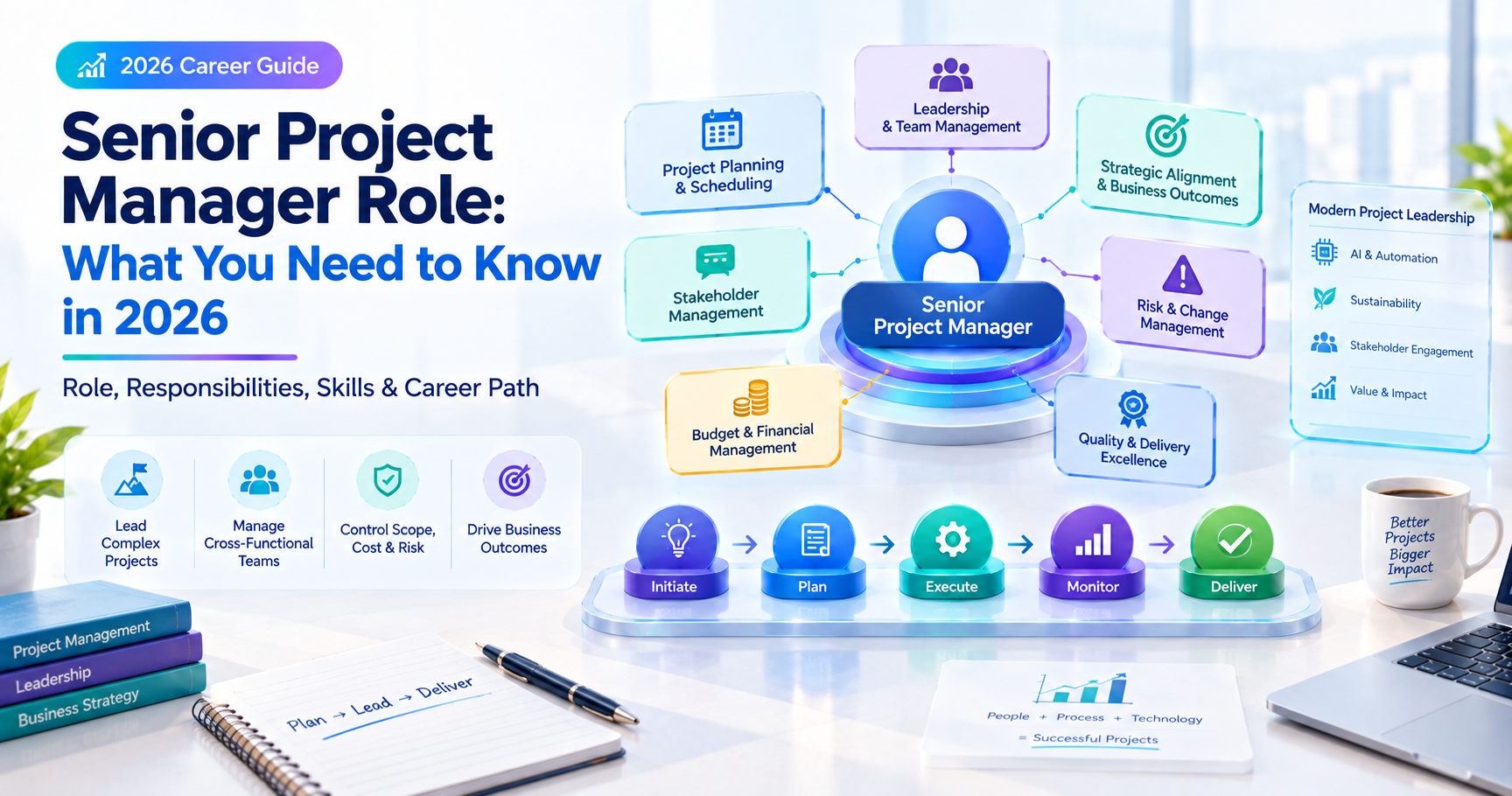
A senior project manager leads complex, high-budget, or cross-functional projects with minimal oversight, often mentoring junior PMs and reporting directly to senior leadership. The role typically requires five or more years of project-leading experience, strong stakeholder and financial communication skills, and increasingly a PMP certification. In India, average salaries run ₹23-26.5 lakh per year, according to Glassdoor and PayScale 2026 data.
Key Highlights of Senior Project Manager Role:
- Typically requires 5+ years of hands-on project-leading experience before the title is earned
- Average India salary: ₹23-26.5 lakh per year (Glassdoor/PayScale, 2026)
- PMP certification increasingly a stated requirement (not just preference) at large enterprises and MNCs
- July 2026 PMP exam update raised Business Environment weighting from 8% to 26%, directly testing the financial and strategic skills senior roles demand
- Common next steps: Program Manager, PMO Manager, or Portfolio Manager
- Core differentiator from "project manager": scope of ownership and organizational trust, not tenure alone
"Senior project manager" is one of those titles everyone recognizes but few people can define precisely. Is it just years of experience? A bigger paycheck? A formal promotion, or something you grow into informally before HR catches up?
This article answers all three parts of that question honestly: what the role actually involves, what it pays, and what a realistic path to get there looks like, including whether a PMP certification is genuinely required or just commonly preferred.
What Is a Senior Project Manager?
A senior project manager is a project management professional trusted to lead larger, more complex, or higher-risk initiatives with less oversight than a standard project manager role requires. The distinction isn't really about age or tenure. It's about scope: senior PMs typically manage bigger budgets, coordinate across multiple teams or departments, and are expected to make judgment calls in ambiguous situations without escalating every decision upward.
Many senior project managers also take on an informal or formal mentoring role for junior PMs and project coordinators, functioning as a bridge between individual project delivery and organizational leadership. In larger companies, this role often sits just below Program Manager or PMO Manager on the career ladder.
It's worth being clear about what the title does not automatically mean. It isn't a guaranteed people-management role, some senior PMs manage a team of direct reports, while others remain individual contributors who happen to run larger, higher-stakes work. It also isn't awarded purely on the basis of years served. A project coordinator with three years of experience who has visibly led a complex, cross-functional turnaround can sometimes move into a senior title faster than someone with seven years of experience managing similar, low-complexity projects on repeat. What organizations are actually buying when they promote someone to this title is confidence: confidence that this person can be handed ambiguity and deliver a defensible outcome without close supervision.
Senior Project Manager Responsibilities: What the Role Actually Involves
Day-to-Day Ownership
Where a standard project manager typically owns a single project end to end, a senior project manager often owns multiple concurrent projects, or one large, high-visibility initiative with many moving parts. That means building and maintaining detailed project plans, managing shifting scope and timelines, and making prioritization calls when resources are constrained. Senior PMs are also usually the ones who decide when a project needs to escalate a risk versus manage it quietly within the team.
Team Leadership and Mentoring
A defining responsibility at this level is developing other project managers. Senior PMs frequently hire, train, and mentor junior PMs and coordinators, helping the organization build a deeper bench of project talent rather than relying on any single person. This includes clarifying roles and responsibilities across teams, often through tools like a RACI matrix, and resolving conflicts before they slow down delivery.
Stakeholder and Executive Communication
This is where the role diverges most sharply from a standard PM position. Senior project managers are expected to communicate in the language executives use: business impact, return on investment, and risk exposure, not just task completion percentages. They frequently serve as the primary point of contact for clients, vendors, and senior leadership for the duration of a project, and are expected to manage those relationships proactively rather than reactively.
Budget and Risk Ownership
Senior PMs typically carry direct accountability for project financials, including budgets, cost forecasting, and margin, not just schedule and scope. They're expected to identify risks early, quantify their potential impact, and implement mitigation strategies before problems become expensive. This financial fluency is precisely the skill area PMI's July 2026 exam update leans into more heavily, a point worth remembering if you're mapping your own skill gaps.
How Responsibilities Shift by Industry
The core responsibilities above hold across sectors, but the emphasis shifts depending on where you work, and understanding that shift matters if you're planning a move.
- In IT and software, senior project managers spend disproportionate time on scope management and stakeholder alignment, since requirements often evolve mid-project and multiple engineering, design, and product teams need to stay coordinated. Fluency in agile and hybrid delivery models is close to mandatory here.
- In construction and engineering, the role leans harder into contract management, regulatory compliance, and vendor coordination. Senior PMs in this space often need working knowledge of procurement processes and safety standards alongside standard project management skills, and the financial accountability tends to be more rigid, tied to fixed contracts rather than flexible internal budgets.
- In BFSI and pharma, compliance and risk management dominate. Senior PMs here are expected to understand regulatory frameworks well enough to flag compliance risk before it becomes a delivery problem, and executive communication often includes legal or compliance stakeholders alongside business sponsors.
- In manufacturing, the role increasingly overlaps with process improvement and automation initiatives, where senior PMs are expected to bridge traditional project delivery with continuous improvement methodologies.
This variation is one reason a generic project management skill set only takes you so far. The senior title in one industry can look meaningfully different from the same title in another, which is worth factoring in if you're considering a cross-industry move.
Senior Project Manager vs. Project Manager: What Actually Changes
Factor | Project Manager | Senior Project Manager |
| Typical experience | 2-5 years | 5+ years |
| Project scope | Single project, moderate complexity | Multiple projects or one large, high-complexity initiative |
| Oversight level | Regular check-ins with a manager or PMO | Operates with significant autonomy |
| Stakeholder level | Team leads, project sponsors | Executives, clients, cross-functional department heads |
| Financial accountability | Tracks budget, escalates overruns | Owns budget, forecasting, and margin directly |
| Team role | Executes with the team | Mentors junior PMs, may hire or train team members |
| Certification expectation | PMP often preferred | PMP increasingly required, especially at large enterprises |
If you want the fuller picture of the standard project manager role this table compares against, Project Manager Job Description covers it in more depth.
Senior Project Manager Salary: What the Data Shows
Compensation follows scope, and the data reflects that clearly. According to Glassdoor's 2026 India data, the average senior project manager salary is approximately ₹26.5 lakh per year, with a typical range between ₹16 lakh and ₹34 lakh depending on city, industry, and employer. PayScale's India-specific data for Senior Project Manager, IT roles places the average closer to ₹25.6 lakh, and a third aggregator reports an average around ₹23 lakh, with 70% of reported salaries falling between ₹18 lakh and ₹50 lakh.
Globally, PMI's 14th edition Earning Power: Project Management Salary Survey (based on 14,628 respondents across 21 countries, published November 2025) found that PMP-certified professionals earn a 17% higher median salary than non-certified peers, with the gap in the US reaching nearly 24% ($135,000 median for certified professionals versus $109,157 for non-certified). Professionals certified for more than 10 years reported a median of $173,000, a meaningfully wider gap than those certified for under five years ($123,000), suggesting the salary effect compounds with continued, demonstrated delivery rather than appearing all at once.
City and industry both matter within India specifically. Bangalore, Hyderabad, and Pune tend to sit at the higher end of the range, driven by IT and product-heavy employment. IT and BFSI (banking, financial services, insurance) generally pay more than construction or manufacturing at equivalent seniority, though large infrastructure projects can be an exception.
Skills That Separate Senior PMs From Everyone Else
Technical project management skills, like building a schedule or tracking a budget, are assumed at this level. What actually separates a senior project manager from a competent mid-level one comes down to a handful of less tangible but more consequential skills.
- Judgment under ambiguity. Senior PMs are trusted to make calls without a clear playbook, because the projects they run rarely follow one. This is arguably the single biggest differentiator recruiters look for.
- Financial and business fluency. Understanding concepts like NPV, ROI, and benefit-cost ratios, and being able to explain a project's business case in those terms, is no longer optional at this level. It's also precisely what PMI expanded coverage of in the July 2026 PMP exam update, when the Business Environment domain jumped from 8% to 26% of total exam weight.
- Cross-functional influence without formal authority. Senior PMs frequently need to align stakeholders who don't report to them. This requires a different kind of leadership than managing a direct team.
- Mentorship and talent development. As noted earlier, the ability to develop other PMs is a defining part of the role, not a bonus skill.
- Adaptive delivery fluency. With roughly 60% of the current PMP exam content spanning agile and hybrid approaches, senior PMs are expected to move fluidly between predictive, agile, and hybrid delivery models depending on what a given project actually needs, rather than defaulting to one methodology out of habit.
None of these skills develop overnight, and none of them show up on a certificate by themselves. What a structured certification path does is give you a forcing function, a reason to study financial concepts, governance frameworks, and cross-methodology delivery in a systematic way, rather than picking them up unevenly on the job over many years.
Do You Need PMP to Become a Senior Project Manager?
The honest answer: not always, but increasingly, yes, especially at large enterprises, MNCs, and regulated industries like BFSI and pharma. PMP is not a legal requirement for the title, and plenty of experienced professionals reach senior roles through demonstrated delivery alone, particularly in smaller organizations. But job postings for senior and PMO-level roles increasingly list PMP as a stated requirement rather than a "nice to have," and PMI's own salary data shows a consistent, measurable pay gap favoring certified professionals at this career stage. Job Opportunities for PMP Certified Professionals gives a broader sense of which sectors are actively hiring for this credential right now. If you're weighing whether to pursue it, treat it less as a box-ticking exercise and more as a structured way to close the exact skill gaps, financial fluency and business-environment judgment, that separate senior PMs from everyone else.
How to Become a Senior Project Manager: A Realistic Roadmap
- Build real project-leading experience, not just project-supporting experience. Most paths to "senior" assume five or more years of experience where you owned outcomes, not just tasks. This also happens to align with PMP's own eligibility requirements (36 months with a four-year degree, or 60 months without one, within a defined experience window).
- Actively seek out complexity, not just volume. Managing five small, similar projects builds less of a case for promotion than successfully leading one genuinely complex, cross-functional initiative.
- Close your financial and business-fluency gap deliberately. If budgeting, forecasting, or ROI framing isn't already second nature, this is the single highest-leverage skill to build, both for promotion conversations and for passing the current PMP exam.
- Get certified through a structured program. A live, PMI Authorized Training Partner course, such as Simpliaxis's PMP Certification Training, covers the mandatory 35 hours of project management education in one sitting and builds exam readiness around the current 2026 content, rather than assembling scattered self-study.
- Ask for stretch assignments that stretch your visibility, not just your workload. Leading a project that senior leadership actually watches closely does more for a promotion case than a technically harder project nobody notices.
- Start mentoring before you're asked to. Demonstrating the people-development side of the role informally is often what convinces a manager you're already operating at the next level.
What the July 2026 PMP Exam Update Means for This Role
PMI updated the PMP exam on July 9, 2026, rebalancing its three domains: People dropped from 42% to 33%, Process dropped from 50% to 41%, and Business Environment jumped from 8% to 26%, the largest structural shift in the exam's history. The updated Business Environment domain now covers financial management, strategic alignment, sustainability, and organizational change management in more depth than before. For anyone targeting a senior project manager role specifically, this update is good news rather than a hurdle: the exam now tests more directly for the skills the role actually requires, which means preparing for it also means preparing for the job itself, not just the credential.
Career Paths Beyond Senior Project Manager
Senior project manager is rarely a terminal title. Understanding what comes next helps frame how to position yourself while you're still in the role. For the fuller ladder view, from project coordinator through this title and beyond, Project Manager Career Path maps the whole progression in one place.
Next Role | What Changes | Typical Timeline |
| Program Manager | Owns a portfolio of related projects tied to one business outcome, not a single deliverable | 2-4 years as a senior PM |
| PMO Manager/Director | Shifts from delivering projects to building the systems, standards, and governance that other PMs use | 3-5 years as a senior PM |
| Portfolio Manager | Oversees a full portfolio of programs and projects, aligning them to organizational strategy | 5+ years, often after a Program Manager stint |
| Director of Project Management | Executive-level oversight across the entire PM function | Typically the longest runway, often 8-10+ years total experience |
PMI's own certification ladder mirrors this progression: PMP for senior individual-contributor delivery roles, PgMP for program-level leadership, and PfMP® for portfolio-level strategy, each building on the credibility the previous one establishes.
Common Mistakes That Delay the Promotion
A few patterns consistently slow down the move to senior project manager.
- Confusing tenure with readiness. Simply waiting long enough rarely works if the scope of what you've owned hasn't visibly grown. Managers promote based on demonstrated capability at the next level, not seniority by the calendar.
- Under-investing in financial and business communication skills. Many technically strong PMs treat budgeting and executive communication as "someone else's job" until a senior role suddenly requires them, at which point they're building the skill under pressure rather than in advance.
- Avoiding stretch assignments. A preference for predictable, lower-risk projects is understandable, but it's precisely the harder, more visible initiatives that build a credible promotion case. Volunteering for the project nobody else wants is often a faster path than waiting to be assigned an easy win.
- Never asking what "senior" actually means at your organization. Many capable PMs guess at a bar that was never clearly defined in the first place. A direct conversation with your manager about the specific criteria, project size, budget thresholds, team leadership expectations, can save years of misdirected effort.
- Treating certification as a substitute for experience, or vice versa. Some PMs assume a PMP alone will trigger a promotion regardless of demonstrated scope; others assume enough experience makes certification irrelevant. The strongest promotion cases combine both: real delivery evidence plus a credential that validates it against an external, recognized standard.
Is Senior Project Manager the Right Next Step for You?
Pros:
- Meaningfully higher compensation, with India averages in the ₹23-26.5 lakh range and a clear PMP-linked premium globally
- Greater autonomy and trust in decision-making
- A recognized stepping stone toward Program, PMO, or Portfolio leadership roles
- Skills built at this level (financial fluency, executive communication) transfer well beyond project management itself
Cons:
- Meaningfully higher accountability, including direct exposure when projects go over budget or miss deadlines
- Requires sustained investment in skills beyond technical project management, particularly business and financial fluency
- In organizations without clear leveling criteria, the path to the title can feel ambiguous or inconsistently applied
- Certification and skill-building require real upfront time investment before the payoff materializes
If the responsibilities described above sound like work you're already doing informally, or work you're ready to grow into, the roadmap above is a practical way to close the gap deliberately rather than waiting for it to close on its own.
Conclusion
Becoming a senior project manager isn't really about waiting long enough. It's about deliberately expanding the scope of what you're trusted to own, building the financial and executive-communication fluency the role actually demands, and validating that growth through a recognized credential. PMP remains the most common way to do that structured skill-building, and the July 2026 exam update has only made the certification's content more relevant to what senior roles require day to day.
If you're mapping your next steps, a few related paths are worth exploring alongside this article. If your organization is pushing toward Agile or hybrid delivery, pairing PMP with PMI-ACP can strengthen your case for senior, delivery-agnostic roles. If Program or Portfolio leadership is further down your roadmap, it's worth looking at PgMP certification and PfMP certification now, so you understand the full ladder rather than just the next rung.
Before committing to a full course, you can also gauge your current readiness with a free PMP practice test or start with the Simpliaxis PMP orientation session to see how the training is structured.







 Lowest-Price Challenge











 Personalized Path


.webp)


 USA
USA  Canada
 India
India UK
UK Australia
 Singapore


