


 Call Us



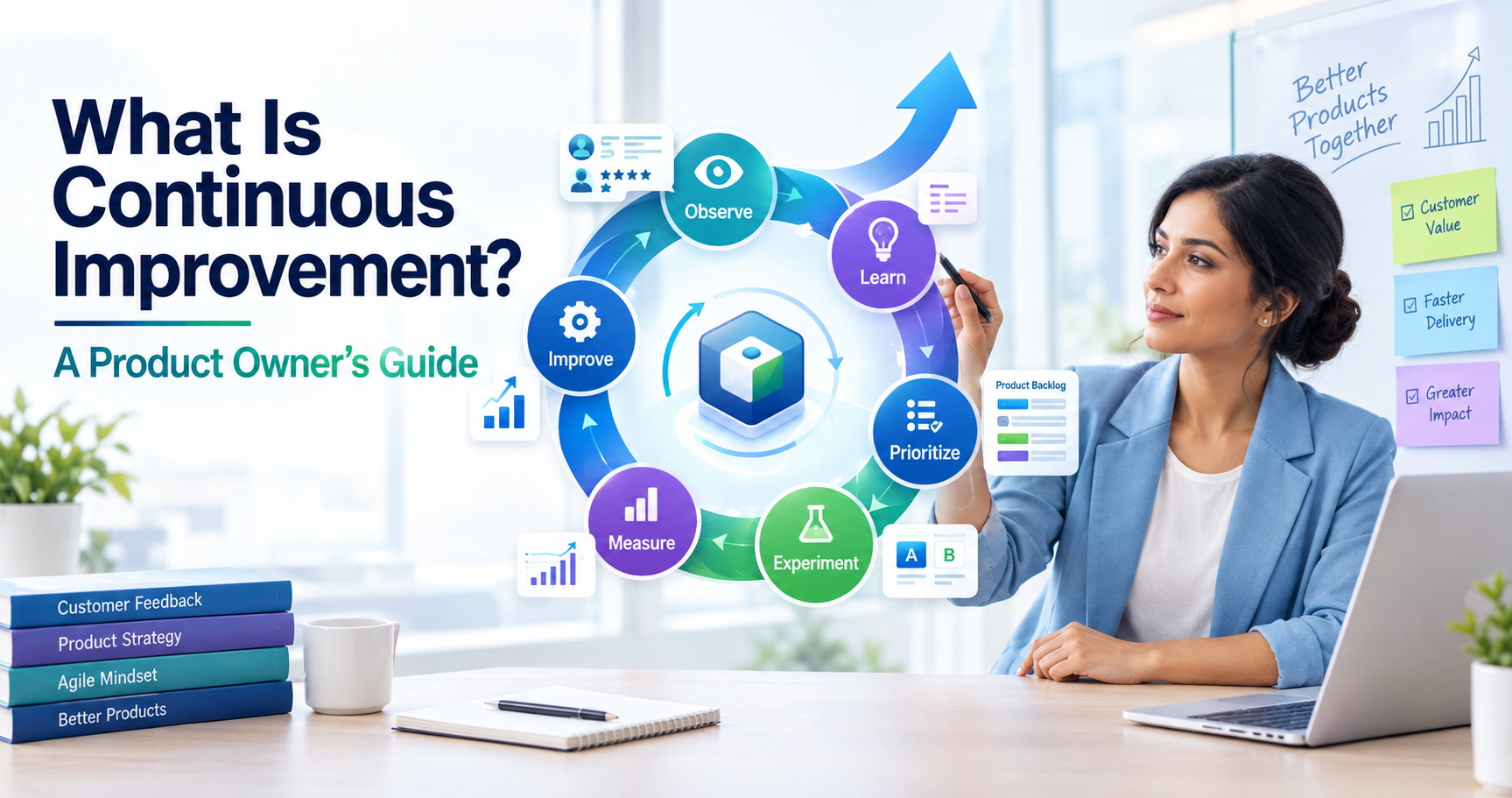
Continuous improvement is the practice of making little adjustments that help a product, process, or team perform better over time. You don’t always have to make significant changes. In many situations, tiny improvements repeated over several sprints can have a huge impact.
Key Highlights
- Understand the meaning and significance of continuous improvement
- Observe how Product Owners facilitate continuous improvement
- Explore means for identifying opportunities for product and process improvement
- See how consumer input and product data lead to improvements
- Learn how to prioritize areas for improvement according to product goals
- Understand the significance of experimentation, inspection, and adaptation
- Learn how to embed continuous improvement into product development in practice
As a Product Owner, constant improvement does not mean only introducing new features. This might include eliminating an ambiguous step in a user experience, enhancing product quality, minimizing repeat defects, clarifying backlog items, improving communication with stakeholders, or letting the team spend more time on meaningful work.
This concept is strongly tied to the Japanese philosophy of Kaizen, which focuses on continuous and gradual development. Toyota included kaizen into their famous manufacturing method. Workers are urged to make improvements every day to eliminate waste, inconsistency, and needless work. Indeed, Toyota says of its production method, “Incremental Kaizen is practiced daily throughout the organization."
This notion also meshes easily with Scrum. Scrum relies on inspection and adaptation. The Scrum Guide defines the Product Backlog as an orderly list of everything required to build the product. It also provides a clear goal for the sprint retrospective: developing strategies to boost quality and effectiveness.
This implies that for Product Owners, improvement should not be a one-off action that is only done when something goes wrong. It might be part of the day-to-day product work.
Continuous Improvement vs. Continuous Delivery
Continuous improvement and continuous delivery sound alike but are not the same.
Continuous improvement is about becoming better at products, processes, and methods of working over time. It might be product quality, team procedures, customer experience, planning, communication, testing, prioritizing, or anything else that needs to be improved.
Continuous delivery is mostly about the capacity to deploy changes rapidly and securely into production or into the hands of users. Agile Alliance defines continuous delivery as the ability to securely and rapidly deploy varying sorts of changes, such as features, bug fixes, configuration changes, and experiments, into production.
Let's illustrate the distinction with a simple example.
Suppose a team takes two weeks to deliver a simple product modification. The team becomes better at deploying, and they can deliver that update a lot quicker. That is a step forward in delivery.
Say the team sees plenty of consumers drop out at some level in the product now. It alters the step, tests the outcome, and sees less attrition among the users. That’s continual product experience enhancement.
They can operate together. The faster things get, the faster a team can test improvements. Continuous improvement helps a team determine which changes are worth delivering.
Continuous Improvement vs. Continuous Discovery
Continuous discovery is about learning what issues your customers have, testing your assumptions, and learning what should be developed or altered.
Product discoverycould entail input from consumers, user research, product data, prototypes, trials, and conversations with the individuals who use or support the product. The new way of thinking about product discovery is that it’s a continuous process that is tightly coupled with delivery, rather than something that is “done” before development work begins.
Continuous improvement is more than just that.
A Product Owner may utilize discovery to learn that consumers have trouble finding a feature. The team then alters the product. The team verifies that the issue is truly better after the adjustment. If it hasn't, then something else must change.
In this instance:
- Discovery asks, what is the issue for users?
- Improvement asks, how can we improve the product or process?
- Delivery asks, how do we get the update to users safely?
These activities are mutually supportive, but they are not the same.
Why Continuous Improvement Matters for Product Owners?
The Product Owner is liable for maximizing the value of the product arising from the work of the Scrum Team.
That obligation is more than what feature should go next. The Product Owner also has to watch that the team is addressing the proper challenges, that the product is becoming better, and that the manner of working is enabling the team to produce value.
Continuous improvement helps this job in a number of ways.
Reducing Technical Debt and Improving Product Quality
Product quality may deteriorate with time. A little flaw may not appear worrisome. Some users may be affected by an unclear process. A little bit of technical debtmight appear doable. But when more and more of the same kinds of issues accumulate, they may make the product tougher to update and sustain.
Continuous improvement provides you with a regular space to identify these things before they become bigger problems.
The Product Owner doesn’t have to make every technical solution. The developers are responsible for delivering a usable increment and for quality, which is the responsibility of the definition of done.
However, when there are significant product issues and quality problems that impact product value, the Product Owner should make them apparent.
Users, for example, often complain that a site loads too slowly. The staff might consider each report as a separate problem. The way to continuous improvement is to pose a wider question: Why does this keep happening? What adjustment might help to prevent the issue from coming back?
That move from treating particular symptoms to changing the underlying system may cut down on duplication of effort.
Psychological Safety and Group Dynamics
Continuous improvement needs individuals to be prepared to communicate about challenges.
If team members think they will be blamed for any issues they raise, they are less likely to raise them. If team members think that they will be blamed for errors, delays, unclear requirements, or inadequate procedures, they will be less inclined to talk about these things. This makes it harder to improve since the team is operating with partial knowledge.
The Product Owner may promote a better atmosphere by ensuring the conversation is on the issue and not the individual.
Instead, the team might ask, “Who is responsible for this problem?”
- What’s going on?
- How was the issue possible?
- What did we overlook?
- What can we do differently next time?
- How will we know the modification worked?
This does not imply forgetting responsibility. It implies learning, not blaming.
A strong culture of continuous improvement means that team members may express issues early, while they are still easy to fix.
Customer-Driven, Data-Informed Choices
Opinions are everywhere for Product Owners. Sometimes a shareholder wants a feature. A user could request a modification. A developer may raise a technical objection. The customer support personnel might get a lot of recurring complaints.
Continuous improvement offers a pathway to incorporate evidence into these discussions.
The Product Owner may consolidate information from many sources, e.g.,
- User feedback
- Product analysis
- Customer service data
- Trends in defects
- Data Transformation
- Task completion rates
- Measures of performance
- Sprint notes
- Stakeholder comments
- Team discussions
This isn’t about making every product choice a data exercise. Data might be deceptive or incomplete when taken in isolation. Instead, it provides additional important input for the team to make choices.
If customers claim a feature is perplexing and statistics reveal many users stop at the same stage, the team has greater cause to dig into the issue.
Competition Differentiation
Just because a product was excellent when it was released doesn't mean it stays strong. User needs evolve. Technology is ever-changing. Expectations in the market shift. New difficulties are arising. A team that continually monitors the health of its product may adapt to such changes rather than waiting for a severe product breakdown.
So continuous improvement may become part of the way a product remains useful. It helps teams explore if a current experience can be simpler, quicker, clearer, safer, and more helpful. We are not here to change for the sake of change. It's about creating a change that has a benefit you can see.
Core Continuous Improvement Frameworks
There's no one-size-fits-all technique that every Product Owner should follow. Different improvement frameworks tackle different challenges.
Four techniques that are very helpful to comprehend are PDCA, Lean, Six Sigma, and Kaizen.
PDCA (Plan-Do-Check-Act)
PDCA is a simple four-step approach for process testing and improvement.
ASQ says the cycle comprises designing a change, testing the change, assessing the results, and finally taking action depending on what was discovered. The cycle is repeated rather than being considered as a one-off action.
Plan
First identify the issue and the modification you wish to test.
For example, a Product Owner realizes that backlog items sometimes require numerous rounds of clarification before they can be developed.
The team might make a simple assumption:
Adding a quick acceptance criteria review beforeSprint Planningwill reduce the need for clarification conversations on backlog items throughout the sprint.
Do
Try the modification out on a small scale.
The team may use this method for the following two Sprints instead of overhauling the whole product process.
Check
Look at what occurred.
Did the number of explanation questions decrease? Was the team spending less time redoing items? Did the modification generate a new problem?
Act
So, what happens next?
If the adjustment worked, the team may keep utilizing it. If it doesn’t, the team may tweak the method and test again.
This makes PDCA beneficial, as it does not presume the initial thought would be right.
Lean
Lean is a management philosophy that focuses on providing customer value and minimizing waste.
According to the Lean Enterprise Institute, Lean is the approach of generating value that is required with fewer resources and less waste. It also stresses the need for constant experimenting and beginning with what the client values.
Waste may manifest in many different ways for a Product Owner.
Examples are:
- Building things that nobody needs.
- In expectation of information.
- Repeating the same approval.
- Writing unclear backlog items.
- Repeating the same error.
- Meetings without a clear aim.
- Keep doing work that no longer adds value.
- Trying to do too much at once.
The idea is not to eliminate any activities that do not immediately provide value to the consumer. Some of the actions are vital even if not seen by clients.
The helpful question is: Is this work adding or protecting value, or is it adding unnecessary effort?
This is a question a Product Owner could ask while examining product processes, backlog procedures, and team workflows.
Six Sigma/DMAIC
Six Sigma offers a more systematic method to process improvement, particularly when the issue is quantifiable and extensive analysis is needed.
A typical Six Sigma methodology is DMAIC, which is an acronym for:
- Define
- Measure
- Analyze
- Improve
- Control
ASQ characterizes DMAIC as a data-driven approach for changing existing processes that do not meet performance criteria or customer expectations. DMAIC is also a core methodology covered in Lean Six Sigma Black Belt certification programs because it helps professionals manage complex improvement projects through structured analysis and controlled implementation
Define
Define the issue clearly.
Instead of stating “The checkout process is bad,” be more precise and state something like, “A high percentage of users abandon the checkout before completion.”
Masure
Collect important data regarding the present situation.
This might include completion rates, time spent on each stage, and number of errors or requests for help.
Analyze
Figure out what's causing the issue.
The team may find that one step confuses users, that an error occurs, or that users have to supply information they do not anticipate having to provide.
Improve
Test modifications that fix the root causes.
Control
Keep assessing the process post-change to ensure the improvement does not fade away over time.
DMAIC is more than just a retrospective discussion. It may be helpful when the issue is serious enough to warrant further investigation and is repeatable and quantifiable.
Kaizen
Continuous incremental improvement is closely related to Kaizen.
Toyota’s production system philosophy aims to improve work and eliminate waste, inconsistency, and unneeded load, and it includes daily incremental Kaizen.
Kaizen in a product team doesn’t have to imply operating a big improvement program.
It might be anything as basic as:
- Describing backlog items in a more user-friendly way
- Improving a regular team meeting
- Removing an unnecessary approval
- Confusing update in workflow
- Increasing test coverage
- Cutting down on repetitive manual labor
- Making comments from clients more accessible
The fundamental concept is that improvement is part of the everyday job, not a unique initiative that occurs once a year.
How Product Owners Drive Continuous Improvement in Scrum?
There are currently various opportunities for inspection and modification in Scrum.
The Scrum Guide 2020 defines the Scrum eventsas formal opportunities to evaluate and change the Scrum objects. The purpose of the sprint retrospective is to improve quality and effectiveness. The Product Owner may take advantage of these possibilities without turning Scrum into a set of additional meetings.
The Sprint Retrospective – A Continuous Improvement Engine
The Sprint Retrospectiveis one of the best venues to see continuous improvement in action.
It is meant to design strategies for improving quality and effectiveness. The Scrum Team reflects on the Sprint, on individuals, interactions, processes, tools, and the Definition of Done. Then it finds helpful modifications.
The Product Owner should be an active member of the Scrum Team, not a bystander waiting for the team to report difficulties. ThroughCSPO certification, aspiring Product Owners learn how to collaborate with Developers, clarify the Product Goal, manage the Product Backlog, and respond to challenges throughout the Sprint
A good retrospective should be more than:
- What went well?
- Where did it all go wrong?
The conversation should come to:
- What was the trouble?
- What kind of pattern do we see?
- What is the most crucial problem?
- What modest thing can we try?
- Who should be involved?
- How do we know the modification worked?
The team should also avoid listing a long list of improvements. Ten action items that no one does are less valuable than one improvement that is actually tested.
The Scrum Guide states that the highest-priority improvements should be tackled immediately and could even be added to the next Sprint Backlog.
Product Backlog Refinement as Ongoing Improvement
Backlog refinement is more than just a meeting to prepare for sprint planning.
Refinement is the process of breaking down and further defining Product Backlog items. The Scrum Guide states it is a continuous effort.
A Product Owner sees refinement as a way to ensure better quality work down the road.
A backlog item might start as a general requirement. Clarification over time by the team:
- The issue being solved
- The user result anticipated
- Acceptance criteria
- Dependencies
- Dangers
- Dimensions
- Technical questions
- Business rules
- Assumptions unlocked
That way, it may help prevent misunderstanding as development starts.
Refinement might also disclose that an item should not be implemented at all. A conversation may indicate that the issue has been addressed elsewhere, that the demand has changed, or that the suggested solution does not address the real user problem.
That’s also an improvement. More frequently, it is more useful to avoid superfluous effort than to make an unneeded object easy to produce.
Turning Retrospective Action Items to Backlog Items
Not all things that are done in reverse are items in the Product Backlog.
The Product Backlogis the ordered list of work that must be completed to enhance the product. Some process changes may be made by the team itself. Others may need real development effort.
For instance, suppose the team determines that a recurrent product fault is caused by low automated test coverage of a certain section of the system.
If the change needs development effort, the work may need to be visible and prioritized as such. The main thing is not to hide genuine improvement efforts.
A Product Owner may aid the team by asking, “Does this improvement need product effort, or teamwork, or both?”
That fundamental difference keeps the backlog from becoming a dumping ground for every team problem.
Using Sprint Review to Create Feedback Loops for Stakeholders
Another option for improvement is the Sprint Review.
It is a working session in which the Scrum Team and stakeholders inspect what occurred in the Sprint and what has changed in the environment. This is described in the Scrum Guide. They agree on what to do next, and the Product Backlog might be changed to accommodate new possibilities.
This event gives the Product Owner the chance to verify if the product is going toward its objective with the work that is given.
TheSprint Review is more than a demo; it’s a discussion that the team can utilize to:
- What happened?
- What did we see?
- What did the people say?
- What fresh facts do we have?
- What assumptions were altered?
- What happens now?
This gives a helpful cycle of developing, exhibiting, getting feedback, and revising future work.
What Are the Practical Techniques That Can Be Used by Product Owners?
You don’t need a formal structure for continuous improvement every time.
Product Owners may incorporate improvement into regular product work with a few practical behaviors.
Regular Feedback Loops
A Product Owner should not depend on just one source of input.
User feedback shows what people say. Analytics can tell you what people do. The product’s performance is shown by its performance indicators. Support data may show you where users are regularly having issues.
Everyone has a piece of the narrative.
Users could, for example, claim that a feature is hard to use. Analytics can tell you that a lot of users drop off at the same place. Together, these indications may assist the team in determining whether more study is warranted.
The feedback has to be linked to action too.
Improvement is not achieved by gathering hundreds of comments without examining them.
A basic method may be:

Then the cycle repeats.
Fostering Iteration and Experimentation
The Product Owner doesn’t have to make every product choice permanent. Sometimes a tiny modification might provide important information when uncertainty is high, before the team spends extensively on a bigger solution.
For example, the team may try a smaller version with a small number of users instead of constructing a big process from the beginning.
The outcome may assist in addressing issues such as:
- Are users aware of the game?
- Are they?
- Will it resolve the predicted issue?
- What surprises are there?
- Does the squad keep going, alter course, or stop?
This is very much in line with Lean thinking, which is about constant experimentation and work-based learning. However, experimentation still needs to be purposeful—simply trying random adjustments for the sake of it isn’t continuous improvement.
Questions for Self- and Team-Improvement Reflection
Good inquiries can uncover issues that the numbers don’t.
A Product Owner could ask themselves often:
About the product
- Are we tackling a genuine consumer problem?
- What’s the reasoning behind this decision?
- What problems do users experience?
- What portion of the product is creating excessive effort?
- What have we learned since this work began?
About the backlog
- Are the main points clear?
- Are we holding on to things that no longer matter?
- Are we breaking work into useful chunks?
- Are assumptions seen?
- Is it sensible to have dependencies?
About the team
- Are people comfortable addressing issues?
- Where are we wasting time?
- Which job is repeated?
- Why do we have rework?
- What do we need to modify the process?
These questions may be used for planning, reviews, and retrospectives. They don’t need another meeting.
Knowledge-Sharing and Peer Learning
That information is locked within one person’s head, so it’s challenging to keep improving.
Product Owners should champion knowledge sharing by pushing the team to record helpful choices, share lessons learned from occurrences, discuss feedback from consumers, and clarify critical product rules. Peer learning may also lessen the need for reliance on individual team members.
For example, if there is one person who knows a crucial product area, the team may provide an opportunity for others to work with that person and grasp the subject. The idea is not to capture every detail. The idea is to provide relevant information when another person needs it.
How to Build a Culture of Continuous Improvement on Your Team?
You can’t just have meetings and expect a team to create a culture of continuous improvement.
Culture is how individuals react to situations, how choices are made, and whether improvement effort is truly carried through.
Clarifying Roles and Responsibilities
The Scrum Team has three accountabilities: Product Owner, Scrum Master, and Developers.
The Product Owner is responsible for maximizing the value of the product. It is the responsibility of developers to build a usable increment and to ensure quality via the Definition of Done. The Scrum Master is responsible for helping to build Scrum according to the framework.
This implies constant development should not be the job of one individual.
The Product Owner may identify a product or value issue.
A technical or quality issue for the developer.
The Scrum Master may see some problem with the way Scrum is applied.
The whole crew can help with progress.
It’s simpler to get from “someone should fix this” to “this is what we are going to change" when you have clear ownership.
Making It Safe to Raise Problems
People need to be able to say, ‘This isn’t working.’
The phrase might be saying:
- The criterion is not apparent.
- The deadline puts undue strain.
- It is too lengthy.
- The feature isn’t resolving the issue it’s supposed to.
- The estimate was off.
- The result is an unreliable test.
- The product has problems with users.
How we react to these remarks is important.
If every issue leads to blame, individuals may stop sharing information.
Instead, teams may approach difficulties as a signal.
The point isn’t to pretend errors don’t matter. The aim is to understand why they occurred and limit the likelihood of them happening again.
Measuring and Replicating What Works
Just because a team chooses to make a change doesn’t mean a fix is in place.
The team should verify that the adjustment has achieved the desired effect.
Think of a Product Owner who wishes to minimize the clarification queries once development has started.
The team can monitor how many queries there were before and after a new refinement practice.
If the number lowers, the change could be beneficial.
The team has to find out why if nothing changes.
If the number drops but the refinement takes far more time, the team may have created a new issue.
That’s why progress is better as a cycle, not a checklist.
- Get ready for the shift.
- Give it a go.
- See outcome.
- Adapt.
- Repeat.
What Are the Common Pitfalls That Product Owners Should Avoid?
It may be a failure even when the team has the best intentions.
Treating retrospectives as a checkbox exercise
A team may attend all the retrospectives and not improve at all.
The gathering becomes a ritual:
"Good stuff. Bad things. Things to do."
Then we go on.
The retrospective format is not the issue. The thing is the follow-through.
If the same issue occurs at every sprint, the team needs to determine why past measures didn’t work. The Scrum Guideis explicit about the aim of the retrospective: to develop strategies to raise quality and effectiveness. That implies the value comes from the adaptation, not just the encounter itself.
Confusing continuous change with continuous improvement
More change is not always more improvement. A Product Owner may keep reordering the backlog, adding new features, changing procedures, and starting new experiments.
That may generate movement without generating value. There has to be a cause for change for continual progress.
Ask first, before changing:
What problem are we trying to improve?
When you’ve modified, ask:
Did the situation actually get better?
If the answers to either question are not obvious, the team may not be improving things but just changing them.
Letting backlog refinement be uneven and ad hoc
Backlog refinement is a continuous effort, not something that should just be done when sprint planning is near. The Scrum Guide defines refinement as the process of decomposing and elaborating Product Backlog items. If refinement isn't consistent, the team can go into sprint planning with items that are still too broad or vague.
The Product Owner should have a continual stream of refinement depending on the demands of the product and the work coming ahead.
That doesn’t imply everything has to be completely specified months ahead.
This implies that thmeans that the tasks we will pick shortly must receive enough attention to support sprint planning discussion.
Continuous Improvement in Action: Real Examples
Continuous improvement might seem like a theoretical concept until you tie it to real-life events.
A few practical instances:
Example 1: Repeated user confusion
The product team realizes consumers are often contacting support because they can’t locate a critical option in their accounts. One possible answer would be to file a feature request.
The continuous improvement strategy begins with understanding the issue.
The Product Owner analyzes input from users and product data. The team learns that the setting is there, but in a part of the interface that users don’t often visit. The team changed the navigation and made the setting simpler to discover. The team watches the number of support inquiries related to the problem after the product is released.
If they do, there is evidence for the shift. If not, the team will dig further.
The improvement cycle, therefore:

Example 2: Rework outside of Sprints
Often, as a team begins work, they realize that backlog items are lacking essential elements.
This causes several discussions, scope creep, and delays. In a retrospective, the Product Owner and team discuss the situation. They decide to do a brief assessment of the items in the forthcoming backlog before Sprint Planning.
They experiment with the method for the following two Sprints. They then compare the amount of rework with previous Sprints. If the new procedure helps, they keep it. If it doesn’t, they change the procedure. This is a basic PDCA cycle in a Scrum context.
Example 3: A feature is utilized less than anticipated
A new feature is launched, but utilization is much below expectations.
The Product Owner might ask the team to implement extra features right now.
Instead, the team examines the facts at hand.
Based on feedback we get from users, people don’t understand what this feature does. Analytics also reveal that a lot of people drop out before finishing the first step. The initial encounter is rephrased and simplified by the team.
Then measure it again after the modification. The product didn’t improve with the increased capability. It improved because the team knew what the real impediment was, and they reacted to it.
Example 4: A recurrent technical issue
Each time, the same crew is fixing the same kind of fault.
The fixes are minor, yet the issue continues to reappear.
In a retrospective, the Developers recognize that the problem is in a certain portion of the system.
The Product Owner talks to the team about the product impact and makes evident the improvement work to be done.
Then the team focuses on the root issue instead of fixing the same symptom over and over again.
This may decrease rework in the future and safeguard the product quality.
Example 5: Stakeholder feedback modifies the backlog
A process is shipped, and the stakeholders say it does not support an essential business case during a Sprint Review.
The Product Owner does not see the input as a complaint that needs defending.
Instead, the response creates fresh information.
The Product Owner and team discuss the requirement, compare it with current priorities, and update the Product Backlog accordingly.
This is precisely the kind of scrutiny and adaptability that Scrum promotes. The Sprint Review is to agree on what to do next for the Scrum Team and the stakeholders.
Key Takeaways
Continuous improvement does not mean altering everything after every Sprint. It’s about getting into the habit of spotting difficulties, trying out new methods of working, and seeing whether those adjustments are genuinely helpful.
For Product Owners, this mentality may help enhance product choices and team communication.
Here are the important points:
- Kaizen is about making things better all the time: products, processes, and methods of working.
- Kaizen, which focuses on modest, incremental improvements, is one method of continuous improvement.
- PDCA provides a straightforward cycle for testing and learning from changes.
- Lean is about the consumer and about waste.
- DMAIC is an organized, data-driven strategy for improving current processes.
- Scrum already has chances for inspection and adaptation.
- The Sprint Retrospective is mainly aimed at identifying how quality and effectiveness may be improved.
- Product Backlog refinement is a continuous endeavor to clarify and elaborate the Product Backlog.
- Sprint Reviews are a vital feedback loop between the Scrum Team and stakeholders.
- Feedback from consumers, analytics, and product data may help inform smarter choices for Product Owners.
- Not all improvements need to be a backlog item. If product or development work is needed, the team should be able to see the improvement work.
- By improving culture, individuals should be more comfortable raising issues without fear of criticism.
- More change is not always more improvement. For every modification, there should be a clear rationale and a means of checking its impact.
- Replicate the finest improvement techniques. A team sees what occurs, changes something, tests the consequence, and learns.
For a Product Owner, continual improvement boils down to one basic habit: don’t assume the present approach is the best way. SAFe POPM certificationhelps Product Owners and Product Managers develop this mindset by encouraging them to examine the product, customer experience, and team ways of working. Keep looking for opportunities to improve, experiment with a reasonable adjustment, assess what occurred, and use that learning to determine what to do next.







 Lowest-Price Challenge











 Personalized Path


.webp)


 USA
USA  Canada
 India
India UK
UK Australia
 Singapore


