


 Call Us
_1788259308.jpeg)


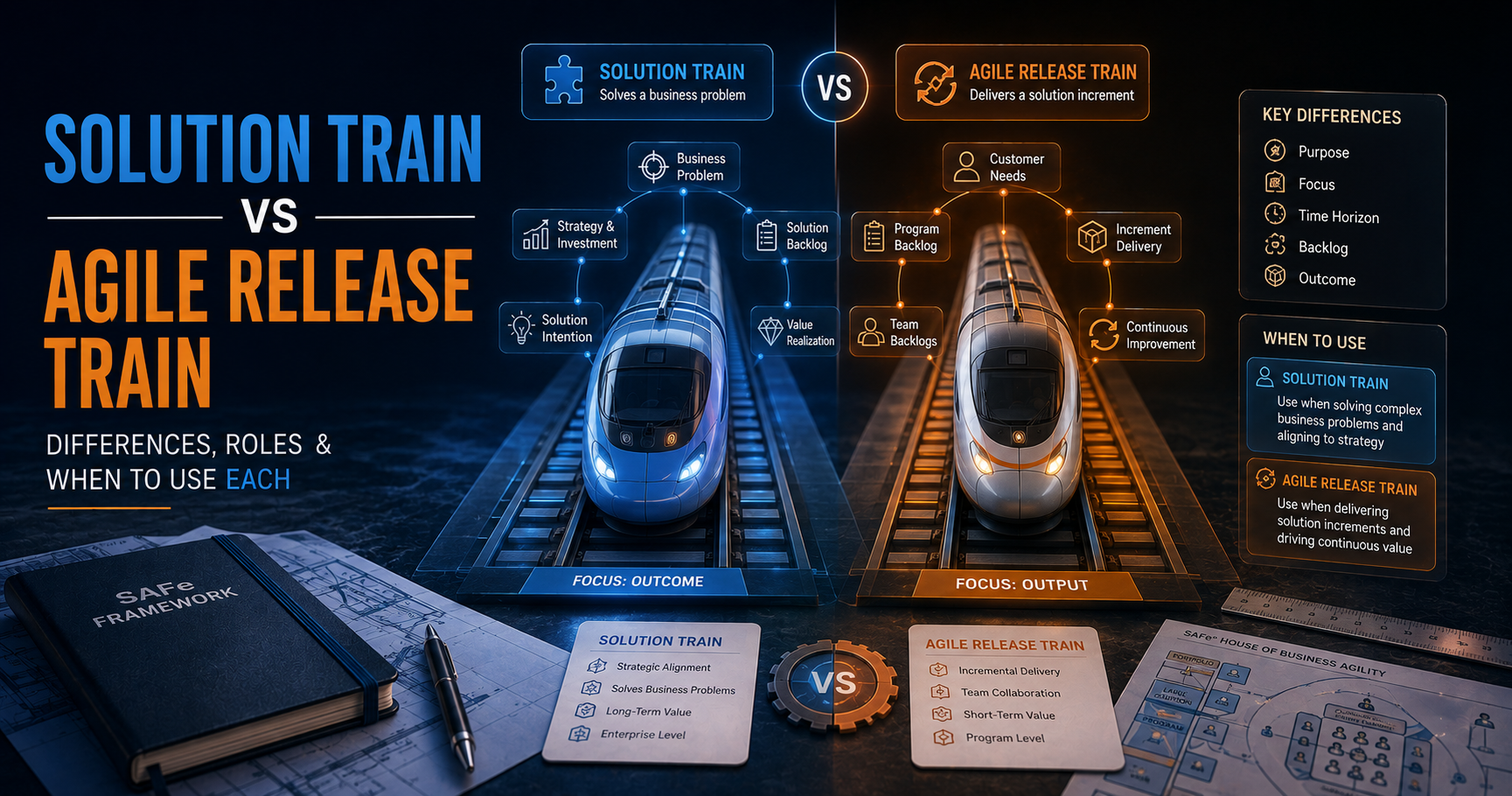
An Agile Release Train (ART) is a team of 5 to 12 Agile teams, roughly 50 to 125 people, that plans and delivers value together on a single cadence. A Solution Train is a larger construct that coordinates multiple ARTs and suppliers when one train can no longer deliver a solution on its own. In short, the Solution Train vs Agile Release Train question comes down to scale.
An ART builds a product and a Solution Train builds a "system of systems" made up of many products working together. You need a Solution Train only when cross-ART dependencies, integration risk, and architectural complexity have outgrown what a single ART can manage.
Key Highlights: Solution Train vs Agile Release Train
- An agile release train is a long-lived team of teams, typically 50 to 125 people across 5 to 12 teams, aligned to a single value stream.
- A solution train coordinates multiple ARTs, often 3 to 10 of them, along with suppliers, to build one large, integrated solution.
- ARTs work with a program backlog made of features. Solution Trains work with a solution backlog made of capabilities.
- The Release Train Engineer (RTE) leads a single ART. The solution train engineer leads the entire Solution Train and coordinates multiple RTEs.
- ARTs run PI Planning, System Demos, and Inspect & Adapt. Solution Trains add Pre-PI Planning, Post-PI Planning, and a Solution Demo.
- Solution Trains exist within Large Solution SAFe, one of the four configurations of the framework, used when solutions cannot be built by one ART alone.
Why Organizations Outgrow a Single Agile Release Train?
A single ART is designed to be self-sufficient. It has its own product manager, its own architect, its own backlog, and its own delivery cadence. For most products, that is enough. Teams plan together every Program Increment, build in short iterations, and release value continuously.
Growth changes this picture. As a company adds product lines, platforms, or regulated systems, the work starts spilling across train boundaries. A payments platform might need input from a fraud detection team on one train and a mobile app team on another. A connected device might require firmware work from one train and cloud services from a completely different one.
At this point, an ART is no longer just delivering its own increment. It is also managing a growing set of dependencies on other trains it does not control. Planning meetings get longer. Integration testing gets pushed later. Nobody owns the end-to-end outcome anymore, because everyone owns only their slice of it.
This is the pressure point where enterprises start evaluating Large Solution SAFe. The framework offers the Solution Train precisely because coordinating multiple ARTs informally, through emails, side meetings, and hope, does not scale. Instead, it introduces structured roles, dedicated events, and a shared backlog designed for cross-ART alignment.
Before deciding whether you need one, it helps to look at the full picture of how the framework scales. You can review thefour levels of the Scaled Agile Framework to see where Solution Trains sit relative to Essential, Portfolio, and Full SAFe.
Agile Release Train vs Solution Train: What Is the Difference?
The clearest way to understand the difference is side by side. The table below compares both constructs across the dimensions that matter most in day-to-day delivery.
| Comparison Area | Agile Release Train | Solution Train |
| Scope and purpose | Delivers a single product or service tied to one value stream | Delivers a large, complex solution built from the combined output of multiple ARTs |
| Team and ART structure | Made up of 5 to 12 Agile teams working directly together | Made up of 3 to 10 ARTs, each with its own teams, working under one shared solution vision |
| Size and scaling | Typically 50 to 125 people; splits into a new ART if it grows beyond this | Can span hundreds to thousands of people across all combined ARTs |
| Roles | Release Train Engineer, Product Manager, System Architect, Business Owners | Solution Train Engineer, Solution Manager, Solution Architect/Engineer, plus all ART-level roles beneath it |
| Backlogs | Program backlog, owned by Product Management | Solution backlog, owned by Solution Management, feeding into each ART's program backlog |
| Features vs capabilities | Works with features, each deliverable by a single ART | Works with capabilities, each requiring coordinated effort from multiple ARTs |
| Events | PI Planning, ART Sync, System Demo, Inspect & Adapt | All ART-level events, plus Pre-PI Planning, Post-PI Planning, and Solution Demo |
| Architecture | Owned by a single System Architect for one train's scope | Owned by a Solution Architect/Engineer who governs architecture across all ARTs |
| Integration | Integration happens within the train, generally each iteration | Integration happens across ARTs and suppliers, validated through the Solution Demo |
| Governance and suppliers | Minimal supplier involvement, governed at the ART level | Formal supplier coordination, often subject to compliance and regulatory oversight |
This comparison shows that the difference is not just about size. It is about the level of integration, governance, and architectural coordination each construct is built to handle. It is also worth noting how a Solution Train compares against the Portfolio level. Solution Train vs Portfolio is a different question altogether.
The Portfolio level governs strategy, funding, and value stream identity across the whole enterprise, while a Solution Train operates one level below it, focused purely on building and integrating one large solution. A Solution Train answers to Portfolio-level priorities; it does not set them.
What is an Agile Release Train in SAFe?
An Agile Release Train is the primary construct at the Essential SAFe level. It is a long-lived, self-organizing team of Agile teams, typically between 50 and 125 people, that plans, commits to, and delivers value together on a fixed cadence known as a Program Increment, or PI.
Each ART is aligned to a single value stream. That means everyone on the train, whether they are a developer, tester, or architect, works toward the same business goal. The train runs on a synchronized rhythm.
Every 8 to 12 weeks, the whole ART comes together for PI Planning, agrees on objectives, and then executes in a series of two-week iterations. Along the way, the ART demos its integrated work through the System Demo and closes each PI with an Inspect & Adapt workshop.
Three core roles keep an ART running.
- The Release Train Engineer acts as a chief Scrum Master, facilitating events and removing impediments.
- Product Management owns the program backlog and prioritizes features.
- The System Architect ensures technical decisions stay consistent across teams.
Beyond these three, you will find Business Owners, Scrum Masters, and Product Owners embedded within each team.
If you want a deeper look at how these responsibilities are distributed, this breakdown ofunderstanding roles in SAFe is a useful companion resource.
An ART works with features on its backlog. A feature is a service that fulfills a stakeholder need and can be delivered entirely within that one train, usually within a single PI. This is the key design constraint of an ART. It is built to be independent. When work regularly needs contributions from outside the train, that independence starts to break down, and this is usually the first sign that a Solution Train may be needed.
The agile release train size limit matters here too. SAFe sets the upper bound at roughly 125 people, or about 12 teams, based loosely on Dunbar's number, the idea that there is a natural ceiling on how many people can maintain stable, effective working relationships. Cross this limit and communication overhead starts eating into delivery time.
TheScaled Agile Framework's official site covers this in more depth, and it is a useful reference before deciding whether your ART needs to split or whether the real issue is cross-ART dependency rather than raw size.
What is a Solution Train in SAFe?
So, what is a solution train in SAFe exactly? It is the organizational construct used to build large, complex solutions that require coordination across multiple Agile Release Trains and, often, external suppliers. Think of it as a train of trains. Where an ART aligns individual teams, a Solution Train aligns entire ARTs around one shared solution vision, roadmap, and backlog.
Solution Trains exist because some solutions are simply too large, too interconnected, or too regulated for a single ART to own end to end. Scaled Agile Inc. describes these as "systems of systems."
Common examples include commercial aircraft, medical devices, automotive platforms, banking core systems, and large government platforms. These solutions often carry serious costs of failure and are subject to industry compliance standards, which is why they need more formal coordination than a single ART can provide.
A Solution Train typically brings together 3 to 10 ARTs, though the number can vary. It runs on the same PI cadence as the ARTs beneath it, which means everyone stays synchronized to the same 8 to 12 week rhythm. It maintains its own solution train backlog, made up of capabilities rather than features. A capability is a higher-order piece of functionality that, unlike a feature, cannot be completed by one ART alone. It has to be broken down and distributed across multiple ARTs, then integrated back together.
This distinction between capability vs feature SAFe terminology is one of the most misunderstood parts of scaling. A feature lives on an ART's program backlog and is small enough for that single train to build within a PI. A capability lives on the Solution Backlog and is deliberately too large for one ART to own. It gets decomposed into a set of features, each assigned to the ART best positioned to build it, and those features are integrated back together to realize the original capability. If your team is describing something as a capability but only one ART is touching it, it is probably just a large feature, not a true solution-level capability.
Three additional solution train roles anchor this construct. The Solution Train Engineer plays a role equivalent to an RTE but at solution scale, facilitating and guiding all the ARTs and suppliers in the value stream. The Solution Manager, sometimes called Solution Management, owns the solution backlog and content decisions, much like a scaled-up Product Manager. The Solution Architect/Engineer sets the technical direction across the entire solution, ensuring the individually built pieces from each ART fit together as one coherent system.
Solution Trains also maintain something called Solution Intent, a single source of truth capturing everything the solution does today and everything it plans to do. This includes specifications, design artifacts, and validation records, which becomes especially important in regulated industries where audit trails matter.
7 Signs Your Agile Release Train Has Outgrown Its Boundaries
Recognizing the tipping point early saves a lot of pain later. Here are seven patterns that suggest a single ART is no longer enough.
1. Cross-ART Dependencies Are Slowing Delivery
If your teams spend more time waiting on another train than building, that is a red flag. When features cannot ship without input from outside the train, and this happens PI after PI, it signals the value stream has outgrown its current boundary. Left unmanaged, this becomes one of the biggest sources of delay in scaled environments. It helps to first look at your practices aroundmanaging dependencies in agile before assuming a structural fix is the only answer.
2. Integration Happens Too Late in the PI
Healthy delivery integrates continuously. If your teams only discover integration problems during the final week of a PI, or worse, after it ends, that is a warning sign. Late integration usually means the work being built across trains was never truly synchronized in the first place.
3. Architecture Decisions Lack a Clear Owner
In a single ART, one System Architect can reasonably own technical direction. Once multiple ARTs are contributing to the same solution, technical decisions start colliding. Two trains might solve the same problem in incompatible ways, simply because no one owns the architecture at the solution level.
4. Multiple ARTs Must Deliver One Integrated Solution
Sometimes the product itself makes the decision for you. If your solution genuinely requires the combined output of two or more ARTs before a customer sees any value, you already have the conditions a Solution Train is designed for.
5. Suppliers Are Creating Solution-Level Dependencies
When third-party vendors or contract manufacturers are contributing components that must integrate with work from multiple internal ARTs, coordination needs shift from an ART-level concern to a solution-level one. Managing supplier deliverables informally at this scale rarely works.
6. Compliance and System-Level Coordination Are Increasing
Industries like aerospace, defense, automotive, medical devices, and banking often carry regulatory obligations that apply to the whole solution, not any single component. When compliance requires end-to-end traceability across everything multiple ARTs are building, that is a strong signal for Large Solution SAFe.
7. One ART Can No Longer Manage the Solution Context Effectively
Solution Context refers to everything specific to how, where, and by whom a solution will be used. Once your product touches multiple environments, customer segments, or deployment contexts that no single ART can reasonably track, it is a sign the solution has outgrown a single train's field of view.
When Should You Use a Solution Train in SAFe?
The honest answer is that you should use a Solution Train only when the coordination problems above are recurring, structural, and expensive to ignore. It is not a reward for growth. It is a response to genuine cross-ART complexity that a single train cannot resolve on its own.
How Many ARTs Typically Justify a Solution Train?
A question we hear often is how many ARTs in a solution train is considered normal. Most guidance, including Scaled Agile's own reference material, suggests a Solution Train typically coordinates 3 to 10 ARTs.
Fewer than that, and the overhead of an additional layer of roles, backlogs, and events may outweigh the benefit. You can likely resolve dependencies through lighter coordination mechanisms like a Scrum of Scrums or shared roadmap syncs. More than 10 ARTs, and you may be looking at a Portfolio-level conversation about splitting into multiple, smaller Solution Trains or reconsidering how value streams are drawn.
There is no rigid rule that says exactly three ARTs is the magic number. What matters more than the count is whether those ARTs are genuinely interdependent. Two ARTs with constant, unavoidable integration points can justify a Solution Train faster than five ARTs that rarely touch each other's work.
Why Headcount Alone Is Not a Scaling Trigger?
It is tempting to treat organizational scaling as a numbers exercise. If we cross 150 people, we need a new layer. That thinking misses the point. Two ARTs of 100 people each, working on genuinely separate products with no shared dependencies, do not need a Solution Train just because their combined headcount looks large on an org chart.
What matters is integration, not people count. The real question is whether the work these ARTs are doing must be combined into a single delivered solution. If the answer is no, keep them as independent ARTs, even if the organization is large. If the answer is yes, and dependencies are already causing delays, headcount becomes a secondary detail.
Solution Train Coordination Cost: What Changes After Scaling?
Adding a Solution Train is not free. It introduces genuine coordination cost, and it is worth understanding this cost clearly before committing to it.
Additional Roles and Governance
You now need a Solution Train Engineer, a Solution Manager, and a Solution Architect/Engineer, on top of every role already in place within each ART. These are typically senior, experienced practitioners, and finding people equipped to operate at this scale takes time and investment.
Additional Events and Planning Overhead
Beyond each ART's own PI Planning, you now run Pre-PI Planning and Post-PI Planning at the solution level, plus a recurring Solution Demo. These events require pulling together representatives from every ART and often from suppliers too, which adds real calendar load across a quarter.
Integration and Dependency Management Costs
Cross-ART dependencies do not disappear once you introduce a Solution Train. They become visible and formally tracked, which is progress, but tracking and resolving them still takes dedicated capacity. Someone has to own the Solution Backlog, groom capabilities, and ensure they are broken down into features that ARTs can actually deliver.
When the Coordination Cost Is Not Worth It?
If your dependencies are occasional rather than constant, or if only two ARTs are involved and they can sync directly without a formal intermediary layer, the coordination overhead of a full Solution Train may cost more than it saves. In these cases, lighter mechanisms, like a shared architectural runway or a regular cross-ART sync, often solve the problem without adding a whole new organizational layer.
Alternatives to Adding a Solution Train
Before committing to a Solution Train, it is worth exhausting simpler options. Not every scaling problem needs a new construct.
Redrawing Value Stream Boundaries
Sometimes dependencies exist because the value stream was drawn incorrectly in the first place. If two ARTs are constantly blocking each other, ask whether the work should actually sit within one value stream instead of two. Reorganizing around how value actually flows to the customer, rather than around existing team structures, often removes dependencies entirely. This is where a structuredvalue stream mapping exercise proves useful, since it exposes exactly where handoffs and delays are occurring.
Splitting an ART Into More Independent ARTs
If a single ART has grown too large, the answer is not always a Solution Train. Sometimes the fix is splitting that ART into two smaller, more independent trains, each capable of delivering value without depending heavily on the other. This works well when the underlying product can genuinely be decomposed into separate, loosely coupled components.
Reducing Unnecessary Cross-ART Dependencies
Many dependencies exist not because the architecture demands them, but because of historical team assignments or unclear ownership. A focused effort to reduce coupling, through better API contracts, shared platforms, or clearer component ownership, can shrink the coordination burden enough that a Solution Train becomes unnecessary.
Solution Train Readiness Checklist for Enterprises
Use this checklist before deciding to launch a Solution Train:
- You have 3 or more ARTs that must deliver one integrated solution.
- Cross-ART dependencies recur every PI and consistently cause delays.
- The solution carries genuine compliance, safety, or regulatory obligations.
- Suppliers contribute components that must integrate with multiple internal ARTs.
- No single ART's architect can reasonably own technical decisions across the whole solution.
- Leadership is willing to invest in a Solution Train Engineer, Solution Manager, and Solution Architect/Engineer.
- You have already tried lighter coordination mechanisms and they have not scaled.
- The organization can commit to Pre-PI Planning, Post-PI Planning, and a recurring Solution Demo without treating them as optional.
If most of these are true, a Solution Train is likely justified. If only one or two apply, consider the alternatives covered above first.
Industries Where Solution Trains Are Common
Solution Trains show up most often in industries where products are physically or technically complex, where failure carries a high cost, and where multiple engineering disciplines must combine into one working system.
Aerospace and defense is a classic example, where software, hardware, and systems engineering teams across several ARTs must deliver a single aircraft or defense platform. Automotive follows a similar pattern, particularly with the rise of connected and autonomous vehicle systems that combine firmware, cloud services, and in-vehicle software.
Medical device manufacturers use Solution Trains to manage the strict regulatory and traceability requirements that come with combining hardware and embedded software. Banking and financial services often rely on Solution Trains for core platform modernization, where payments, fraud, compliance, and customer-facing systems must all evolve together. Government and public sector programs, especially large citizen services platforms, also frequently adopt this construct because of the scale and compliance demands involved.
Solution Train Events: Pre-PI Planning, Post-PI Planning and Solution Demo
Solution Trains inherit every event that ARTs already run, but they add three of their own to keep multiple trains synchronized.
Pre-PI Planning happens before individual ARTs run their own PI Planning sessions. Its purpose is to align solution-level priorities, review the solution roadmap and vision, and surface cross-ART dependencies early. Attendees typically include the Solution Train Engineer, Solution Management, Solution Architect/Engineer, RTEs from every ART, and supplier representatives where relevant. Without this step, individual ARTs risk planning in isolation and discovering conflicts only after commitments are already made.
Post-PI Planning happens right after all the ARTs complete their individual PI Planning events. Here, each ART presents its draft plans, objectives, and milestones. The group reviews dependencies across trains, resolves conflicts, and consolidates everything into a single solution-level plan. This session typically ends with a confidence vote on the aggregated solution PI objectives, much like the confidence vote that closes ART-level PI Planning.
The Solution Demo happens at least once every PI, though many organizations run it more frequently. Unlike an ART's System Demo, which shows one train's integrated work, the solution demo SAFe teams rely on shows the combined, end-to-end output of every ART and supplier contributing to the solution. It is the moment stakeholders see whether the pieces built independently across trains genuinely work together as one system. If integration problems exist, this is where they surface, which is exactly why continuous integration practices across ARTs matter so much in a Solution Train setting.
Together, pre and post PI planning and the Solution Demo form the backbone of Solution Train coordination. Skip any one of them, and the whole point of running a Solution Train, catching misalignment before it becomes a delivery failure, starts to erode.
Moving From Release Train Engineer to Solution Train Engineer
For many experienced RTEs, becoming a Solution Train Engineer is a natural next step. It is also a significant shift in scope and responsibility. An RTE facilitates one train. An STE facilitates a network of trains, each with its own RTE, its own backlog, and its own local priorities that occasionally conflict with the bigger picture.
The transition demands stronger systems thinking. An STE has to see the whole solution, not just one train's slice of it. It also demands more political and relationship skill, since an STE regularly works with senior stakeholders, external suppliers, and multiple Business Owners at once.
If you are exploring this career path, it is worth first getting comfortable with everything expected of the foundational role by reviewing theroles and responsibilities of a release train engineer, since the STE role builds directly on these same fundamentals at a larger scale.
RTE vs STE Skills and Responsibilities
Both roles are servant leaders and both are Execution Authorities within their respective scopes. But the day-to-day work looks different.
An RTE facilitates PI Planning for one ART, runs the ART Sync, tracks program-level metrics, and coaches Scrum Masters within the train. Their focus is largely internal to that one team of teams.
An STE facilitates Pre-PI and Post-PI Planning across every ART in the Solution Train, coordinates with each RTE individually, manages solution-level risks and dependencies, and works closely with the Solution Manager and Solution Architect/Engineer. Their focus is external and cross-boundary by design. They spend more time managing relationships between trains than managing any single train's internal execution.
Formal certification paths exist for professionals making this transition. StructuredSAFe RTE certification training is often the recommended starting point, since a strong grounding in RTE-level facilitation and coaching translates directly into the broader coordination skills an STE needs.
SAFe Solution Train Anti-Patterns: When Not to Scale
Not every scaling decision goes well. A few anti-patterns show up repeatedly in organizations that add a Solution Train without genuinely needing one.
The most common mistake is scaling based on org chart size rather than integration need. Leadership sees a large program and assumes it needs solution-level governance, even when the underlying ARTs have almost no real dependencies on each other.
Another frequent anti-pattern is launching a Solution Train without appointing a real Solution Architect/Engineer. Without someone genuinely accountable for cross-ART technical decisions, the new events and roles become bureaucratic overhead rather than a coordination mechanism that actually resolves conflicts.
Some organizations also treat Pre-PI and Post-PI Planning as optional check-ins rather than the structured, well-prepared events they are meant to be. Skipping preparation defeats the purpose. These events exist specifically to surface dependencies before they become blockers, and rushing through them just moves the same integration problems later into the PI.
Finally, watch for Solution Trains that never dissolve, even after the underlying complexity that justified them has gone away. If ARTs have decoupled, dependencies have dropped, and the solution has stabilized, continuing to run the full Solution Train machinery adds cost without adding value. SAFe is meant to be applied with judgment, not treated as a permanent, one-way ratchet toward more structure.
How Simpliaxis Helps Organizations Scale SAFe Effectively?
Deciding between an Agile Release Train and a Solution Train is rarely a one-time decision. It evolves as your organization, product complexity, and dependencies change. SimpliAxis works with enterprises at every stage of this journey, from standing up a first ART to designing a full Large Solution SAFe implementation with multiple coordinated trains.
Through certified training programs covering RTE, STE, and broader SAFe practitioner tracks, SimpliAxis helps teams build the practical skills needed to run these constructs well, not just understand them on paper. Whether your organization is preparing its first Solution Train or trying to determine whether it genuinely needs one, having practitioners trained in the underlying principles makes the difference between a smooth scale-up and a costly misstep.
Conclusion
The debate around Solution Train vs Agile Release Train usually is not really about which one is better. It is about matching the right structure to the actual complexity your organization is managing. A single ART, run well, can deliver enormous value without ever needing a Solution Train. Many organizations never need to make the jump, and that is a perfectly good outcome.
A Solution Train earns its place only when multiple ARTs must genuinely combine their work into one integrated solution, when dependencies are structural rather than occasional, and when the organization is prepared to invest in the roles, events, and governance that come with it. Before scaling up, look honestly at your dependency patterns, your architecture ownership, and your integration cadence.
Try the lighter alternatives first. If the signs from this guide keep showing up PI after PI, then it is time to build the coordination layer that a Solution Train provides.

-Training---Blog-Banner_1741781597.jpg)








 Lowest-Price Challenge











 Personalized Path


.webp)


 USA
USA  Canada
 India
India UK
UK Australia
 Singapore


