


 Call Us



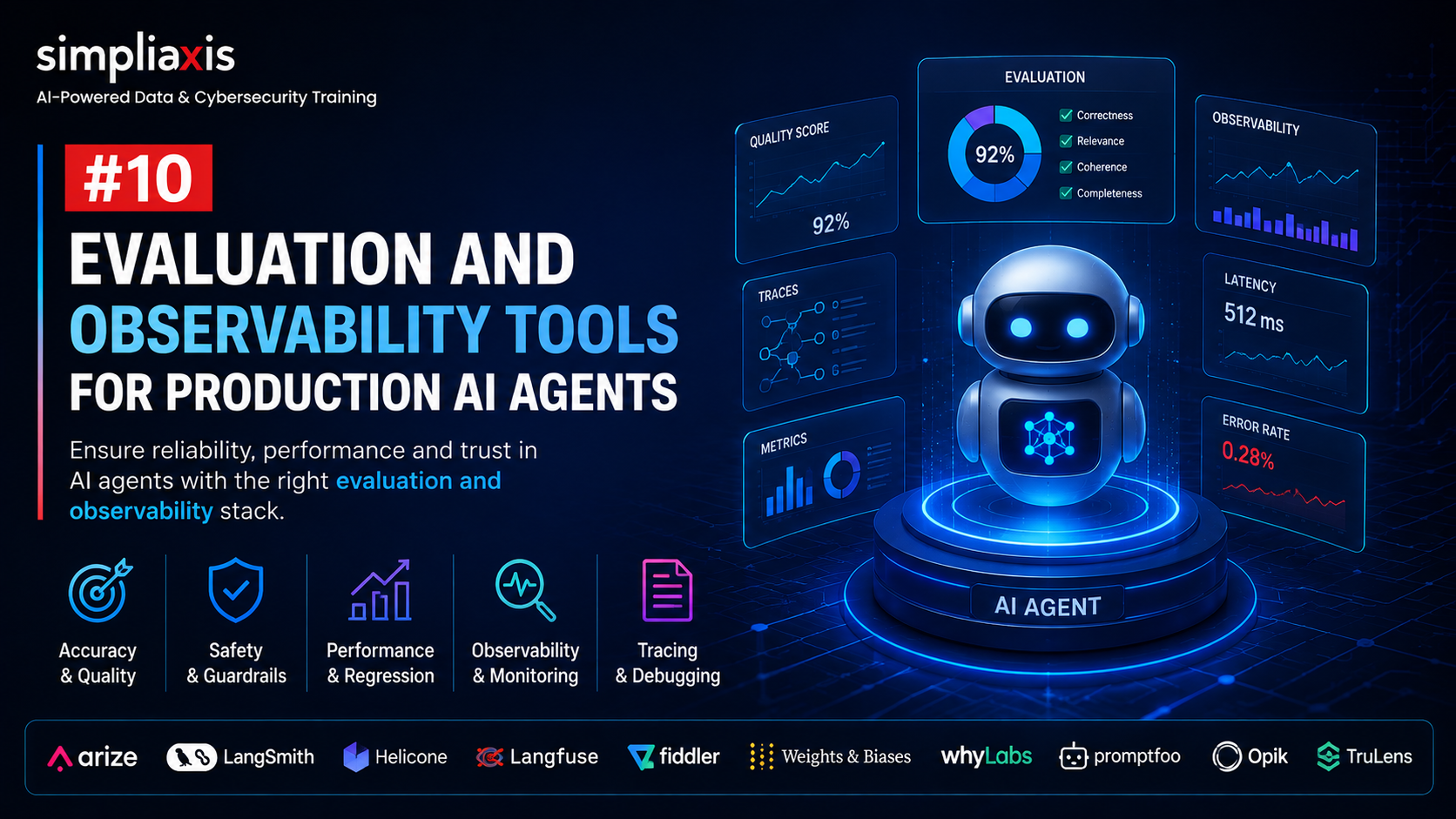
The least glamorous and most neglected part of building production AI is knowing whether it actually works, and it is exactly where forward deployed engineers earn their keep. An AI agent can produce plausible, fluent, confident output that is subtly or completely wrong, and without evaluation and observability, nobody notices until it fails visibly in front of a customer. This piece walks through ten tools that let you measure and watch production AI agents, what each is for, and why this category matters so much for the reliability that forward deployed work demands. These are the tools that turn hope into evidence, which is the difference between an agent you can trust in production and one you are merely crossing your fingers over.
Evaluation is where a great deal of enterprise AI quietly fails, deployed without anyone really knowing if it works, so command of this category is a genuine differentiator. Building the discipline of measuring and observing AI systems, as part of what the Forward Deployed Engineering Program teaches, is what lets you deploy agents you can actually stand behind.
Key Highlights
- AI agents can produce plausible but wrong output, so evaluation and observability are what tell you whether a system actually works before it fails visibly.
- Observability platforms treat the AI trace as the primary object, capturing what happened across an agent's models, retrievers, and tools.
- Evaluation tools measure quality, correctness, faithfulness, and hallucination, often using models to judge other models' output.
- The category is where a great deal of enterprise AI quietly fails, deployed without anyone knowing whether it works.
- Command of evaluation and observability is a genuine differentiator, because it turns hope into evidence.
Why this category matters more than it seems
Before the tools, it is worth being clear about why evaluation and observability matter so disproportionately in AI work, because engineers coming from traditional software often underrate them. In traditional software, correctness is frequently obvious, a function returns the right answer or it does not, a system works or throws an error. AI systems break this. An agent can return a fluent, confident, plausible answer that is wrong, with nothing about the output signalling the failure, which means you cannot tell whether the system is working just by looking at it casually.
This changes everything about how you deploy AI responsibly. Because you cannot see failures directly, you have to measure them deliberately through evaluation, and you have to watch the system's behaviour through observability, or you are deploying blind. An enterprise that deploys an AI agent without evaluation is trusting that it works on the basis of a few casual tests, which is exactly how systems fail systematically in production while looking fine in a demo. This is a major reason enterprise AI pilots stall: they were never properly evaluated, so nobody knew they did not work until it mattered. For forward deployed engineers, whose job is to deploy AI that actually delivers, building evaluation and observability in from the start is not optional polish but a core part of doing the job responsibly.
LangSmith: observability across the ecosystem
LangSmith, from the LangChain team, is one of the most widely used observability and evaluation platforms, and it has grown into a broad agent-operations stack. It treats the AI trace as the primary object, capturing the nested steps an agent takes across its models, retrievers, and tools, so you can see exactly what happened inside a run rather than just its final output. This visibility into the internal steps of an agent is what lets you diagnose why it produced a given result, which is essential when the result is wrong in a non-obvious way.
Beyond observability, LangSmith supports evaluation, including approaches that use a model to judge the quality of another model's output, which is one of the main ways AI systems are evaluated at scale. It integrates especially well with the LangChain and LangGraph ecosystem, making it a natural choice for systems built on those frameworks, and it has expanded into deployment and cost management as well. For forward deployed engineers building on the LangChain stack, LangSmith offers a well-integrated way to see inside their agents and measure their quality, which is exactly the visibility that production reliability depends on. Its trace-centric view aligns closely with what you need to debug and trust an agent running in a customer's environment.
Langfuse: open-source and self-hostable
Langfuse is a leading open-source observability and evaluation platform, and its open, self-hostable nature makes it especially relevant for forward deployed work in restricted environments. Like other platforms in this category, it captures traces of an agent's behaviour and supports evaluation, but the fact that it can be self-hosted means it can run inside a customer's environment when sending AI traces to a third-party service is not acceptable.
This matters enormously in the regulated and high-security settings where forward deployed engineers often work, because AI traces can contain sensitive information from the customer's data, and many customers cannot allow that to leave their environment. A self-hostable platform like Langfuse lets the engineer build proper observability and evaluation while keeping everything inside the customer's boundary, which a managed-only service cannot do. This is the same data-residency consideration that shapes so many forward deployed technology choices, from vector stores to cloud platforms, and it connects to the broader challenge of building AI under data governance constraints. For engineers who need real observability in an environment where data cannot leave, Langfuse is frequently the right answer precisely because of its self-hostable, open-source nature.
Arize and Phoenix: evaluation rigour
Arize and its open-source Phoenix offering are known particularly for evaluation rigour, with strong capabilities for measuring the things that matter most in AI quality, such as faithfulness, hallucination detection, and the quality of retrieval. For forward deployed engineers building retrieval-heavy systems, the ability to rigorously evaluate whether the system is retrieving the right material and whether its answers are faithful to the source is exactly what tells you whether an enterprise RAG system actually works.
Phoenix in particular is widely used for exactly this kind of evaluation, including native support for popular evaluation approaches, and its open-source nature again suits environments where self-hosting matters. The emphasis on evaluation rigour makes Arize and Phoenix valuable when the priority is genuinely measuring quality rather than just watching behaviour, which is often the case for the retrieval systems that dominate forward deployed AI work. Rigorous evaluation of faithfulness and hallucination is what lets an engineer catch the plausible-but-wrong failures that are so dangerous in production, and building that measurement in is part of deploying enterprise RAG that survives rather than fails silently. For quality-focused evaluation, this pair is a strong choice.
Braintrust and the eval-first workflow
Braintrust is a platform built around an eval-first workflow, meaning it centres the practice of evaluation in how you build AI systems rather than treating it as an afterthought. This philosophy, evaluation as a first-class part of development rather than a check bolted on at the end, aligns well with how serious AI systems should be built, and Braintrust provides the tooling to make evaluation central to the workflow.
For forward deployed engineers, an eval-first approach is valuable because it embeds the discipline of measuring quality into the building process, which is exactly what prevents the deploy-and-hope failures that plague enterprise AI. Rather than building a system and then wondering whether it works, an eval-first workflow means you are continuously measuring quality as you build, catching problems early and building with evidence rather than hope. Tools like Braintrust support this by making it easy to define, run, and track evaluations throughout development. The broader lesson is that evaluation is not just a tool category but a discipline and a mindset, and the engineers who internalise it, building with continuous measurement rather than deploying and hoping, are the ones who ship AI that actually works. This connects to the built-in-quality thinking that separates production-grade AI from demos.
Ragas, DeepEval, and TruLens: specialised evaluation
Alongside the broader platforms, several focused tools specialise in evaluating AI quality in specific ways. Ragas is widely used for evaluating retrieval-augmented generation specifically, measuring the quality of both the retrieval and the generated answers, which makes it directly relevant to the RAG systems forward deployed engineers so often build. Its focus on RAG evaluation means it addresses exactly the failure modes that matter most in enterprise retrieval work.
DeepEval is a framework for evaluating LLM outputs across a range of metrics, offering a structured way to test whether a system's outputs meet quality standards, which supports the disciplined, test-driven approach to AI quality that production work demands. TruLens similarly provides tools for evaluating and tracking the quality of LLM applications, with an emphasis on measuring and improving quality over time. These specialised tools complement the broader platforms by offering focused, rigorous ways to measure specific aspects of AI quality, particularly for retrieval and output quality. For a forward deployed engineer, knowing these focused evaluation tools alongside the broader observability platforms means having the right instrument for measuring each specific dimension of a system's quality, which is part of the thorough evaluation that reliable deployment requires.
OpenTelemetry: the observability standard
OpenTelemetry is not an AI-specific tool but the broad industry standard for observability, and it matters here because AI observability increasingly builds on it rather than reinventing the wheel. As a standard for collecting traces, metrics, and logs across systems, OpenTelemetry provides the foundation that many observability tools, including AI-focused ones, build upon, which means understanding it helps an engineer work across the observability landscape rather than being locked into one vendor's approach.
For forward deployed engineers, the relevance is that a customer's environment often already has observability infrastructure built on standards like OpenTelemetry, and fitting AI observability into that existing infrastructure, rather than imposing a separate AI-specific system, is often the pragmatic choice. Because forward deployed engineers work inside customers' existing environments rather than greenfield ones, the ability to integrate with standard observability infrastructure is valuable, letting AI systems report their behaviour into the monitoring the customer already runs. OpenTelemetry represents the connection between AI observability and the broader observability world, and knowing it helps an engineer build AI monitoring that fits into the customer's existing operational reality rather than standing apart from it, which supports both the deployment and the eventual handoff.
Building an evaluation practice, not just picking a tool
The most important thing to understand about this category is that the tools matter far less than the practice, and an engineer who adopts a sophisticated evaluation tool without building an evaluation discipline has gained little. Evaluation is fundamentally about a way of working, continuously measuring whether your AI system does what it should, rather than about any particular tool. A team with a strong evaluation practice and simple tools will outperform one with the fanciest tools and no discipline, because the discipline is where the value lives.
Building that practice means defining what good looks like for the specific system, whether that is answer correctness, retrieval quality, faithfulness to sources, or absence of hallucination, and then measuring against it systematically and continuously rather than checking casually and hoping. It means treating evaluation as part of building, not a step at the end, so that quality is measured as the system develops. And it means using the results to actually improve the system, closing the loop between measurement and change. The tools support this practice, but they do not create it, and an engineer who internalises the discipline of continuous, defined measurement is far more valuable than one who merely knows the tools. Developing this evaluation discipline, as part of the reliability-focused approach the Forward Deployed Engineering Program teaches, is what actually lets you deploy AI you can stand behind, and it is the difference between an engineer who measures and one who hopes.
Fitting evaluation into the customer's constraints
As with every other technology choice in forward deployed work, evaluation and observability have to fit the customer's environment and constraints, and this often shapes the tools you can use more than raw capability does. The biggest constraint is data residency, since AI traces and evaluation data can contain sensitive information from the customer's environment, which frequently means self-hostable, open-source tools are the only acceptable option in regulated or high-security settings. A managed evaluation service that requires sending traces to a third party is a non-starter for many enterprise customers, however capable it is.
Beyond data residency, the tools have to fit the customer's existing operational infrastructure, integrating with their monitoring, respecting their security requirements, and being maintainable by their team after handoff. This means the right evaluation and observability setup for a given engagement is often determined as much by the customer's constraints as by the tools' features, and an engineer who understands this chooses tools that fit rather than the most capable ones in the abstract. This is the same fit-the-customer principle that governs the choice of vector stores and cloud platforms, applied to the evaluation layer. Building observability that respects the customer's governance and integrates with their environment is part of deploying AI responsibly in the real world, which is exactly where forward deployed engineers earn their value.
The ten tools at a glance
To help you choose, here is how the ten tools map across what they do.
| Tool | Category | Best for |
| LangSmith | Observability and eval | LangChain and LangGraph systems |
| Langfuse | Observability and eval | Self-hosting in restricted environments |
| Arize | Evaluation | Rigorous faithfulness and retrieval eval |
| Phoenix | Evaluation, open-source | Self-hostable rigorous evaluation |
| Braintrust | Eval-first workflow | Making evaluation central to development |
| Ragas | RAG evaluation | Measuring retrieval and answer quality |
| DeepEval | LLM output evaluation | Structured, test-driven quality checks |
| TruLens | Evaluation and tracking | Measuring and improving quality over time |
| Weights and Biases | Experiment tracking | Tracking runs and model development |
| OpenTelemetry | Observability standard | Integrating with existing monitoring |
Read the table as a guide to matching a tool to a need, whether you need observability into an agent's steps, rigorous evaluation of retrieval quality, an eval-first workflow, or integration with the customer's existing monitoring. The through-line is that all of these exist to answer the same essential question: does this AI system actually work, which is the question forward deployed engineers cannot afford to leave unanswered.
Ultimately the tools in this category exist to answer one question that traditional software rarely had to ask so deliberately: is this system actually doing what we think it is. Building the habit of always being able to answer that question with evidence, through the agentic AI practitioner discipline of continuous measurement, is what separates production AI you can trust from production AI you are merely hoping about. In a field defined by systems that fail silently, the engineer who can always show the evidence is the one whose deployments actually hold.
Evaluation also pairs naturally with the observability tooling already common in a customer's environment, so fitting AI measurement into what they run rather than standing it up separately is part of deploying responsibly.
The bottom line
Evaluation and observability are what tell you whether a production AI agent actually works, and they matter disproportionately because AI systems can produce plausible, confident output that is wrong, with nothing signalling the failure. The tools span observability platforms like LangSmith and the self-hostable Langfuse that capture what happens inside an agent, evaluation-focused tools like Arize, Phoenix, Ragas, DeepEval, and TruLens that measure faithfulness, hallucination, and retrieval quality, the eval-first workflow of Braintrust, and the OpenTelemetry standard that connects AI observability to a customer's existing monitoring.
This category is where a great deal of enterprise AI quietly fails, deployed without anyone knowing whether it works, which is exactly the gap forward deployed engineers exist to close. Building evaluation and observability in from the start, and choosing tools that fit the customer's environment including its data-residency constraints, is what lets you deploy agents you can actually stand behind. Developing that discipline, as part of the reliability-focused skill the Forward Deployed Engineering Program teaches, is a genuine differentiator, because it turns hope into evidence.
Building the discipline behind the tools
The tools matter less than the practice, and building a genuine evaluation discipline is what separates engineers who deploy AI they can stand behind from those who deploy and hope. Developing that discipline through agentic AI foundations and hands-on engineering with agents is what lets you measure whether an AI system works rather than trusting that it does. In a field where systems fail silently with plausible wrong answers, the habit of continuous, defined measurement is a genuine differentiator, and it is built through practice rather than by adopting a tool and hoping the discipline follows.







 Lowest-Price Challenge











 Personalized Path


.webp)


 USA
USA  Canada
 India
India UK
UK Australia
 Singapore


