


 Call Us



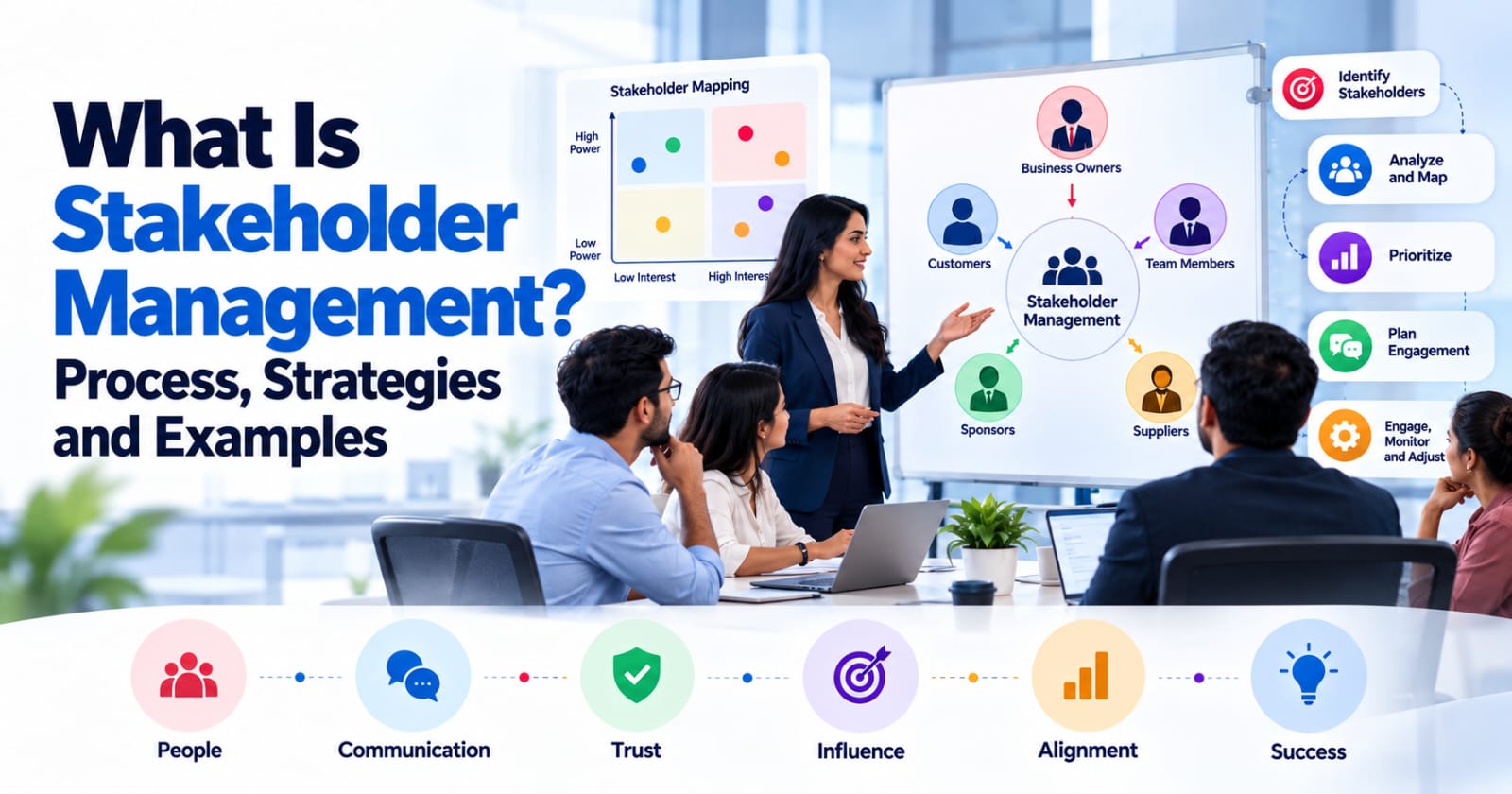
Stakeholder management is the process of identifying, analyzing, prioritizing, and engaging people who can impact, or be impacted by, a project or product. This helps teams to align expectations, improve communication, manage conflict and stay focused on common goals.
What is included in this guide: Stakeholder management strategies and Stakeholder mapping. The 7 C’s, stakeholder engagement plans, practical examples, common challenges, and stakeholder management in Agile and SAFe. It also includes how tools like the power-interest matrix and RACI matrix can help Product Owners and teams manage stakeholder relationships effectively.
Key Highlights of Stakeholder Management
- Stakeholders may be internal or external, and can have varying levels of power and influence.
- Stakeholder management is a process, not an event.
- Stakeholder mapping prioritizes engagement by interest/power.
- A power-interest matrix can help you decide how best to engage.
- A RACI matrix is used to lay out roles and who is accountable for decisions.
- Each stakeholder has a different communication need.
- Stakeholder management is used by Product Owners to balance customer, business and delivery needs.
- Product Owners align stakeholders to business value and delivery objectives in SAFe.
- Stakeholder needs can change, so engagement plans should be reviewed regularly.
Introduction
Most projects involve far more people than the project team itself.
Consider a digital transformation project. The core team might consist of a Product Owner, developers, testers, designers, architects, and a project or program manager. But the initiative may also involve executives, customers, finance, legal, compliance, marketing, operations, vendors, support teams, and regulators.
Each group may define "success" differently.
An executive may care about return on investment. A customer may care about usability. A compliance manager may care about regulatory requirements. A developer may care about technical feasibility. A support team may care about maintainability.
These differences are not necessarily a problem. They become a problem when they remain unidentified or unmanaged.
PMI research has repeatedly highlighted the connection between stakeholder communication and project outcomes. One PMI report, The Essential Role of Communications, found that two out of five projects did not meet their original goals and business intent, with ineffective communication associated with half of those unsuccessful projects.
What Is Stakeholder Management?
Stakeholder management is the systematic identification, understanding, prioritization, engagement and monitoring of stakeholders throughout the life cycle of a project, product, program, or organizational change.
It’s analysis and relationship management.
On the analytical side, it includes tools such as stakeholder registers, power-interest matrices, stakeholder mapping, influence analysis, and RACI matrices.
The relationship side is about communication, consultation, expectation management, conflict resolution, trust building, negotiation and continuous feedback.
Stakeholder Management Definition
A simple stakeholder management definition is:
Stakeholder management is the process of understanding who can affect or be affected by an initiative and deliberately managing relationships, expectations, communication, and involvement to support successful outcomes.
The important word is deliberately.
A team may communicate with stakeholders every week without actually practicing effective stakeholder management. If every stakeholder receives the same generic presentation regardless of their needs, communication can become noise rather than engagement.
One good approach is to look at it from the stakeholder’s perspective.
For example, a CFO might not need to understand the details of every user story. They might need a short summary of investment, expected benefits, risk and financial impact.
Or a customer may want to know how a change will affect their workflow.
Why Stakeholder Management Matters
Stakeholder management is important because the decisions and behavior of stakeholders may directly affect project outcomes.
A sponsor can approve or deny funding. A customer can either accept or reject a product. A regulator can slow down a launch. A department head may or may not provide resources. A subject-matter expert can identify a critical need. A key employee can be a supporter or an opponent of organizational change.
Poor stakeholder management can therefore lead to:
- Conflicting requirements
- Delayed decisions
- Scope changes
- Resistance to change
- Lack of executive support
- Unclear ownership
- Missed requirements
- Escalated conflicts
- Poor adoption
- Reduced customer satisfaction
PMI research has also identified poor communication as a negative factor in requirements management. One study found that three out of four organizations that identified poor communication as a key reason for project failure also said it negatively affected requirements management.
In other words, stakeholder management is not just a "soft skill." It can influence scope, requirements, risk, schedule, adoption, and ultimately business value.
Who Counts as a Stakeholder?
A stakeholder is anyone who can influence an initiative, is affected by it, has an interest in its outcome, or has authority relevant to its success.
Stakeholders can include:
- Project sponsors
- Business leaders
- Customers
- End users
- Product Owners
- Product Managers
- Developers
- Testers
- Operations teams
- Sales and marketing teams
- Finance teams
- Legal and compliance teams
- Vendors and partners
- Regulators
- Investors
- Community groups
The list should not be restricted to those who attend project meetings. You might not ever go to a meeting, but you can still influence what happens.
For example, a compliance officer may have relatively low day-to-day involvement but considerable authority over whether a product can launch.
Types of Stakeholders
Stakeholders can be classified in several ways. Two useful distinctions are internal versus external and primary versus secondary/key stakeholders.
Internal and External Stakeholders
Internal stakeholders belong to the organization or delivery environment.
Examples include:
- Executives
- Employees
- Product teams
- Project managers
- Business Owners
- Finance
- HR
- IT
- Operations
External stakeholders exist outside the organization but can affect or be affected by the initiative.
Examples include:
- Customers
- Suppliers
- Vendors
- Partners
- Regulators
- Government agencies
- Industry groups
- Community organizations
The distinction is useful because internal and external stakeholders often have different expectations and communication needs.
An internal executive may require a monthly review of the business performance; an external customer may require product demos and feedback sessions.
Primary, Secondary and Key Stakeholders
Primary stakeholders are those directly affected by the outcome, or who are critical to achieving it.
For a mobile banking application, the main stakeholders will be the customers and the organization that runs the application.
Secondary stakeholders are indirect interests or influence.
They could be industry associations, outside advisors or community groups.
Key stakeholders are those stakeholders that, due to their influence, authority, interest or impact, are of particular importance to the success of the project.
A useful principle is that stakeholder importance can change.
A stakeholder who appears low priority during planning can become critical later. For example, a regulator may become a high-priority stakeholder immediately before launch.
The Stakeholder Management Process
A practical stakeholder management process can be organized into five steps.
Step 1: Identify Stakeholders
Start by creating a broad stakeholder list.
Ask:
- Who will be affected?
- Who can influence decisions?
- Who controls funding?
- Who approves requirements?
- Who supplies resources?
- Who uses the product?
- Who can create regulatory or operational constraints?
- Who might support the initiative?
- Who might resist it?
- Who has expertise the team needs?
Do not make the mistake of identifying stakeholders only by job title.
Instead of writing "customer," identify the relevant customer group or representative. Instead of "management," identify the actual decision maker.
In terms of identifying stakeholders, PMI suggests casting a wide net and considering anyone who may be affected, have influence, an interest or the ability to affect the outcome.
A simple stakeholder register might contain:
| Stakeholder | Role | Interest | Influence | Main Concern |
| Executive Sponsor | Funding/strategy | High | High | ROI |
| Customer | Product user | High | Medium | Usability |
| Compliance | Governance | Medium | High | Regulatory risk |
| Development Lead | Delivery | High | Medium | Technical feasibility |
| Support Team | Operations | Medium | Medium | Maintainability |
Step 2: Analyze and Map Them
After identifying stakeholders, analyze their expectations, influence, attitude, and potential impact.
This is where stakeholder mapping becomes useful.
A basic stakeholder map can answer four questions:
- How much power does this stakeholder have?
- How interested are they in the initiative?
- What is their current attitude?
- What do they need from the team?
You can also use legitimacy and urgency if a 2D map is not detailed enough. For instance, stakeholder salience models prioritize stakeholders using power, legitimacy, and urgency.
Step 3: Prioritize by Power and Interest
The classic power-interest matrix divides stakeholders into four groups:
| Power | Interest | Approach |
| High | High | Manage closely |
| High | Low | Keep satisfied |
| Low | High | Keep informed |
| Low | Low | Monitor |
For example, a project sponsor may be high power/high interest and require regular strategic engagement.
A department head whose approval matters but who is not deeply involved may be high power/low interest.
End users might be low power/high interest and therefore need consistent opportunities to provide feedback.
PMI describes this four-quadrant approach as a practical way to prioritize stakeholder engagement and communication.
Step 4: Plan Engagement and Communication
Once stakeholders are prioritized, decide how you will work with them. This is the core of project communication management.
A stakeholder management plan should answer:
- Who needs to be involved?
- What information do they need?
- How frequently should communication occur?
- Which channel should be used?
- What topics should be brought up?
- How will feedback be gathered?
Don’t make a communication plan that lists every stakeholder on every update.
I'm going to take the other road. I'm going to try the other road.
Executive Sponsor: Monthly Business Review and escalation on an exception basis.
Customer group: product demos, interviews, surveys, usability sessions.
Backlog refinement by the development team, technical talks, collaboration on a daily basis.
Compliance: scheduled reviews prior to major releases.
In this way, communication is relevant, not excessive.
Step 5: Engage, Monitor and Adjust
Stakeholder management does not end when the stakeholder register is complete.
Stakeholders change.
Their priorities can change. Their influence can increase. New stakeholders can enter the project. Existing stakeholders can become resistant.
Therefore, teams should regularly ask:
- Has stakeholder influence changed?
- Has their attitude changed?
- Have their expectations changed?
- Are they receiving the right information?
- Are decisions being delayed?
- Are conflicts emerging?
- Is anyone being over- or under-engaged?
A stakeholder management framework should therefore be treated as a living system rather than a static document.
Stakeholder Management Strategies (The 7 C's)
There is no single universally accepted "7 C's" standard for stakeholder management. Different organizations and authors use different formulations.
For practical use, the following 7-C stakeholder management model provides a useful framework:
- Communicate
- Consult
- Clarify
- Connect
- Collaborate
- Commit
- Continuously adapt
Together, these principles cover the relationship from initial communication through ongoing delivery.
Communicate, Consult and Clarify
Communicate means sharing relevant information consistently.
Good stakeholder communication should be timely, clear, and tailored to the audience.
Consult means actively seeking stakeholder perspectives rather than merely informing them.
For example, a Product Owner could say:
"We are considering removing this feature from the next release. What customer impact do you foresee?"
That is consultation.
Clarify means resolving ambiguity around expectations, responsibilities, priorities, and decisions.
A large number of stakeholder problems begin with assumptions.
For example:
- "We thought the launch date was fixed."
- "We assumed legal had approved it."
- "We thought the customer wanted this feature."
- "We thought the Product Owner was responsible for the decision."
Clarification turns assumptions into explicit agreements.
Build Trust and Manage Expectations
Trust is a prerequisite to the other four Cs – connect, collaborate, commit and continuously adapt.
Connect: Create relationships before problems happen.
Partner: Work with the stakeholders on decisions where their knowledge or authority can add value.
Commit: Define ownership, decision-making processes, timelines and expectations.
Change the way you engage as the needs of your stakeholders and the conditions of your project change. Be flexible.
Expectation management is one of the most important stakeholder management techniques.
You can't always give stakeholders what they want. But you can explain constraints, trade-offs, alternatives and decisions in a transparent way.
This is often a better approach than making promises the team can not keep.
Building a Stakeholder Engagement Plan
A stakeholder management plan documents how the team will identify, prioritize, communicate with, and engage stakeholders.
A practical plan can include the following fields:
| Stakeholder | Power | Interest | Attitude | Needs | Communication | Owner |
| Sponsor | High | High | Supportive | ROI visibility | Monthly review | PM |
| Customer | Medium | High | Neutral | Product value | Demo/feedback | PO |
| Compliance | High | Medium | Neutral | Evidence | Review meetings | Compliance Lead |
| Engineering | Medium | High | Supportive | Clear priorities | Refinement/sync | PO/Tech Lead |
The plan should also document:
- Engagement objectives
- Communication frequency
- Preferred channels
- Decision rights and escalation paths (part of wider project governance)
- Key concerns
- Risks
- Feedback mechanisms
- Review dates
A RACI matrix can complement this plan.
RACI stands for:
- Responsible: Does the work.
- Accountable: Owns the outcome.
- Consulted: Provides input.
- Informed: Receives updates.
Stakeholder mapping assists
Stakeholder mapping is a way of understanding who is important and how to engage with them. RACI helps clarify who owns certain activities and decisions.
“RACI is a useful way to clarify who is responsible and accountable, particularly when there is more than one group involved,” PMI says.
Stakeholder Management Example (Walkthrough)
Consider a company launching a new employee expense-management platform.
The project team initially identifies six stakeholder groups:
- CFO
- Employees
- Finance team
- IT security
- Product team
- Software vendor
Step 1: Identify interests
CFO wants cost control and measurable ROI.
Employees want a simple and fast way to submit expenses.
Finance wants good reporting and policy compliance.
IT security requires safe authentication and protection of data.
The Product team wants a maintainable solution.
The vendor wants clear requirements and timely decisions.
Step 2: Map stakeholders
The CFO has high power and high interest.
IT security has high power because security approval is required but may have moderate interest.
Employees show a high interest but a comparatively low formal decision power.
The finance team owns key processes, so has tremendous interest and influence.
Step 3: Define engagement
The CFO receives monthly updates from the executive level.
Finance is involved in the workflow design and acceptance testing.
Employees are part of the usability testing and pilot programs.
IT security reviews architecture and controls security prior to release.
The vendor will have technical and delivery discussions.
Step 4: Manage a conflict
Employees are asking for a one-click reimbursement process and finance wants to add additional approval fields.
The Product Owner doesn’t let the disagreement become a product-vs-business argument. Using practical conflict management skills, they lead a discussion about the underlying goals.
The team learned that finance is asking for more detailed reporting on high-value expenses, not all expenses. The solution is an optimized workflow for normal claims with an additional approval requirement beyond a certain threshold. This is stakeholder management, simply put, know the interests, find the need behind the interests, and negotiate a solution that is valuable within legitimate constraints.
Common Stakeholder Management Challenges and How to Handle Them
Conflicting priorities
Different stakeholders naturally want different outcomes.
Use explicit prioritization criteria such as customer value, business impact, regulatory risk, cost, urgency, and strategic alignment.
Too many stakeholders
Large initiatives can involve dozens or even hundreds of stakeholders.
Do not attempt to give everyone equal attention.
Use stakeholder mapping and prioritization to determine the appropriate level of engagement.
Stakeholders who resist change
Resistance is often a signal rather than simply an obstacle.
Ask:
- What are they worried about?
- What could they lose?
- What information are they missing?
- Have previous initiatives damaged trust?
- Do they have a legitimate risk concern?
Address the underlying issue rather than labeling the person as "difficult."
Silent stakeholders
Some stakeholders rarely complain but may still be disengaged.
Use targeted questions, one-to-one conversations, surveys, demos, and feedback sessions to uncover concerns.
Changing stakeholder influence
Organizational changes, leadership changes, regulatory developments, and product decisions can alter stakeholder power.
Review stakeholder maps at major milestones instead of creating them once and forgetting them.
Communication overload
More communication does not necessarily mean better communication.
PMI has noted that generic reports can fail when they provide information based on what the project team thinks stakeholders should receive rather than what stakeholders actually need. Project Management Institute
The solution is to communicate the right information to the right person at the right time.
Stakeholder Management for Product Owners in Agile and SAFe
The importance of stakeholder management in Agile is particularly important as product development is iterative.
Agile teams don’t wait until the end of a long project to show the solution. They gather feedback, inspect results, and change priorities continuously.
Therefore, stakeholder management is closely related to backlog management and product strategy for a Product Owner.
- A Product Owner has to balance:
- Customer requirements
- Company objectives
- Strategy of product
- Technical limitations
- Regulatory obligations
- Requirements
- Team capacity.
- Comments from users and stakeholders
If you are developing your SAFe Product Owner/Product Manager skills, you can look into SAFe POPM certification training for structured learning around these responsibilities.
You can also read more about SAFe POPM roles and responsibilities.
Business Owners, Customers, and ART Stakeholders
In SAFe, Product Owners operate within a wider stakeholder ecosystem.
Business Owners have business and technical responsibility for the solutions developed by the Agile Release Train (ART).They are considered primary stakeholders in the ART (SAFe, Business Owners). Scaled Agile Framework
Customers provide another critical source of information.
A Product Owner needs to understand not only what customers request but why they are requesting it.
For example, a customer might request an "export to Excel" function. Instead of immediately adding the feature, the Product Owner could investigate the underlying need.
Perhaps customers actually need better financial reporting.
That discovery could lead to a dashboard or automated report that solves the underlying problem more effectively.
This is where stakeholder management connects directly with product strategy.
For more on the role, see who is a SAFe Product Owner.
Managing Stakeholders Across PI Planning and Delivery
PI Planning is a major stakeholder alignment opportunity in SAFe.
According to SAFe’s PI Planning Facilitator’s Guide, PI Planning brings Agile Teams and stakeholders together around a shared mission and plan. It helps teams align development to business goals, identify dependencies, match demand to capacity, and create a transparent view of value delivery.
- Product Owners may utilize PI Planning to:
- Learn stakeholder priorities
- Business Objectives Validation
- Surface dependencies
- Discuss capacity limitations
- Negotiate priorities
- Set clear PI objectives
- Spot risks early
- Set shared expectations
- Stakeholder management continues after PI Planning.
Product Owners can keep stakeholders aligned during delivery by using backlog refinement, iteration reviews, system demos, feedback from customers, ART Syncs, and Inspect & Adapt activities.
The objective is not to make every stakeholder part of every meeting. It is to create the right feedback loops.
Conclusion
Stakeholder management is ultimately about turning a collection of competing expectations into a coordinated path toward a shared outcome.
The process begins with identifying stakeholders, but identification alone is not enough. Teams must analyze influence and interest, prioritize stakeholders, create an engagement approach, communicate appropriately, manage expectations, and continuously reassess relationships.
The most useful stakeholder management strategies are often straightforward:
- Know who matters.
- Understand what they care about.
- Prioritize based on influence and interest.
- Communicate information that is actually useful.
- Consult people before decisions that affect them.
- Clarify assumptions and responsibilities.
- Build trust before problems arise.
- Make decisions transparent.
- Review stakeholder positions throughout delivery.
For project managers, these practices can reduce uncertainty and improve alignment.
For Product Owners, they help turn diverse customer and business input into better product decisions.
For Agile and SAFe teams, they create the feedback loops necessary to connect business strategy, customer value, and delivery.
If you want to explore stakeholder mapping in more detail, see our guide to stakeholder analysis and the power-interest matrix.
The most important point is simple: stakeholders should not be managed only when there is a problem. They should be understood and engaged throughout the lifecycle of the work.






 Lowest-Price Challenge











 Personalized Path


.webp)


 USA
USA  Canada
  India
India  UK
UK  Australia
  Singapore


