


 Call Us



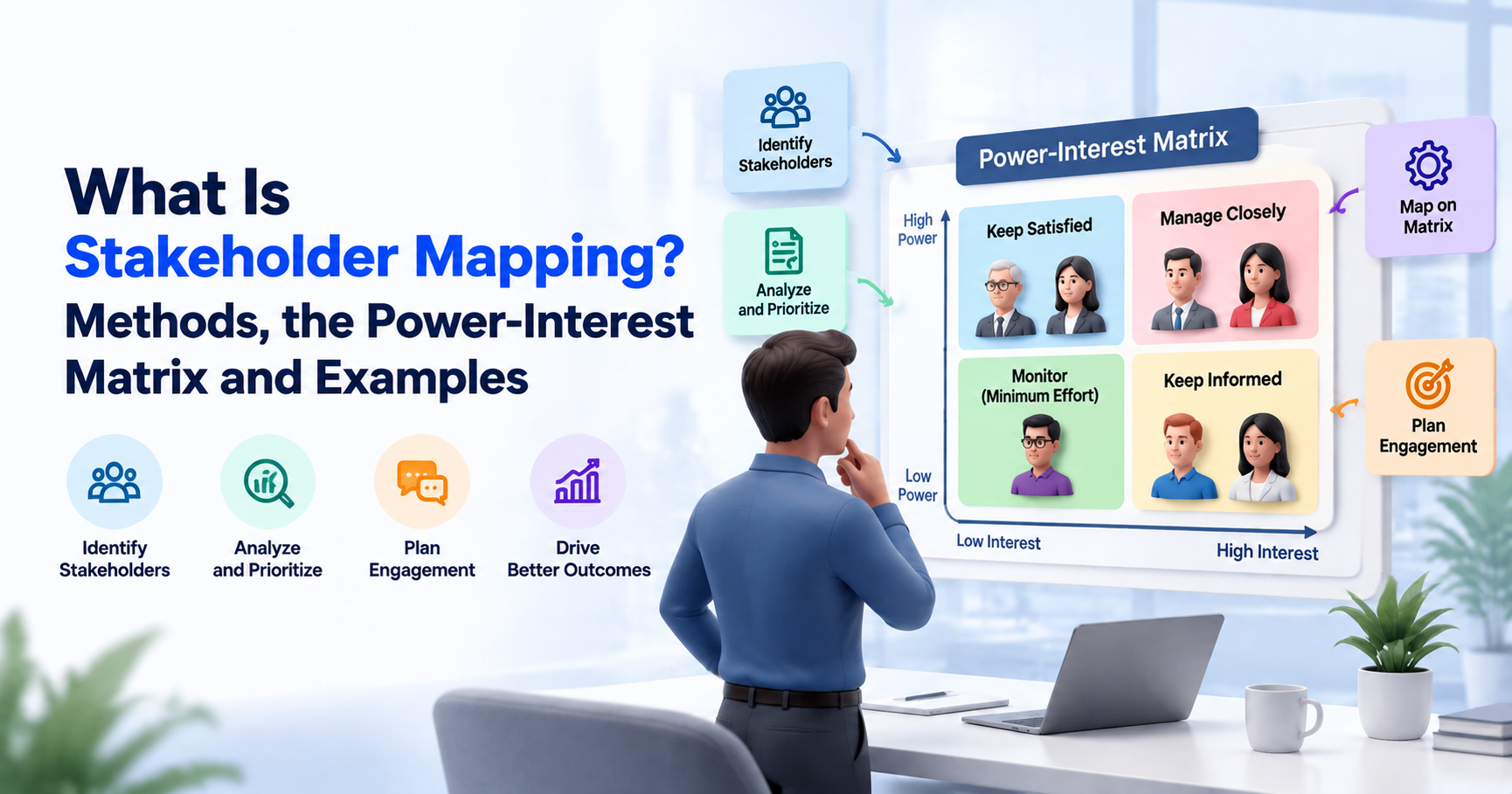
Stakeholder mapping helps you work out who needs to be involved in a project, who can influence its direction, and who will be affected by the outcome. Instead of sending the same update to everyone, a team can use a stakeholder map to decide whose input is needed, who has approval authority, and who simply needs to stay informed.
One of the simplest ways to do this is with a power-interest grid. It groups stakeholders into four categories: manage closely, keep satisfied, keep informed, and monitor.
The technique is useful for project managers, product owners, business analysts, and leadership teams. It can be applied to a small software release just as easily as a company-wide transformation. The level of detail changes, but the purpose remains the same: involve the right people before their concerns turn into project problems.
Key Highlights of Stakeholder Mapping
- Stakeholder mapping identifies people and groups who can influence a project or be affected by it.
- A stakeholder mapping matrix helps teams prioritize relationships instead of treating every stakeholder's needs as equally urgent.
- The power-interest grid is a useful starting point, while the influence-impact grid and salience model offer alternative ways to assess stakeholders.
- An effective stakeholder mapping process includes identification, categorization, engagement planning, and regular reviews.
- Product owners can use stakeholder maps to connect customer needs with business priorities and technical constraints.
- Stakeholder maps work best when they lead to actual conversations and decisions, rather than becoming documents that nobody revisits.
Introduction
A product team has spent two months developing a new feature. The developers are happy with the progress, the design looks polished, and the release date is approaching. Then a compliance specialist raises a concern about how customer information is collected. The team needs to revisit its design, and the launch is pushed back.
The problem is not necessarily poor development. The team may simply have involved an important stakeholder too late.
Situations like this occur in software development, business transformation, marketing campaigns, and operational projects. Different people judge success differently. A finance manager may care about cost, a customer may want ease of use, and a technical lead may worry about reliability. These priorities can coexist but need to be understood early.
Stakeholder mapping offers teams a pragmatic way to do this. It helps them know who matters to a project, understand what each group cares about, and determine when to involve them.
This exercise may be especially useful for product teams. Sales, customer support, senior management and users all have feature requests vying for the attention of a product owner. Plotting those relationships helps provide context to decide whose input is needed and what decisions need more discussion.
This guide explains the main stakeholder mapping techniques, how to create a stakeholder mapping matrix, and goes through a practical example. It also covers tools, common errors, and how product owners can use these techniques in Agile and SAFe settings.
What Is Stakeholder Mapping?
Stakeholder mapping is a way to identify and organize the people, teams, and organizations connected to a project. The map shows how stakeholders relate to the work and helps the team understand their influence, interest, expectations, or potential impact.
The output does not need to be complicated. A spreadsheet with a few columns may be enough for a small project. A large transformation initiative might require a visual matrix, a stakeholder register, and a more detailed engagement plan.
Consider a company replacing its customer relationship management (CRM) system. Sales representatives will use the new platform every day. The IT team will oversee integrations. Finance may approve the budget, while senior management will want evidence that the investment is delivering value.
Listing these groups is the first step. Understanding what each group needs from the project is what makes the map useful.
Stakeholder Mapping Definition
Stakeholder mapping is the process of identifying stakeholders and assessing their characteristics to determine how they should be involved in a project.
Those characteristics depend on the situation. A team might assess power and interest, while another might focus on influence and impact. A project involving urgent regulatory requirements may also need to consider legitimacy and urgency.
A useful stakeholder map often records:
- The stakeholder's name, team, or organization
- Their role in the project
- Their level of power or influence
- Their interest in the outcome
- Their expectations, concerns, or dependencies
- Their preferred communication channel
- The action required from the project team
Not every project needs every field. The aim is to capture enough information to guide decisions without creating unnecessary paperwork.
Why Stakeholder Mapping Matters
A project can have a sound business case and a capable delivery team yet struggle because the people involved are not aligned. One department may expect a feature that another considers out of scope. A decision-maker may not realize that a deadline depends on an external supplier. Users may be asked for feedback only after the design is finalized.
Stakeholder mapping helps teams identify these situations earlier.
It clarifies who makes decisions. When approval responsibilities are understood, teams are less likely to discover late in the process that a crucial decision-maker has not been consulted.
It makes communication more relevant and supports effective project communication management. An executive who needs to approve funding probably does not need every technical update. A support team preparing for a new workflow may need more detailed guidance.
It exposes competing expectations. Two stakeholders may want different outcomes from the same feature.Recognizing the conflict early gives the team time to discuss trade-offs using sound conflict management skills.
It supports better product decisions. Stakeholder feedback can reveal business constraints and operational needs that may not emerge from customer research alone.
There is a limitation worth remembering: a map cannot resolve disagreements by itself. It helps the team see where conversations are needed, but people still have to make decisions and follow through.
Stakeholder Mapping vs Stakeholder Analysis
The two terms are often used together, although they emphasize different activities.
Stakeholder mapping organizes stakeholders visually or in a structured register. Stakeholder analysis examines their interests, expectations, influence, concerns, and likely responses in greater detail.
Imagine that a product owner places the head of sales in the high-power, high-interest quadrant. That is the mapping result. Analysis explores why the stakeholder has those ratings. Perhaps the new product changes the sales process, affects quarterly targets, and requires training across several teams.
The distinction is useful because a map shows where a stakeholder sits, while analysis helps explain what the team should do about it.
Most projects benefit from both. Start with the map to understand the overall picture, then analyze the relationships that could materially affect the outcome.
Types of Stakeholders to Map
Before choosing a stakeholder mapping framework, establish who belongs on the map. Some stakeholders contribute directly to the work. Others provide approvals, supply essential services, or experience the consequences without participating in daily decisions.
Two useful ways to classify them are by their relationship to the organization and by how directly they are connected to the project.
Internal vs External Stakeholders
Internal stakeholders are people who work for the organization that owns the project. Depending on the initiative, they can include:
- Product Owners & Project Managers.
- Executive sponsors and business leadership
- Developers, designers and test engineers
- Sales, marketing, finance and operations teams
- Legal, Security & Compliance Professionals
External stakeholders are outside the organization but may be influenced or affected by the work. Customers, suppliers, implementation partners, regulators, investors and distributors are all common stakeholders.
Consider a company launching an online healthcare service. Internal stakeholders might include the product team, customer support, security specialists, and operations managers. External stakeholders could include patients, healthcare providers, payment partners and applicable regulatory authorities;
The groups may not need the same amount of information or involvement. An internal developer may be involved in technical discussions every week, while an external partner may only need to be involved when a decision is needed regarding an integration.
Primary vs Secondary Stakeholders
Primary stakeholders are directly involved in a project or are significantly affected by its results. Secondary stakeholders have a more indirect connection. For an employee payroll system, primary stakeholders could include employees, payroll administrators, HR managers, and the implementation team. A department that only receives an occasional summary report may be considered a secondary stakeholder at first. But these labels depend on the project. If the new payroll system changes how that department approves labor costs, its involvement may become much more important.
This is why stakeholder classification should be reviewed when the scope changes. A group that seemed peripheral during planning may become central once the project moves into implementation.
Stakeholder Mapping Methods and Models
There is no single stakeholder mapping method that fits every situation. A simple power-interest grid may be sufficient for a small product launch. A complex program with regulatory obligations, external suppliers, and urgent risks may need a more detailed assessment.
Three widely used approaches are the power-interest grid, the influence-impact grid, and the salience model.
The Power-Interest Grid (Mendelow Matrix)
The power-interest grid, commonly associated with Mendelow's stakeholder analysis approach, classifies stakeholders according to two factors:
- Power: How much authority or practical influence a stakeholder has over project decisions and outcomes.
- Interest: How concerned the stakeholder is about the project's progress or results.
The grid has four quadrants.
| Stakeholder category | What it means | How to engage |
| High power, high interest | Can influence important decisions and cares about the outcome | Manage closely |
| High power, low interest | Has considerable authority but limited day-to-day involvement | Keep satisfied |
| Low power, high interest | Cares about the result but has limited formal decision-making authority | Keep informed |
| Low power, low interest | Has limited influence and little immediate involvement | Monitor |
A finance director approving a major project budget may belong in the high-power, high-interest quadrant during investment decisions. A senior leader who only needs to know that the project remains on track might sit in the high-power, low-interest quadrant.
The exact placement depends on the situation. A senior executive may become more interested when a launch approaches, while an end-user group may gain influence as adoption feedback begins to shape the roadmap.
The power-interest grid is useful because it helps teams prioritize engagement. It should not be used to dismiss people with limited formal authority. Users may have little power individually, for example, but their collective feedback can determine whether a product succeeds.
The Influence-Impact Grid
The influence-impact grid considers the influence level of a stakeholder and the extent to which the project impacts them.
Influence is the ability of a stakeholder to affect decisions. Impact is how much the result of the project changes their work, experience, responsibilities, or interests.
For example, in a banking application project, a regulatory specialist may have a strong say in whether a feature can be released or not. For the customers, though, the biggest impact may be in the day-to-day, because the feature changes how they manage their accounts.
This method is useful for when the team has to think about people who might be affected significantly but don’t have much power to make decisions.
It can also highlight gaps in engagement. A group undergoing a major change but with little power may need a team to provide more opportunities for feedback, testing or representation.
The Salience Model (Power, Legitimacy, Urgency)
The salience model, introduced by Mitchell, Agle and Wood in Toward a Theory of Stakeholder Identification and Salience (1997), evaluates stakeholders using three attributes
- Power: The ability to influence decisions or outcomes.
- Legitimacy: Whether a stakeholder's involvement or claim is considered appropriate and valid.
- Urgency: How time-sensitive the stakeholder's concerns are.
This model helps teams understand why some stakeholders need attention right away, even if they don’t look particularly important on a conventional matrix.
Take for example a software company that is about to launch a payment feature. Just before launch, the security team discovers a flaw that could result in the exposure of customer information. It's the team's actual job to raise the issue, the timing makes it urgent, and its findings may have enough authority to delay the release.
In such situation the immediate importance of a stakeholder can not be explained on the basis of interest alone.
The salience model can be useful in regulated industries, high-risk projects and where stakeholder concerns compete for attention. It also serves as a reminder to teams to re-assess priorities when things change.
How to Create a Stakeholder Map Step by Step
Creating a stakeholder map does not require a lengthy workshop or specialized software. What matters is following a consistent process and checking that the resulting map reflects the real project environment.
Step 1: Identify All Stakeholders
Start with the purpose and scope of the project. Ask who signs off the work. Who provides the resources? Who will use the output and who may block progress or have to change significantly?
One good place to start is with a quick brainstorming session that includes representatives from various departments. Interviews, customer research, project documents, and dependency reviews can identify people who might otherwise be missed.
Say a team is trying to make an e-commerce checkout better. Its initial list might include customers, product owners, designers, developers, payment providers, fraud specialists, customer support, marketing, and finance.
Look beyond the people attending project meetings. An operational team might inherit new responsibilities after launch, and an external provider may control an integration the project depends on.
Step 2: Categorize by Power and Interest
Next, evaluate each stakeholder’s power and interest. You may use low, medium and high ratings or a numeric rating of one to five.
Please agree on the meaning of the ratings before using them. High power might mean the power to approve funding, block a release or shift priorities. A high interest may be because you are directly responsible for the outcome or because you will be greatly affected by the changes being implemented.
Do not assume that seniority automatically means high influence. A specialist responsible for a critical technical integration may have more practical influence over delivery than a senior manager who is only loosely involved.
Where ratings are uncertain, ask the stakeholder or validate the assessment with people who understand the project's decision-making structure.
Step 3: Plot Them on the Matrix
Place each stakeholder in the appropriate quadrant of your stakeholder mapping matrix. A spreadsheet is often sufficient, particularly for smaller projects.
For more collaborative work, teams may prefer a shared whiteboard or diagramming application. Whatever the format, record the reasons behind important classifications.
For example, a privacy specialist may have high power because the organization requires privacy review before release. Customer support may have high interest because the new feature changes how its staff handles complaints.
The purpose is not to produce a perfectly precise score. It is to create a shared understanding of who needs to be involved and why.
Step 4: Define an Engagement Strategy for Each Quadrant
A matrix becomes useful when it changes what the team does next.
For high-power, high-interest stakeholders, schedule regular decision-making discussions and involve them in important reviews. For high-power, low-interest stakeholders, provide concise updates and escalate decisions that require their approval.
Keep high-interest, lower-power groups informed through demonstrations, feedback sessions, and clear progress updates. For groups with limited immediate involvement, monitor changes and communicate when relevant.
These are starting points rather than rigid rules. A stakeholder may prefer a short written update instead of another meeting. Another may need hands-on testing because the project changes a daily workflow.
Record the agreed actions, communication frequency, and person responsible for maintaining the relationship.
Step 5: Review and Update Regularly
A stakeholder map reflects the project at a particular moment. It should change when the project changes.
Review it after major scope decisions, changes in leadership, new dependencies, or the discovery of significant risks recorded in your risk register. Agile teams can also revisit stakeholder information during iteration reviews and planning sessions.
For example, a finance manager may show limited interest during early discovery but become much more involved when the team finalizes pricing. A supplier may gain influence when the project depends on its technical approval.
You do not need to redraw the entire map every week. A brief review at meaningful checkpoints is usually more practical than constant updates without a clear purpose.
Stakeholder Map Example (Walkthrough)
Imagine a company developing a subscription-based fitness application. The planned release includes personalized workout recommendations, progress tracking, and a premium subscription option.
The product owner has several groups to consider, and their priorities are not identical.
| Stakeholder | Power | Interest | Initial classification | Engagement approach |
| Executive sponsor | High | High | Manage closely | Discuss product goals, investment, and major decisions |
| Finance director | High | Low | Keep satisfied | Share pricing assumptions and revenue forecasts |
| Existing customers | Low individually | High | Keep informed | Run interviews, usability tests, and feedback sessions |
| Development team | Medium | High | Keep informed | Discuss feasibility, dependencies, and delivery progress |
| Privacy and legal specialists | High | Medium | Keep satisfied | Review data collection and consent requirements |
| General audience | Low | Low | Monitor | Track market feedback and emerging interest |
These ratings are illustrative. A real team should assess stakeholders according to its own governance arrangements and project circumstances.
What happens next?
The first task is to understand the concerns behind each stakeholder's position. The sponsor is looking for proof that the premium subscription can lead to business growth. “The customers want recommendations that add value but don’t make the application hard to navigate. Privacy experts want to know what personal data the feature gathers and how it will be used.
Then the product owner can schedule the right conversations. When you talk to customers, you might find that they care more about tracking their progress than very personalized recommendations. The privacy review may uncover data requirements that need to be addressed before the development is finished.
Those findings can shape how the product owner prioritizes the product backlog.The team can compare customer evidence, business objectives, delivery effort and compliance requirements, rather than prioritize each proposed feature.
The map must also change. Once prices are decided, the finance director might get more involved. New data collection by the team might require closer involvement of privacy specialists.
This stakeholder mapping example shows how a matrix supports real decisions. It helps the team identify whose input is needed, understand competing expectations, and involve people before important choices become expensive to change.
Stakeholder Mapping Tools and Templates
You do not need specialized software to start stakeholder mapping. The best tool is one the team can maintain and use when decisions need to be made.
Here are some practical options:
- Microsoft Excel or Google Sheets: Suitable for stakeholder registers, ratings, contact details, and engagement plans. These tools are a sensible choice when the project has a manageable number of stakeholders.
- Miro or Mural: Useful for workshops where several people need to add stakeholders, discuss ratings, and move items around a visual grid.
- Lucidchart or diagrams.net: Helpful for presenting stakeholder relationships and creating diagrams that can be included in project documentation.
- Project management platforms: Project management platforms: tools such as Jira and other Agile tools can help teams connect stakeholder-related actions with delivery work, although built-in stakeholder mapping capabilities vary.
A practical stakeholder mapping template might contain these fields:
| Field | What to record |
| Stakeholder | Name, role, or group |
| Project responsibility | How they relate to the work |
| Power and interest | Current ratings and rationale |
| Main concerns | Expectations, risks, or requirements |
| Engagement plan | Meetings, updates, reviews, or feedback |
| Action owner | Person responsible for follow-up |
| Last reviewed | Date of the most recent assessment |
Additional fields for attitude, risk, or decision authority may be useful for complex projects. For a small initiative, however, an elaborate register can create more work than value.
PMI explains how stakeholder mapping and RACI work together in Stakeholder Management and RACI. RACI stands for Responsible, Accountable, Consulted, and Informed. It clarifies who performs a task, who owns the result, and who must be consulted or notified. A stakeholder map focuses on understanding stakeholder relationships and planning engagement.
Using both can be helpful: the map identifies the relevant people, while RACI clarifies responsibility for particular tasks and decisions.
Stakeholder Mapping for Product Owners in Agile and SAFe
Product owners regularly balance requests from customers, business leaders, technical teams, and other stakeholders. Some requests address immediate customer problems, while others relate to revenue targets, architecture, risk, or operational efficiency.
Without a clear view of these relationships, backlog discussions can become a contest between the loudest voices. Stakeholder mapping helps product owners understand the reasons behind competing requests and involve the right people when priorities need to be negotiated.
It complements broader stakeholder management practices by connecting stakeholder identification with ongoing communication, feedback, and decision-making.
Mapping Business Owners, Customers and ART Roles
In the Scaled Agile Framework (SAFe), product owners collaborate with Agile teams and relevant stakeholders to help maximize value. Depending on the organization and the work involved, the wider group may include business owners, customers, product management, system architects, and members of an Agile Release Train (ART).
Each group contributes a different perspective.
- Business owners provide business context, help establish priorities, and contribute to important economic or governance decisions. (SAFe, Business Owners)
- Customers and end users explain their needs, frustrations, and expectations. Their feedback can help the team distinguish a genuine problem from an assumed one.
- Product management communicates broader product direction, market priorities, and feature expectations.
- System architects and technical leaders identify technical constraints, architectural considerations, and dependencies across teams.
- ART stakeholders and delivery teams help coordinate work, discuss dependencies, and support integrated delivery.
The exact responsibilities depend on the organization's SAFe configuration and governance structure. A stakeholder map helps the product owner establish who needs to be consulted, who has decision-making authority, and who should receive updates.
Professionals looking to strengthen these skills can explore SAFe POPM certification training and review SAFe POPM roles and responsibilities.
Aligning Stakeholders Ahead of PI Planning
PI Planning brings Agile teams and stakeholders together to establish a shared direction, identify dependencies, and plan work for the upcoming increment.
A stakeholder map can make preparation more effective. Before the event, product owners can identify the business owners who need to participate, confirm which customer problems deserve attention, and surface decisions that have not yet been resolved.
Consider a team planning changes to an online payments platform. The checkout team needs to coordinate with fraud prevention specialists and an external payment gateway provider. If these relationships are identified early, the team can clarify dependencies before committing to work that relies on another group's decisions.
The same approach helps product owners identify disagreements about priorities. If business owners expect a revenue-focused feature while customers are reporting a serious usability problem, the team can bring the relevant evidence into planning rather than allowing the conflict to emerge halfway through delivery.
Stakeholder mapping does not replace PI Planning, backlog refinement, or dependency management. It helps ensure the right people and questions are part of those activities.
Common Stakeholder Mapping Mistakes
A stakeholder map can look complete while missing the information the team actually needs. These are some of the problems worth watching for.
1. Leaving out less-visible stakeholders
Senior leaders are easy to identify because they appear in governance meetings. Operational staff, customer support representatives, and end users may be less visible, even when a project changes their work significantly.
Ask each department who will use, support, approve, or be affected by the final outcome.
2. Assuming authority equals influence
A job title does not tell the whole story. A technical specialist may control a critical integration, while a senior executive may have little involvement in day-to-day decisions.
Assess actual decision rights, dependencies, expertise, and relationships rather than relying on hierarchy alone.
3. Treating the map as a one-time task
A stakeholder who was only loosely involved during discovery may become essential during implementation. Revisit the map when scope, risks, leadership, or delivery dependencies change.
4. Sending everyone the same updates
Different stakeholders need different information. An executive may want a concise summary of risks and business outcomes, while a development team needs detailed technical decisions and an end-user group may need a demonstration.
Choose communication based on what each group needs to understand or decide.
5. Recording names without understanding concerns
A list of stakeholders is not a substitute for analysis. Ask what each group expects, what could concern them, and what evidence they need before supporting a decision.
6. Building an unnecessarily complicated template
Too many fields make the map difficult to maintain. Begin with the information that affects decisions and add complexity only when there is a clear reason.
7. Confusing stakeholder engagement with task ownership
A stakeholder may need to be consulted without being responsible for completing the work. Use a RACI matrix or another responsibility framework when the project needs explicit accountability for activities and decisions.
The aim is not to create a perfect diagram. It is to help people work together more effectively.
Conclusion
It helps teams understand who has influence, who will be impacted and where there is a need for communication or consultation.
The power-interest grid is a good place to start. The influence-impact grid and salience model can offer additional insight for projects with more complex relationships. The key elements are the same regardless of which approach you take: identify stakeholders, understand their needs and level of influence, agree an engagement strategy, and update the map as circumstances change.
These techniques can be especially useful for product owners when technical constraints, business priorities, and customer needs are at odds. Used alongside stakeholder management, a RACI matrix, and a clear product strategy, stakeholder mapping can help teams make better-informed decisions.
Start with a simple map, validate your assumptions with the people involved, and use the results to guide actual conversations. That is far more useful than maintaining a detailed document that never influences the work.






 Lowest-Price Challenge











 Personalized Path


.webp)


 USA
USA  Canada
  India
India  UK
UK  Australia
  Singapore


