


 Call Us



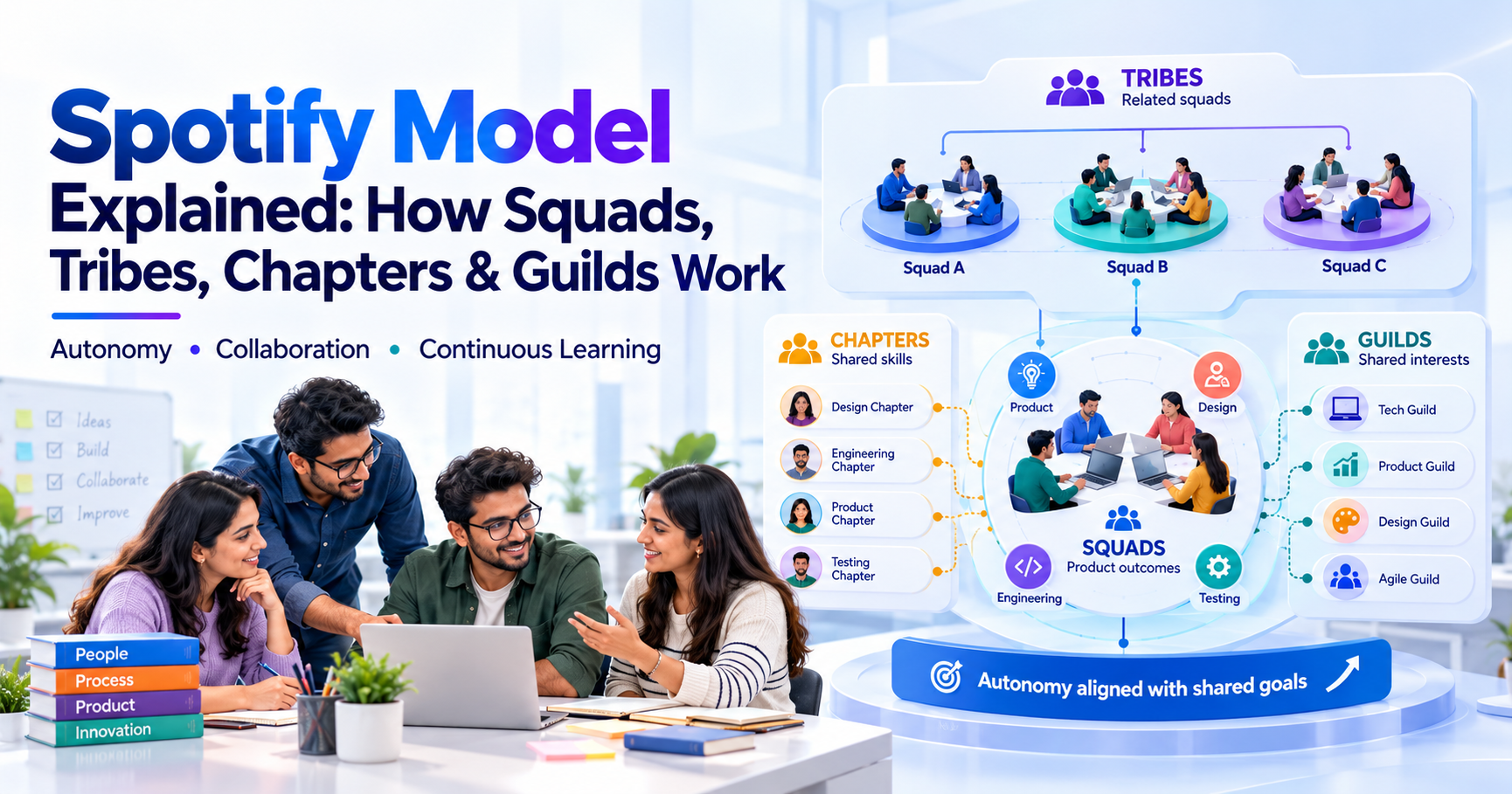
The Spotify model is an example of an Agile product management approach that stresses autonomy, collaboration, and continuous learning. The model was popularized through a 2012 paper by Henrik Kniberg and Anders Ivarsson that talked about how Spotify’s engineering teams organized.
The model has four elements: squads, tribes, chapters, and guilds. The Squads focus on product delivery; Tribes groups multiple squads together, chapters bring together people with similar skill sets across a tribe, and guilds connect people with shared interests across the organization.
The Spotify model is unique because it doesn't follow a standard. It shows how an organization can balance independent decision-making with shared goals. It isn’t a formal framework that everyone needs to copy; it's an evolving organizational approach that’s adaptable.
Key Highlights of the Spotify Model
- Squads are cross-functional teams in charge of specific product outcomes.
- Tribes bring related squads together to help in coordination and shared objectives.
- Chapters connect employees with similar professional skills.
- Guilds promote knowledge sharing across the organization.
- The Spotify model promotes autonomy, experimentation, and continuous improvement.
- The effectiveness of the Spotify model framework depends on the organization’s culture, leadership, and technical capabilities.
- Unlike SAFe and Nexus, it doesn’t follow a completed, standardized scaling process.
Introduction
Spotify is one of the most popular streaming platforms globally, with about 777 million users worldwide, which continues to grow. The immense popularity, combined with the surging amount of users, means that the organization needs to coordinate and work together even better.
Usually, when organizations grow, working with Agile teams becomes increasingly harder, one of the common challenges in scaling Agile. It's easier to coordinate, communicate, and respond to feedback in smaller teams. But when different parts of the same product are spread across multiple teams, the number of dependencies, conflicting priorities, and inconsistent practice make the delivery slower.
While this makes it challenging for enterprises to keep team independence intact while not losing organizational alignment, Spotify did something different.
The Spotify model builds a method centered around self-sufficient teams and communities that encourage collaboration. The concept of squads, tribes, chapters, and guilds gives organizations a blueprint to see team structures and professional development differently.
But it’s important to remember that you can’t create an Agile setup by just copying the model’s organizational structure. Organizations need to build trust, clear responsibilities, and effective communication channels and make sure teams have the right technical capabilities.
To understand what the Spotify model is, you need to examine not just its structure but also the principles behind it.
What Is the Spotify Model?
Definition and Core Idea
The Spotify model approaches Agile product development through the creation of autonomous teams and like-minded communities that come together to share knowledge. The goal is to give teams the freedom to decide how they want to work while making sure that their tasks align with organizational objectives as well.
It has four unique elements that all serve a different purpose:
- Squads: Execute product improvements and outcomes
- Tribes: Connect squads that are working towards common objectives
- Chapters: Enhance professional development within a tribe
- Guilds: Share knowledge across the organization
Imagine this setup: a music streaming company might have squads that take care of playlists, recommendations, search, and payment. Squads that are related to one another can belong to a common tribe. Engineers from a specific tribe can be part of chapters and employees interested in or having information about a certain topic can be part of the knowledge-sharing environment of a guild.
The goal of this arrangement is to enable teams to make independent decisions while not isolating themselves from the overall organization.
Origins in the 2012 Kniberg and Ivarsson Whitepaper
The Spotify model became popular through the 2012 white paper titled Scaling Agile @ Spotify with Tribes, Squads, Chapters & Guilds, published by Hernrik Kniberg and Anders Ivarsson.
They talked about how Spotify organized its engineering teams as the company grew. The whole paper showcased a gradual evolvement of the company’s approach to balancing autonomy, collaboration, and shared technical practices.
Kniberg and Ivarsson didn’t publish these observations as a universal modus operandi. They were simply documenting the practices that Spotify was experimenting with at that time.
But as the paper grew popular, companies began adopting its terminology and exploring similar organizational structures. Some adapted the concept to suit their own needs, while others saw the model as a ready-to-use solution.
So, the best way to see this paper is as an organizational experiment, not a permanent way to scale Agile.
Why It Is a Culture, Not a Framework
Most formal Agile frameworks usually have practices, accountability systems, and coordination methods set in place. The Spotify model mainly shows organizational patterns that help with team autonomy and collaboration.
Its success relies on the environment where those patterns function.
Simply calling a team a squad doesn’t make it self-sustaining if managers oversee and approve every decision they make. Likewise, creating a guild doesn’t automatically mean knowledge sharing, especially if employees don’t have the time or lack the motivation to take part in it.
Established frameworks like the Scaled Agile Framework (SAFe) give structured guidance to get work done across different organizational levels. To learn how this framework helps scale Agile practices, see What Is the Scaled Agile Framework?
The Spotify model, on the other hand, gives organizations the idea that they can adapt.
The underlying point is that organizational structures need to build in such a way that they support Agile behaviors effectively, not just simply take inspiration from labels.
The Building Blocks of the Spotify Model
Squads: Autonomous, Mini-Startup Teams
Squads are small, cross-functional teams responsible for a specific product area, customer need, or business outcome.
It is a collection of six to twelve people equipped with the skills needed to deliver improvement, test ideas, and maintain their responsibility area. .
They’re labelled as mini-startups because, like other self-organizing Agile teams, they have the freedom to decide how to achieve their goals. They can plan tasks, choose their way of work, and experiment with solutions within agreed boundaries.
A squad responsible for recommendations, for example, may look into user feedback, create an improvement, test it within a small group, and assess the results from it.
But having autonomy doesn't automatically mean working in isolation. Squads still need to meet quality and security standards, convey risk, and coordinate changes that can affect other teams.
The key principle: Give teams ownership of their outcomes and the liberty to deliver them.
Tribes: Groups of Related Squads
Tribes consist of multiple squads that work in a specific product area or toward shared or related objectives. They help different teams coordinate with priorities, identify dependencies, and maintain a shared direction.
So, a listening-experience tribe can consist of squads responsible for search, playlists, recommendations, and audio playback.
Each squad is responsible for a specific area, but their work contributes to the same product experience. Being in a tribe helps them share information a lot more easily and address issues that impact multiple teams.
A tribe leader helps with coordination and removes organizational obstacles, but their exact responsibilities depend on what the organization needs.
But being in a tribe shouldn’t lead to the creation of another approval layer. Their goal is to improve collaboration while letting squads retain the right decision-making authority.
The key principle: Bring related teams together to make coordination better, not to centralize every decision.
Chapters: Skill-Based Communities Within a Tribe
Chapters connect people with similar skills within a tribe. They facilitate learning, professional development, and the sharing of technical knowledge.
A tribe can have chapters for backend engineers, design, and quality engineers. Members of a chapter can work in different squads but can come together to talk about common challenges and make their professional practices better.
For instance, backend engineers working on search and recommendations can use their chapter to discuss performance, code quality, and architecture.
The key principle: Maintain professional connections even when employees belong to different teams.
Guilds: Cross-Organization Communities of Interest
Guilds bring people with shared interests of expertise together from across the organization. They’re not restricted to one tribe, unlike in organizations.
A guild for accessibility, for example, might bring together designers, testers, developers, and product specialists to discuss inclusive design and shared testing practices.
Guilds help make useful knowledge accessible across the organization and also help teams avoid duplication. Participation is voluntary, which lets employees contribute based on their availability and interests.
It is important that guilds have a clear purpose and active participation, or else discussions might lose focus and communities might become inactive.
Key principle: Make knowledge accessible beyond just formal team structures.
How the Spotify Model Works
Autonomy Aligned to a Common Mission
The model blends team autonomy with organizational compliance. While the Spotify model squads get the freedom to make decisions, their work needs to contribute to the objectives of the company.
It’s important that there is a balance between both. Too much centralization can slow down delivery. But too little coordination can lead to duplicated work, inconsistent decisions, and conflicting priorities.
Let’s say a company is trying to make its digital customer experience better. One squad takes ownership of the search, one handles recommendations, and the other manages payments. Each team can figure out how they want to bring improvements, but they need to work together on changes that affect shared systems.
Transparency, clear ownership, and proper communication are needed to sustain this balance.
Autonomy doesn’t mean that leadership disappears. Instead, it's the intentional distribution of decision-making authority within agreed-upon boundaries.
The Roles of Squad, Tribe, and Chapter Leads
Leadership levels on each level help support delivery, coordination, and professional growth.
- Squad-level leadership: Help make product priorities clear and focus on team outcomes. Product decisions can be overseen by product owners or equivalent roles while the rest of the team gets to decide how the work is executed.
- Tribe leadership: Supports alignments between squads, helps manage dependencies, and removes organizational obstacles.
- Chapter leadership: Promotes the development of skills and consistency. In the original Spotify model, chapters also led and managed employees.
However, these aren’t universally mandated roles; they’ organizational patterns. When companies adapt the Spotify model, they can distribute responsibilities based on what the circumstances are.
Leaders that make a difference are the ones who clarify expectations, promote collaboration, and help teams overcome obstacles without approving every decision.
Communities of Practice and Knowledge Sharing
Chapters and guilds help in the sharing of knowledge across the organization. They prevent it from being trapped within individual squads.
Employees can share technical solutions, discuss common challenges, document useful practices, and learn from the experiments conducted by other teams.
Let’s say a squad builds an effective approach to automated testing. They can share their findings through a testing chapter or engineering guild and help other teams adapt the approach to their own product.
The aim isn’t to make teams work identically; it’s to make useful knowledge accessible and reduce the effort it would take to find solutions from scratch.
Communities work best when they address real problems and employees hae time to participate.
Benefits of the Spotify Model
Team Autonomy and Speed
One of the primary benefits of the Spotify model is its capability to bring down delays in decision-making.
When squads have clear ownership and authority, they can investigate problems, test solutions, and implement improvements without continuously having to get approval from different management layers.
But even though autonomy can make feedback loops shorter and strengthen team ownership, it cannot guarantee faster delivery. Teams still need to have the right skills, reliable systems, and clear priorities.
Cross-Team Knowledge Sharing
Chapters and guides bring employees from different teams together.
A design chapter, for instance, can help employees from across a tribe come together to discuss accessibility standards. Likewise, an accessibility guild could help bring specialists together from across different tribes.
Such communities promote reusable solutions, professional development, and consistent product quality.
But it’s important that these gatherings have meaningful participation. Just having regular meetings doesn’t prove that useful knowledge is being shared.
A Culture of Trust and Experimentation
The Spotify model framework encourages teams to experiment, learn from results, and continuously improve.
When employees flag concerns and discuss mistakes constructively, they can find problems earlier and explore alternatives.
Let’s take the example of a squad testing out a new recommendation feature. They might realize that it isn’t bringing the improvement that it was supposed to. To assess this, the team can analyze the results, share its findings, and adjust its next experiment.
Psychological safety helps this process by letting people challenge assumptions without the fear of humiliation. But accountability must still coexist with trust; teams need to stay responsible for quality, risk, and outcomes.
Criticisms and Common Misconceptions
Copying Structure but Ignoring Culture
A common mistake that organizations make is adopting the terminology from the Spotify model without making adjustments to how decisions are made.
A company can rebrand their teams as squads but still might not have the autonomy to make decisions. So, even when the structure has been changed, it systematically remains the same.
Adopting practices effectively needs clear decisions, shared goals, supportive leadership, and suitable technical capabilities.
Changing labels cannot replace organizational capabilities, which is one of the main reasons Agile transformations fail.
Silos and Cross-Tribe Coordination Gaps
When squads focus on autonomy without keeping wider goals in mind, it can lead to the creation of silos.
Let’s say a payment squad introduces a change to make their teams’ processes easier. However, these changes create problems for customer support and other shared platforms. While tribes can help in making coordination easier, they cannot eliminate every dependency across the organization.
Companies need to have clear ownership of shared systems, dependency management, and communication channels that help support decisions on time.
Guilds Losing Effectiveness at Scale
Guides can also struggle as their membership grows. Discussions may go off track, useful information becomes difficult to find, and the responsibility of the gathering might be undertaken by only a small group of volunteers.
Organizations can prevent this by establishing the purpose of each guild, appointing facilitators, documenting useful outcomes, and letting asynchronous participation take place.
Guilds should be determined by their value and not their meeting frequency or membership size.
Why Spotify Itself Moved On
The 2012 Spotify Model framework wasn’t planned to be the company’s permanent organizational structure.
As companies grow, so do their practices. Their products, technology, workforces, and business needs keep evolving, and a model that might have worked at one point in time may change to keep up with the team's progress.
You can see how Spotify’s own engineering practices have continued to evolve, as seen in its engineering blog.
That doesn’t mean the original model is no longer useful. Organizations can still learn from the principles that it formed rather than assuming Spotify still adheres to the same practices as described in 2012.
Spotify Model vs. Other Scaling Approaches
Organizations should choose their scaling approach based on their delivery challenges, governance needs, and the level of structure they desire.
Spotify Model vs. SAFe
The Spotify model and the Scaled Agile Framework (SAFe) address the challenges of working across multiple teams, but they differ in what they emphasize.
SAFe gives structured guidance for scaling Lean and Agile practices. This includes planning, coordination, and aligning with business strategy. The Spotify model, on the other hand, focuses on autonomous teams, organizational culture, and communities of practice.
Scrum, like SAFe, helps in incorporating Agile practices across teams. However, in large, complex organizations that continuously evolve, SAFe becomes ideal. o understand the difference, see Scrum vs SAFe vs Agile.
| Comparison area | Spotify model | SAFe |
| Main emphasis | Autonomy & collaboration | Coordinated Agile delivery |
| Structure | Squads, tribes, chapters, guilds | Defined team & organizational constructs |
| Planning | Adapted to organizational needs | Established planning practices |
| Flexibility | Highly adaptable | Structured and tailorable |
| Main challenge | Maintaining alignment | Avoiding unnecessary complexity |
Neither of the approaches assures complete success. The right choice depends on what the organization needs.
Spotify Model vs. Nexus and LeSS
The Nexus Framework, one approach to scaling Scrum, focuses on three to nine Scrum teams delivering an integrated product increment.
The Nexus Framework focuses on working with around three to nine Scrum teams to deliver an integrated product increment. LeSS pushes Scrum principles across different teams while focusing on a common product and getting rid of unnecessary organizational complexities.
The Spotify model framework focuses on organizational structures that aim at autonomy and knowledge sharing.
| Comparison area | Spotify model | Nexus | LeSS |
| Main purpose | Organize autonomous teams. | Coordinate multiple Scrum Teams | Scale Scrum around one product |
| Structure | Squads, tribes, chapters, guilds | Multiple Scrum Teams in a Nexus | Multiple Scrum teams sharing one product |
| Main focus | Autonomy and knowledge sharing | Integration and dependencies | Product focus and simplicity |
| Prescribed practices | No complete standardized rule set | Defined accountabilities and events | Defined principles and structural rules |
Choose which approach to use based on the problem you need to solve.
Lessons for Teams Adopting the Model
Adapt, Do Not Copy
Organizations should look at their existing challenges before taking elements of the Spotify model.
So, a company having problems with duplicated technical work might benefit from having communities of practice. Another company dealing with slow approvals may need to redefine their decision rights.
Here’s what an adoption process should look like:
- Identify the problem: Look at slow decisions, unclear ownership, silos, and dependencies.
- Define team missions: Give each team clear responsibilities and outcomes that can be measured.
- Establish decision boundaries: Clarify which decisions teams can independently make.
- Create useful communities: Introduce chapters or guilds to address genuine needs.
- Measure results: Examine delivery performance, customer outcomes, and employee feedback.
- Adapt continuously: Keep effective practices and change those that create unnecessary blockages or delays.
Invest in Autonomy and Psychological Safety
Autonomy means having decision-making authority, necessary information, the right skills, and clear priorities.
Having psychological safety gives employees the space to raise concerns, question assumed practices, and talk about mistakes without the fear of humiliation. Leaders can promote this by welcoming different viewpoints, listening, empathizing, and responding to problems in a constructive way.
But these safety nerds don’t get rid of accountability. Teams still need to meet quality standards, convey risks, and take the responsibility for outcomes.
Technical skills are important too. Things like automated testing and reliable deployment processes help squads execute changes independently.
The blend of trust, clear authority, technical competence, and shared accountability helps make autonomy sustainable.
The Scrum Master in a Spotify-Style Organization
A Scrum Master can help squads make collaboration better, remove blockages, and produce value in a better way.
Let’s say a squad keeps missing sprint goals because a team keeps giing dependencies late. The Scrum Master can help make team coordination better by having discussions and bringing the problems to life.
The Scrum Master helps teams make better decisions without becoming another approval layer.
If you want to deepen your knowledge on Agile and Scrum practices, then consider enrolling in the SAFe Scrum Master Certification Training and learning to guide teams in Agile environments effectively.
The Agile Coach and Chapter Lead Overlap
Agile coaches and chapter leads both support learning, but their responsibilities differ, much like the difference between an Agile coach and a Scrum Master.
An agile coach usually helps individuals, teams, or the overall organization make their agile practices better. Chapter leads, on the other hand, concentrate on professional development within a specific domain. In the original Spotify model framework, it was line management.
So, an Agile coach would help their squads make their retrospectives better while a chapter lead would help engineers build technical skills and have common standards.
Having clear responsibilities helps Scrum masters, agile coaches, and chapter leads work together without duplicating the effort.
Conclusion
The Spotify model offers a distinctive way to scale Agile via autonomous squads, tribes, chapters, and cross-organizational guilds.
Agility is more than simply team structures. It needs the right principles as well. Teams should have a clear mission, decision rights, professional relationships, and an environment that supports experimentation and continuous improvement.
But we should be careful not to think the model is universally applicable. Using its language regardless of the organization's culture, technical dependencies, and leadership practices
But the model is not a general-purpose framework. By merely repeating its language, without regard to culture, technical dependencies, and leadership practices, new problems can be created.
Organizations should have an approach that understands the challenges and their specific problems, adopts practices that offer meaningful value, and evaluates if those practices are effective.
The best Agile organizations are not the ones that look the most like the Spotify model. It’s the one that allows people to collaborate, make better decisions, learn continuously, and deliver meaningful value.








 Lowest-Price Challenge











 Personalized Path



.webp)


 USA
 Canada
 India
 UK
 Australia
 Singapore


