


 Call Us



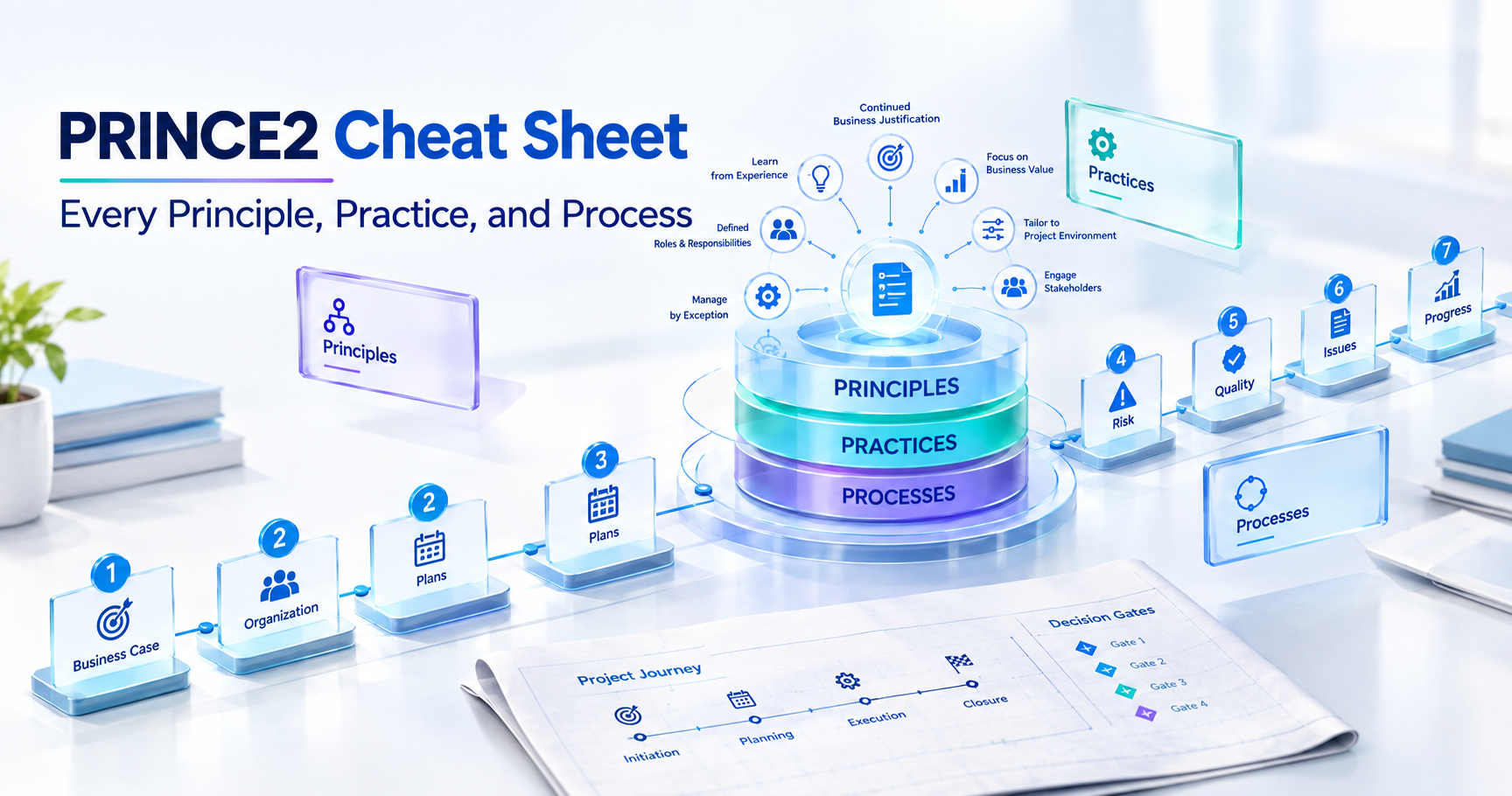
This PRINCE2 cheat sheet covers the current PRINCE2 7 structure: 7 principles, 7 practices (renamed from "themes" in the 2023 update), and 7 processes, plus the standalone focus on People that PRINCE2 7th Edition introduced as its biggest structural change. PRINCE2 7, published by PeopleCert in September 2023, kept the seven principles and seven processes largely intact but renamed themes to practices, added sustainability as a seventh performance target alongside time, cost, quality, scope, risk, and benefits, and introduced three new management approaches: digital and data, commercial, and sustainability. The Foundation and Practitioner pass marks also rose to 60%, up from 55%, and the Practitioner exam grew from 68 to 70 questions. Use this as a quick reference for exam prep or day-to-day project governance, not a substitute for the full manual.
PRINCE2 7th Edition – Key Highlights of PRINCE2 Cheat Sheet
- PRINCE2 7th Edition has the core structure of the same 7 principles, 7 practices, and 7 processes. The term “themes” used in earlier editions has been replaced with “practices”.
- Sustainability was added as a seventh project performance target in PRINCE2 7, alongside time, cost, quality, scope, risk, and benefits.
- PRINCE2 7th Edition added three new management approaches to the previous five (risk, change control, benefits, quality, communications) – digital and data, commercial and sustainability.
- PRINCE2 7 introduced people as a standalone integrated element, addressing the biggest gap of the previous editions.
- In PRINCE2 7, Foundation and Practitioner pass marks went up to 60% (from 55%) and the Practitioner exam increased from 68 to 70 questions.
- PRINCE2 is recognized and applied in more than 150 countries, making it one of the most widely adopted structured project management methodologies globally.
PRINCE2 Cheat Sheet: The 7 Principles
Every PRINCE2 project must apply all seven principles; they are not optional guidelines, and a project that ignores any of them is not genuinely running PRINCE2 project management at all.
- Continued business justification: every project must have a valid, ongoing reason to exist, checked throughout, not just at the start.
- Learn from experience Lessons from past projects should be actively sought out and applied, not just recorded and forgotten.
- Defined roles and responsibilities: clear ownership and accountability across the project management team, avoiding ambiguity about who decides what.
- Manage by stages: projects are planned and reviewed in manageable stages rather than committed to fully upfront.
- Managed by exception: tolerances are set for scope, cost, time and other targets and only breaches of those tolerances are reported upwards.
- Focus on products: deliverables drive project activities, not just the schedule; the definition of the product determines what work is actually needed.
- Tailored to suit the project PRINCE2 is tailored to suit the project size, complexity and environment and not applied in exactly the same way in every situation.
PRINCE2 Cheat Sheet: The 7 Practices
PRINCE2 7 renamed "themes" to "practices" to emphasize action over abstract theory. The seven practices remain conceptually the same territory as before, with updated guidance reflecting current project realities, part of what gives PRINCE2 its documented advantages over less structured methodologies.
- Business Case: ensures the project remains desirable, viable, and achievable throughout its life, not just at initiation.
- Organization: defines the project management team structure, roles, and reporting lines.
- Plans: describes how the project will be planned on a project, stage and team level.
- Quality: Creates quality standards and procedures to guaranty products meet requirements.
- Risk: Identifies, assesses and manages risks and opportunities within the project.
- Change: What issues and changes are identified, assessed and accepted or rejected.
- Progress: monitors performance against plans and supports decision-making at each management stage.
PRINCE2 Cheat Sheet: The 7 Processes
The seven processes describe the activities that move a project from idea to closure, each triggered at a specific point in the project lifecycle, spanning the full journey candidates study across PRINCE2 certification levels.
- Starting Up a Project (SU) Pre-project stage to assess viability and develop the project brief.
- Directing a Project (DP): senior management oversight, spanning from project authorization through to closure decisions.
- Project Initiation (IP): detailed planning and documentation; production of the full Project Initiation Documentation.
- Controlling a Stage (CS): day-to-day management of a single management stage, including work assignment and progress monitoring.
- Managing Product Delivery (MP): coordinates the work between the project manager and the teams actually producing deliverables.
- Managing a Stage Boundary (SB): reviews the current stage and plans the next one before it is authorized to proceed.
- Closing a Project (CP): Accepts products, captures lessons learned, formally closes the project.
What Changed in PRINCE2 7: The Structural Shifts
PRINCE2 7, published by PeopleCert in September 2023, arrived six years after the sixth edition and introduced changes significant enough that earlier PRINCE2 certifications are not accepted as prerequisites for the PRINCE2 7 Practitioner exam. Four shifts matter most for anyone learning or refreshing PRINCE2 today.
People became a standalone focus. Previous editions implied people management without dedicating structured guidance to it. PRINCE2 7 gives people its own integrated chapter, addressing what many practitioners considered the biggest omission from earlier versions.
Sustainability joined the performance targets. The original six project performance targets, time, cost, quality, scope, risk, and benefits, now have a seventh: sustainability, each with its own tolerance range. PRINCE2 7 also references the United Nations Sustainable Development Goals directly in its opening chapter as a prompt for smaller organizations weighing sustainability considerations.
Three new management approaches were added. Earlier editions covered five management approaches: risk, change control, benefits, quality, and communications. PRINCE2 7th Edition adds digital and data, commercial, and sustainability management approaches, reflecting how project environments have shifted since 2017.
Documentation was simplified. Management product outlines now sit inside each practice chapter rather than in a separate section, and logs and registers were consolidated to reduce overall documentation overhead.
PRINCE2 7th Edition Exam Changes You Should Know
If you are studying for certification rather than applying PRINCE2 informally at work, these format changes matter directly, and this PRINCE2 Practitioner exam format guide breaks down the current requirements in more depth.
Element | Before PRINCE2 7 | PRINCE2 7th Edition |
| Foundation pass mark | 55% | 60% |
| Practitioner pass mark | 55% | 60% |
| Practitioner question count | 68 questions | 70 questions |
| Practitioner exam duration | 2.5 hours | 2.5 hours (unchanged) |
| Practitioner exam basis | Scenario-based | Scenario-based, drawn from one of four included scenarios |
The higher pass mark alongside a similar question count means less room for error than earlier editions allowed, which is worth building into your study timeline if you are preparing for the current version.
PRINCE2 Cheat Sheet: The Project Board Roles
No PRINCE2 cheat sheet is complete without the project management team structure, since roles and responsibilities is one of the seven principles and shows up constantly in scenario-based exam questions.
- Executive owns the business case and represents the customer's interests, sitting at the top of the project board with ultimate accountability for the project's success. There is only ever one Executive per project, avoiding the ambiguity of shared ultimate ownership.
- Senior User represents everyone who will use the project's products once delivered, responsible for specifying user requirements and confirming the products actually meet those needs.
- Senior Supplier represents the people designing, developing, and delivering the project's products, accountable for the quality of supplier-side work and resourcing.
- Project Manager runs the project day to day, planning, monitoring, and controlling within the tolerances the project board sets, escalating only when those tolerances are breached.
- Team Manager is an optional role for larger projects, managing the delivery of a specific work package on the project manager's behalf, common on projects large enough to need multiple parallel delivery streams.
- Project Assurance provides independent oversight on behalf of the project board, checking that the project remains on track without being part of day-to-day management, a check-and-balance function distinct from the project manager's own reporting.
- Change Authority is the authority, usually from the project board, to approve specific changes and off-specification requests without having to pass every change decision up the line so that change control is practical and does not become a bottleneck.
- Project Support provides administrative assistance, from configuration management to maintaining project files, and can be a dedicated role or an informal responsibility absorbed by the project manager on smaller projects.
PRINCE2 Cheat Sheet: Key Management Products to Know
Beyond principles, practices, and processes, PRINCE2 defines a specific set of management products, the documents and records a project actually produces and maintains. A handful come up constantly in both exam questions and day-to-day project governance.
The Business Case captures why the project is worth doing and gets revisited at every stage boundary, not written once and forgotten. The Project Initiation Documentation (PID) consolidates the full agreed baseline: scope, approach, plans, and controls, effectively the reference document the rest of the project measures itself against. The Risk Register records the identified risks, their assessed probability and impact, and the planned response. Rather than being compiled once in planning, it is reviewed and updated throughout the project.
The Issue Register tracks problems, changes, and off-specifications raised during the project, distinct from risks since issues have already happened rather than merely being possible. The Highlight Report is the project manager's regular, usually time-driven, summary to the project board on progress, issues, and risks. The End Stage Report and End Project Report close out a stage or the full project respectively, feeding into the lessons captured for future projects, directly supporting the "learn from experience" principle in practice rather than just in name.
Notice that most of these products map directly back to the seven practices: the Business Case product supports the Business Case practice, the Risk Register supports the Risk practice, and so on. This is a deliberate design choice in PRINCE2's structure, and recognizing the pairing between practice and product is one of the fastest ways to build genuine recall rather than memorizing two separate lists that happen to share similar names.
Tailoring in Practice: What It Actually Looks Like on a Small Project
"Tailor to suit the project" is easy to state as a principle and genuinely difficult to apply correctly, since under-tailoring and over-tailoring are both common mistakes candidates and practitioners make.
On a small, low-risk internal project, proper tailoring might mean combining the Executive and Senior User roles into one person, since a separate individual for each role adds governance overhead without adding real value at that scale. It might mean a simplified Highlight Report delivered verbally in a short weekly call rather than a formal written document, provided the project board agrees this still meets their oversight needs. What tailoring does not mean is skipping the principles themselves: even a two-week internal project still needs continued business justification and defined roles, just expressed more lightly than a multi-year infrastructure program would require.
The exam-relevant distinction worth remembering is that principles are never tailored away entirely; only how they are applied gets adjusted. A project claiming to run PRINCE2 while ignoring manage-by-exception entirely, for instance by requiring the project board to approve every minor decision regardless of tolerance, is not a tailored version of PRINCE2. It is a project not actually following the method, regardless of what documentation it produces.
PRINCE2 vs PMP: A Quick Distinction Worth Remembering
PRINCE2 and PMP get confused constantly because both are widely recognized project management credentials, but they approach the discipline differently. PRINCE2 is a defined methodology, a specific set of principles, practices, and processes you follow. PMP is a certification of general project management competency across any methodology, predictive, agile, or hybrid, without prescribing one specific process framework.
This distinction shapes which one fits your situation. If your organization or region already runs on PRINCE2, especially common across the UK, Europe, and Australia, learning the methodology directly is the practical choice, a comparison worth extending to APM vs PRINCE2 methodology if you are weighing UK-specific frameworks.
If you want a credential recognized broadly across countries and industries without being tied to one specific process framework, PMP is the stronger fit. This detailed PRINCE2 vs PMP comparison walks through cost, recognition, and career impact side by side if you are still deciding between the two.
How to Use This Cheat Sheet Effectively
Treat this as a recall aid, not a replacement for understanding why each element exists. The seven principles explain the philosophy behind PRINCE2; the seven practices explain what you manage; the seven processes explain when you do it. Reviewing all three together, rather than memorizing each list in isolation, is what actually helps during scenario-based exam questions, since PRINCE2 7's exam format increasingly tests how these elements interact, not just whether you can recite them.
If you are preparing for certification specifically, pairing this quick reference with structured PRINCE2 Foundation exam preparation gives you both the recall speed this cheat sheet builds and the deeper scenario practice the current exam format actually tests. If you are unsure whether Foundation alone is enough for your goals, this breakdown of PRINCE2 vs PRINCE2 Agile helps clarify which path fits your role.
Conclusion
This PRINCE2 cheat sheet covers what changed and what stayed the same in PRINCE2 7: the same seven principles and seven processes, practices renamed from themes, and a genuinely new focus on people and sustainability that earlier editions lacked. Use it to refresh your memory quickly, but build your actual exam readiness on the full manual and structured practice through PRINCE2 Foundation and Practitioner training, since PRINCE2 7's scenario-based questions test how these elements interact, not just whether you can list them.
If you are preparing for certification now, confirm you are studying PRINCE2 7 materials specifically, not content still built around the 2017 sixth edition.


_1738228222.jpg)



 Lowest-Price Challenge











 Personalized Path


.webp)


 USA
USA  Canada
 India
India UK
UK Australia
 Singapore


