


 Call Us


Last updated: 7 October 2026.
Sources: U.S. Bureau of Labor Statistics Occupational Outlook Handbook (management analysts), IIBA certification pages, Robert Half 2026 Salary Guide.
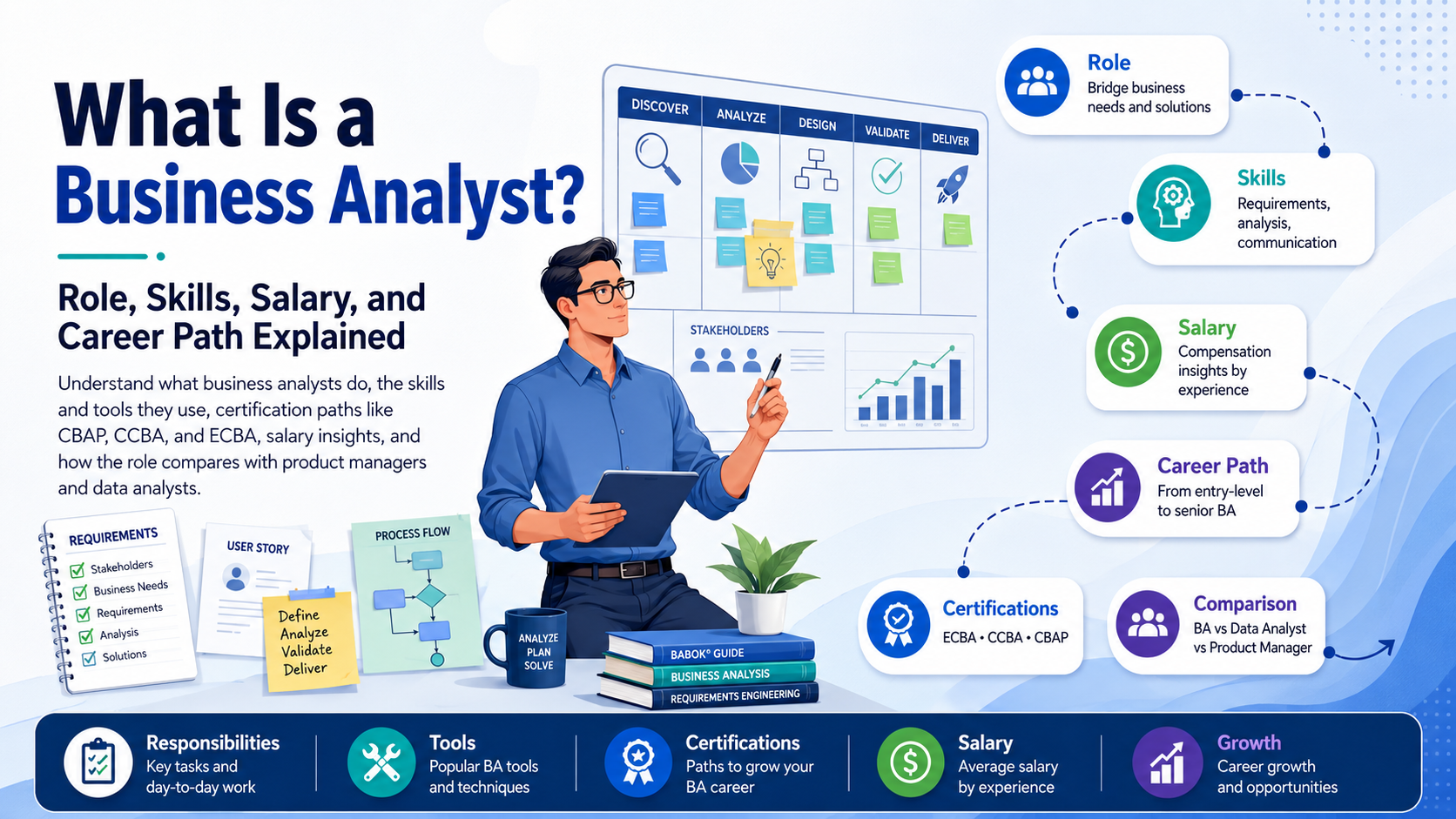
A business analyst is a professional who studies how an organization's processes, data and systems work, finds problems or missed opportunities, and defines the requirements for fixing them. They sit between business stakeholders and technical teams so that what gets built solves the original business problem.
A business analyst is a professional who studies an organization's processes, data, and systems to identify problems and recommend solutions that improve efficiency, profitability, or customer outcomes. The role sits between business stakeholders and technical teams, translating vague business needs into clear, actionable requirements that developers, project managers, and leadership can act on. Business analysts typically hold or work toward an IIBA credential such as ECBA, CCBA, or CBAP, and they use tools like Excel, SQL, JIRA, and Confluence to gather, document, and validate requirements. In the United States, related occupations that the Bureau of Labor Statistics tracks under "management analysts" earned a median annual wage of $101,190 as of May 2024.
Key Highlights of What Is a Business Analyst
- A business analyst bridges the gap between business needs and technical solutions by eliciting, analyzing, and documenting requirements.
- Core responsibilities include stakeholder interviews, process modeling, writing user stories and use cases, and validating that delivered solutions meet business goals.
- The most recognized credentials come from the International Institute of Business Analysis (IIBA): ECBA for beginners, CCBA for practitioners with two to three years of experience, and CBAP for professionals with five or more years of experience, all based on the BABOK Guide.
- Common tools of the trade include Microsoft Excel, SQL, JIRA, Confluence, Tableau or Power BI, and diagramming tools such as Visio or Lucidchart.
- The U.S. Bureau of Labor Statistics reports a median wage of $101,190 per year for management analysts, the closest official government category to business analyst work, with the top 10 percent earning $174,140 or more.
- A business analyst is distinct from a product manager, a data analyst, and a systems analyst, even though the roles overlap and are frequently confused in job postings.
What Is a Business Analyst? Definition and Core Purpose
A business analyst (often abbreviated BA) is a professional who examines an organization's operations, workflows, data, and technology to identify inefficiencies, unmet needs, or opportunities for improvement, and then defines requirements and solutions to address them. The role exists because most organizations have a persistent communication gap between the people who understand the business problem (executives, department heads, end users) and the people who build the technical solution (developers, engineers, IT teams). The business analyst closes that gap.
Depending on the organization, a business analyst might work on process improvement, software requirements, data-driven strategy, digital transformation, or a mix of all four. What stays constant across industries is the core loop of the job: understand a business problem, gather input from the people affected by it, define what "solved" looks like in precise, testable terms, and confirm that whatever gets built or changed actually solves the original problem.
Business analysts are employed across nearly every sector, including banking and financial services, healthcare, insurance, government, retail, manufacturing, and technology. The specific title varies by company and industry: common variants include business systems analyst, IT business analyst, functional analyst, requirements analyst, and process analyst. A detailed look at how this plays out inside Agile delivery teams specifically is covered in this guide to the role of the business analyst in Agile.
Business Analyst vs Business Analytics: What Is the Difference?
A business analyst is a person and a job role. Business analytics is a method: the use of data, statistics and modeling to answer business questions. A business analyst may use business analytics as one tool, but the role is broader and also covers stakeholder interviews, requirements documentation and change support.
| Aspect | Business Analyst | Business Analytics |
|---|---|---|
| Meaning | A professional role | A data-driven discipline |
| Main question | What does the business need, and why? | What do the numbers say, and what is likely to happen? |
| Typical activities | Workshops, process mapping, requirements writing, UAT support | Querying, statistical analysis, forecasting, dashboards |
| Core skills | Communication, elicitation, critical thinking, documentation | Statistics, SQL or Python, data visualization |
| Typical output | Requirements, process maps, recommendations | Reports, dashboards, predictive models |
Business Analyst Roles and Responsibilities
The core responsibilities of a business analyst are to elicit and clarify requirements, analyze current processes and data, manage stakeholder expectations, document requirements and solutions, support delivery and testing, and confirm after launch that the change solved the business problem.
| Responsibility | What it involves | Typical output |
|---|---|---|
| Requirements elicitation | Interviews, workshops, surveys and observation to uncover real needs | Elicitation notes, requirements list |
| Process and gap analysis | Current-state and future-state mapping, root cause analysis | Process maps, gap analysis |
| Stakeholder engagement | Aligning executives, users and IT; resolving conflicting priorities | Stakeholder map, recorded decisions |
| Documentation | Writing requirements so a developer who was not in the room can build the right thing | BRD, functional specification, user stories, acceptance criteria |
| Solution recommendation | Weighing options by cost, effort and value | Options analysis, business case input |
| Delivery and testing support | Clarifying requirements and supporting user acceptance testing | UAT scripts, defect triage notes |
| Change management support | Managing scope changes and preparing users for new ways of working | Change log, training inputs |
| Outcome measurement | Comparing results with the original goal after release | Benefit tracking report |
What Does a Business Analyst Do Day to Day?
A business analyst spends most of the day talking with stakeholders, writing and refining requirements, analyzing data and processes, and checking that delivered work matches what the business asked for.
The day-to-day work of a business analyst is less about any single deliverable and more about a continuous cycle of listening, documenting, and validating. A typical week blends meetings, documentation work, and analysis, and the balance shifts depending on where a project sits in its lifecycle.
Requirements Elicitation
This is the process of drawing out what stakeholders actually need, which is often different from what they initially ask for. Business analysts use interviews, workshops, surveys, document analysis, and direct observation of existing workflows to surface both explicit requirements and the underlying business objectives behind them. Skilled elicitation frequently uncovers a real problem that is different from the one a stakeholder originally described.
Stakeholder Management
Business analysts regularly work with a wide range of stakeholders, from front-line staff to senior executives, and have to manage competing priorities, conflicting requirements, and differing levels of technical fluency. This includes facilitating workshops, running sprint ceremonies such as backlog refinement and sprint reviews on Agile teams, and reporting progress back to sponsors.
Documentation
Once requirements are gathered, they need to be written down in a form that both business stakeholders and technical teams can act on. This includes business requirements documents (BRDs), functional specifications, user stories, use cases, process flow diagrams, and acceptance criteria. Good documentation is unambiguous enough that a developer who was not in the room can build the right thing from it.
Analysis and Gap Identification
Business analysts examine gathered requirements for contradictions, missing pieces, and misalignment with the stated business objective. This often involves current-state versus future-state process mapping, root cause analysis, and cost-benefit or feasibility assessments before a recommendation is finalized. A broader look at how organizations apply these techniques is covered in these business analysis practices for driving business success.
Solution Validation and Testing Support
After a solution is built, the business analyst's job is not done. They typically support user acceptance testing (UAT), verify that the delivered product matches the documented requirements, and manage change requests when the business need shifts mid-project.
Business Analyst Example: Fixing Drop-Off in Online Account Opening
The scenario below is illustrative. A retail bank notices that many applicants start an online account application but never finish it.
- Understand the problem. The business analyst interviews product, operations, compliance, customer support and IT, and reviews drop-off data for each step of the application.
- Map the current process. The analyst maps the journey end to end and finds that applicants must upload identity documents before they can see any account details.
- Define requirements. Applicants should be able to save progress and upload documents later, while compliance checks still finish before the account is activated. The analyst writes testable acceptance criteria, for example: given an applicant who has completed personal details, when they return within seven days, then their progress is restored.
- Recommend and prioritize. The analyst compares options such as save and resume, fewer form fields and mobile document capture, rates each on effort and expected impact, and gets stakeholder agreement on the first release.
- Support delivery and testing. During development the analyst answers questions, updates requirements as decisions change, and helps business users run user acceptance testing.
- Measure the result. After launch the analyst tracks completion rate, time to complete and support contacts, and recommends follow-up changes if the target is not met.
The same loop of understand, define, validate and measure applies in every industry, whether the project is a bank onboarding flow, a hospital scheduling system or a retail returns process.
Types of Business Analysts
The main types are the IT business analyst, agile business analyst, business systems analyst, data or BI analyst, process or management analyst, and product-focused business analyst.
"Business analyst" is an umbrella term, and the day-to-day differs based on specialization:
- IT Business Analyst: focuses on software and systems requirements, working closely with developers and QA teams.
- Agile Business Analyst: embedded in Scrum or SAFe teams, writing and refining user stories and participating in sprint ceremonies. See this deep dive on the Agile business analyst role and responsibilities.
- Business Systems Analyst: sits closer to the technical side, translating business requirements into system specifications and data models.
- Data or Business Intelligence Analyst: focuses on quantitative analysis, reporting, and dashboards, though this overlaps with the distinct data analyst role covered later in this guide.
- Process or Management Analyst: focuses on operational efficiency, cost reduction, and organizational workflow redesign rather than software delivery.
- Product-Focused Business Analyst: works inside a product team supporting a product manager with detailed requirements, though the two roles remain distinct, as explained in the related roles section below.
- Financial Business Analyst: analyzes budgets, forecasts and financial performance to support investment and cost decisions.
- Marketing Business Analyst: studies campaigns, customer behavior and market trends to improve acquisition and retention.
- Healthcare Business Analyst: improves clinical and administrative processes and systems, often within regulatory constraints.
- Risk Business Analyst: identifies and assesses risks to projects and operations and defines requirements and controls to reduce them.
Business Analyst Skills: What You Need to Succeed
The most important skills are communication, elicitation, critical thinking, requirements documentation, process modeling and basic data analysis with Excel and SQL.
Because the role sits at the intersection of business and technology, successful business analysts need a blend of interpersonal, analytical, and technical skills.
Core Soft Skills
- Communication: translating between non-technical stakeholders and technical teams, in both directions, without losing meaning.
- Active listening and interviewing: drawing out real needs rather than surface-level requests during elicitation sessions.
- Negotiation and conflict resolution: balancing competing stakeholder priorities and reaching agreement on scope.
- Critical thinking and problem-solving: identifying root causes rather than just symptoms.
- Facilitation: running workshops, requirements sessions, and Agile ceremonies that stay on track and produce decisions.
- Adaptability: shifting between projects, industries, and methodologies (Waterfall, Agile, hybrid) as needed.
Core Technical and Analytical Skills
- Requirements modeling techniques: use case diagrams, user stories, process flow diagrams, data flow diagrams, and business process model and notation (BPMN).
- Data analysis fundamentals: comfort with spreadsheets and basic SQL to validate assumptions with real data rather than opinion.
- Documentation standards: writing BRDs, functional requirement specifications, and acceptance criteria that hold up under technical scrutiny.
- Domain knowledge: understanding the specific industry (banking, healthcare, insurance, retail) well enough to spot unstated assumptions and regulatory constraints.
- Basic project management literacy: understanding sprint cycles, backlogs, and delivery timelines even when a dedicated project manager owns the schedule.
Business Analyst Tools and Software
Business analysts most often use Excel, SQL, JIRA, Confluence, Power BI or Tableau, and a diagramming tool such as Visio or Lucidchart.
Most business analyst job postings list a mix of the following tools as required or preferred:
| Category | Common Tools | Primary Use |
|---|---|---|
| Requirements and Issue Tracking | JIRA, Azure DevOps | Logging requirements as trackable work items, linking them to development tasks, and monitoring status through the delivery lifecycle |
| Documentation and Collaboration | Confluence, SharePoint, Notion | Centralized requirements documents, wikis, and project knowledge bases shared across teams |
| Data Analysis | Microsoft Excel, SQL | Validating assumptions with real transactional or operational data, building quick pivot analyses |
| Data Visualization / BI | Tableau, Power BI | Turning requirements or process data into dashboards stakeholders can act on |
| Process and Diagramming | Microsoft Visio, Lucidchart, draw.io | Mapping current-state and future-state business processes, workflows, and system interactions |
| Wireframing / Prototyping | Balsamiq, Figma | Sketching screen flows to validate requirements with stakeholders before development starts |
No single job requires mastery of every tool on this list. Most postings expect strong Excel and documentation skills as a baseline, with JIRA/Confluence and one BI tool (Tableau or Power BI) as common additions, especially in tech-adjacent industries.
Business Analyst Certifications: ECBA, CCBA, and CBAP
The three core IIBA certifications are ECBA for beginners, CCBA for analysts with two to three years of experience, and CBAP for analysts with five or more years.
The International Institute of Business Analysis (IIBA) maintains the most widely recognized certification path for business analysts globally, built around its Business Analysis Body of Knowledge (BABOK Guide), currently at version 3. The core certifications form a ladder based on experience level.
| Certification | Full Name | Experience Required | Exam Format |
|---|---|---|---|
| ECBA | Entry Certificate in Business Analysis | No work experience required; 21 hours of professional development in the last 4 years | 50 multiple-choice questions, 1 hour |
| CCBA | Certification of Capability in Business Analysis | About 3,750 hours of business analysis work in the last 7 years, roughly 2 to 3 years | 130 multiple-choice, scenario-based questions, 180 minutes |
| CBAP | Certified Business Analysis Professional | About 7,500 hours of business analysis work in the last 10 years, roughly 5 or more years | 120 scenario-based multiple-choice questions, 3.5 hours |
Beyond the core IIBA ladder, professionals working specifically in Agile delivery environments sometimes pursue the IIBA's Agile Analysis Certification (IIBA-AAC) as a specialty add-on. Organizations evaluating which credential to pursue first typically start with ECBA if they are new to the field, since it has no prerequisites, and move to CCBA or CBAP as they accumulate documented business analysis experience. A structured comparison of the three, along with the skills and salary implications of each, is available in this business analyst certification guide covering skills and salary, and candidates preparing for the entry-level exam specifically can review these ECBA certification exam tips and study strategies.
Formal training toward these credentials, including instructor-led preparation for the ECBA certification, the CCBA certification, and the CBAP certification, is offered by multiple training providers and typically maps directly to BABOK Guide knowledge areas: business analysis planning and monitoring, elicitation and collaboration, requirements life cycle management, strategy analysis, requirements analysis and design definition, and solution evaluation.
Prepare for Business Analysis Certification
Choose training by experience level. Start with ECBA Certification Training if you are new to the field, move to CCBA Certification Training once you have two to three years of experience, and choose CBAP Certification Training at five or more years. For specialist skills, see Agile Analysis Certification (IIBA-AAC) Training, IT Business Analyst Training and Generative AI for Business Analysts and Functional IT Consultants Training.
Business Analyst Career Path and Progression
A typical path runs from junior analyst to business analyst, senior analyst, lead or manager, and then director of business analysis or enterprise architect.
Business analysis offers a relatively clear, multi-stage career ladder, though the exact titles vary by company.
- Junior Business Analyst / Business Analyst Intern: supports requirements gathering, documentation, and reporting under supervision. Typically requires a bachelor's degree in business, IT, computer science, or a related field.
- Business Analyst: owns requirements gathering and documentation for a defined scope of work, works semi-independently with stakeholders.
- Senior Business Analyst / Business Systems Analyst: leads more complex, higher-stakes analysis efforts, may mentor junior analysts, and works directly with senior management to align projects with strategic goals.
- Lead Business Analyst / Business Analyst Manager: oversees a team of analysts across multiple projects, standardizes analysis practices, and owns analyst hiring and development.
- Director of Business Analysis / Enterprise Architect: sets organization-wide business analysis strategy, often reporting into a CIO, COO, or CTO function.
Lateral moves are also common. Experienced business analysts frequently transition into product management, project management, business architecture, or management consulting, since the underlying skill set (requirements definition, stakeholder management, structured problem-solving) transfers directly.
Is Business Analyst a Good Career in 2026?
Yes. Business analysis remains a strong career in 2026 because organizations keep funding system modernization, process automation and data projects, and each one needs someone to define requirements and confirm the result. The U.S. Bureau of Labor Statistics projects 9 percent employment growth for management analysts, the closest official category, from 2024 to 2034.
- Demand across industries: banking, insurance, healthcare, government, retail and technology all run large systems that need requirements-driven change.
- Clear progression and lateral moves: junior analyst to senior analyst to manager, or sideways into product management, project management, business architecture or consulting.
- Entry from many backgrounds: finance, engineering, operations, commerce and QA professionals can move into the role by building elicitation, documentation and SQL skills.
- Strong pay: the BLS median for management analysts was $101,190 in May 2024, and staffing-firm data shows a base range of roughly $63,000 to $95,500 for business analysts.
How Is AI Changing the Business Analyst Role?
AI tools can now draft user stories, summarize workshop notes, suggest process maps and generate first-pass test scenarios. They do not replace the parts of the job that depend on context and trust: deciding which problem is worth solving, resolving conflicts between stakeholders, judging trade-offs and confirming that an AI-assisted solution is correct and responsible. Business analysts who use AI for repeatable work can spend more time on that judgment.
Business Analyst Salary: What the Data Actually Shows
In the United States, the BLS median annual wage for management analysts, the closest official category, was $101,190 in May 2024, while job-board data puts average business analyst pay at about $85,723.
Salary figures for "business analyst" vary significantly across sources because it is not a single standardized government job category and because pay depends heavily on industry, geography, seniority, and whether total compensation or base salary is being measured. Here is what the most credible sources report.
Government Data (Closest Official Benchmark)
The U.S. Bureau of Labor Statistics (BLS) Occupational Outlook Handbook does not track "business analyst" as a standalone occupational code, but groups this type of work under management analysts, the closest official match. As of May 2024, BLS reported:
- Median annual wage: $101,190
- Highest-earning 10 percent: $174,140 or more per year
- Lowest-earning 10 percent: $59,720 or less per year
Because this BLS category also includes management and strategy consultants, whose pay tends to run higher than a typical in-house IT business analyst, this figure should be read as a ceiling-leaning benchmark rather than a precise match for every business analyst job title.
Job-Board and Staffing-Firm Data
- Robert Half's 2026 salary guide lists a base salary range of approximately $63,000 to $95,500 for business analyst roles in the United States, varying by market and company size.
- Aggregated job-board data (compiled from sources including Glassdoor, Payscale, and BLS figures) puts average total pay for U.S. business analysts at approximately $85,723 per year.
- Entry-level business analysts typically start in the $55,000 to $74,000 range, while senior business analysts with 7 or more years of experience commonly earn $115,000 to $140,000 before bonuses or equity.
The spread between these figures illustrates an important point for anyone researching this role: always check whether a quoted number is base salary, total cash compensation, or total compensation including equity, and whether it reflects a national average or a specific high-cost market. Detailed salary breakdowns by certification level are available in this business analyst certification guide covering skills and salary expectations.
Business Analyst vs Related Roles
Business analyst job postings are frequently confused with several adjacent titles. Understanding the distinctions matters both for job seekers choosing a career direction and for hiring managers writing accurate job descriptions.
Business Analyst vs Product Manager
A business analyst is generally an inward-facing role, focused on understanding and improving internal processes, systems, and requirements. A product manager is generally an outward-facing role, focused on market research, customer needs, competitive positioning, and the overall product roadmap. Business analysts typically support delivery within a defined initiative; product managers typically own the strategic direction and prioritization decisions for a product line. In many organizations, business analysts report into or work alongside product managers, translating the product manager's strategic vision into detailed, testable requirements. A full side-by-side comparison is available in this product manager vs business analyst comparison.
Business Analyst vs Data Analyst
A business analyst uses data as one input among many (alongside stakeholder interviews, process documentation, and business strategy) to solve a defined business problem. A data analyst is more narrowly focused on extracting, cleaning, and interpreting data itself, typically using SQL, Python, or R, to answer specific analytical questions. Business analysts tend to work more heavily in stakeholder meetings and requirements documents; data analysts tend to work more heavily in query editors, notebooks, and statistical models. Reported pay is broadly similar, though data-analyst-specific roles have shown faster projected job growth in some BLS-adjacent projections than general business analyst or management analyst roles. A full breakdown of skills, tools, and salary differences between the two is available in this business analyst vs data analyst comparison.
Business Analyst vs Systems Analyst
A business analyst focuses on understanding what the business needs and why. A systems analyst takes those documented business requirements and designs how a system or software solution should be technically built to satisfy them, working much closer to the engineering and architecture side. In smaller organizations, one person may perform both functions under a single "business systems analyst" title; in larger organizations, the two roles are typically kept separate, with the business analyst focused on the "what" and "why" and the systems analyst focused on the "how."
Business Analyst vs Project Manager
A business analyst focuses on what needs to be built and why, while a project manager focuses on when, how and at what cost it gets delivered. The business analyst owns requirements, analysis and solution validation. The project manager owns the schedule, budget, risks, resources and status reporting. On small projects one person may do both, but on larger ones the two roles work side by side.
Comparison at a Glance
| Role | Primary Focus | Typical Output | Faces |
|---|---|---|---|
| Business Analyst | Business process and requirements | Requirements documents, user stories, process maps | Inward (internal stakeholders) |
| Product Manager | Product strategy and market fit | Product roadmap, prioritized backlog, go-to-market plan | Outward (customers and market) |
| Data Analyst | Data extraction and interpretation | Reports, dashboards, statistical analysis | Data itself |
| Systems Analyst | Technical system design | System specifications, architecture diagrams | Technical implementation |
| Project Manager | Delivery of schedule, budget and risk | Project plan, status reports, risk log | Delivery team and sponsors |
How to Become a Business Analyst
Build a business or technical foundation, learn requirements documentation, SQL and process mapping, gain entry-level experience, earn the ECBA, then progress to CCBA and CBAP.
- Get a relevant bachelor's degree, commonly in business administration, information systems, computer science, finance, or a related field. A degree is typically expected but the specific major matters less than demonstrable analytical and communication skills.
- Build foundational skills in requirements documentation, basic SQL, spreadsheet analysis, and process mapping, either through coursework, on-the-job exposure, or a structured course.
- Gain entry-level experience through internships, junior analyst roles, or adjacent positions such as QA analyst, project coordinator, or operations analyst, where you can practice stakeholder communication and documentation.
- Pursue a recognized certification such as ECBA, which has no experience prerequisite and is designed specifically for newcomers, to formalize your knowledge of the BABOK framework and signal commitment to the field.
- Specialize and advance toward CCBA and eventually CBAP as you accumulate two, then five or more years of documented business analysis experience, while optionally adding domain expertise (healthcare, banking, insurance) or methodology expertise (Agile, SAFe) to differentiate yourself.
Can You Become a Business Analyst Without a Degree?
Yes. Many employers care more about demonstrated skills than the degree, especially for candidates who already have experience in operations, QA, support or finance. A degree still helps with some large employers, so a certification and a portfolio are the best way to close the gap.
- Learn the fundamentals: the business analyst role, requirements, process mapping and the BABOK Guide.
- Build practical skills: Excel, basic SQL, JIRA and a diagramming tool.
- Create a portfolio: a sample BRD, a current-state and future-state process map, and a set of user stories with acceptance criteria.
- Get experience: move from an adjacent role such as QA analyst, support lead, operations analyst or project coordinator, or take internships and volunteer projects.
- Earn the ECBA, which has no work experience requirement, to show structured knowledge.
- Apply for junior or associate roles and plan to move toward the CCBA as you log experience.
Prepare for Business Analysis Certification
Choose training by experience level. Start with ECBA Certification Training if you are new to the field, move to CCBA Certification Training once you have two to three years of experience, and choose CBAP Certification Training at five or more years. For specialist skills, see Agile Analysis Certification (IIBA-AAC) Training, IT Business Analyst Training and Generative AI for Business Analysts and Functional IT Consultants Training.
Key Takeaways
- A business analyst identifies business problems and defines clear, actionable requirements that connect business needs to technical or process solutions.
- Day-to-day work centers on requirements elicitation, stakeholder management, documentation, and solution validation.
- Common tools include Excel, SQL, JIRA, Confluence, Tableau or Power BI, and process-mapping software such as Visio or Lucidchart.
- The IIBA's ECBA, CCBA, and CBAP certifications form the most recognized credentialing path, tied to increasing years of experience and based on the BABOK Guide.
- Government wage data (BLS, management analysts category) reports a median of $101,190 per year as of May 2024, while job-board and staffing-firm data show a wider real-world range from roughly $55,000 at entry level to $140,000 or more at the senior level.
- The role is distinct from, though closely related to, product manager, data analyst, and systems analyst positions, each of which has a different primary focus and typical output.



_1747641504.jpg)



 Lowest-Price Challenge











 Personalized Path


.webp)


 USA
USA  Canada
  India
India  UK
UK  Australia
  Singapore


