


 Call Us


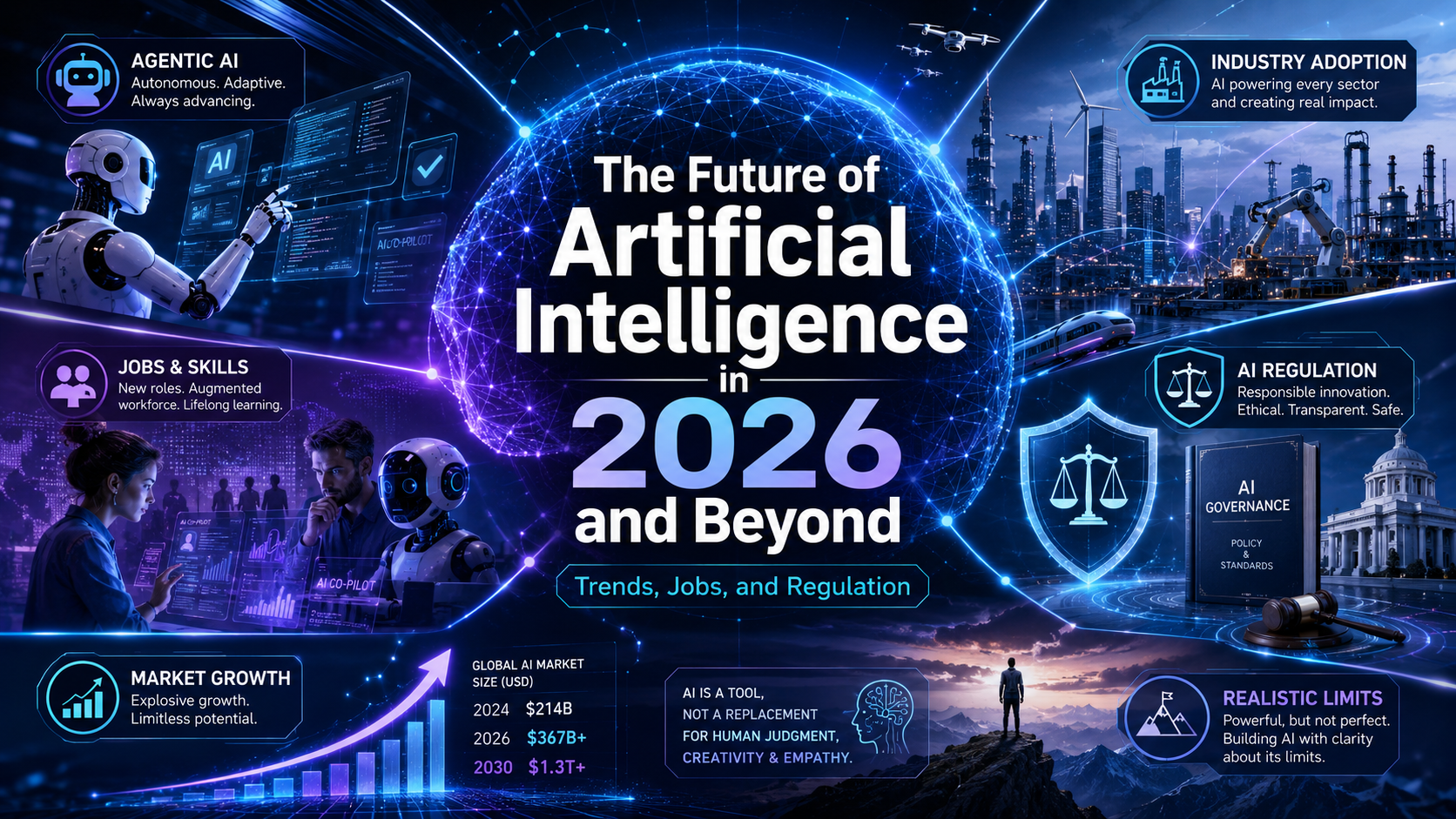
The future of AI (artificial intelligence) is a shift from chatbots that answer questions to agentic systems that plan and complete multi-step work, adopted across almost every industry and increasingly governed by law. Between now and 2030, expect AI to reshape most jobs rather than eliminate work overall, with the World Economic Forum projecting about 170 million roles created and 92 million displaced.
The future of artificial intelligence over the next few years is defined less by chatbots and more by autonomous "agentic" systems that plan, execute, and coordinate multi-step work with limited human supervision. Corporate AI investment has surged past half a trillion dollars globally, generative AI use inside organizations has roughly doubled since 2024, and governments from the European Union to India are now actively regulating how AI gets deployed. At the same time, real limits remain: persistent hallucinations, a widening gap between AI adoption and measurable business value, and rising energy costs from AI data centers. The near-term future belongs to professionals and organizations that pair AI tools with strong human judgment, not to AI acting alone.
Key Highlights of Future of Artificial Intelligence
- Global corporate AI investment reached roughly 581.7 billion dollars in the latest reporting year, up 130 percent year over year, according to Stanford HAI's AI Index.
- Agentic AI, systems made of multiple AI agents that plan and act with minimal supervision, is the dominant technology theme for 2026 according to Gartner's strategic technology trends.
- Generative AI adoption inside organizations has jumped from about a third of companies in 2024 to roughly seven in ten today, though McKinsey research finds most organizations still cannot show measurable revenue impact.
- The EU AI Act's core obligations, including rules for high-risk systems and AI transparency requirements, become enforceable in 2026, with some deadlines for high-risk standalone systems extended into late 2027.
- The World Economic Forum projects roughly 92 million roles could be displaced by 2030 while about 170 million new ones are created, but the workers losing jobs are rarely the same people filling the new ones, making reskilling the central workforce challenge.
- Entry-level, junior technical roles are the first white-collar job category showing measurable, AI-attributable contraction, even as demand for AI-skilled workers grows and commands a meaningful wage premium.
The Current State of AI in 2026
AI is now mainstream in business: about 88 percent of surveyed organisations use it, but far fewer report measurable value at scale.
Artificial intelligence in 2026 looks different from the AI of even two years earlier. The shift is not just about smarter models: it is about what those models are now allowed to do. Stanford's Institute for Human-Centered AI (HAI), through its widely cited annual AI Index, reports that AI capability has accelerated sharply on measurable benchmarks. One coding benchmark, SWE-bench Verified, moved from roughly 60 percent accuracy to near 100 percent within a single year, and some leading models now score above human expert baselines on PhD-level science questions. Organizational adoption of AI has reached roughly 88 percent among surveyed companies, and a large majority of university students report using generative AI regularly.
Alongside capability gains, the AI Index also flags a widening gap between what AI can do and how well its risks are documented. Most AI developers still do not publish detailed safety evaluations, bias audits, or transparency reports, even as investment and deployment accelerate. This tension, fast capability growth paired with slow-moving safety disclosure, is one of the defining characteristics of AI in its current phase, and it matters for anyone deciding how much autonomy to hand an AI system in a real business process.
Competition at the model layer has also intensified. Multiple frontier labs, including OpenAI, Anthropic, and Google, along with open-weight efforts like Meta's Llama family, are now trading the technical lead on different benchmarks rather than one company holding a durable advantage. For a business or a working professional, the practical implication is that "the best AI model" is no longer a single answer. It depends on the task: reasoning and long-context work, coding, general-purpose writing, or low-cost self-hosted deployment all currently favor different tools.
From Chatbots to Agentic AI: The Biggest Shift Underway
Agentic AI refers to systems of AI agents that set sub-goals, use tools and complete tasks with limited human supervision; Gartner ranks it the leading strategic technology trend for 2026.
If one trend defines the near-term future of AI, it is the move from single-turn chat assistants to agentic AI: systems built from multiple specialized AI agents that plan tasks, call tools, and coordinate with each other to complete multi-step work with limited human oversight. Gartner names multiagent systems as a leading technology trend for 2026, describing them as work divided among task-specialized agents that can operate within one environment or be deployed independently across distributed systems. Gartner also highlights that "context" (an agent's ability to understand domain-specific nuance) is becoming the key differentiator between agent deployments that succeed and those that stall in pilot mode.
This shift is already visible in how businesses are structuring AI security and governance. Gartner projects that by 2028, more than half of enterprises will use dedicated AI security platforms to guard against agent-specific risks such as prompt injection, data leakage, and rogue autonomous actions. In other words, the more autonomy an organization hands to AI agents, the more it needs new categories of oversight tooling, not less.
McKinsey's research on the state of AI trust echoes this pattern from a different angle: most current enterprise AI efforts still focus on augmenting individual employees on narrow tasks, while more ambitious efforts to embed AI agents directly into core business processes remain in pilot or planning stages. Adoption is broad; deep, trusted, production-grade autonomy is still comparatively rare.
AI Market Growth and Investment
The AI market is projected at about USD 539.5 billion in 2026 and about USD 3.5 trillion by 2033 (Grand View Research), while corporate AI investment is measured separately at about USD 581.7 billion (Stanford AI Index).
Multiple independent research firms track the size of the AI market, and their figures differ by methodology and scope, which is itself worth understanding before quoting any single number as definitive.
| Source | Estimate | Time Frame |
|---|---|---|
| Grand View Research | Market valued near 390.9 billion dollars in 2025, projected to around 539.5 billion dollars in 2026, growing toward roughly 3.5 trillion dollars by 2033 (about 30.6 percent CAGR from 2026) | 2025 to 2033 |
| Stanford HAI AI Index | Global corporate AI investment of approximately 581.7 billion dollars, up 130 percent year over year; generative AI investment alone rose nearly fivefold to about 170.9 billion dollars | Latest reported year |
| PwC (economic impact, not market size) | PwC estimated in 2017 that AI could add up to USD 15.7 trillion to the global economy by 2030. | By 2030 |
The gap between these numbers is a useful lesson for anyone reading AI market statistics: "market size" (revenue from AI products and services), "corporate investment" (capital spent building and deploying AI), and "economic contribution" (GDP impact across the whole economy) are three different measurements, and headlines often blur them together. What is consistent across all three sources is the direction: continued double-digit to triple-digit percentage growth, concentrated heavily in a small number of large technology companies and frontier labs, which the AI Index notes now capture roughly 91 percent of AI-related output.
Near-Term AI Trends by Industry
Healthcare
Healthcare has become one of the more tightly regulated proving grounds for AI. As of early 2026, the FDA's AI-Enabled Medical Device List included over 1,500 entries, with roughly 200 new clearances added per year and about three-quarters concentrated in radiology. Notably, no device using generative AI or large language models has yet received FDA authorization, and no drug whose target and molecule were both AI-discovered has reached FDA approval, an important reality check against more sweeping claims about AI-driven drug discovery. On the adoption side, around 75 percent of U.S. health systems report using at least one AI application, up sharply from the prior year, though fewer than 20 percent describe their AI use in core clinical diagnosis as fully reliable. The clearest validated value today sits in image analysis (radiology and cardiology), predictive risk scoring, drug-discovery triage, and administrative automation such as scheduling and prior authorization, rather than autonomous clinical decision-making.
Finance
Financial services shows some of the highest AI penetration of any sector, with an estimated 85 percent of providers using AI in some capacity and employee access to AI tools roughly doubling year over year. Common use cases include millisecond-level fraud detection, real-time market insight generation, robo-advisory for retail investors, and regulatory compliance monitoring. Agentic AI adoption is moving quickly in private equity and mid-market financial firms specifically, with a large majority reporting they have begun or plan to implement agentic AI workflows. Regulators are responding in kind; supervisory bodies have begun explicitly stating that firms remain fully accountable for outcomes their AI systems produce, closing off "the algorithm did it" as a defense.
Manufacturing and Retail
In manufacturing, AI-powered digital twins are increasingly used to simulate production and supply chain scenarios before committing capital, while computer vision handles quality control and defect detection on the line. In retail, AI drives dynamic pricing, personalized recommendation engines, and social-listening tools that read sentiment shifts in near real time to inform just-in-time inventory decisions. Across both sectors, the common thread for the next few years is a move from AI as a reporting or analytics layer to AI as an operational actor embedded directly into workflows.
Software and Technology
Perhaps the most measurable industry-level effect is in software development itself. The AI Index reports that entry-level software developer roles for workers aged 22 to 25 have fallen nearly 20 percent since 2024, making this the first white-collar job category to show a contraction plausibly attributable to AI coding assistants. This is a significant, specific, and testable data point, not a general prediction, and it should inform how technology employers and computer science graduates think about early-career planning.
Education and Learning
AI is moving education from one-size-fits-all courses to adaptive learning that adjusts pace and content to each learner; studies of adaptive systems report improvements in student performance of roughly 15 to 25 percent (cited by Simplilearn). For working professionals, AI tutors, simulated scenarios and skills-gap analysis will make continuous reskilling the norm, which matters because about 4 in 5 workers are expected to need new AI skills within the next 12 to 18 months.
Real-World Examples
- Pharma R&D: Merck used retrieval-augmented generation and agents to cut a chemical identification task from about 6 months to 6 hours (cited by Netguru).
- Insurance claims: ARC Europe reduced claims processing time from about 30 minutes to 5 minutes using multi-agent orchestration (cited by Netguru).
- Healthcare: more than 1,500 AI-enabled medical devices appear on the FDA list, about 75 percent of them in radiology (FDA, early 2026).
Workforce and Skills Impact
AI is changing skills faster than it is removing jobs: roughly 39 percent of core skills are expected to change by 2030, and entry-level roles are feeling the impact first.
The workforce story around AI is more nuanced than either "AI takes all the jobs" or "AI creates more jobs than it destroys," although both directional claims have supporting data. The World Economic Forum's Future of Jobs research projects that approximately 92 million existing roles could be displaced by 2030 while about 170 million new roles are created, a net positive of around 78 million jobs globally. The catch, which the Forum itself emphasizes, is that these are not the same people: workers whose roles are automated away are rarely the ones qualified to step directly into the newly created AI-adjacent roles. That mismatch, not the net number, is the real workforce challenge.
Several concrete labor-market signals reinforce this in 2026:
- U.S. job postings requiring AI skills grew roughly 144 percent year over year as of early 2026.
- Workers with AI skills can command wage premiums reported as high as 56 percent above peers without those skills.
- Employers expect close to 39 percent of workers' core skills to change by 2030.
- Roughly four out of five workers are expected to need new AI-related skills within roughly 12 to 18 months to stay competitive, according to combined PwC and World Economic Forum estimates.
- Despite this urgency, only around a third of organizations report that more than half their employees are actively engaging with upskilling programs, and a similar share are not meaningfully investing in reskilling at all.
The roles growing fastest in demand include AI specialists, cybersecurity professionals, big data and analytics experts, UX/UI designers, and FinTech engineers, with AI and big data topping most "fastest-growing skills" lists, followed closely by networking, cybersecurity, and general technological literacy. For working professionals, this points toward a fairly clear near-term strategy: build applied AI fluency (prompt design, tool orchestration, evaluating AI output) on top of an existing domain specialty, rather than treating AI skills as a stand-alone credential.
What Jobs Will AI Replace, and Which Are Safe?
AI is most likely to automate tasks that are routine, rules-based and data-heavy, and least likely to replace work that depends on judgment, empathy, physical dexterity in unpredictable settings, and accountability.
| More Exposed to Automation | Less Exposed (AI Augments) |
|---|---|
| Data entry and processing | Nurses, therapists and caregivers |
| Basic customer support | Teachers and trainers |
| Routine bookkeeping and transaction processing | Project and program managers |
| Simple content and report drafting | Skilled trades (electricians, plumbers) |
| Entry-level coding and testing tasks | Senior engineers, architects and AI system designers |
| Basic scheduling and administration | Leaders, negotiators and strategists |
The bigger change is inside jobs: most roles will keep their titles but lose some tasks and gain new ones. Workers aged 22 to 25 in highly AI-exposed roles have already seen employment fall about 6 percent between 2022 and 2025, while employment for workers over 30 in the same roles rose about 13 percent (ADP Research, cited by Built In).
AI Regulation: The EU AI Act and Beyond
Regulation has moved from theoretical to operational in 2026. The European Union's AI Act, the world's first comprehensive horizontal AI law, has a phased timeline, and several of its most consequential dates fall in 2026 itself. The bulk of requirements for providers and deployers of high-risk AI systems under Annex III, along with transparency obligations under Article 50 (such as disclosing when a user is interacting with an AI chatbot or viewing synthetic media), take effect on August 2, 2026. In a mid-2026 amendment, the European Parliament extended the deadline for organizations deploying standalone high-risk systems under Annex III to December 2, 2027, a 16-month extension from the original date, reflecting how difficult full compliance has proven even for well-resourced organizations. A separate six-month extension, to February 2, 2027, applies to compliance for AI systems generating synthetic audio, image, or video content that were already on the market before August 2026. Guidance documents clarifying exactly how to classify "high-risk" systems have themselves been delayed, leaving many organizations preparing for deadlines without complete regulatory clarity.
Beyond the EU, regulatory activity is accelerating in multiple jurisdictions simultaneously, from sector-specific U.S. financial regulator guidance to national AI safety reporting frameworks. The throughline across nearly all of these efforts is a shift from voluntary AI principles toward binding obligations, particularly around transparency, high-risk system oversight, and accountability for AI-driven decisions in regulated industries like finance and healthcare.
India's AI Push and the IndiaAI Mission
India's national AI strategy is a useful case study in how a large, fast-growing economy is approaching AI differently from the EU's compliance-heavy model. The IndiaAI Mission, approved by the Indian Cabinet in March 2024 with an allocation of roughly 10,372 crore rupees, was fully launched at the AI Impact Summit in February 2026. The mission is structured around pillars that include compute infrastructure access, an Innovation Centre for foundational model development, startup financing (including support for Indian AI startups entering the European market), and a "Safe and Trusted AI" pillar funding thirteen projects on issues like machine unlearning, bias mitigation, and privacy-preserving machine learning. Notably, India's 2026 governance guidelines adopt a risk-tiered advisory model rather than the EU's mandatory pre-deployment conformity-assessment regime, a materially lighter-touch regulatory posture. The February 2026 AI Impact Summit itself drew more than 20 heads of state, 60 ministers, and 500 global AI leaders, with over 90 countries signing a joint declaration and investment commitments reportedly topping 200 billion dollars, underscoring how central India has become to the global AI policy conversation, not just as an adopter of AI tools but as a policy voice.
Realistic Risks and Limits of Today's AI
Today's AI still hallucinates, inherits bias, consumes rising amounts of energy and can be misused for deepfakes and fraud, so human oversight remains essential.
A genuinely useful picture of AI's future has to include where it currently falls short, not just where it is heading.
- Hallucinations remain unresolved. Even the most advanced models still generate fabricated but plausible-sounding information, and as models grow more fluent, their errors can become harder for non-expert users to catch. Reliability drops further on long, multi-step tasks and on anything requiring physical-world reasoning.
- Adoption outpaces measurable value. McKinsey's research finds that while a large majority of organizations have deployed generative AI somewhere, only a small fraction of leaders describe their rollouts as mature, and a much smaller share report meaningful revenue gains than report simple productivity gains. Deployment is not the same as return on investment.
- Energy demand is rising sharply. The International Energy Agency's analysis on energy and AI shows global data center electricity demand climbing fast, with AI-focused data center electricity use surging roughly 50 percent in a single recent year and projected to roughly triple by 2030 even as total data center consumption merely doubles. Newer AI workloads like video generation and complex agentic reasoning tasks can consume hundreds to thousands of times more energy per query than simple text generation, making energy infrastructure a genuine constraint on how fast agentic AI can scale.
- Governance and transparency lag behind capability. As noted earlier, most AI developers still do not publish detailed safety evaluations or bias audits, even as their systems take on more autonomous responsibility.
- Bias is a persistent, structural issue, not a bug that gets patched out; AI systems trained on historical data continue to inherit and sometimes amplify the biases present in that data, and organizations deploying AI in hiring, lending, or healthcare need active bias testing rather than assuming vendor tools have handled it.
- Regulatory and reputational accountability is tightening, meaning organizations can no longer treat "the AI made the decision" as a defense when something goes wrong, particularly in regulated industries.
None of this negates the genuine progress described earlier in this article. It does mean that the realistic near-term future of AI is one of significant but uneven capability, where the organizations and professionals who benefit most are the ones who treat AI output as a strong first draft requiring human verification, not as a finished, autonomous decision-maker.
Deepfakes, Privacy and Misuse
Generative AI makes convincing fake audio, images and video cheap to produce, which raises risks of fraud, impersonation and election misinformation. Privacy is a parallel concern: a 2024 Cisco survey found 48 percent of businesses had entered non-public information into generative AI tools (cited by Built In). Expect stronger labelling rules for synthetic media (such as the EU AI Act's transparency obligations), wider use of content provenance standards, and company policies that restrict which data employees can share with AI tools.
AI Predictions Timeline, 2026 to 2035
Here is what credible forecasters expect, year by year:
| When | What Is Expected | Source |
|---|---|---|
| 2026 | Agentic AI becomes the top enterprise technology trend; EU AI Act transparency and high-risk obligations begin phasing in | Gartner; EU AI Act |
| 2027 | Organisations use task-specific AI models at least three times more than general-purpose LLMs | Gartner (cited by Simplilearn) |
| 2028 | Enterprise AI spending reaches about USD 632 billion; over half of enterprises use AI security platforms | IDC (cited by Simplilearn); Gartner |
| 2030 | About 170 million jobs created and 92 million displaced; about 39 percent of core skills change; AI data centre electricity use roughly triples | World Economic Forum; IEA |
| 2033 | Global AI market reaches about USD 3.5 trillion | Grand View Research |
| 2034 to 2035 | Multimodal assistants become standard in work and home life; AGI remains uncertain and debated | IBM; expert surveys |
Will We Reach Artificial General Intelligence?
Artificial general intelligence (AGI) means AI that can learn and perform any intellectual task a human can. There is no agreed definition or test for it, and expert timelines range from within this decade to never. Today's systems already beat expert baselines on some benchmarks yet still fail at reliable long, multi-step reasoning, which is why most near-term planning should assume powerful but fallible tools rather than AGI.
Three plausible paths for the next decade:
| Scenario | What Happens | What It Means for Professionals |
|---|---|---|
| Acceleration | Agentic and multimodal AI mature; hallucination is engineered down; agents run end-to-end workflows | Roles shift to supervising, designing and auditing AI systems |
| Copilot plateau | Gains slow because of cost, compute and reliability limits; humans stay in the loop | AI remains a productivity tool; domain expertise plus AI skills wins |
| Fragmented risk | Weak governance, misuse and inconsistent regulation slow adoption | Governance, risk and compliance skills become critical |
Scenario framework adapted from Netguru (2026).
How Professionals and Businesses Can Prepare
Given everything above, three practical priorities stand out for 2026 and beyond. First, build applied AI literacy on top of an existing professional specialty rather than as a stand-alone skill; the wage premium data shows AI skills are valued most when paired with domain expertise in fields like project management, HR, business analysis, or product ownership. Professionals looking to build this kind of applied fluency can explore Simpliaxis's generative AI certification courses, which cover practical tool use and prompt engineering for specific job functions rather than only theory. Second, treat agentic AI as a capability to pilot carefully rather than adopt wholesale; organizations exploring AI agents for real workflows benefit from structured foundations, such as Simpliaxis's Agentic AI Foundation Training or its more advanced Agentic AI Engineering with Claude course, before scaling autonomous agents into core operations. Third, build organizational governance now, before regulation forces it; understanding how AI is already reshaping adjacent disciplines, such as the shift toward AI-assisted project management, can help teams anticipate where oversight, not just adoption, will matter most.
A Brief History of AI: Key Milestones
| Year | Milestone |
|---|---|
| 1950 | Alan Turing proposes the Turing Test |
| 1956 | The term "artificial intelligence" is coined at the Dartmouth workshop |
| 1997 | IBM Deep Blue defeats world chess champion Garry Kasparov |
| 2012 | Deep learning breakthrough in image recognition (AlexNet) |
| 2016 | DeepMind AlphaGo defeats Go champion Lee Sedol |
| 2017 | Transformer architecture introduced, the basis of modern LLMs |
| 2022 | ChatGPT launches and brings generative AI to the mainstream |
| 2023 | First global AI Safety Summit held at Bletchley Park, UK |
| 2024 | EU AI Act enters into force |
| 2025 | GPT-5 released; agentic AI tools spread in enterprises |
| 2026 | India hosts the AI Impact Summit; EU AI Act obligations begin applying |
Key Takeaways
- Agentic AI, not conversational chatbots, is the defining near-term shift, with enterprises moving cautiously from pilots toward limited production use.
- Corporate AI investment has grown well over 100 percent year over year by some measures, but most organizations still cannot show mature, measurable business returns from their AI deployments.
- Regulatory deadlines are no longer distant: core EU AI Act obligations take effect in 2026, with some high-risk compliance timelines extended into 2027.
- The workforce impact of AI is a reskilling and mismatch problem more than a simple net-job-loss problem, and entry-level technical roles are the first job category showing measurable AI-attributable contraction.
- Healthcare, finance, manufacturing, and retail are each adopting AI at different speeds and for different use cases; broad claims about "AI in industry" should be read against sector-specific data.
- Real limits, hallucinations, energy costs, bias, and weak safety transparency, mean the realistic future of AI over the next few years is one of powerful but imperfect tools requiring active human oversight, not autonomous replacement of human judgment.








 Lowest-Price Challenge











 Personalized Path


.webp)


 USA
USA  Canada
  India
India  UK
UK  Australia
  Singapore


