


 Call Us




A go-to-market strategy (GTM strategy) is a structured plan that explains how a business will introduce a product or service to its target customers, communicate its value, reach buyers, and generate revenue. It brings product, marketing, sales, pricing, distribution, and customer success activities together to support a coordinated market launch.
A successful go-to-market strategy typically includes:
- Target market: Identify the customers most likely to need and buy the product.
- Value proposition: Explain the problem the product solves and why customers should choose it.
- Pricing and positioning: Determine how the product will compete and what customers will pay.
- Sales and marketing channels: Decide how customers will discover, evaluate, and purchase the product.
- Launch execution: Coordinate timelines, responsibilities, campaigns, and customer support.
- Performance measurement: Track metrics such as conversion rate, customer acquisition cost (CAC), revenue, and retention.
Key Highlights of Go to Market Strategy
- A go-to-market strategy connects product value with customer needs and business objectives.
- A practical GTM strategy framework covers market research, customer segmentation, positioning, pricing, distribution, launch planning, and performance measurement.
- A marketing plan focuses primarily on generating demand, while a GTM strategy also addresses sales, delivery, pricing, and customer adoption.
- SaaS companies may use product-led growth, sales-led selling, or a combination of both to acquire customers.
- A go-to-market strategy template helps teams document their target audience, messaging, channels, launch milestones, budgets, and KPIs.
- Product owners and product managers contribute by aligning customer needs, product capabilities, and launch priorities.
Introduction
Launching a product is only one part of bringing it to market. Even a well-designed solution can struggle to attract customers if businesses fail to identify the right audience, communicate its value, choose appropriate sales channels, or prepare teams to support adoption.
This is where a go-to-market strategy becomes important. It gives businesses a structured approach to connecting a product with its intended customers. Rather than treating product development, marketing, and sales as separate activities, a GTM strategy aligns them around a shared objective: delivering customer value while achieving measurable business results.
For example, a software company launching a project management platform must decide which organizations are most likely to buy it, how the platform differs from competing solutions, whether to offer a free trial, how to price subscriptions, and which channels will generate qualified leads. These decisions form the foundation of its go-to-market marketing strategy.
A GTM approach is not limited to new product launches. Businesses can also use it when expanding into a different geographic market, targeting a new customer segment, introducing a premium product tier, or repositioning an existing offering. The strategy should reflect the product's complexity, customer buying behavior, competitive environment, and available resources.
In this guide, we will explore the meaning of a GTM strategy, its essential components, the steps involved in building a practical framework, and examples for SaaS companies, B2B enterprises, and startups. You will also find a reusable go-to-market strategy template to help turn strategic decisions into an actionable launch plan.
What Is a Go-to-Market Strategy?
A go-to-market strategy (GTM strategy) is a coordinated plan that defines how a business will introduce a product or service to a specific market, attract its intended customers, communicate its value, and convert demand into sales. It connects decisions about the target audience, product positioning, pricing, distribution, sales, and marketing to a common business objective.
The GTM meaning in business goes beyond promoting a product. It involves deciding who the product is for, why customers should choose it, how they will purchase it, and how the business will measure success.
Consider a company launching a cloud-based project management platform. Before investing in advertising or hiring additional sales representatives, the company needs to determine whether its primary customers are startups, mid-sized businesses, or large enterprises. It must also establish what differentiates the platform, how much customers will pay, and whether they prefer a free trial, a self-service subscription, or a sales consultation.
These decisions shape the company's go-to-market approach and help its teams work toward the same goals.
A GTM strategy is useful in several situations:
- New product launches: Introducing a new product or service to potential customers.
- Market expansion: Entering a new geographic region, industry, or customer segment.
- Product repositioning: Communicating a revised value proposition to a different audience.
- New business models: Introducing subscription pricing, freemium access, or a different distribution model.
- Product relaunches: Reintroducing an existing product with significant improvements or a revised market focus.
A well-defined GTM strategy does not guarantee a successful launch. However, it gives teams a structured way to validate demand, allocate resources, coordinate activities, and evaluate results
GTM Strategy vs. Marketing Plan vs. Business Plan
Although these terms are related, they serve different purposes. A business plan outlines the broader direction of a company, a go-to-market strategy focuses on reaching and winning customers for a specific offering or market initiative, and a marketing plan details the marketing activities used to support those objectives.

Image 1:
For example, a SaaS company may have a business plan to grow annual revenue, a GTM strategy for launching a new analytics product, and a marketing plan covering the SEO content, webinars, paid campaigns, and email sequences that will attract prospective buyers.
The marketing plan is therefore one part of the wider GTM effort. A GTM strategy also addresses how sales will convert interested prospects, how the product will be delivered, and how customers will receive ongoing support.
Who Owns the GTM Strategy?
A go-to-market strategy is a shared responsibility across teams, with one clearly accountable leader or coordinator. Depending on the organization, product marketing, product management, or a business or revenue leader may drive the process. The best choice depends on the company's structure, product complexity, and sales model.
The core go-to-market team typically includes the following functions:
| Team or role | Primary responsibility |
| Product management | Defines customer problems, product requirements, priorities, and the value the product should deliver. |
| Product marketing | Leads market positioning, messaging, competitive differentiation, and launch coordination. |
| Marketing | Builds awareness, generates demand, and develops campaigns and content. |
| Sales | Engages prospects, manages opportunities, addresses objections, and converts qualified buyers. |
| Customer success and support | Helps customers adopt the product, resolve issues, and realize value after purchase. |
| Finance and revenue operations | Supports pricing, budgeting, forecasting, data tracking, and performance measurement. |
| Executive leadership | Sets strategic priorities, approves resources, and resolves major cross-functional decisions. |
The team should agree on the target audience, launch objectives, messaging, responsibilities, timeline, and success metrics before execution begins. For professionals interested in developing these capabilities, product management vs. project management explains how the two disciplines differ, while who is a product manager explores the responsibilities of product management professionals.
Components of a Go-to-Market Strategy
An effective go-to-market strategy framework brings together the decisions a business needs to make before, during, and after a launch. These components should work together: the target audience influences positioning, positioning affects pricing, and the chosen sales motion determines which channels and metrics matter most.
The following five components provide a practical foundation for building a GTM strategy.
Target Market and Ideal Customer Profile
The first step is to determine who is most likely to benefit from the product and become a customer. Without a clearly defined target market, businesses risk spending resources on audiences that have little need for their offering or are unlikely to purchase it.
Two concepts help narrow the audience:
- Target market: The broader group of potential customers a business intends to serve.
- Ideal Customer Profile (ICP): A description of the type of customer or organization most likely to benefit from the product and become a valuable, sustainable customer.
For B2B companies, an ICP may include industry, company size, location, technology stack, budget, and business challenges. For B2C products, relevant factors may include demographics, interests, purchasing behavior, and customer needs.
For example, a SaaS company selling workflow automation software might initially target mid-sized IT services firms with 100–500 employees. These businesses may have recurring approval delays, manual reporting processes, and distributed teams that need a more efficient way to coordinate work.
To develop an effective go-to-market segmentation approach, businesses should:
- Research customer needs, industry trends, competitors, and market demand.
- Segment potential customers based on relevant characteristics and shared problems.
- Identify the segment with the strongest combination of demand, product fit, and revenue potential.
- Validate the assumptions through customer interviews, pilot programs, or early sales conversations.
- Document the decision-makers, end users, buying triggers, and common objections.
A focused initial market makes it easier to test messaging, refine the product offering, and build a repeatable acquisition process before expanding to additional segments.
Value Proposition and Positioning
Once the target audience is defined, the business must explain why its product deserves consideration. This is the purpose of the value proposition: to communicate the customer problem being solved, the benefit delivered, and the reason the offering is worth choosing over alternatives.
Product positioning places that value in context by defining how the offering should be perceived relative to competing products and existing solutions.
For example, a project management platform could position itself as a simple, affordable solution for growing teams that need better visibility into deadlines without the complexity of enterprise project management software.
Its value proposition might emphasize:
- Faster task coordination and approval workflows.
- Clear ownership of tasks and deadlines.
- Improved visibility into project progress.
- Easier adoption for teams without dedicated project management specialists.
The strongest messaging connects product capabilities to outcomes customers care about. Rather than saying, “Our platform offers automated workflows,” a business could explain, “Automate routine approvals so your team spends less time following up and more time completing important work.”
To strengthen this part of the GTM strategy, businesses should review their product positioning, identify meaningful differentiators, and test messaging with prospective customers before using it across sales presentations, landing pages, and campaigns.
Pricing Strategy
A go-to-market pricing strategy determines how much customers will pay, how the product will be packaged, and which pricing model best supports customer expectations and business objectives.
Pricing influences more than revenue. It can shape how customers perceive product value, which market segments the company can serve, and whether buyers prefer self-service purchasing or a guided sales process.
Common pricing models include:
- Subscription pricing: Customers pay monthly or annually for continued access, commonly used by SaaS businesses.
- Freemium pricing: A free version attracts users, while advanced capabilities are available through paid plans.
- Usage-based pricing: Customers pay according to consumption, such as API calls, storage, or processing volume.
- Tiered pricing: Different packages offer varying features, limits, or service levels.
- Value-based pricing: Prices reflect the perceived or demonstrated value delivered to customers.
For example, a new SaaS product targeting small businesses might offer a free plan, a paid professional tier, and a custom enterprise package. This structure can attract individual users while creating opportunities to monetize growing teams and larger organizations.
Before finalizing pricing, businesses should evaluate customer willingness to pay, competitor offerings, product delivery costs, expected margins, and the support required for each customer segment.
The objective is to establish a price and packaging structure that customers can understand, the sales team can explain, and the business can sustain.
Channels and Sales Motion
The next component determines how potential customers will discover, evaluate, purchase, and begin using the product. Businesses need to choose both the channels through which they reach customers and the sales motion that converts interest into adoption.
GTM channels may include:
- Organic search and educational content.
- Paid advertising and social media.
- Email marketing and webinars.
- Direct sales and outbound prospecting.
- Resellers, distributors, and strategic partners.
- Product-led discovery through free trials or freemium plans.
The appropriate mix depends on where customers seek information, how they prefer to buy, and how complex the product is to evaluate.
For instance, a low-cost productivity app may attract customers through SEO, online communities, and a free trial. An enterprise cybersecurity platform, on the other hand, may require account-based marketing, sales consultations, security assessments, and procurement discussions.
Businesses should map the customer journey from initial awareness to purchase and identify the channel or team responsible for each stage. They should also define how leads move between marketing, sales, and customer success.
A product manager can support these decisions by aligning the product roadmap with customer needs and launch priorities. Resources on what a product roadmap is and product discovery can provide additional context.
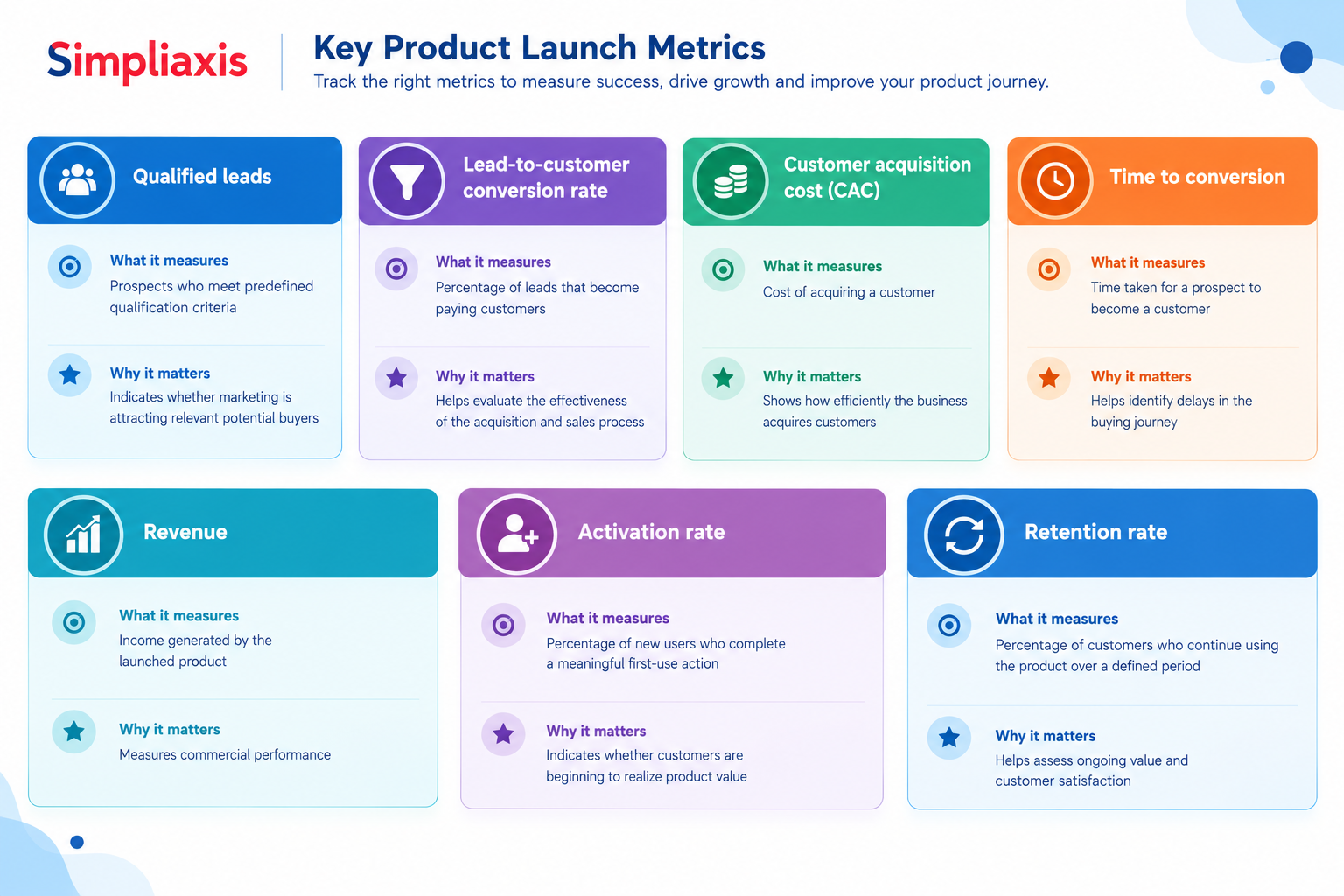
Launch Metrics
A go-to-market strategy needs measurable objectives to determine whether the launch is progressing as expected. These metrics should reflect the intended business outcome rather than focusing exclusively on visibility or activity. track them with the right mix of OKRs and KPIs
For example, a large number of website visits may indicate awareness, but it does not necessarily demonstrate that the product is attracting the right customers or generating sustainable revenue.

Image 2: Types of Product Launch Metrics
The specific metrics will vary by business model. and Amplitude's go-to-market strategy guide offers further background on measuring launch performance. A product-led SaaS business may prioritize activation, free-to-paid conversion, and retention, while an enterprise B2B company may emphasize qualified pipeline, win rate, deal size, and sales-cycle length.
Each metric should have a defined measurement period, target, data source, and accountable owner. Teams should also establish a baseline where possible, so they can compare launch performance against existing results or clearly stated assumptions.
A regular review of these metrics helps businesses identify weak points, adjust channel investment, refine messaging, and improve the overall go-to-market execution.
Types of GTM Motions
A go-to-market motion describes how a business attracts potential customers, helps them evaluate its offering, and converts them into paying customers. The right approach depends on the product's complexity, price, target audience, buying behavior, and the level of support customers need before making a purchase.
The three common approaches are product-led, sales-led, and marketing-led GTM motions. Businesses can also use partner-led distribution to reach customers through other organizations. These approaches are not mutually exclusive; many companies combine them as their products and customer segments grow.
Product-Led Growth
Product-led growth (PLG) is a go-to-market approach in which the product itself plays a central role in customer acquisition, conversion, and retention. Prospective customers can often experience the product through a free trial, freemium plan, or self-service onboarding process before speaking with a sales representative.
Instead of relying entirely on advertising or direct sales, businesses use the product experience to demonstrate value and encourage continued usage.
For example, a SaaS company offering a collaborative project management tool might allow users to create a free workspace, invite teammates, and manage a few projects at no cost. As teams need advanced reporting, additional integrations, or higher usage limits, they can upgrade to a paid plan.
Common characteristics of a product-led GTM strategy include:
- Self-service access: Customers can sign up and explore the product independently.
- Fast time to value: Onboarding helps users experience a meaningful benefit quickly.
- Usage-based conversion opportunities: Relevant prompts encourage users to upgrade when they reach a feature or usage limit.
- Product analytics: Teams monitor activation, feature adoption, engagement, and retention.
- Scalable acquisition: A successful product experience can attract and convert customers without requiring a sales interaction at every stage.
PLG is particularly suitable for products that are relatively easy to try, demonstrate value quickly, and support self-service onboarding. However, product-led growth does not eliminate the need for sales or marketing. Larger customers may still require demonstrations, security reviews, procurement support, or enterprise contracts.
Sales-Led GTM Strategy
A sales-led GTM strategy relies on sales professionals to guide potential customers through the buying process. It is common when products are expensive, technically complex, highly customized, or purchased by multiple stakeholders.
The process typically involves identifying target accounts, contacting decision-makers, qualifying opportunities, conducting product demonstrations, preparing proposals, negotiating contracts, and supporting implementation.
For example, a company selling enterprise resource planning software to large manufacturers may need to understand each customer's operational processes, integration requirements, compliance obligations, and budget. A sales representative can coordinate consultations and demonstrations to show how the product addresses these specific needs.
A sales-led approach commonly includes:
- Target account selection and prospect research.
- Outbound outreach and lead qualification.
- Consultative selling and product demonstrations.
- Customized proposals, pricing, and contract negotiations.
- Coordination between sales, technical teams, and customer success.
This approach is often appropriate for enterprise software, high-value B2B services, and products involving long buying cycles. Its effectiveness depends on the quality of sales opportunities, the team's expertise, and the ability to demonstrate a clear return on investment.
The main trade-off is that acquiring each customer can require substantial time and resources. Businesses should therefore evaluate deal size, sales-cycle length, win rate, and customer acquisition cost when deciding whether a sales-led model is sustainable.
Marketing-Led and Partner-Led GTM Strategies
Marketing-led and partner-led approaches provide additional ways to generate demand and reach customers. Although both can support other GTM motions, they rely on different mechanisms.
Marketing-led GTM
A marketing-led strategy uses campaigns, content, events, search visibility, social media, email, and other marketing activities to attract and educate potential customers. Marketing helps prospects understand the problem, compare solutions, and develop enough interest to take the next step.
For example, a company launching a business analytics platform might publish educational guides, run webinars, offer downloadable reports, and use targeted campaigns to generate qualified leads. The sales team can then engage prospects who demonstrate purchase intent.
This approach is useful when customers research solutions before contacting a vendor and when educational content can help explain the product's value.
Partner-led GTM
A partner-led strategy uses third-party organizations to introduce, distribute, sell, implement, or support a product. Partners may include resellers, distributors, consultants, technology providers, and industry specialists.
For example, a cybersecurity software company might work with managed service providers that already serve its intended business customers. These partners can recommend the software, assist with implementation, and provide ongoing support.
Partner-led strategies can help businesses access established customer relationships, enter new markets, and expand distribution. However, they require clear partner incentives, training, defined responsibilities, and processes for managing customer relationships.
The following table summarizes the four approaches.
| GTM motion | How Customers are Acquired | Best Suited for | Key Consideration |
| Product-led | Customers experience the product directly, often through free access or self-service onboarding | SaaS products with relatively low-friction adoption | Product usability, activation, and retention |
| Sales-led | Sales teams engage prospects and guide them through the buying process | Complex, high-value, or enterprise offerings | Sales-cycle length and acquisition cost |
| Marketing-led | Campaigns and educational content generate awareness, interest, and qualified leads | Products that benefit from research, education, and demand generation | Lead quality and conversion |
| Partner-led | Partners introduce, sell, distribute, or implement the offering | Products that benefit from third-party expertise or established market access | Partner enablement, incentives, and channel coordination |
Go to Market Strategy Framework: Step by Step
A go-to-market strategy framework turns business objectives into a structured process for researching the market, defining the product's value, preparing the launch, and measuring results. It helps teams coordinate decisions across product, marketing, sales, and customer success instead of treating the launch as a series of disconnected activities.
The following four-step GTM framework can be adapted to SaaS products, B2B offerings, startups, and established businesses entering new markets.
Step 1: Research the market
Identify target customers, validate demand, analyze competitors, and assess market opportunities.
Step 2: Develop messaging
Define positioning, the value proposition, pricing, and the messages that resonate with the target audience.
Step 3: Build the launch plan
Assign responsibilities, select channels, establish a timeline, and coordinate launch activities.
Step 4: Review post-launch performance
Track KPIs, gather customer feedback, identify gaps, and optimize the GTM approach.
Step 1: Conduct Market Research
Market research establishes whether there is a genuine opportunity for the product and identifies the customers most likely to benefit from it. Before investing heavily in a launch, businesses should understand customer problems, existing alternatives, buying behavior, and competitive conditions.
Start by answering these questions:
- Which customer segment experiences the problem the product solves?
- How do potential customers address this problem today?
- What are the limitations of existing solutions?
- How much are customers willing to pay for a better alternative?
- Who makes the purchasing decision, and what influences it?
- What barriers could prevent adoption?
Use customer interviews, surveys, competitor analysis,product discovery techniques
industry reports, existing customer data, and small-scale product tests to validate assumptions.
A quick competitor product teardown shows where rivals are weak and where your message can stand out. company size, industry requirements, purchasing authority, procurement processes, and implementation complexity. For startups, this stage is particularly important because limited budgets make it essential to prioritize the most promising customer segments.
The research should produce a clear ICP, a prioritized target market, a summary of customer pain points, and evidence supporting the product's market opportunity.
Step 2: Develop Your Messaging and Positioning
Once the target market is established, translate the research into messaging that explains the product's value. Prospective customers should be able to understand what the product does, whom it helps, which problem it solves, and why it is different from competing options.
A useful messaging framework includes:
- Target audience: Who is the product designed for?
- Customer problem: What challenge or unmet need does it address?
- Value proposition: What outcome can customers expect?
- Differentiation: Why should customers consider this product instead of alternatives?
- Proof points: What evidence supports the product's claims?
- Call to action: What should the customer do next?
For example, a workflow automation product might use the following positioning:
For growing businesses struggling with manual approval processes, our workflow automation platform helps teams reduce administrative work and improve process visibility through configurable workflows and centralized tracking.
This statement connects a specific audience and problem with the product's value and differentiating capabilities.
Messaging should remain consistent across the website, sales presentations, product pages, email campaigns, advertisements, and partner materials. However, the emphasis can vary by audience. Executives may care about cost savings and business outcomes, while end users may prioritize usability and reduced manual work.
Product teams can also use competitive analysis and customer feedback to refine positioning as market conditions change. For further reading, explore SVPG's overview of product strategy.
Step 3: Build the Launch Plan and Timeline
A go-to-market plan translates strategic decisions into specific activities, deadlines, and responsibilities. It ensures that the product, marketing, sales, and customer support teams are ready to deliver a consistent customer experience.
The plan should cover the following areas:
- Launch objectives: Define measurable goals for awareness, adoption, pipeline, revenue, or market penetration.
- Marketing activities: Schedule content, campaigns, email sequences, webinars, events, and public announcements.
- Sales readiness: Prepare sales collateral, demonstrations, pricing information, objection-handling guides, and training.
- Product readiness: Confirm that essential features, onboarding flows, documentation, and integrations are ready.
- Customer support: Prepare FAQs, help documentation, escalation procedures, and support capacity.
- Launch responsibilities: Assign an owner and deadline to every critical task.
- Budget and resources: Allocate spending, people, and tools according to the launch priorities.
Consider a SaaS company planning to launch a new analytics platform in eight weeks. Its team might spend the first two weeks validating messaging, the next two preparing the website and sales materials, the following two testing onboarding and campaigns, and the final two coordinating launch communications and readiness checks.
This is an illustrative timeline, not a fixed rule. Your GTM timeline should sit inside the wider product management workflow, from idea to release.Enterprise launches, regulated products, and complex integrations may require substantially more preparation.
Businesses can use project management tools, shared calendars, launch checklists, and AI-assisted research tools to coordinate execution. Simpliaxis also offers a guide to AI tools for product launch planning.
Step 4: Conduct a Post-Launch Review
A product launch should not be treated as the end of the GTM process. The post-launch review helps teams determine whether the strategy is working and where changes are needed.
Compare actual performance with the objectives defined before launch. Depending on the business model, review metrics such as:
- Website visits and qualified leads.
- Lead-to-customer conversion rates.
- Customer acquisition cost.
- Revenue and sales pipeline.
- Product activation and feature adoption.
- Customer retention and churn.
- Customer satisfaction and support requests.
Suppose a SaaS company attracts many free-trial users but converts very few into paying customers. The problem may not be a lack of awareness. It could indicate that users struggle with onboarding, fail to experience value quickly, or do not see enough differentiation in the paid plans.
The team should investigate the causes using product analytics, customer interviews, sales feedback, and support data before changing its strategy.
A practical post-launch review should document what worked, what underperformed, why the results differed from expectations, and which changes will be tested next. Assign owners and deadlines to improvement actions, then monitor the impact during the next review cycle.
This creates a continuous go-to-market process in which customer insights and performance data inform future campaigns, product improvements, pricing decisions, and market expansion.
Go to Market Strategy Template
A go-to-market strategy template helps teams turn their launch decisions into an actionable plan. Instead of keeping market research, messaging, pricing, sales activities, and launch tasks in separate documents, businesses can use a single template to coordinate responsibilities and track progress.
The following go-to-market plan template can be adapted to new product launches, SaaS businesses, B2B offerings, and startups. Customize the fields according to the product's complexity, target market, and launch objectives.
| GTM component | What to document | Example: Project management SaaS |
| Business objective | The primary outcome expected from the launch | Acquire 100 paying business customers in the first six months |
| Target market | The industry, geography, or customer segment being targeted | Small and mid-sized IT services companies |
| Ideal Customer Profile (ICP) | Customer characteristics, needs, budget, and buying behavior | Companies with 50–500 employees managing multiple client projects |
| Customer pain points | The problems the product addresses | Missed deadlines, fragmented communication, and limited project visibility |
| Value proposition | The main benefit offered to customers | Centralize project tracking and improve team coordination |
| Product positioning | How the offering differs from competing solutions | An easy-to-adopt project management platform for growing teams |
| Pricing strategy | Pricing model, packages, and payment structure | Free trial, professional subscription, and enterprise plan |
| GTM motion | The primary customer acquisition approach | Product-led onboarding supported by content marketing |
| Marketing channels | The channels used to attract prospects | SEO, webinars, email campaigns, and professional social media |
| Sales strategy | How qualified prospects become customers | Self-service conversion for smaller teams and sales consultations for larger accounts |
| Launch timeline | Milestones, deadlines, and launch phases | Eight-week preparation followed by launch and performance reviews |
| Team responsibilities | Owners for product, marketing, sales, and support activities | Product manager coordinates readiness; marketing owns campaigns; sales handles qualified opportunities |
| Budget and resources | Planned spending, staffing, and required tools | Campaign budget, content resources, product analytics, and sales enablement |
| Success metrics | The KPIs used to measure performance | Qualified leads, trial-to-paid conversion, CAC, revenue, and retention |
| Post-launch improvements | Feedback, performance gaps, and corrective actions | Improve onboarding if users abandon the trial before completing setup |
Go to Market Strategy Examples
A go-to-market strategy looks different for every business because products, customers, buying processes, and available resources vary. A SaaS company may rely on free trials and self-service onboarding, while an enterprise software provider may need a dedicated sales team and a lengthy procurement process. A startup, meanwhile, may prioritize a small customer segment to validate demand before investing in large-scale marketing.
The following go-to-market strategy examples illustrate how businesses can apply the framework to different scenarios. These are hypothetical examples designed to demonstrate practical decision-making, rather than claims about specific companies' actual launch results.
SaaS Go-to-Market Strategy Example
Consider a SaaS company developing a cloud-based project management platform for small and mid-sized businesses. The product helps teams manage tasks, track deadlines, collaborate with colleagues, and monitor project progress from a centralized workspace.
The company wants to attract customers without relying entirely on expensive, one-to-one sales interactions.
GTM objective: Acquire paying business customers and establish a repeatable customer acquisition process within the first six months.
| GTM element | Strategy |
| Target audience | Small and mid-sized businesses with distributed project teams |
| Customer problem | Fragmented communication, missed deadlines, and limited project visibility |
| Value proposition | Help teams coordinate projects and track progress through one centralized platform |
| Pricing model | Free trial, paid subscription tiers, and a customized enterprise option |
| GTM motion | Product-led growth supported by marketing |
| Acquisition channels | SEO, product tutorials, webinars, email marketing, and professional communities |
| Conversion strategy | Guide trial users through onboarding and encourage upgrades when they experience product value |
| Key metrics | Trial sign-ups, activation rate, trial-to-paid conversion, CAC, and customer retention |
How the strategy works
The company begins by researching how its target customers manage projects and identifying the limitations of their existing tools. It then develops messaging around ease of use, improved visibility, and reduced administrative effort.
To attract potential customers, the marketing team publishes educational articles targeting searches related to project tracking and team collaboration. Visitors can sign up for a free trial and explore the product without speaking to sales.
During onboarding, users receive prompts to create their first project, invite team members, and assign tasks. The company tracks these actions to identify where users encounter friction.
Marketing automation helps re-engage users who have signed up but have not completed setup. As teams grow or require additional features, they receive relevant information about paid plans. Larger accounts with more complex needs can be routed to the sales team.
The company reviews activation, conversion, and retention data to identify which acquisition channels and onboarding experiences generate the most valuable customers.
Key takeaway: A SaaS go-to-market strategy works best when the acquisition channel, pricing model, and product experience reinforce one another. A free trial alone is not enough; customers must understand the product's value and have a clear path to adoption.
B2B Enterprise Go to Market Strategy Example
Consider an enterprise software company launching a cybersecurity platform for large financial services organizations. The product offers threat monitoring, risk reporting, and integration with existing security systems.
Unlike a low-cost SaaS tool, this product requires technical evaluation, security reviews, stakeholder approval, and potentially lengthy contract negotiations. The company therefore adopts a sales-led B2B go-to-market strategy supported by targeted marketing and strategic partnerships.
GTM objective: Build a qualified enterprise sales pipeline and convert suitable target accounts into long-term customers.
| GTM element | Strategy |
| Target audience | Large banks, insurance companies, and financial services organizations |
| Decision-makers | Chief information security officers, IT directors, procurement teams, and risk leaders |
| Customer problem | Increasing security complexity, fragmented monitoring, and compliance requirements |
| Value proposition | Improve threat visibility and security oversight through integrated monitoring and reporting |
| Pricing model | Customized enterprise pricing based on requirements, scale, and service needs |
| GTM motion | Sales-led, supported by account-based marketing |
| Acquisition channels | Executive briefings, industry events, targeted outreach, partner referrals, and technical content |
| Conversion strategy | Discovery meetings, product demonstrations, technical assessments, and tailored proposals |
| Key metrics | Qualified pipeline, opportunity conversion, win rate, sales-cycle length, contract value, and retention |
How the strategy works
The company first identifies organizations that match its ideal customer profile and researches their security challenges, existing technology, and purchasing requirements. It prioritizes accounts where its capabilities address a clear business need.
The marketing team develops industry-specific content, technical resources, and executive briefings to establish credibility. Meanwhile, sales representatives engage relevant decision-makers and arrange discovery meetings to understand each organization's requirements.
Qualified prospects receive tailored demonstrations and technical assessments. The company works with security specialists to address integration concerns and with procurement teams to negotiate contracts.
After closing a deal, implementation and customer success teams help customers deploy the platform, train users, and evaluate whether it meets the agreed objectives.
Because enterprise deals can take considerable time to close, the company tracks pipeline progress and sales-cycle length alongside revenue. These measures help it distinguish between a lack of market interest and delays caused by technical evaluations or internal purchasing processes.
Key takeaway: A B2B go-to-market strategy must account for the entire buying committee, not just the end user. Technical credibility, stakeholder alignment, sales enablement, and post-sale implementation can be as important as marketing reach.
Go to Market Strategy for Startups
Consider an early-stage startup developing an AI-powered scheduling tool for independent consultants and small professional services firms. The founders have built a minimum viable product (MVP) and want to determine whether customers will pay for it before committing substantial resources to growth.
Rather than targeting every business that schedules meetings, the startup begins with a narrow customer segment and uses direct feedback to validate its assumptions.
GTM objective: Validate product-market fit signals, secure initial paying customers, and identify a repeatable acquisition channel.
| GTM element | Strategy |
| Target audience | Independent consultants and small consulting firms |
| Customer problem | Time lost coordinating meetings, rescheduling appointments, and managing client availability |
| Value proposition | Simplify scheduling and reduce administrative work for client-facing professionals |
| Pricing model | Low-cost introductory subscription with a free trial |
| GTM motion | Founder-led sales combined with product-led onboarding |
| Acquisition channels | Professional communities, targeted outreach, educational content, and referrals |
| Conversion strategy | Offer guided product trials, gather feedback, and convert users who experience measurable value |
| Key metrics | Active users, activation rate, paid conversions, CAC, customer feedback, and early retention |
How the strategy works
The founders begin by interviewing prospective customers to understand how they currently schedule meetings, which tools they use, and what frustrates them about existing solutions.
They invite a small group of potential customers to test the MVP. During this pilot, they observe onboarding behavior, collect feedback, and identify which features customers value most.
Instead of spending heavily on paid advertising, the startup initially focuses on founder-led outreach, relevant professional communities, and referrals. It tests different messages to discover which customer problems generate the strongest interest.
The founders then assess whether trial users become active customers, whether paying customers continue using the product, and whether acquisition costs appear sustainable. If one segment demonstrates stronger demand, the startup can focus its next iteration on that audience before expanding.
Key takeaway: A go-to-market strategy for startups should prioritize learning and validation before large-scale growth. A focused audience, short feedback loops, and disciplined spending help founders test assumptions without committing resources prematurely.
These examples show that there is no universal GTM model. The most suitable approach depends on how customers discover products, how they evaluate alternatives, what influences their buying decisions, and what it takes for them to realize value.
The Product Owner Role in Go to Market
A product owner can play an important role in a go-to-market strategy by ensuring that the product delivers customer value and that development priorities align with launch objectives. While product marketing may lead positioning and launch messaging, and sales may own customer acquisition, the product owner helps connect customer needs, product capabilities, and delivery priorities.
In Agile environments, this responsibility is particularly relevant because product development and market feedback often influence one another throughout the launch process.
Key Responsibilities of a Product Owner in GTM
1. Understand customer needs
The product owner works with stakeholders, customers, and the product team to understand customer problems, evaluate feedback, and prioritize the needs that the product should address. This helps ensure that launch messaging reflects genuine product value.
2. Prioritize the product backlog
A product owner prioritizes features, fixes, and improvements according to customer value, business objectives, dependencies, and available resources. This helps the team focus on the capabilities that matter most for launch readiness.
3. Align product capabilities with launch commitments
The product owner collaborates with product management, marketing, sales, and other stakeholders to confirm which features are ready, which benefits can be communicated accurately, and which capabilities may need further development.
4. Support launch readiness
Product owners may contribute to acceptance criteria, release planning, demonstrations, documentation, and feedback collection. They help ensure that the delivered functionality meets agreed requirements and supports the intended customer experience.
5. Incorporate market feedback
After launch, the product owner helps evaluate customer feedback, reported issues, and emerging requirements. These insights can inform backlog priorities and subsequent product improvements.
Common GTM Mistakes
Even a well-planned go-to-market strategy can underperform when businesses make assumptions about customers, misalign internal teams, or fail to measure results. Recognizing common mistakes early helps organizations reduce avoidable costs and improve launch execution.
1. Targeting Too Broad an Audience
Trying to reach everyone can dilute product messaging and waste acquisition resources. Without a clearly defined ideal customer profile, marketing teams may attract unqualified leads while sales teams struggle to convert them.
How to avoid it: Start with a clearly defined customer segment, validate its needs, and expand to additional segments when evidence supports doing so.
2. Failing to Differentiate the Product
A product may offer useful features but still struggle to gain traction if customers cannot understand why they should choose it over alternatives.
How to avoid it: Develop a specific value proposition grounded in customer needs, meaningful differentiators, and credible evidence. Test the messaging with prospective buyers before launch.
3. Choosing the Wrong GTM Motion
A self-service model may not work well for a complex enterprise product requiring technical consultations. Similarly, a high-touch sales process can make customer acquisition unnecessarily expensive for a simple, low-cost product.
How to avoid it: Match the GTM motion to product complexity, customer expectations, buying behavior, and expected revenue per customer.
4. Treating Marketing as the Entire GTM Strategy
Marketing campaigns can generate awareness and leads, but they cannot compensate for unclear pricing, an unprepared sales team, difficult onboarding, or poor customer support.
How to avoid it: Coordinate product, marketing, sales, finance, and customer success around shared launch goals, responsibilities, and timelines.
5. Setting Unrealistic Launch Targets
Aggressive revenue or customer acquisition targets without sufficient market evidence can lead to overspending and poor resource allocation.
How to avoid it: Base targets on available data, historical performance where applicable, conversion assumptions, budget, and delivery capacity. Clearly label estimates when reliable baseline data is unavailable.
6. Ignoring Pricing and Packaging
Pricing that does not reflect customer expectations or product value can discourage purchases, reduce margins, or attract customers who are unlikely to remain.
How to avoid it: Validate willingness to pay, test packaging where practical, and evaluate the relationship between pricing, acquisition costs, customer lifetime value, and retention.
7. Measuring Activity Instead of Outcomes
Impressions, clicks, and sign-ups can indicate engagement, but they do not automatically translate into revenue or long-term adoption.
How to avoid it: Track a balanced set of metrics covering acquisition, conversion, revenue, activation, and retention. Use these results to identify bottlenecks and guide improvements.
8. Failing to Review Performance After Launch
A launch is not a one-time event. Customer expectations, competitor offerings, and market conditions can change, making the original GTM assumptions less effective over time.
How to avoid it: Schedule regular performance reviews, gather customer feedback, and assign owners to corrective actions. Update the strategy when evidence indicates that the current approach is not working.
Avoiding these mistakes requires more than a detailed launch document. Businesses need clear accountability, realistic objectives, cross-functional coordination, and a willingness to adapt their go-to-market approach as new information becomes available.
Conclusion
A successful go-to-market strategy connects a product's value with the customers who need it. It helps businesses determine whom to target, how to differentiate their offering, which pricing and sales models to use, and how to coordinate launch activities across teams.
The right approach varies by business. SaaS companies may benefit from product-led growth, enterprise providers may need a consultative sales process, and startups may need to validate demand through focused experiments before scaling. In every case, market research, clear positioning, practical launch planning, and measurable performance goals provide a foundation for better decisions.
Businesses should also treat GTM planning as an ongoing process rather than a document created only before launch. Reviewing customer feedback, monitoring conversion and retention, and adapting the strategy helps teams improve execution as market conditions evolve.
Whether you are launching a new product, entering a different market, or refining an existing offering, a structured go-to-market strategy framework and reusable template can help align teams around a shared objective: delivering customer value while building sustainable business growth.








 Lowest-Price Challenge












 Personalized Path



.webp)


 USA
 Canada
 India
 UK
 Australia
 Singapore


