


 Call Us



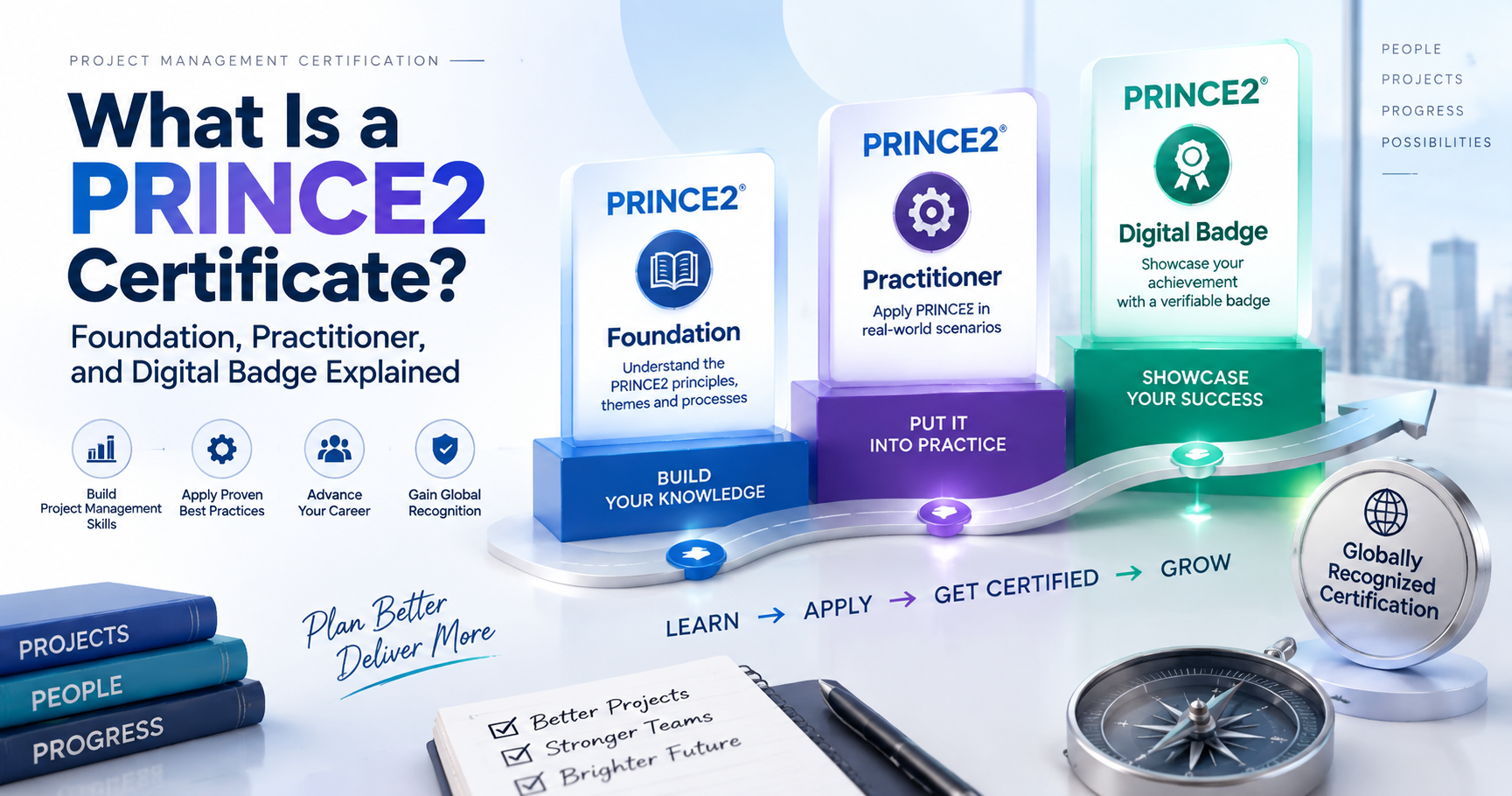
A PRINCE2 certificate is the official credential PeopleCert issues after you pass a PRINCE2 Foundation or Practitioner exam. It arrives as a PDF e-certificate plus a shareable digital badge in your PeopleCert account, usually within two business days of your result. Foundation certificates are widely treated as not expiring, while Practitioner certificates need renewal roughly every three years through CPD or a re-sit. Anyone can verify a certificate through PeopleCert's Certificate Verification Service.
Key Highlights of PRINCE2 Certificate
- A PRINCE2 certificate is issued by PeopleCert, the examination institute that owns and administers the PRINCE2 certification scheme, not by the training provider you study with.
- You get two components after passing: an eCertificate (PDF) uploaded to your PeopleCert account, and a digital badge hosted on Credly that you can share on LinkedIn.
- PRINCE2 Foundation and PRINCE2 Practitioner are separate certificates with separate exams, separate certificate numbers, and different renewal rules.
- Foundation-level status is generally treated as permanent, while Practitioner status runs on a roughly three-year cycle tied to CPD points or exam re-sits. [VERIFY: PeopleCert's current published renewal policy directly with your PeopleCert account, since some official PRINCE2 sources describe both levels as time-limited]
- Employers and recruiters can confirm a certificate is genuine using PeopleCert's Certificate Verification Service, which checks a certificate number against PeopleCert's records.
- A hard copy certificate is a separate, optional purchase with its own delivery timeline; the default credential is digital.
If you have just passed your PRINCE2 exam, or you are trying to figure out what happens after you do, the word "certificate" can mean a few different things. Is it a PDF? A physical document? A badge on LinkedIn? All three, depending on what you ask for.
This article walks through exactly what a PRINCE2 certificate is, what it looks like, how PeopleCert delivers it, and how the Foundation and Practitioner certificates differ from each other. It also covers how long each certificate stays valid, how to verify a certificate that someone has listed on their CV or LinkedIn profile, and how to add your own certificate to your professional profiles the right way.
The short version: PRINCE2 (Projects IN Controlled Environments) is a project management method, and the certificate is the formal proof that you sat and passed an accredited PRINCE2 exam. PeopleCert, the company that now owns and administers PRINCE2 certification on behalf of the PeopleCert Group (which acquired the AXELOS portfolio), issues that proof. Everything else in this guide builds from that starting point.
If you are still getting oriented to the method itself rather than the certificate, this beginner's guide to PRINCE2 is a useful companion read before you go further here.
What Does a PRINCE2 Certificate Actually Look Like?
A PRINCE2 certificate today is primarily a digital document, not a framed piece of paper. When you pass your exam, PeopleCert uploads your official result and your eCertificate to your PeopleCert account, typically within two business days of the exam date. You log into your account, go to the Certificates section, and download the PDF.
The PDF certificate includes your full name, the certification title (for example, "PRINCE2 Foundation Certificate in Project Management" or "PRINCE2 Practitioner Certificate in Project Management"), a unique certificate number, the date of award, and the PeopleCert branding and signatory details. That certificate number is what an employer or verification service checks against PeopleCert's records, so it is worth keeping a copy of the number even after you have shared the certificate elsewhere.
Alongside the PDF, you also receive a digital badge. This is a separate credential object, hosted through Credly (PeopleCert's badge partner), that displays your certification name, issue date, and a short description of what the certification means. Anyone you send the badge link to can click through and see the verified issuer information, which makes it more tamper-resistant than a PDF you could theoretically edit.
If you want a physical, printed copy of your certificate, most PeopleCert-administered certifications allow you to order one separately, either through your PeopleCert account or through your training provider. Hard copies are not sent automatically. Expect a separate order step and a delivery window measured in weeks rather than days, since it depends on your location and shipping method.
PRINCE2 Foundation Certificate vs PRINCE2 Practitioner Certificate
PRINCE2 has two core certification levels, and each one produces its own, separate certificate. They are not two halves of one document. If you hold both, you will have two certificate numbers, two PDFs, and two digital badges in your PeopleCert account.
PRINCE2 Foundation certificate. This confirms you understand the PRINCE2 method: its principles, themes, processes, and terminology. It is the entry point into PRINCE2 and is also the prerequisite most training providers expect before you sit Practitioner. The Foundation exam is closed book, multiple choice, and tests recall and understanding rather than applied judgment.
PRINCE2 Practitioner certificate. This confirms you can apply PRINCE2 to a real project scenario, not just recite the method. The Practitioner exam is open book (you can bring your official PRINCE2 manual), scenario-based, and tests whether you can tailor the method to a given project context. You need to hold a valid Foundation certificate (or an accepted equivalent, such as PMP or a recognized prior qualification) before you can sit Practitioner. If you are unsure which route applies to your background, this breakdown of PRINCE2 certification eligibility requirementswalks through the prerequisites for each level.
Here is a side-by-side view of how the two certificates compare:
Aspect | PRINCE2 Foundation Certificate | PRINCE2 Practitioner Certificate |
| What it proves | Knowledge and understanding of PRINCE2 terminology, principles, and structure | Ability to apply and tailor PRINCE2 to a live project scenario |
| Exam format | Closed book, objective/multiple choice | Open book, objective, scenario-based questions |
| Prerequisite | None | Valid PRINCE2 Foundation certificate or accepted equivalent |
| Typical audience | Team members, coordinators, anyone who needs a shared project vocabulary | Project managers, team managers, project support staff who run or contribute directly to projects |
| Validity | Widely treated as not expiring | Approximately 3 years from the award date, then renewal is required |
| How to keep it current | No standard renewal action required | CPD points via PeopleCert Plus, a re-sit of the exam, or passing another certification in the same product suite |
If your organization is deciding which level to target first, the practical rule of thumb most training providers use is: Foundation for anyone who needs to understand or support PRINCE2 projects, Practitioner for anyone who will actually run one. Many candidates study for both back-to-back, which is why combined Foundation and Practitioner training paths, such as thePRINCE2 Foundation & Practitioner Certification Training, exist.
How PeopleCert Issues Your PRINCE2 Certificate: The Digital Badge and Credential System?
PeopleCert runs the entire PRINCE2 certification lifecycle through a candidate account system, and it is worth understanding the mechanics because they affect how fast you get your certificate and how you prove it later.
Step 1: You sit the exam through a PeopleCert-accredited channel
Whether you take the exam online with a proctor or at a physical test center, the exam is administered under PeopleCert's rules. Your training provider (for example, an accredited organization like Simpliaxis) arranges your exam voucher and booking, but the exam itself, the marking, and the certificate issuance are all controlled by PeopleCert directly.
Step 2: PeopleCert releases your result and eCertificate
Official results, along with the eCertificate, are uploaded to your PeopleCert account, generally within two business days of your exam. You do not need to request this. If you passed, the certificate simply appears.
Step 3: Your digital badge is generated automatically
At the same time your result is confirmed, PeopleCert issues a matching digital badge through Credly, the badge platform PeopleCert uses across its certification portfolio. You access it from your PeopleCert account by selecting your profile icon and choosing "Digital Badges." From there, you can share it directly to LinkedIn or Facebook, download the badge image, or copy a verification link.
Step 4: You decide what to do with each format
Most candidates keep the PDF for records and HR requirements, and push the digital badge out to LinkedIn since it is designed for that. A shared digital badge is arguably a stronger public proof point than a static PDF screenshot, because a viewer can click through to confirm the credential is real rather than trusting a picture.
Optional: ordering a hard copy
If your employer specifically wants a printed certificate for a file or a wall, you can order one, but treat this as an add-on step rather than something that happens by default.
How Long Is a PRINCE2 Certificate Valid?
This is the question that generates the most confusion, partly because guidance has shifted over time as PeopleCert has rolled out its CPD (Continuing Professional Development) scheme across its certification portfolio.
The consistent, widely repeated position across current PRINCE2 training resources is this: PRINCE2 Foundation certificates do not expire. Once you pass Foundation, that qualification stands permanently on your record and does not need active renewal.
PRINCE2 Practitioner certificates are valid for approximately three years from the award date. To keep Practitioner status active past that point, you generally have three options:
- Retake the Practitioner exam before your renewal date.
- Pass another certification within the same PeopleCert product suite (for example, an additional project or programme management certification) before your Practitioner certificate lapses.
- Maintain an active PeopleCert Plus (formerly MyAxelos) subscription and log the required CPD points annually, without sitting another exam.
One useful detail: if you renew your Practitioner certification through any of these routes, your Foundation status is typically refreshed automatically at the same time, so you are not managing two separate renewal clocks.
VERIFY: There is a conflict in publicly available sources on this point. Most third-party training providers and current guides describe Foundation as non-expiring and Practitioner as a strict three-year cycle. At least one PRINCE2-affiliated source states that both Foundation and Practitioner certificates expire after three years. Because PeopleCert's CPD policy has changed more than once in recent years, confirm your own certificate's exact expiry status by logging into your PeopleCert account rather than relying on a blog post, including this one. One official source describing the renewal cycle in detail is the PRINCE2 practitioner status renewal guidance.
Given that uncertainty, the safest habit is a calendar reminder set for roughly two and a half years after you pass Practitioner, so you have time to plan a renewal route before anything lapses.
How to Verify a PRINCE2 Certificate?
If you are hiring, subcontracting, or simply want to confirm a certificate someone lists on their CV is genuine, PeopleCert provides a Certificate Verification Service specifically for this. It is a public tool built so employers do not have to take a certificate holder's word for it. If you are more used to verifying project management credentials through PMI, the process is conceptually similar to using the PMI registry to verify a PMP certification, just run through PeopleCert's own system instead.
To verify a certificate, you generally need:
- The certificate number exactly as it appears on the eCertificate (PeopleCert certificate numbers follow a structured format, for example, a two-letter country code followed by a numeric string and a suffix).
- Completion of an image or CAPTCHA-style verification step, which exists to stop the service from being scraped in bulk.
Submitting these returns a confirmation of whether that certificate number is genuine and matches an issued PRINCE2 credential. This is the same mechanism corporations use when they want to audit the certifications their staff claim to hold, which is particularly relevant if your organization bids for contracts that require a minimum number of certified PRINCE2 practitioners on a project team.
A digital badge shared via Credly gives you a faster, informal version of the same check: clicking through a shared badge link shows you the issuer (PeopleCert), the certification name, and the issue date without needing a separate lookup step.
What a PRINCE2 Certificate Is Used For?
A PRINCE2 certificate is not just a line item on a CV. In practice, it does three jobs.
It signals a shared vocabulary to employers and clients. Recruiters and hiring managers scanning project management roles look for PRINCE2 Foundation or Practitioner specifically because it tells them you can walk into a PRINCE2-run environment and understand the terminology (Project Board, Stage Boundary, Highlight Report, and so on) without a ramp-up period. This guide on the importance of PRINCE2 Foundation certification goes deeper into why employers weight it the way they do.
It supports procurement and contract requirements. Government and large enterprise project tenders in the UK and Commonwealth markets in particular often specify PRINCE2 certification as a named requirement for project managers bidding on or delivering the work. A verifiable certificate is what satisfies that requirement, not a claim on a resume.
It is a stepping stone to further certifications. Many professionals use PRINCE2 Practitioner as the foundation for moving into PRINCE2 Agile, which layers agile ways of working (Scrum, Kanban, iterative delivery) onto the PRINCE2 governance structure. If your projects mix traditional stage-gated delivery with agile execution, PRINCE2 Agile Foundation Certification Training and PRINCE2 Agile Practitioner Certification Training extend your existing PRINCE2 certificate rather than replacing it.
Practical Guidance
How to Add Your PRINCE2 Certificate to LinkedIn?
Step | What to do |
1 | Log in to your PeopleCert account and open the Digital Badges section |
2 | Select your PRINCE2 Foundation or Practitioner badge and choose "Share to LinkedIn" |
3 | LinkedIn will prompt you to add it under the Licenses & Certifications section of your profile |
4 | Fill in the issuing organization as PeopleCert, the issue date from your certificate, and the credential ID (your certificate number) |
5 | Paste the badge verification URL into the credential URL field so viewers can confirm it independently |
If you would rather add the PDF-based certificate manually, you can still create a Licenses & Certifications entry by hand using the same details from your certificate: exact certification name, PeopleCert as the issuing organization, issue date, and certificate number. The badge route is faster and gives viewers a clickable proof, which is why most candidates prefer it.
How to Verify Someone Else's PRINCE2 Certificate?
Step | What to do |
1 | Ask the candidate or contractor for their exact certificate number, not just a screenshot |
2 | Go to PeopleCert's Certificate Verification Service |
3 | Enter the certificate number and complete the image verification step |
4 | Submit and review the confirmation returned by PeopleCert |
5 | If a digital badge link was shared instead, click through it directly, since Credly badges display verified issuer data without a separate lookup |
Common Mistakes to Avoid
- Assuming a screenshot of a certificate is proof. Screenshots can be edited; a certificate number checked against PeopleCert's service or a live badge link cannot be faked the same way.
- Losing track of the Practitioner renewal date. Because Practitioner runs on a multi-year cycle rather than a fixed expiry everyone remembers, it is easy to let it lapse without noticing.
- Confusing the training provider's completion certificate with the PeopleCert certificate. Some training organizations issue their own "certificate of completion" for attending a course. That is not the same as the PeopleCert exam certificate, and it does not carry the same verification or recognition.
Simpliaxis Training Relevance
If you are working toward your first PRINCE2 certificate, Simpliaxis runs accreditedPRINCE2 Foundation Certification Training that prepares you for the Foundation exam, including the exam voucher and official materials as part of the course. If you already hold Foundation and are ready to build applied, scenario-based skills, thePRINCE2 Practitioner Certification Training is the direct next step, and it maps closely to the open-book, scenario-driven exam format described earlier in this article. For a closer look at how the syllabus is structured across both levels, the PRINCE2 Foundation & Practitioner course curriculum overview breaks down what each module covers.
For candidates who would rather study both levels together instead of returning for a second course later, Simpliaxis also offers the PRINCE2 Foundation & Practitioner Certification Training, which is structured as a single combined learning path.
Once you hold your core PRINCE2 certificate, extending it into agile delivery is a natural next move for teams that blend PRINCE2 governance with iterative execution. Simpliaxis' PRINCE2 Agile Foundation Certification Training and PRINCE2 Agile Practitioner Certification Training cover that extension separately, or you can take them together through the PRINCE2 Agile Foundation & Practitioner Certification Training path.
If you are certifying a project management team rather than a single individual, Simpliaxis also runs Corporate / Team Training, which lets an organization schedule PRINCE2 training (Foundation, Practitioner, or PRINCE2 Agile) for a group, with the same PeopleCert-accredited exam path and certificate outcome described throughout this article.
Conclusion
A PRINCE2 certificate is straightforward once you separate the parts: it is a credential issued by PeopleCert, delivered as a PDF and a shareable digital badge, split into two distinct levels (Foundation and Practitioner) with different exams and different renewal expectations. Foundation is generally a one-time achievement; Practitioner needs active maintenance roughly every three years. Anyone can confirm a certificate is genuine through PeopleCert's verification service or a shared Credly badge link, which is exactly what makes the credential useful to employers and procurement teams, not just to the person who earned it.
If any part of your own certificate's status or renewal timeline is unclear, your PeopleCert account is the definitive source, ahead of any third-party guide, including this one.
Ready to Earn Your PRINCE2 Certificate?
If you are starting from scratch, PRINCE2 Foundation Certification Training is the standard entry point and builds directly toward the certificate described in this guide. If you already understand the fundamentals and want to compare how Foundation and Practitioner training actually differ in depth and exam format, the PRINCE2 Practitioner Certification Training and the combined PRINCE2 Foundation & Practitioner Certification Training are both worth reviewing before you commit to one. For teams certifying together, Simpliaxis' corporate and group trainingoption can schedule the same accredited path for your whole group.








 Lowest-Price Challenge











 Personalized Path


.webp)


 USA
USA  Canada
 India
India UK
UK Australia
 Singapore


