


 Call Us



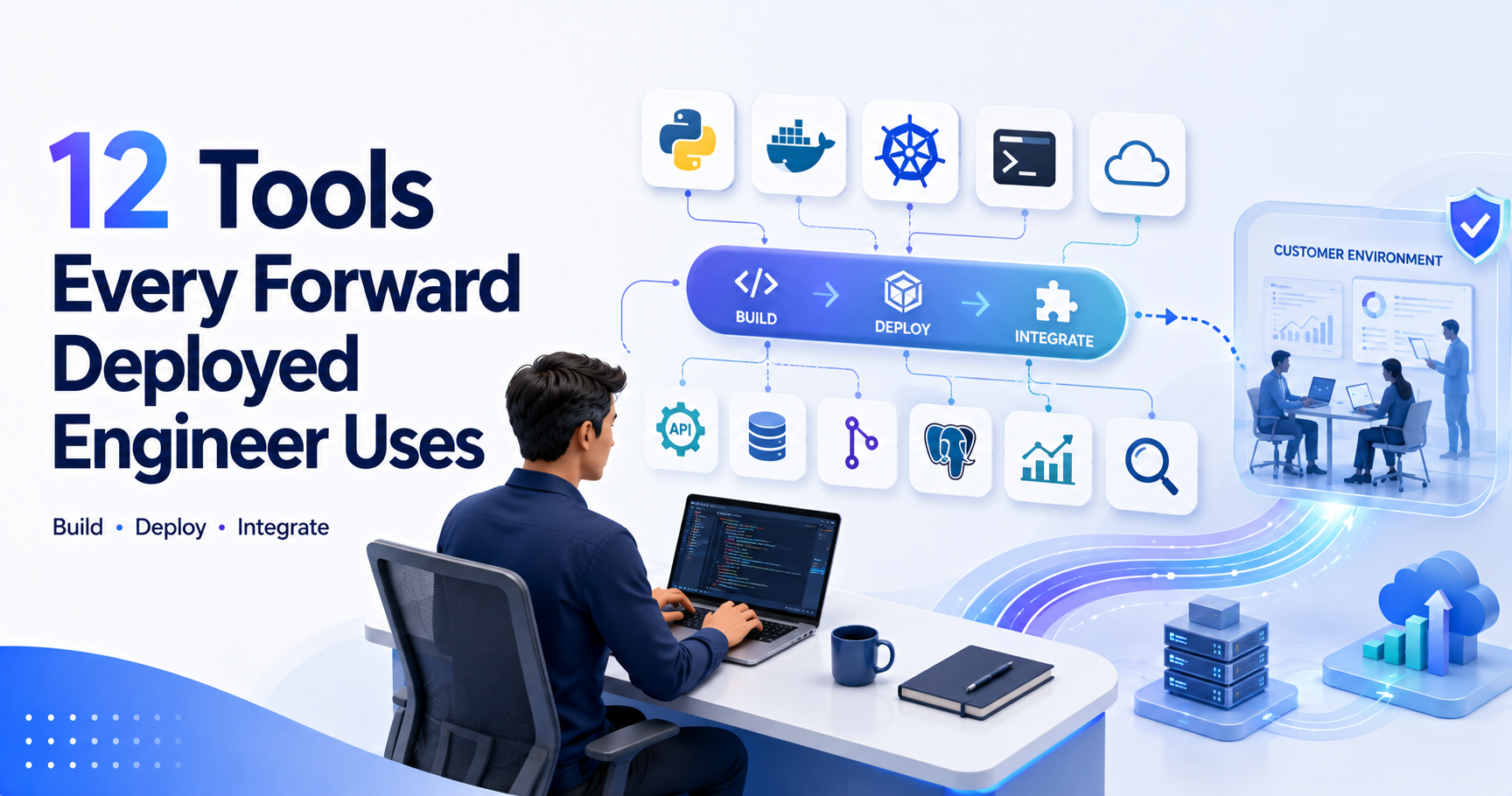
If you want to know what a forward deployed engineer actually does all day, look at their toolkit, because the tools reveal the work. The role is not about one exotic technology but about a practical stack for building, integrating, and deploying real software inside a customer's environment. This piece walks through twelve tools that show up again and again in forward deployed work, explains what each is for, and gives you a concrete picture of the technical foundation the role rests on. It is not an exhaustive list, and no engineer uses all twelve every day, but together they map the terrain you should be comfortable in.
Knowing the toolkit is useful whether you are preparing for the role, an interview, or your first engagement, because fluency with these tools is assumed rather than taught on the job. Building genuine command of this stack, through the Forward Deployed Engineering Program, is what lets you spend your energy on the customer's problem rather than on catching up with the basics in front of them.
Key Highlights
- The forward deployed toolkit centres on building, integrating, and deploying real software, not on any single exotic technology.
- Python is the backbone, because so much AI and integration work runs through it, and fluency in it is effectively assumed.
- Containerisation and deployment tools like Docker and Kubernetes matter because the engineer has to ship software into environments they do not control.
- Data tools like Postgres, Redis, Snowflake, and dbt appear constantly, because enterprise AI work is fundamentally data work.
- Fluency with the toolkit lets you focus on the customer's problem rather than fighting the basics, which is why command of it is assumed.
Python: the backbone of the work
Python is the single most important tool in the forward deployed toolkit, because it is the language most of the modern AI and integration work runs through. The AI libraries, the model SDKs, the data-processing tools, and the frameworks for building agents and retrieval systems are overwhelmingly Python-first, which makes fluency in Python effectively a prerequisite rather than a nice-to-have. A forward deployed engineer writes Python constantly, to build solutions, wire up integrations, process data, and glue systems together.
What matters is not just knowing Python syntax but being genuinely fluent, able to write clean, effective Python quickly, work with its ecosystem, and use it to solve real problems under time pressure in a customer's environment. Because so much of the AI stack assumes Python, weakness here slows everything else down, while fluency lets the engineer move fast on the actual problem. This is why building real Python capability, and the applied AI skills that sit on top of it, is foundational to the role. Python is the language the rest of the toolkit speaks.
Docker: shipping into environments you do not control
Docker and containerisation are essential to forward deployed work because the engineer has to ship software into environments they do not control, and containers are how you make software run reliably somewhere other than where you built it. A container packages an application with everything it needs to run, so it behaves the same in the customer's environment as it did on your machine, which solves one of the classic problems of deploying into unfamiliar infrastructure.
For a forward deployed engineer, this matters enormously, because a huge amount of the pain in deploying into a customer's environment comes from differences between environments, the it-works-on-my-machine problem multiplied by the messiness of enterprise infrastructure. Docker tames that, providing a consistent unit of deployment that reduces the friction of getting software running in the customer's world. Fluency with containerisation, building images, managing containers, understanding how they run, is a core skill because deployment is a core part of the job. The engineer who is comfortable with Docker can get their work running in a customer environment far more smoothly than one who is not, which is why it appears in nearly every forward deployed toolkit.
Kubernetes and Terraform: orchestration and infrastructure
For larger deployments, Kubernetes and Terraform extend the deployment toolkit from single containers to whole systems and infrastructure. Kubernetes orchestrates containers at scale, managing how they run, scale, and recover across a cluster, which matters when a forward deployed solution is more than a single service and has to run reliably in a real production environment. Understanding Kubernetes lets the engineer deploy and operate more sophisticated systems inside the customer's infrastructure.
Terraform handles infrastructure as code, letting the engineer define and provision the infrastructure a solution needs in a repeatable, version-controlled way. This matters because forward deployed work often involves setting up infrastructure in the customer's cloud environment, and doing it as code rather than by hand makes it reliable, repeatable, and maintainable, which supports the eventual handoff to the customer's team. Neither tool is needed for every engagement, and simpler deployments do not require them, but for the larger, production-grade deployments that forward deployed engineers frequently do, comfort with orchestration and infrastructure as code is a valuable part of the toolkit that separates engineers who can deploy real systems from those who can only build them.
FastAPI and Postman: building and testing interfaces
Much forward deployed work involves building services that expose functionality through APIs, and FastAPI and Postman are common tools for building and testing them. FastAPI is a popular Python framework for building APIs quickly and cleanly, which fits the forward deployed need to stand up services efficiently inside a customer engagement. Because so much of integrating AI into a customer's systems involves exposing capabilities through well-designed interfaces, a fast, clean way to build APIs is a recurring need, and FastAPI meets it.
Postman, on the other hand, is a tool for testing and exploring APIs, both the ones the engineer builds and the ones they have to integrate with in the customer's environment. A large part of forward deployed work is connecting to the customer's existing systems, which usually means working with their APIs, and Postman makes it far easier to explore, test, and debug those interactions. Together, these tools support the interface-building and integration work that runs through so much of the role, letting the engineer both create clean services and connect reliably to the tangle of systems already present in the customer's environment.
Postgres and Redis: the data layer
Almost all forward deployed work touches data, and Postgres and Redis are two of the most common tools in the data layer. Postgres is a powerful, widely used relational database, and it appears constantly because so many solutions need to store and query structured data reliably. For AI work specifically, Postgres has become even more relevant through its vector capabilities, which let it store the embeddings that power retrieval systems, so it often serves double duty as both the application database and the vector store. Comfort with Postgres is a near-universal need in the role.
Redis, an in-memory data store, shows up wherever speed matters, serving as a cache, a fast key-value store, or a component in real-time systems. In forward deployed work, Redis often supports the performance and responsiveness of a solution, caching results, managing state, or speeding up access to frequently needed data. Together, Postgres and Redis cover a large part of the data needs of a typical forward deployed solution, the durable structured store and the fast in-memory layer, which is why both appear so frequently. Because enterprise AI work is fundamentally data work, fluency with these data tools is as important as fluency with the AI tools themselves.
Snowflake and dbt: enterprise data at scale
When forward deployed work involves large-scale enterprise data, Snowflake and dbt frequently enter the picture, because that is the stack a great deal of enterprise data lives in and is transformed through. Snowflake is a dominant cloud data platform, and many enterprises store and process their data there, which means a forward deployed engineer building AI on top of that data has to be able to work with it. Understanding how to query, access, and work with data in Snowflake is often necessary simply because that is where the customer's data is.
dbt, a tool for transforming data within these warehouses, is how a lot of enterprise data gets shaped into usable form, and forward deployed engineers building on enterprise data often encounter it. Because AI systems are only as good as the data feeding them, and enterprise data usually needs transformation before it is usable, familiarity with the tools that do that transformation is valuable. Snowflake and dbt are not needed on every engagement, but for the many that involve serious enterprise data, comfort with the modern data stack is an important part of the toolkit, and it connects directly to the reason enterprise RAG is so hard: the data work underneath it is substantial.
Git and Datadog: version control and observability
Two tools round out the toolkit by supporting how the engineer works and how they see their systems. Git, the standard for version control, is assumed knowledge, but it takes on extra importance in forward deployed work because of the collaborative, hand-off nature of the role. Using version control well, with clear history and good practices, is part of building software the customer's team can eventually own, so Git fluency supports the maintainability and handoff that define successful engagements rather than being mere hygiene.
Datadog, and observability tools like it, matter because forward deployed engineers deploy systems into environments where they cannot always watch what is happening directly, so they need their systems to report on their own behaviour. Observability, monitoring, logging, and tracing, lets the engineer see how a deployed system is performing and diagnose problems, which is essential when debugging inside a customer environment you do not fully control. Building observability in from the start, using tools like Datadog, is what lets an engineer maintain and troubleshoot systems running in the customer's world, which is why it belongs in the toolkit.
The AI-specific layer that sits on top
The twelve tools so far are the general engineering foundation, but modern forward deployed work sits on top of an AI-specific layer that deserves its own mention, because it is what turns a general engineer into one who can build the AI systems the role now centres on. This layer includes the model SDKs for working with the major AI providers, the orchestration frameworks that coordinate models into agents and pipelines, the vector stores that power retrieval, and the evaluation and observability tools that tell you whether an AI system works. These are not on the core list because they are a category of their own, but they are as essential to the modern role as the general tools.
What matters is that a forward deployed engineer needs both layers, the general engineering foundation of Python, containers, data, and deployment, and the AI-specific layer of models, orchestration, retrieval, and evaluation. The general layer lets you build and ship real software, and the AI layer lets you build the specific AI systems customers now want. Weakness in either limits you: an engineer strong in general engineering but weak in the AI layer cannot build modern AI solutions, while one strong in AI tools but weak in the fundamentals cannot ship them reliably into production. This is why building command of the whole stack, both layers together, through the Forward Deployed Engineering Program, is what actually prepares you for the role, rather than mastering one layer and hoping the other sorts itself out. The AI layer is covered in depth in dedicated guides on orchestration frameworks and the tools that surround them.
Why fluency, not familiarity, is the bar
A point worth stressing about the toolkit is that the bar is genuine fluency rather than passing familiarity, and the difference matters enormously in the pressured reality of forward deployed work. Familiarity means you have used a tool and can muddle through with documentation open. Fluency means you can reach for it instinctively and use it effectively under time pressure without breaking your focus on the actual problem. In a customer environment, where you are often building against a deadline and sometimes in front of the customer, the difference between familiarity and fluency is the difference between spending your attention on the tool and spending it on the customer's problem.
This is why the toolkit is worth genuinely mastering rather than merely sampling. An engineer fluent across the stack moves fast and keeps their scarce attention on what matters, while one who is merely familiar burns time and focus fighting the tools. Fluency also builds credibility with the customer, who can see whether you are working confidently or struggling, and confidence in the basics frees you to handle the genuinely hard, novel parts of a problem that no amount of tool knowledge prepares you for. Developing real fluency takes deliberate practice rather than passive exposure, which is why structured, hands-on building through something like the agentic AI engineering practice matters more than reading about the tools. The goal is to make the toolkit second nature, so your mind is free for the customer's actual problem.
The toolkit at a glance
To fix the picture, here is what each tool is for and why it appears in forward deployed work.
| Tool | Category | Why it matters in the role |
| Python | Language | The backbone of AI and integration work |
| Docker | Deployment | Reliable shipping into environments you do not control |
| Kubernetes | Orchestration | Running larger systems reliably at scale |
| Terraform | Infrastructure | Repeatable infrastructure as code for handoff |
| FastAPI | Building | Standing up clean services quickly |
| Postman | Testing | Exploring and integrating with the customer's APIs |
| Postgres | Data | Structured storage, and vectors for retrieval |
| Redis | Data | Fast caching and state for responsiveness |
| Snowflake | Data platform | Where enterprise data often lives |
| dbt | Data | Transforming enterprise data into usable form |
| Git | Version control | Collaborative, hand-off-friendly development |
| Datadog | Observability | Seeing and diagnosing systems you cannot watch directly |
Read the table as a map of the work rather than a checklist to memorise. The categories, language, deployment, building, data, and observability, are the recurring shapes of forward deployed engineering, and the tools are the common instruments in each. An engineer comfortable across these categories is equipped for most of what the role throws at them.
A final point worth making is that the toolkit evolves, and the specific tools matter less than the underlying capabilities they represent. Languages, frameworks, and platforms change, but the categories endure: you will always need to build, deploy, integrate, manage data, and observe. An engineer who understands the categories deeply can pick up whatever specific tool a customer uses, while one who only knows a fixed list is stranded when the list changes. Investing in the durable capabilities beneath the tools is what keeps you effective as the specific tools come and go.
The bottom line
The forward deployed toolkit reveals the work: Python as the backbone, Docker and Kubernetes and Terraform for shipping into environments you do not control, FastAPI and Postman for building and integrating interfaces, Postgres and Redis and Snowflake and dbt for the data layer that underlies everything, and Git and Datadog for version control and observability. No engineer uses all twelve every day, but together they map the terrain, building, deploying, integrating, and operating real software inside a customer's messy environment.
Fluency with this stack matters because it is assumed rather than taught on the job, and weakness in the basics slows everything else down in front of the customer. Command of the toolkit lets the engineer spend their energy on the customer's actual problem, which is where the value is. Building that command across the full stack, through the Forward Deployed Engineering Program, grounded in agentic AI foundations, is what lets you walk into an engagement equipped rather than catching up.





 Lowest-Price Challenge











 Personalized Path


.webp)


 USA
USA  Canada
 India
India UK
UK Australia
 Singapore


