


 Call Us



Job opportunities with AI in 2026 fall into three broad groups: heavily technical roles like AI Engineer and Machine Learning Engineer, semi-technical roles like AI Governance Specialist and Prompt Engineer, and business-facing roles like AI Product Manager and AI-for-CXO advisory positions. LinkedIn ranked AI Engineer as the fastest-growing job title in the US for the second year running, with postings up 143 percent year over year, but the fastest-growing category overall is broader than engineering alone: governance, data annotation, AI-augmented marketing, and healthcare AI roles are all expanding fast, and many entry points do not require a computer science degree.
Key Highlights of Job Opportunities with AI
- AI and machine learning hiring grew 88 percent year over year in 2026, even as broader tech hiring stayed flatter, according to LinkedIn-sourced industry analysis.
- Professionals with AI expertise earn roughly 56 percent more on average than peers without it, and skills in AI-exposed roles are evolving 66 percent faster than in less-exposed jobs, per PwC's Global AI Jobs Barometer.
- Not every AI job needs coding. Roles in AI training, evaluation, governance, and prompt design increasingly hire people without a traditional engineering background.
- Entry-level AI-adjacent roles are shifting: routine junior positions are shrinking, but demanding entry points requiring judgment and leadership are growing roughly 35 percent since 2019.
- Around 60 percent of AI positions in 2026 offer remote or hybrid arrangements, opening opportunities beyond major tech hubs.
Why AI Hiring Looks Different in 2026 Than It Did in 2023
Three years ago, most AI hiring concentrated in a narrow band of machine learning research positions at a handful of large tech companies. That has fractured into dozens of distinct specializations, each with its own demand curve and skill requirements, and the concentration of roles has shifted too.
Big tech still employs the largest number of AI builders, but the fastest growth now sits in specialized industries where AI needs to meet regulation or perform inside a specific domain, banking compliance, healthcare diagnostics, industrial safety. That shift matters for anyone planning a career move: the safest long-term bet is often not chasing the flashiest title, but pairing AI literacy with genuine depth in an industry that is regulated or operationally complex enough to need careful, well-governed AI deployment.
How to Think About Job Opportunities with AI: Three Broad Categories
Most career advice lumps every AI job into one undifferentiated list. In practice, the roles split cleanly into three groups, and knowing which one fits your background changes everything about how you should prepare.
- Technical building roles: people who design, train, deploy, and maintain AI systems. Requires programming and, usually, a foundation in math or data.
- Semi-technical and governance roles: people who evaluate, audit, secure, and guide how AI systems behave, without necessarily writing production code themselves.
- Business and leadership roles: people who decide what AI products to build, manage AI-driven teams, or advise executives on AI strategy.
Technical AI Job Opportunities: Engineering and Data Roles
1. AI Engineer
The single fastest-growing job title in the US on LinkedIn for two consecutive years, with postings up 143 percent year over year. AI Engineers design, build, and deploy AI systems in production, commonly working with LangChain, RAG pipelines, and PyTorch. Median prior experience for hires is under four years, making it accessible to early-to-mid-career professionals. For a full roadmap, see our guide on how to become an AI engineer.
2. Machine Learning Engineer
ML Engineers research, build, and maintain the models behind AI systems, often serving as the bridge between data science and production software engineering. This role remains one of the most consistently in-demand across every industry adopting AI, from finance to healthcare.
3. Data Scientist
Data scientists turn raw data into actionable insight and remain the backbone of most AI teams. The US Bureau of Labor Statistics projects data scientist employment growing 34 percent from 2024 to 2034, one of the fastest-growing occupations in the American economy.
4. MLOps / AI Infrastructure Engineer
MLOps engineers focus on model deployment, CI/CD pipelines, and cloud scalability, the unglamorous but essential work of getting a model from a research notebook into a system that runs reliably at scale.
5. Forward Deployed Engineer
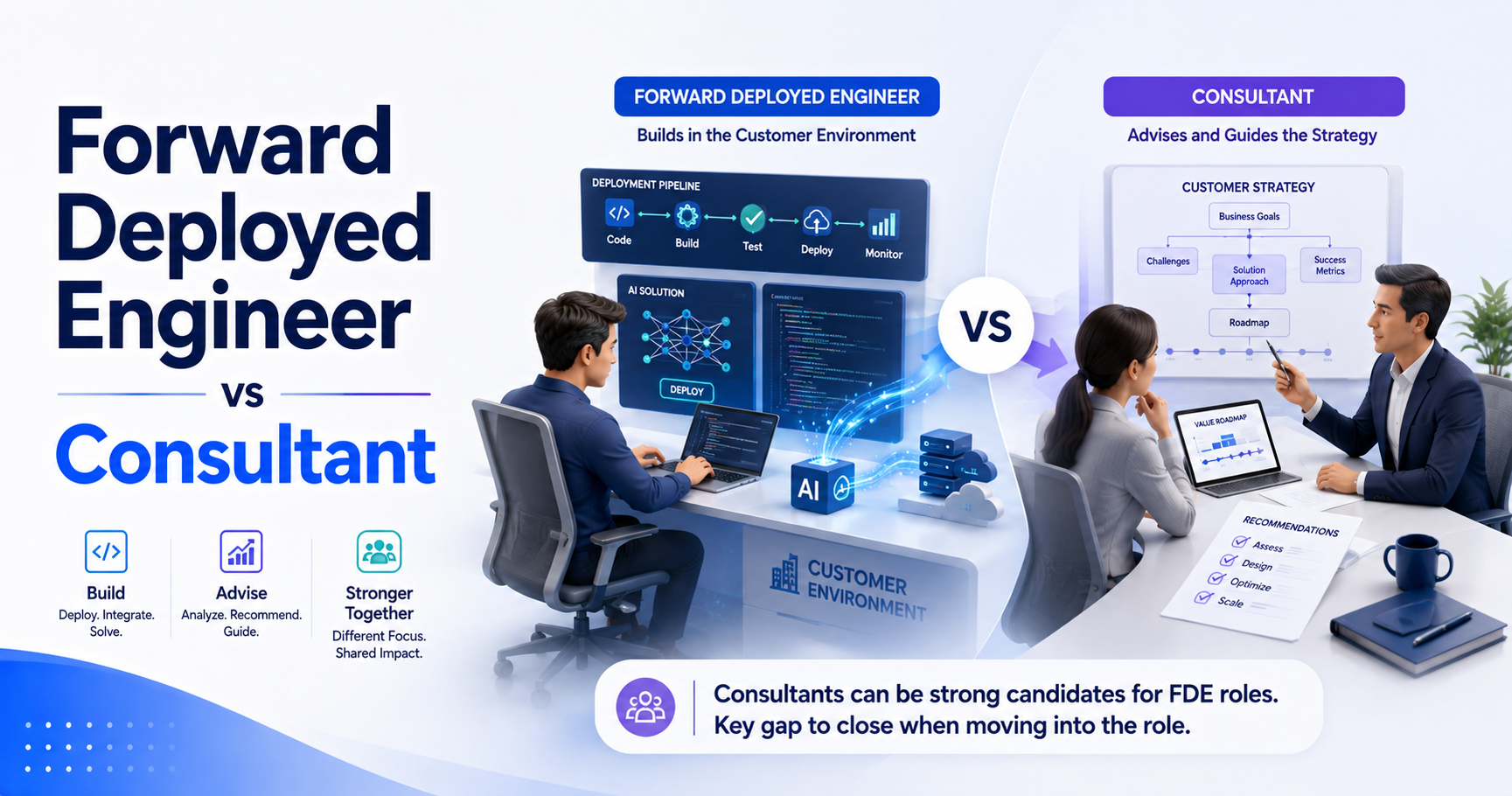
A newer, fast-growing role that embeds directly with a customer to build and deploy AI solutions inside their environment, blending software engineering with client-facing delivery. The World Economic Forum's data flags Forward Deployed Engineers alongside AI Engineers and Data Annotators as one of three job categories driving significant new AI hiring.
6. Applied AI / LLM Product Engineer
This role ships AI features directly inside a product, integrating large language models into real software rather than researching them in isolation. Search volume for this specialization grew 47 percent year over year in 2025, the largest single-category increase across AI engineering roles, and it typically sits closer to full-stack product engineering than to pure research.
Semi-Technical AI Job Opportunities: Governance, Safety, and Training
This category has grown the fastest relative to how little attention it gets in most career guides, and it is where a non-engineering background can genuinely be an advantage.
7. AI Governance and Ethics Specialist
As regulations like the EU AI Act roll out, companies deploying high-risk AI systems increasingly need people who maintain human oversight, bias testing, and technical documentation. Demand here is driven by both compliance requirements and platform vendors building governance features directly into their products.
8. AI Security Analyst
Unlike traditional cybersecurity roles, AI security analysts focus on AI-specific threats like prompt injection and data poisoning, protecting AI systems from being manipulated or corrupted rather than just protecting servers and passwords.
9. AI Trainer and Evaluator
Global demand for human evaluators who train and grade AI model outputs is growing 25 to 35 percent annually. Individual contributor roles typically pay $20 to $40 an hour, while senior leads who design evaluation programs can clear six figures.
10. Prompt Engineer
Prompt engineering as a formal job title has cooled somewhat as the underlying skill becomes table stakes across many roles rather than a standalone position, but the skill itself, designing and refining prompts for accurate, consistent AI output, remains valuable and is increasingly bundled into broader AI-adjacent roles.
11. Clinical AI Validator
A healthcare-specific example of the governance category: professionals who test AI models against medical standards before they touch a patient-facing workflow, combining domain medical knowledge with AI literacy rather than deep coding skill.
Business and Leadership AI Job Opportunities
12. AI Product Manager
AI Product Managers act as team leaders directing an AI product's full lifecycle, but need enough technical fluency to understand what goes into building an AI application, including data sets, algorithms, and model behavior, so they can make realistic scoping decisions. AI product manager hiring searches grew 41 percent year over year in 2025. See our full AI Product Manager guide for the complete role breakdown.
13. Chief AI Officer (CAIO)
An executive role that became one of the most-added positions on org charts in 2024 and 2025, tasked with owning AI strategy across an entire organization, not just one product line.
14. AI Consultant
AI consultants help organizations decide where and how to adopt AI, often working across multiple client engagements rather than one internal product, similar in structure to traditional management consulting but focused specifically on AI transformation.
15. AI-Augmented Roles in Marketing, HR, and Operations
AI literacy is becoming table stakes well outside engineering. Marketing, HR, finance, and operations professionals who add AI fluency to their existing domain expertise are seeing measurable wage premiums, without needing to become engineers at all.
Salary Ranges Across AI Job Categories
| Role | Typical Range (Global, Annual) | Entry Point |
| AI Engineer | $110,000-$205,000+ | 3-5 years engineering experience |
| Machine Learning Engineer | $120,000-$210,000 | Strong programming and math background |
| Data Scientist | $95,000-$180,000 | Statistics, Python, SQL |
| MLOps Engineer | $115,000-$195,000 | DevOps background plus ML fundamentals |
| AI Governance/Ethics Specialist | $110,000-$180,000 | Policy, legal, or compliance background plus AI literacy |
| AI Product Manager | $120,000-$200,000 | Product management background plus technical fluency |
| AI Trainer/Evaluator | $20-$40/hour (IC); $150,000+ (senior lead) | Domain expertise, no coding required |
| Robotics Engineer (entry) | $64,728 and up | Engineering degree |
Treat these as directional global ranges rather than fixed numbers; actual pay varies significantly by country, company stage, and how directly the role touches revenue-critical AI systems.
Common Mistakes People Make Chasing AI Job Opportunities
A few patterns show up repeatedly among candidates who struggle to convert AI interest into an actual offer, and most are avoidable once you see them named.
- Collecting certificates instead of building anything. A stack of course completions signals effort, but hiring managers consistently say a single working project tells them more than five badges.
- Chasing the flashiest title instead of the closest fit. Someone with a finance background often has a faster, more credible path into AI governance or AI risk roles than into a pure AI Engineer role with no coding history.
- Treating AI literacy as optional in a non-technical career. Marketing, HR, and operations professionals who skip AI fluency entirely are increasingly competing against peers who added it on top of their existing expertise.
- Waiting for the market to feel less crowded. Every source reviewed for this guide points the same direction: the gap between open roles and qualified candidates is not closing on its own, so waiting rarely pays off.
How to Move Into an AI Career, Regardless of Your Starting Point
- Identify which of the three categories, technical, semi-technical, or business, fits your existing background best, rather than assuming you need to become a coder.
- Build foundational AI and machine learning literacy first, even for non-technical roles, since every category now expects baseline fluency in how these systems actually work.
- Pick one specialization and go deep rather than skimming five. A recruiter would rather see real depth in agent design or AI governance than surface familiarity with everything.
- Build a demonstrable project or portfolio piece. Across every source reviewed for this guide, practical, showable work outweighs credentials alone in getting hired.
- Target structured training that matches your chosen category, rather than generic "AI 101" content that will not differentiate you in a competitive market.
Simpliaxis offers structured paths for each category above: the Artificial Intelligence Course and Introduction to AI and Machine Learning for technical foundations, the Generative AI Architect Advanced Program and Applied Agentic AI Training Course for deeper technical specialization, and the AI for CXOs Certification for business and leadership tracks.
Conclusion
Job opportunities with AI are not limited to engineers writing model code. Governance, product, training, and domain-expert roles are growing just as fast, often faster.
Start with the category above closest to your current skills, then go deep with structured training like Simpliaxis's Artificial Intelligence Course.
For a closer look at the systems driving this hiring wave, see our companion guides on Agentic AI Examples and AI Orchestration.
The window is open now, but it will not stay wide open indefinitely, so the smartest move is starting rather than waiting for more certainty.








 Lowest-Price Challenge











 Personalized Path


.webp)


 USA
USA  Canada
 India
India UK
UK Australia
 Singapore


