


 Call Us



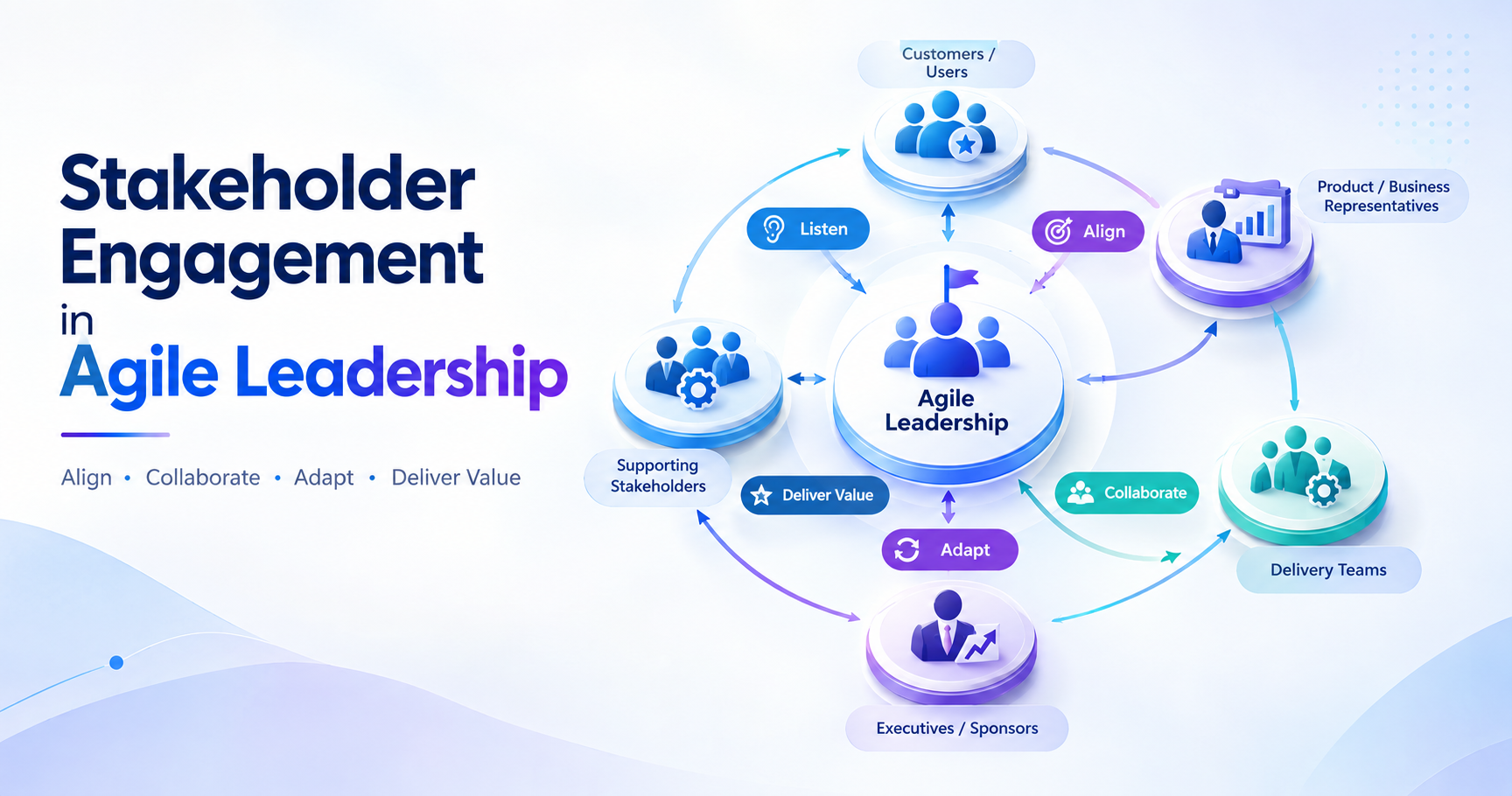
Agile leadership is collaborative work. They need continuous updates from business teams, customers, as well as other team members working on product development. This is where stakeholder engagement plays an important role.
Stakeholder engagement in Agile is defined as involving the right people throughout the product cycle. It is not just about following the regular updates. Stakeholders review the progress, ask questions, share feedback, and help the team make better and more effective decisions.
This approach is ideal for Agile teams where teams work closely with various teams, people, customer feedback, and implement the changes accordingly.
What Is Stakeholder Engagement in Agile Leadership?
Definition of Stakeholder Engagement
Stakeholder engagement is a continuous process through which an organization includes people or organizations that could be affected by its decisions, projects, or policies. In Agile, this usually involves regular conversations and reviews. Stakeholders can see what the team is building and share their views before the work is finished.
They may help the team:
- Understand business needs.
- Clarify customer problems.
- Review product increments.
- Identify risks.
- Point out missing requirements.
- Share market information.
- Discuss changing priorities.
- Make business decisions.
- Check whether the product status is going according to planned objectives.
The Project Management Institute (PMI) defines stakeholder engagement as an effective method that involves stakeholders in project development and effective decision-making.
Agile makes this process more frequent.
Take an example: suppose there is a team building a mobile banking app. The stakeholders play a core role here understanding customer feedback, product managers, compliance teams, security experts, customer support staff, executives, and banking partners. This approach helps to fix the issue at the initial stage.
Regular reviews solve part of this problem. A compliance expert might notice a regulatory issue during an early Sprint. A customer service employee might showcase a genuine customer complaint.
The team can then act on that information.
How It Differs from Stakeholder Management?
Stakeholder managementand stakeholder engagement are related. They are not the same. Stakeholder management mainly focuses on identifying stakeholders, understanding their interests, planning communication, and managing their expectations effectively. Stakeholder engagement keeps more focus on participants.
Understand the key difference with the given example:
- Stakeholder management: How should we work with this person?
- Stakeholder engagement: How can this person contribute?
This core difference plays an important role in how an Agile team works. For example, a manager may receive a monthly project report from the product development team. This approach is communication to get a monthly update. If we change the method, like if the same manager reviews a working feature and discusses a business problem with the team, that is engagement.
Good Agile leadership promotes this kind of two-way interaction.
The focus moves from:
- Sending updates to having useful conversations.
- Managing expectations to building understanding.
- Reporting decisions to discussing decisions.
- Following a fixed plan to adapting when needed.
- Collecting feedback at the end to using feedback during development.
Why Agile Leadership Redefines Stakeholder Engagement?
Agile projects deal with change.
A customer's needs may change. A competitor may launch a new product. A regulation may be updated. A technical assumption may prove wrong. Because of this, a plan made at the start may not stay perfect.
Agile teams work in shorter-duration cycles. Their major focus is to build, review it, learn from it, and plan accordingly what to do next.
The Sprint Review is a perfect example of this.
In Scrum, theSprint Review does not mean it is just a presentation. The Scrum team and stakeholders understand the results, discuss what has changed, and plan accordingly. They can then talk about what should happen next.
That makes stakeholder engagement part of the Agile process.
It is not a separate activity that happens only when someone asks for a status update.
Stakeholder Engagement vs. Traditional Project Management: Key differences
Traditional project managementmethods also involve stakeholders. The main difference is often how and when this interaction takes place.
Traditional projects may use planned meetings, reports, approval points, and formal communication schedules. Agile teams depend on creating more frequent opportunities for feedback
Communication Plans vs. Continuous Collaboration
Aspect | Traditional Project Management | Agile Approach |
| Communication | Planned and scheduled | Frequent and ongoing |
| Stakeholder interaction | Meetings and reports | Reviews, demos, workshops, and discussions |
| Reporting | Periodic updates | Regular review of working results |
| Feedback | Often collected at set stages | Collected throughout the work |
| Main focus | Information and governance | Collaboration and learning |
| Result | Structured communication | Faster feedback and adjustment |
This does not mean Agile teams need meetings every day with every stakeholder.
The aim is to involve people when their input can make a difference.
For example, a product team may invite a customer support expert to a feature review. There is no need for that person to attend every team meeting.
One-Directional Reporting vs. Two-Way Feedback Loops
Traditional reporting can look like this:

Information moves mainly in one direction.
Agile often creates a different flow:
Team ↔ Stakeholders ↔ Customers ↔ Business
The conversation goes both ways.
Aspect | Traditional Approach | Agile Approach |
| Information flow | Mainly one-way | Two-way |
| Feedback | Often stage-based | Frequent |
| Stakeholder role | Receives information | Reviews and contributes |
| Decisions | Often move through management | Can involve several groups |
| Changes | May need formal approval | Can be discussed as new information appears |
| Main benefit | Control and governance | Faster learning |
Some projects still need formal approval processes. This is especially true in regulated environments.
Agile does not remove those controls. It helps to get more chances to learn before making the final decision.
Why Stakeholder Engagement Matters in Agile?
Stakeholder engagement plays an important role in situations where a team can complete its planned work and resolve the problem along with the ongoing problems.
Regular input helps the team stay connected to customer needs and business goals.
Alignment with Business Goals
Agile teams plan and make decisions about what to build next effectively. Stakeholder engagement helps to understand why every step of the work matters.
Business goals may include:
- Increasing revenue.
- Retaining customers.
- Reducing costs.
- Improving customer experience.
- Meeting regulations.
- Increasing employee productivity.
- Entering a new market.
- Improving operational efficiency.
Imagine that two backlog items need about the same amount of effort.
One could help retain a large customer. The other could make a small change to the user interface.
The Product Ownerneeds enough business context to make a sensible choice.
Stakeholder input can provide detailed context.
Faster Feedback and Course Correction
Early feedback gives teams time to make changes.
It can answer simple but important questions:
- Does the solution solve the problem?
- Will customers use it?
- Is anything important missing?
- Has the business situation changed?
- Is this still the right priority?
- Have new risks appeared?
Finding a problem during an early Sprint is usually easier than finding it just before release.
That is one of the practical benefits of short feedback cycles.
Building Trust and Reducing Resistance
Changes can affect people if they do not understand them properly. Stakeholder engagement provides them with a more detailed understanding and visibility.
They can see what is happening. They can ask questions. They can explain their concerns.
Transparency also improves when leaders are open about complex issues.
For example, stakeholders should understand:
- Why a decision was made.
- What trade-offs were considered.
- What has been completed.
- What is still uncertain.
- How their feedback was used.
People do not have to agree with every decision.
They should, however, understand how the decision was reached.
Risk Mitigation Through Early Insight
The delivery team does not know everything.
A compliance team may know about a new rule. A sales team may know what customers are asking for. An operations team may know about a deployment problem.
That information can be valuable.
For example:
- Compliance teams can identify regulatory risks.
- Customer support teams can share common complaints.
- Sales teams can explain customer objections.
- Operations teams can point out practical constraints.
- Executives can explain changes in business direction.
- Customers can tell the team whether the product solves a real problem.
Early feedback helps the team to respond at an early stage.
What are the Types of Stakeholders in Agile Projects?
Agile projects often involve many people.
Some work directly on the product. Others provide specialist knowledge. Some may use the final product. Not all of the work needs the same type of participation.
Primary (Internal) Stakeholders — Product Owner, Scrum Master, Dev Team
The Product Owner, Scrum Master, and Developers have a close connection to the product.
There is one important Scrum terminology point.
The Scrum Guide defines the Product Owner, Scrum Master, and Developers together as the Scrum Team.
In Scrum, the word “stakeholders” usually refers to people outside the Scrum Team who have an interest in the product or its results.
Still, each Scrum accountability has an important role.
Product Owner
The Product Owner plays an important role in maximizing product value and managing the Product Backlog.
Their stakeholder work may include:
- Understanding customer needs.
- Understanding business needs.
- Gathering feedback.
- Explaining the Product Goal.
- Setting backlog priorities.
- Balancing competing requests.
- Explaining important decisions.
The Product Owner does not need to accept every request.
They need to consider which work creates the most value.
Scrum Master
The Scrum Master helps the team and organization use Scrum effectively.
They may:
- Facilitate discussions.
- Help stakeholders understand Scrum.
- Remove organizational barriers.
- Support better Sprint Reviews.
- Help people work through conflicts.
- Encourage useful stakeholder participation.
The Scrum Master is not the person who decides product priorities.
Developers
Developers build the product increment.
They also bring technical knowledge to stakeholder conversations.
For example, they can explain:
- Technical risks.
- Dependencies.
- Architecture issues.
- Security concerns.
- Feasibility.
- Technical trade-offs.
This detailed information can help stakeholders make effective decisions.
Secondary (Internal) Stakeholders — Other Departments, Support Teams
The product team may depend on many other departments.
These can include:
- Marketing.
- Sales.
- Finance.
- Legal.
- Human resources.
- Procurement.
- Information security.
- Operations.
- Customer service.
- Data teams.
- Compliance.
- Enterprise architecture.
These people may not need to attend every Sprint Review.
Their involvement may be needed at specific points.
For example, marketing may need launch information. Customer support may need training. Legal may need to check new terms.
Bringing them in at the last minute can delay the release.
External Stakeholders — Customers, Regulators, Partners, Investors
External stakeholders are outside the core delivery team.
They may include:
- Customers.
- Users.
- Regulators.
- Partners.
- Vendors.
- Investors.
- Shareholders.
Customers can explain what they need from the product.
Regulators can set requirements that affect the product.
Partners and vendors may support technology or integrations.
Investors and shareholders may encourage strategic priorities.
The collaborative role depends on the stakeholder’s role.
Stakeholder Mapping by Interest, Influence, and Impact
Not all stakeholders follow the same method. A simple stakeholder map can help.
Consider three questions:
- Interest: How much does this person care about the initiative?
- Influence: How much power do they have over decisions?
- Impact: How much will the initiative affect them?
A basic matrix looks like this:
Stakeholder Category | Recommended Engagement |
| Strong influence, high interest | Work closely with them |
| Strong influence, low interest | Keep them satisfied |
| Low influence, high interest | Keep them informed |
| Low influence, low interest | Monitor as needed |
This map can change.
A stakeholder with low interest today may become an effective decision maker later.
What are the Core Principles of Agile Stakeholder Engagement?
Transparency and Continuous Visibility
Stakeholders need complete information to understand what is happening in the organization.
That may include:
- Product Goals.
- Product Backlogs.
- Roadmaps.
- Sprint results.
- Product increments.
- Risks.
- Dependencies.
- Release forecasts.
- Key performance indicators.
More information is not always better.
An executive may need a short business update.
A security specialist may need technical details.
Good transparency gives each person the information needed for their role.
Frequent, Iterative Touchpoints
Stakeholder interaction should happen throughout the project.
Useful touchpoints include:
- Sprint Reviews.
- Product demos.
- Backlog discussions.
- Roadmap reviews.
- Discovery workshops.
- User interviews.
- Customer feedback sessions.
- Steering meetings.
A short conversation at the right time can prevent a larger problem later.
Adaptive, Relationship-Driven Collaboration
Different stakeholders need different conversations.
An executive may want to discuss business results.
A security expert may want to review technical risks.
A customer may want to talk about usability.
There is no reason to use one communication style for everyone.
Good Agile leaders adjust the conversation to the person and the situation.
Shared Ownership of Outcomes
Stakeholders should not feel like spectators.
Instead of asking:
“Did the team complete everything requested?”
Ask:
“Did we create the value we wanted?”
That small change can improve the discussion.
It encourages people to talk about outcomes rather than simply checking whether tasks were completed.
The Agile Leader's Role in Stakeholder Engagement
Agile leaders help connect people with the business objectives and delivery work. They also help people communicate effectively with each other.
Product Owner's Responsibilities
The Product Owner has a central role in stakeholder engagement. The Scrum Guide states that the Product Owner is responsible for increasing the value resulting from the Scrum Team's work and for effective Product Backlog management.
In practice, the Product Owner may:
- Talk with customers.
- Gather business input.
- Explain the Product Goal.
- Review stakeholder requests.
- Set priorities.
- Explain trade-offs.
- Balance different needs.
- Keep the backlog aligned with product goals.
Listening to stakeholders is important.
So is making a decision.
The Product Owner should consider the feedback without allowing one person's request to control the entire backlog.
Scrum Master as Facilitator
The Scrum Master has a different focus.
They help people work together effectively.
A Scrum Master may:
- Facilitate difficult discussions.
- Help stakeholders understand Scrum.
- Remove organizational obstacles.
- Improve Sprint Reviews.
- Coach stakeholders.
- Support conflict resolution.
- Encourage better collaboration.
The Scrum Master does not own the product backlog.
Their role is to help the Scrum Team and organization work more effectively.
Leading by Example — Modeling Collaborative Behavior
People notice how leaders respond to feedback.
If a leader listens to bad news, others are more likely to speak honestly.
If a leader blames people for problems, others may start hiding those problems.
Useful behaviors include:
- Listening carefully.
- Accepting feedback.
- Asking questions.
- Being transparent.
- Admitting uncertainty.
- Respecting disagreement.
- Taking responsibility.
- Staying open to change.
A good Agile leader does not need to know everything.
They need to create a space where people can raise issues and discuss them openly.
What are the Key Strategies for Engaging Stakeholders in Agile?
Involving Stakeholders Early (Agile Chartering)
Stakeholder engagement should start early.
During Agile chartering, discovery, or early planning, the team can discuss:
- The business problem.
- The desired outcome.
- Product vision.
- Success measures.
- Scope.
- Constraints.
- Risks.
- Assumptions.
- Customer needs.
- Responsibilities.
These conversations can uncover disagreements before development moves too far.
That saves time later.
Tailoring Communication by Stakeholder Type
Different people need different information.
Executives may want to know about:
- Business results.
- Strategic progress.
- Investment.
- Major risks.
Customers may care about:
- Usability.
- Features.
- Reliability.
- Experience.
Technical stakeholders may need information about:
- Architecture.
- Security.
- Integration.
- Dependencies.
The goal is not to send more information.
The goal is to send useful information.
Setting Clear, Measurable Goals and Scope
Stakeholders may disagree because they have different ideas about success.
Clear goals can reduce this problem.
For example:
- Increase conversion by 10%.
- Reduce checkout time by 30%.
- Improve customer satisfaction.
- Reduce support requests.
- Meet regulatory requirements.
- Increase employee adoption.
- Lower processing costs.
Measurable goals give the team something concrete to discuss.
They also make it easier to compare different requests.
Managing Expectations and Feedback Continuously
Agile does not mean that every request can be accepted.
Teams still have limits.
These may include:
- Capacity.
- Budget.
- Scope.
- Cost.
- Dependencies.
- Technical limits.
- Quality requirements.
- Delivery timelines.
When new feedback arrives, ask a few basic questions:
- What problem does it solve?
- How important is that problem?
- Who is affected?
- What evidence do we have?
- Does it support the Product Goal?
- What work would need to move?
This creates a better discussion than simply saying yes or no.
What are the Tools and Techniques for Stakeholder Engagement?
Sprint Reviews and Demos
Sprint Reviews give stakeholders a chance to see working results.
The team can demonstrate what has been built and discuss what has changed.
A useful Sprint Review can include:
- A working product increment.
- Stakeholder questions.
- Customer feedback.
- Market information.
- New priorities.
- Discussion about next steps.
The event should feel like a conversation.
It should not become a long status presentation.
Backlogs, Roadmaps, and Burndown Charts
Visual tools can make project information easier to understand.
A Product Backlog shows upcoming work.
A roadmap shows broader product direction.
A burndown chart can show remaining work over a period.
Teams may also use:
- Kanban boards.
- Release plans.
- Product dashboards.
- Risk boards.
- Dependency maps.
- Outcome dashboards.
The tool is useful when it helps people talk about the work.
A tool should not replace the conversation.
Workshops, Surveys, and Interviews
Different methods work for different situations.
A workshop can help a group solve a problem together.
A survey can collect feedback from many people.
An interview can reveal more detail about an individual experience.
Other options include:
- Focus groups.
- Design thinking sessions.
- Story mapping.
- User testing.
- Journey mapping.
- Prototype testing.
The best method depends on what the team wants to learn.
Retrospectives for Continuous Improvement
Sprint Retrospectivesfocus on improving the Scrum Team's way of working.
They can also reveal stakeholder-related problems.
For example, the team may discover:
- Decisions are taking too long.
- Requirements are unclear.
- Approvals arrive late.
- Sprint Reviews have low attendance.
- Departments are not sharing information.
- Stakeholders interrupt the team too often.
The team can then try a different approach.
This turns stakeholder engagement into an area for continuous improvement.
Categorizing Stakeholder Attitudes ("Zones")
Stakeholders can also be grouped by their attitude toward a project or Agile transformation.
One simple model is:

These are not official Scrum categories.
They are simply a useful way to think about stakeholder attitudes.
Unaware, Resistant, and Neutral Stakeholders
Unaware stakeholders may not know what is changing.
They need basic information.
Explain what the initiative is, why it matters, and how it may affect their work.
Resistant stakeholders know about the change but may not support it.
Their concerns can come from:
- Fear of losing control.
- Uncertainty.
- Previous bad experiences.
- Conflicting incentives.
- Lack of trust.
- Limited knowledge of Agile.
Do not assume that resistance means someone is difficult.
First, find out what is causing it.
Neutral stakeholders understand the initiative but may not feel strongly about it.
They may need a clearer reason to get involved.
Supportive and Leading Stakeholders
Supportive stakeholders take part in discussions and provide useful feedback.
Leading stakeholders go further.
They may encourage others to adopt Agile practices. They may also help remove obstacles or promote better collaboration.
These people can become useful change champions.
Navigating "Green Zone" vs. "Red Zone" Behaviors
Some organizations use green-zone and red-zone language to describe behavior.
Green-zone behavior can include:
- Openness.
- Collaboration.
- Curiosity.
- Constructive feedback.
- Transparency.
- Shared responsibility.
Red-zone behavior can include:
- Blame.
- Defensiveness.
- Withholding information.
- Rejecting feedback.
- Command-and-control behavior.
- Protecting one department at the expense of the wider goal.
These labels should describe behavior, not people.
Someone may act defensively in one situation and work well with others in another.
The aim is to improve the situation, not label the person.
What are the Common Challenges in Agile Stakeholder Engagement?
Resistance to Agile Practices
People who are used to traditional project methods may have questions about Agile.
They might ask:
“Why can't you tell me exactly what will be delivered six months from now?”
Or:
“Why do the requirements keep changing?”
These are fair questions.
Agile does not remove planning.
It accepts that plans may change when the team learns something new.
Clear communication can help stakeholders understand this difference.
Misaligned Expectations
Different teams often want different things.
Sales may care about customer commitments.
Engineering may care about technical quality.
Finance may focus on cost.
Customers may focus on ease of use.
Executives may focus on growth.
These priorities can conflict.
The answer is not to make everyone happy.
Instead, make the decision process clear.
Product Goals, measurable outcomes, roadmaps, and backlog priorities can help.
Communication Gaps Across Distributed Teams
Distributed teams face a few extra challenges.
Common problems include:
- Different time zones.
- Cultural differences.
- Less informal communication.
- Too many messages.
- Language barriers.
- Slow decisions.
Teams can reduce these problems with:
- Shared digital boards.
- Recorded demos.
- Decision logs.
- Asynchronous feedback.
- Overlapping work hours.
- Written summaries.
- Well-planned online workshops.
The aim is simple: make important information easy to find.
Best Practices for Effective Stakeholder Engagement
Conduct Stakeholder Analysis Early
Identify important stakeholders early.
Look at:
- Influence.
- Interest.
- Impact.
- Expectations.
- Information needs.
- Possible risks.
- Preferred communication methods.
Do not treat the first stakeholder map as final.
Review it when the project changes.
Prioritize Based on Stakeholder Input
Stakeholder feedback matters.
It should not, however, automatically decide what goes into the backlog.
The Product Owner may need to consider:
- Customer value.
- Business value.
- Risk.
- Cost.
- Technical dependencies.
- Regulatory needs.
- Strategic goals.
This helps prevent the backlog from becoming a list of requests from the most powerful person in the room.
Use Agile Ceremonies as Engagement Touchpoints
Agile events can create useful opportunities for stakeholder interaction.
Sprint Reviews are especially valuable because stakeholders can see the working product.
Planning and refinement discussions may also benefit from business or domain experts.
Still, not every stakeholder needs to attend every event.
Invite people when their knowledge or decision is needed.
Educate Stakeholders on Agile Values
Stakeholders often participate better when they understand why Agile works differently.
Explain:
- Why teams work in short cycles.
- Why priorities can change.
- Why feedback matters.
- How backlog priorities are set.
- What happens during a Sprint Review.
- Why transparency matters.
- How Agile balances planning and change.
The Agile Manifesto provides a useful starting point. It emphasizes people, customer collaboration, and responding to change.
How to Measure Stakeholder Engagement Success?
Meeting attendance is not enough.
A team can have many stakeholder meetings and still have poor engagement.
The better question is whether stakeholder involvement improves decisions and results.
Feedback Loops and Satisfaction Surveys
Surveys can help teams understand how stakeholders feel about:
- Communication.
- Decision-making.
- Responsiveness.
- Alignment.
- Trust.
- Product confidence.
- Opportunities to participate.
Customer feedback can come from:
- CSAT.
- Net Promoter Score.
- User interviews.
- Product reviews.
- Feature feedback.
Numbers are useful.
Comments and conversations can explain what those numbers mean.
Engagement Metrics to Track
Teams can track several measures:
- Sprint Review participation: Are the right people attending?
- Feedback frequency: Is useful feedback reaching the team?
- Feedback implementation: Does useful input affect priorities?
- Decision turnaround time: How quickly are decisions made?
- Stakeholder satisfaction: Do stakeholders feel informed?
- Requirement clarification time: How quickly are questions resolved?
- Rework: Is poor communication causing extra work?
- Customer adoption: Are customers using the delivered features?
Do not use these metrics blindly.
For example, more people at a Sprint Review does not always mean better engagement.
Three people having a useful discussion may provide more value than twenty people who say nothing.
Metrics should help the team learn.
What are the Essential Skills for Agile Leaders to Engage Stakeholders?
Stakeholder engagement depends on people skills as much as Agile practices.
Leaders need to communicate clearly, listen well, and handle disagreement.
Communication and Active Listening
Good communication is not only about explaining things.
It also means listening.
Active listening includes:
- Asking open questions.
- Clarifying assumptions.
- Avoiding quick judgments.
- Summarizing what was said.
- Asking about concerns.
- Looking beyond the first request.
For example, a stakeholder might say:
“I need this feature immediately.”
The real concern could be:
“I am worried that we will lose an important customer.”
Those two statements lead to different conversations.
Understanding the real concern can lead to a better solution.
Emotional Intelligence and Trust-Building
Stakeholder discussions can become difficult.
People may be under pressure. They may disagree about priorities. They may also worry about change.
Emotional intelligence helps leaders notice these reactions.
It can help them recognize:
- Their own emotions.
- Stakeholder concerns.
- Resistance.
- Conflict.
- Organizational pressure.
Trust takes time.
It grows when leaders are honest, keep their commitments, explain decisions, and admit when something is uncertain.
Conflict Resolution
Conflict is normal in Agile projects.
Different stakeholders can have valid reasons for wanting their work prioritized.
The goal is not to remove every disagreement.
Instead, bring the conversation back to:
- The problem.
- Evidence.
- Customer value.
- Business value.
- Risks.
- Constraints.
- Available options.
A respectful disagreement can lead to a better decision.








 Lowest-Price Challenge











 Personalized Path


.webp)


 USA
USA  Canada
 India
India UK
UK Australia
 Singapore


