


 Call Us



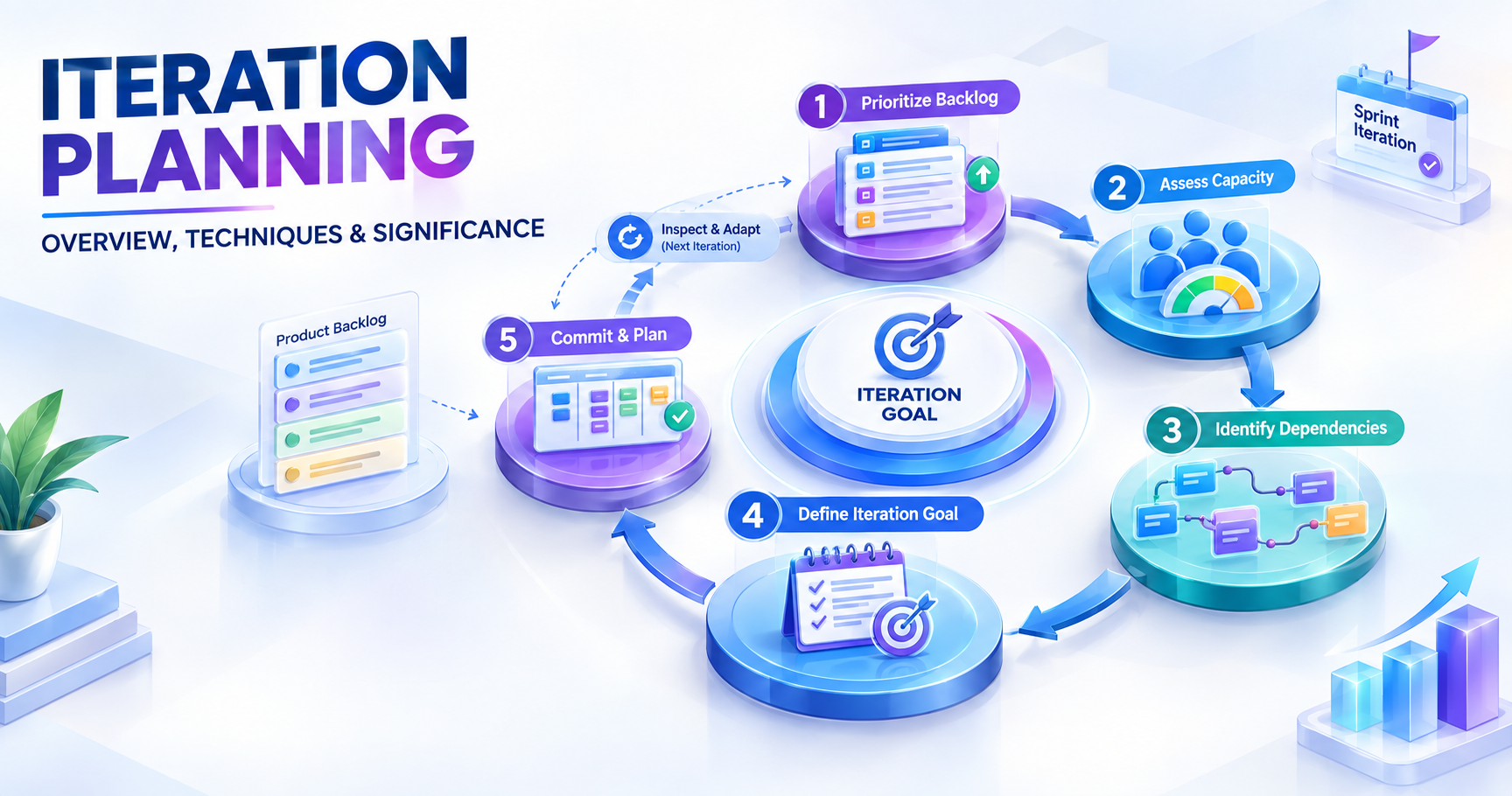
An important aspect of the Scrum framework, helping teams deliver quality products as per the set timelines, is known as iteration planning. Here, we will look into planning small product increments at a cadence. We also establish high-level objectives for what to complete during the iteration.
Key highlights:
- There are five key inputs to transforming a product backlog into an iteration plan: the team’s velocity, the Definition of Done, stakeholder input, the team’s capacity, and the backlog items.
- The different steps in the process are identifying the items in the backlog that will best help achieve the iteration goal, assessing the team’s capacity and velocity, estimating the effort for backlog items, and agreeing to do the work.
- The planning techniques include backlog prioritization, story point estimation, breaking work into smaller components, and planning based on the team’s velocity.
- Iteration planning focuses on the work to be done in the next one to four weeks. Release planning focuses on the work to be done in the upcoming months.
- Sprint planning and iteration planning are similar, and in practice are the same activities.
- There are challenges faced during planning, which include inadequate backlog items and planning fallacies. Continuous backlog grooming, capacity checks and disciplined planning help alleviate challenges faced during planning.
Introduction
Once your strategy turns into concrete work, we start iteration planning. The team’s velocity is taken into account in order to accept feasible user stories. An entire team is involved in the planning process, including key stakeholders. In other cases, we will have a smaller team- a project manager, architect, or an analyst. They have a meeting in advance to prepare a draft iteration plan.
In this blog, we will talk about the importance of iteration planning, key stakeholders involved, the iteration planning process, and techniques used. We will also shed light on the challenges of iteration planning and share the best practices for effective iteration planning.
What is iteration planning?
Iteration planning refers to the collaborative process whereby a team makes a decision on what they can deliver in the next iteration. This is tracked through some of the best project management tools. Iteration planning is considered a core practice in software development.
Let’s take you through what a typical iteration planning meeting looks like:
- Your team gets aligned on product iteration goals.
- A set of high-priority backlog items are chosen.
- Clarifyacceptance criteria and dependencies, ensuring work is understood.
- Create an iteration goal and an iteration backlog which the entire team owns.
You will be in a position to improve business value and ensure that there is alignment with business goals.
Why is iteration planning important?
Iteration planning is important because it turns broad product goals into a realistic plan for the next iteration.
Transforms strategy into actionable iteration goals:
By connecting customer feedback, roadmap priorities, and capacity, the team develops iteration goals. This describes outcomes instead of task lists, helping people look into how upcoming work supports bigger objectives. Through iteration planning, the team gets aligned with customers’ evolving needs.
Reduces waste, risk, and rework:
A structured session surfaces blockers, acceptance criteria, and dependencies, helping your team undertake realistic commitments.
Boosts team engagement and ownership:
When specialists, developers, and testers help in identifying risks and shaping scope, they tend to share ownership of the plan and make effective in-iteration decisions that are aligned with the agreed goal.
When iteration planning is done well, it becomes a predictable rhythm, supporting learning, delivery and stakeholder trust. Not to mention, it helps teams deliver the final product that helps meet business needs.
What do you need during the iteration planning meeting?
Prior to people joining the call, the iteration planning meeting gets started smoothly.
A prioritized backlog:
Once the top items are ordered via clear criteria, you’ll have enough detail to discuss and estimate. The feedback is reviewed by the product owner, who will update priorities and refine large items into testable work. Here, an iteration plan template will be useful for teams to remember what to prepare.
Realistic capacity and context:
Capacity planninglooks into evaluating the team’s velocity. To estimate the work involved in the next iteration, the historical average of completed stories is used. Deadlines, cross-team plans, and visible product goals are used to keep trade-offs grounded.
Who is involved in iteration planning?
Both the backlog and having the right people in the room are crucial. Without them, plans will stay theoretical, and decisions stall. Some of the core participants include the following:
Product owner:
A product owner brings the product vision, current goals, and roadmap into the picture, explaining why each item matters. They work with the team to agree on realistic iteration goals.
Scrum master:
They facilitate the iteration planning meeting, ensuring that the team stays focused and productive. Not to mention, the scrum master also removes any obstacles that might arise during the planning phase.
Development team:
Developers, testers, and other specialists - they are responsible for completing the tasks during the iteration. This includes identifying dependencies, highlighting quality, and breaking stories into executable tasks.
What are the Key Inputs and Outputs of Iteration Planning?
Some of the key inputs and outputs of iteration planning are:
Inputs:
- Product backlog:
A product backlog is a list of all the features, changes and bug fixes that a product may need to have. The backlog is managed and prioritized by the product owner. This backlog is continually changing based on the maturity of the product and changes in the market.
When a team is performing iteration planning, the product backlog is assumed to be infinite. During this planning, the product owner provides the backlog items that the team is expected to plan and work on during the iteration.
It is often beneficial for the product owner to provide items that the team has previously worked to define.
Having a well-defined product backlog significantly reduces the effort required for iteration planning. A poorly defined product backlog often results in iteration planning taking much longer and requiring additional effort
- Velocity:
Velocity is the average number of story points that a team has closed during an iteration. This is not a target that a team is attempting to achieve. This is an average that is communicated to the team as an estimate for the number of points that may be closed during the next iteration.
If the average velocity of a team is 30 story points, the team should not consider planning and committing to 45 story points during the next iteration.
- Stakeholder feedback:
Feedback from stakeholders is often in the form of input and/or comments about product priorities and changes or defects with the product. This feedback is often used to evaluate what the next most valuable product change should be.
Iteration planning allows teams to incorporate recent feedback and to weigh it against existing feedback, represented in the product backlog, to prioritize the work to be completed in the next iteration.
- Team capacity:
Team capacity refers to the number of hours or days in the iteration during which the team can perform task work. It represents the team’s availability taking into account vacations, absence due to leave, part-time work on other projects, and other meetings. - Definition of Done:
A Definition of Done (DoD) represents the steps required to complete a work item and achieve a given end state. Examples of steps in software development include code review, integration, and automated testing.
A clear and sound DoD helps the team recognize when a work item has been completed and prevents a sense of progress when work remains.
Routinely reviewing and updating the Definition of Done helps planning to remain relevant and effective as the overall skills of the team change.
Outputs:
- Iteration plan:
The focus of the meeting is on producing an iteration plan. The plan contains the iteration goal, the backlog items to be undertaken in the iteration, and the means or ways by which the team will pursue the items. Thus, the plan serves as an agreement by the team on the work to be undertaken in the iteration. - Task breakdown:
Each backlog item to be undertaken in the iteration is broken down into a number of tasks. Each of these tasks is estimated to take a certain amount of effort and is to be completed by the end of the iteration. - Effort estimates:
Each task is estimated in terms of effort required in relative measure. The estimates are expressed in story points. The estimates facilitate the planning of work to be undertaken by the team in the iteration. - Task assignments:
When balancing the workload of the team, assigning tasks to members based on specific skills is essential. In anAgile environment, the member of the team who is best suited to complete a specific task is often best determined by the member of the team who is most skilled at completing the task. It makes sense to allow this member of the team to determine this. - Sprint goal:
A Sprint Goal is a statement which describes what a team will accomplish during a sprint. This statement is used to provide a focal point for a sprint. An example of a Sprint Goal is “Allow customers to add payment methods to their account to use for future checkouts.” - Iteration backlog:
An Iteration Backlog is created from the Product Backlog, and contains items which a team has agreed to accomplish during a sprint. The items on the backlog represent work which has not been completed, and is tracked to determine when the work moves into completed status.
How Does Iteration Planning Work?
Different teams may use slightly different methods for iteration planning, but most work through a more or less similar process.
1. Review the Iteration Goal
After reviewing the goal for the upcoming iteration, the team considers how best to accomplish it and reviews related backlog items. If there is a goal set at the level of the program or release, the iteration goal may be set relative to that.
2. Review and Prioritize Backlog Items
The product owner discusses the top items on the product backlog with the team. The team may also consider and discuss relative priority and stakeholder concerns. The product owner is also free to alter the order of the product backlog as he or she sees fit. If there is new information or a change in priority, the product backlog item may be changed.
3. Estimate the Required Work
If the team has not previously determined the size of a particular backlog item, they are free to estimate the effort involved using a relative estimate of effort.
4. Check team capacity and velocity
The final step is for the team to consider the estimated effort required to accomplish the work items and whether the team has the capacity to accomplish the work. A good baseline for capacity is the average work done in the previous iterations of the project.
5. Select and break down the work
With capacity and velocity in mind, the team decides on the next work to do. Once a decision is made, the work is further analyzed and definitions of smaller elements are created. Often, this is when the team discovers the element’s true complexity. Because of this, work that seemed complex when evaluating the backlog may consist of many simple tasks.
6. Create the iteration backlog
Next, the tasks that comprise the work to be done are documented and maintained in an order ready for execution. This list is called the iteration backlog.
7. Confirm the plan and commitment
The final element is the team’s commitment. The plan consists of the work to be done and the means to achieve the iteration goal. The plan is analyzed to ensure the team feels the work is achievable. Upon achieving this analysis, the team formally agrees to execute the plan.
Iteration Planning Process in Software Project Management
In software project management specifically, iteration planning connects directly to the broader delivery pipeline: requirements gathering, development, testing, and release. The table below maps out how each stage of iteration planning translates into concrete project management activity.
| Stage | Primary Activity | Key Participants | Typical Output |
| Pre-planning backlog grooming | Refine and prioritize backlog items ahead of the meeting | Product owner, technical leads | Refined, ready backlog items |
| Goal alignment | Connect iteration goal to release or program objectives | Product owner, scrum master, team | Draft iteration goal |
| Capacity assessment | Calculate available hours or days per team member | Scrum master, team members | Capacity figure for the iteration |
| Estimation | Size unestimated backlog items | Development team | Story point or time estimates |
| Work selection | Choose items that fit within capacity and velocity | Whole team | Shortlisted backlog items |
| Task decomposition | Break stories into technical tasks | Development team | Task list with owners |
| Risk and dependency check | Identify blockers, cross-team dependencies | Scrum master, technical leads | Risk log, dependency map |
| Commitment | Team agrees to the final plan | Whole team | Finalized iteration backlog |
| Execution tracking | Monitor daily progress against the plan | Scrum master, team | Burndown chart, daily updates |
| Review and retrospective | Assess what was delivered against the goal | Whole team, stakeholders | Lessons learned, backlog updates |
This process repeats every iteration, which is usually one to four weeks depending on the team's chosen cadence. The repetition is what makes agile project management so adaptive. Instead of locking in a rigid year-long plan, teams recalibrate constantly based on what they learn.
Goals of Iteration Planning Process
The iteration planning process aims to achieve a number of objectives which help a team to achieve the goal of delivering value iteratively and incrementally.
1. Helps in setting realistic and achievable goals:
Planning helps a team to set realistic and achievable goals. During the process of setting goals, the team discusses their goals and plans vis-à-vis their available time and other constraints. This helps to set realistic goals for the team.
2. Align teams on a shared purpose:
Next, planning helps a team to focus on a common goal. This is especially important when a team member works on an isolated task and cannot correlate their work with other members’ tasks.
3. Identify risks:
Third, planning helps a team to identify risks for a current goal. While breaking work into smaller tasks, a planning team identifies risks for achieving a goal.
4. Improves predictability:
Fourth, planning helps a team to understand that goal achievement is a certainty. Planning with the help of historical data of the team's work helps the team to understand that goals for the current iteration can be achieved.
5. Fosters a culture of continuous improvement:
Last, planning fosters a culture of continuous improvement in a team. Planning helps a team to redefine estimates and goals for the definition of done.
What Techniques Are Used in Iteration Planning?
Several techniques are used in the industry to improve the process and reliability of iteration planning. The maturity of the team and type of work influence which of these techniques are used.
1. Capacity planning
Capacity planning, also known as contingency planning, involves analyzing how many actual available working days and hours a team has during an iteration and setting limits on the team’s work acceptance based on those available days and hours. This takes into account vacation days, absences, and partial work days.
There are several ways to mathematically determine this capacity. Two of the most common are
(a) Multiply the total number of team members by the total number of work days by the average number of hours a team member is productive during the day, and subtract the number of absences and meeting attendance.
(b) For more detailed analysis, capacity can be determined on an individual team member basis, especially if team members do not have interchangeable skills.
2. Velocity-based planning
This planning involves setting a team’s commitment based on the average number of story points a team has committed to and accomplished during the recent iterations. This type of planning reduces the adverse impact of variation present in the iterations.
When using this type of planning, teams average the story point velocities of recent iterations (usually between 3 to 5).
3. Story point estimation
Story point estimation is a technique that helps teams quantify the level of effort required for a user story through a relative size comparison. This technique is generally used with backlog items and helps in breaking misconceptions of team members relating to the level of effort.
When using this technique, a reference story is selected, and all other backlog items are compared to this story. For example, if the reference story is considered to be of 3 points of effort, and one other story is considered to be twice as complex, then the latter story would be of 6 points.
There are various methods for facilitation in story point estimation, the most common being planning poker. This technique requires all members of the team to individually select a point value. The points selected are then revealed simultaneously, and in case of any inconsistency, the team discussion is limited, and a vote is taken to arrive at a consensus.
4. Task breakdown
It is the process of taking larger, more abstract work items and creating smaller, more concrete items. This is often done by taking larger user stories and creating smaller items that can be completed in a day. Decomposition provides the additional benefit of showing progress on the larger user story rather than it remaining “in progress” for the duration of the iteration.
Breaking down larger user stories can also uncover other work that is associated with the user story. This work is also added to the backlog as separate user stories.
5. Backlog prioritization
There are several ways to determine the backlog item order, including the MoSCoW technique (which states that items must, should, could, or will not be done), weighted scoring, or value/effort trade-off analysis.
When order is determined based on ease, there is a greater chance that less valuable items will be worked on first. In addition, items that are partially completed may remain partially completed until the end of the iteration, which can mislead the team to believe that a great deal of work was completed.
What is an Iteration Planning Meeting?
The Iteration Planning Meeting serves as a catalyst for creating the iteration plan. It is a formal get-together of the product owner, scrum master and the development team at the beginning of each iteration. Participants in this meeting do not take part in the development work of the iteration in progress.
This meeting is restricted to a specific duration, and the scrum master ensures that the participants adhere to the time restriction. Often, a rough guide is to restrict the meeting to a duration of two times the length of the iteration. This means that for a 2-week iteration, the meeting can be restricted to a duration of 4 hours.
There are three main objectives of this meeting.
- First, it is ensured that the development team understands the requirements of the features to be built in the current iteration.
- Next, the development team should come up with an appropriate way to implement the requirements.
- Lastly, the development team should be committed to implementing the requirements. It is important to note that this meeting does not serve as a medium to assign work to the development team.
Iteration Planning Meeting Agenda
The objectives of the meeting are achieved by discussing the items listed in the backlog in priority order.
The meeting is managed in an effective manner by adhering to the time restrictions set and following a prescribed order of business. The order of business has a great deal of latitude. However, the essential elements are covered.
1. Informing/sharing:
The scrum master or Product Owner provides any new information from the last iteration. This information may include unsolved issues, stories that were not completed and solved, or feedback that the team provided during the last planning meeting.
2. Review:
The Definition of Donemay be revised next. The team determines how much work they can complete during the next iteration (also known as a sprint) and plans the work to be completed.
3. Prioritized Backlog Items:
The product owner presents backlog items that the team is recommended to consider for the next sprint. The team provides feedback and raises questions to the product owner. Items that have not been estimated are sized by the team. The team finally determines which items to consider for the next sprint.
4. Tasking:
The items that the team decides to consider for the next sprint are further analyzed to identify the work that needs to be completed to resolve the item. Owners are assigned to each of the work items, and an estimate is provided.
The team identifies and addresses risks and concerns that were discussed during the analysis. The team agrees to work towards resolving the items.
What Is the Difference Between Iteration Planning and Release Planning?
The differences between iteration planning and release planning are the following:
| Aspect | Iteration Planning | Release Planning |
| Time horizon | One iteration, usually one to four weeks | Several iterations, often spanning months |
| Primary focus | Specific tasks and stories for the immediate cycle | High-level features and themes for a product release |
| Level of detail | Highly detailed, task-level breakdown | Broad, feature-level scope |
| Frequency | Repeated at the start of every iteration | Done less often, typically at the start of a release cycle |
| Key participants | Product owner, scrum master, development team | Product owner, stakeholders, sometimes customers |
| Primary output | Iteration backlog and sprint goal | Release plan with target features and rough timelines |
| Basis for decisions | Team velocity and current capacity | Overall product roadmap and business priorities |
What are the Differences Between Iteration Planning and Sprint Planning?
The differences between iteration planning and sprint planning are the following:
| Aspect | Iteration Planning | Sprint Planning |
| Terminology origin | Broader agile and iterative frameworks, including Scrum, Kanban-based cycles, and scaled frameworks like SAFe | Specific to the Scrum framework |
| Scope of use | Applies to any time-boxed work cycle, regardless of framework label | Applies specifically to a Scrum sprint |
| Core activities | Backlog review, estimation, task breakdown, capacity check, commitment | Identical activities, framed within Scrum's defined roles and events |
| Output | Iteration backlog and iteration goal | Sprint backlog and sprint goal |
| Framework flexibility | Used across various agile and iterative methodologies | Strictly bound to Scrum's prescribed structure and roles |
What Are the Common Challenges in Iteration Planning?
Challenges during iteration planning are normal, and experienced teams are able to identify various types of recurring challenges.
1. Unclear or Unrefined Backlog Items
Planning meeting time is typically consumed with clarifying backlog items instead of determining how to implement them. Backlog items become inadequate mostly due to a lack of backlog grooming by the product owner.
Backlog items that require more grooming are prioritized lower than planning meeting items; however, time should be allocated in the current iteration for grooming of items that are scheduled for planning in the next iteration.
2. Inaccurate Estimates
Story estimates represent a best guess, and a range of estimates is acceptable; however, estimates that exceed the entire range result in capacity planning and other meeting estimates being adversely impacted.
Story estimates are often performed in isolation and/or a story may represent a complex set of interconnected tasks. Through retrospective meetings and product backlog prioritization, teams are trained to assess which product backlog items (PBIs) to implement in the upcoming iteration and recalibrate their story estimation.
3. Changing Priorities
New priorities during a sprint cause inflexions in the committed iteration backlog. A degree of flexibility to the backlog is necessary; however, if a constant changing of scope occurs during a sprint, then the backlog is not truly committed, and the planning of the sprint becomes ineffective.
4. Limited Team Capacity
There are many reasons for a team’s capacity to be less than expected, especially unplanned leave during a sprint. Teams that depend on velocity to create a plan often end in overcommitment.
5. Dependencies and Interruptions
Completing a project sometimes depends on other teams, vendors and external sources. Though disruptions are inevitable, strategies should be put in place during planning to identify and manage external risks.
6. Overcommitting to Work
It is the nature of people to overcommit and take on too much. Oftentimes, this is caused by a lack of true understanding of a team’s capacity.
A commitment to complete a project to an exceptionally high standard should not be at the expense of delivering the project at all. Repeated overcommitment will cause a team to lose faith in achieving a goal and, in turn, lose faith in the team.
What Are the Best Practices for Effective Iteration Planning?
There are several practices that help teams who plan well distinguish themselves from those who plan poorly.
1. Refine the Backlog:
Efficient planning requires a refined backlog. Many teams fail to do this and, as a result, it takes them much longer to complete planning meetings. If a backlog is refined before a planning meeting, the meeting tends to be much shorter and more productive.
2. Use Realistic Velocity:
Many planning failures occur due to teams overcommitting and assuming the best-case scenario. Teams should base their commitments on realistic velocity and capacity.
3. Have Clear Goals:
A goal that outlines multiple disparate objectives is effectively the same as having no goal at all. It is best practice to articulate a goal using a single, focused sentence.
4. Engage the Team:
It has been shown that estimates generated by the team achieve more precise range and duration estimates and build a greater sense of commitment to the estimate than management-imposed estimates. Likewise, task breakdown should be performed by the team.
Limit the scope of the backlog. An organization should allow some flexibility with regard to scope changes. However, backlog items should not be freely changeable. Track and define when a user story is complete. A team should update this definition as the skills and ability of the team evolve.
4. Close Loop:
A team should perform a retrospective to learn how effectively they met the goals established during their last iteration planning meeting. A retrospective should be facilitated to identify how effectively a team planned and estimated the work to be performed during the next iteration.
5. Timebox the Planning Meeting:
A planning meeting should be timeboxed, and facilitators should avoid discussing off-topic issues. A facilitator should evaluate if the product backlog is sufficiently prioritized and ready for planning. Additionally, if a meeting consistently runs over time, the facilitator should reevaluate the focus of the meeting and determine if they are allowing discussion to veer off topic.
Conclusion
Iteration planning meetings are a staple of the typical Scrum calendar. While the meeting invites may seem excessive, these meetings ultimately help Scrum teams manage their capacity. Iteration planning ensures Scrum teams create a shared understanding of what work needs to be done to reach the sprint goal. Ideally, iteration planning takes a long product backlog and extracts a piece of work that is small enough for a Scrum team to implement in a sprint.
Fortunately, iteration planning offers continuous opportunities for improvement. Teams can use iteration planning to assess and adjust their estimates. Iteration planning helps teams refine their Definition of Done. Effective iteration planning ultimately results in improved discipline and greater confidence in the Scrum team. Improved planning builds trust with the teams’ customers and stakeholders.
Sometimes, Scrum teams may utilize different terminology to describe iteration planning. However, the goal of all of these planning activities is to combine a body of work that a Scrum team deems too large to be managed with a plan to accomplish that body of work. Iteration planning helps Scrum teams better understand and manage their work to be done. Effective iteration planning helps Scrum teams better prepare for and manage the work to be done.









 Lowest-Price Challenge











 Personalized Path


.webp)


 USA
USA  Canada
 India
India UK
UK Australia
 Singapore


