


 Call Us



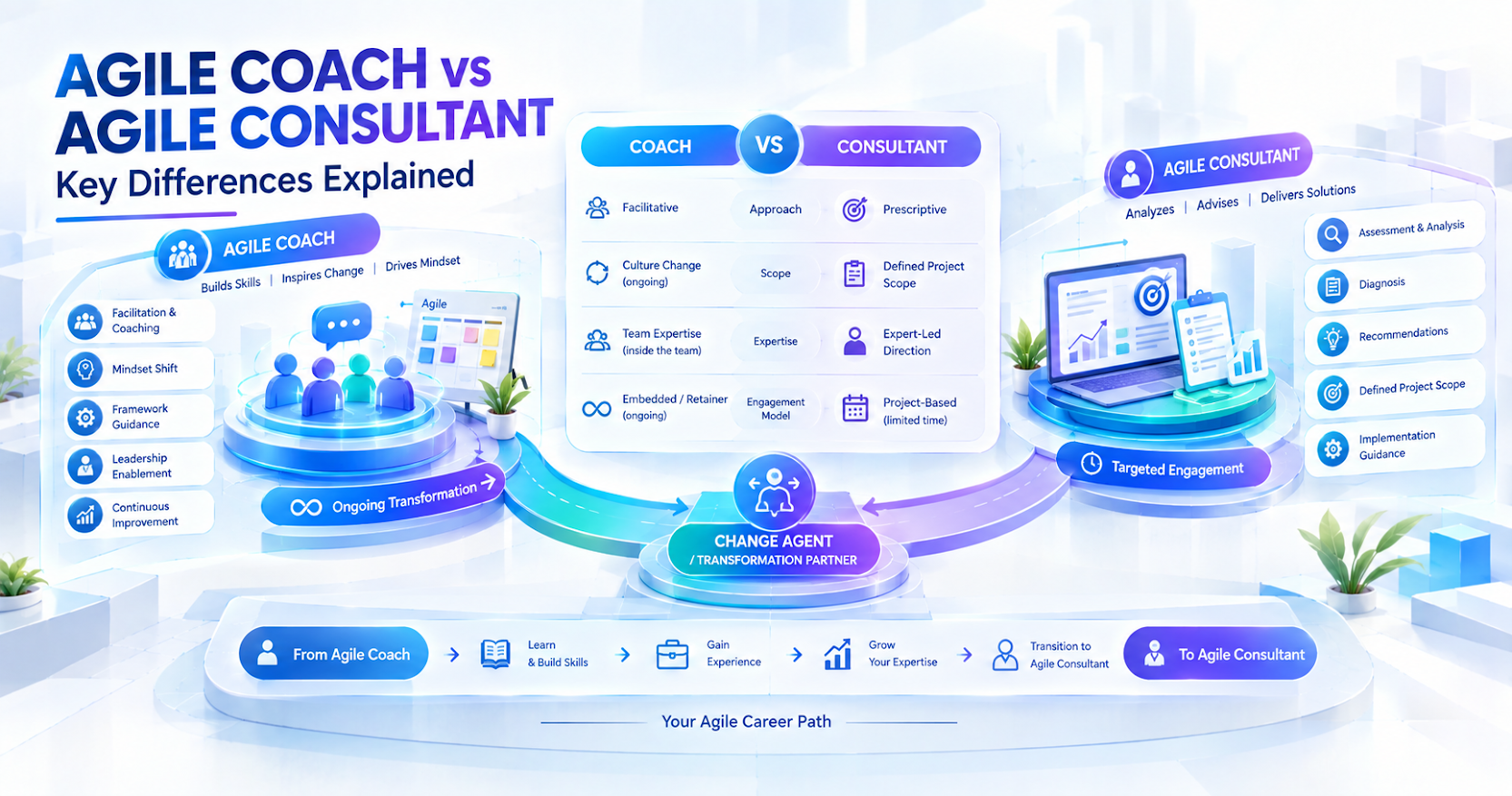
An Agile Coach builds lasting capability through facilitation and mindset work. An Agile Consultant diagnoses issues and prescribes solutions on a defined, often shorter engagement. The right hire depends on whether you need culture change or a targeted delivery of answers.
Key highlights:
- An Agile Coach builds a team’s long-term ability to work effectively with Agile by enabling mindset shifts, shared ownership, leadership growth, and continuous improvement rather than leading the team or doing the work for them.
- Agile Coaches focus on behavioural and cultural change over time, while Agile Consultants diagnose a defined problem, recommend solutions, and implement a structured operating model within a fixed project scope.
- Hire an Agile Coach when challenges involve trust, habits, leadership behaviour, weak Scrum practices, too many priorities, poor flow, or a need to develop internal capability that lasts after the coach leaves.
- Hire an Agile Consultant when the organization needs an expert-led decision, such as selecting a scaling model, redesigning team structures, improving governance, creating a portfolio system, or rolling out a new operating model within a set timeframe.
- The core distinction is the working stance: coaches use questions, observation, facilitation, and experiments to help people find their own solutions, while consultants use assessments, external expertise, recommendations, and implementation plans to reduce ambiguity.
- Hybrid Agile professionals can coach, consult, teach, and mentor depending on the situation. Still, organizations must clearly define the role, phase, deliverables, timeline, decision rights, and success metrics to avoid confusion and mismatched expectations.
What Is an Agile Coach?
An Agile Coach supports and develops a team’s ability to work effectively in an agile manner. The aim is not to do the work for them or become the team lead. Rather, it’s to help the team work without that constant support.
Depending on the needs of the organization, a coach may support a single Scrum team or work with the product, management, and executive teams. Enterprise coaches are concerned about the system as a whole and consider the funding, structure, metrics, and culture.
As an agile coach, a good understanding of all the Agile frameworks is important. However, the skills of coaching, facilitating, and mentoring, as well as the frameworks, are the floor.
Core Responsibilities (facilitating mindset shifts, framework guidance, leadership enablement, continuous improvement)
1. Facilitating mindset shifts.
Agile will not be effective if someone simply copies some techniques. A coach is focused on the shift in belief from a command-and-control to shared ownership. A coach helps a leader to shift from “I decide, you execute” to “we learn together”.
A coach helps a team to shift from “heroics” to a state of “flow”. The shift occurs in workshops and the various moments throughout the day.
2. Framework guidance.
A coach is able to articulate the principles of Scrum, Kanban, XP, Lean, among others, as well as the various scaling models, i.e., SAFe, Nexus, etc. They do not try to promote a single model.
Their goal is to help an organization select the practices that fit the work the organization is doing. They do not teach the “why” behind the work so that teams see the ceremonies as a waste and become theater.
3. Leadership enablement.
The majority of Agile issues occur above the team. Coaches work with product owners, middle managers, and executives. They assist leaders with outcome framing and impediment removal, and help mould leaders’ mindsets away from measuring people through frameworks that negatively impact collaboration.
4. Continuous improvement.
Coaches build feedback loops along with enhancing retrospectives, metrics, and experiments. They help teams visualize cycle time, quality, and customer outcomes. They ensure delivery pressure does not result in the neglect of learning.
Their typical other duties include training and mentoring Scrum Masters, facilitating large-group events, and building an internal coaching community to ensure the organization does not remain dependent on external support.
What Is an Agile Consultant?
An Agile Consultant is an external expert contracted to address problems, envision solutions, and construct ways of working utilizing Agile methods and approaches on a project with a clearly defined conclusion.
When to hire an agile consultant?
- You are building a scalable and redesignable organization, or introducing new funding and governance.
- Internal teams lack the design elements to advance the next step.
- You have a sponsor, budget, and structure. You’re not looking for an open-ended culture change.
Coaching Approach: Non-Directive and Long-Term
With coaching, the focus is more on drawing conclusions and developing a plan. While the consultant may provide recommendations, they listen and facilitate workshops as needed.
A typical assessment takes 2 to 6 weeks, while a standard implementation program ranges from 8 to 16 weeks. Major shifts may take longer, but will typically have milestones and deliverables.
Pricing usually mirrors project fees or daily rates. The client buys either a deliverable or a defined block of time, not an ongoing engagement.
This approach is most appropriate when there is a structural problem to solve and time is limited. It is less useful for issues around trust, fear, and/or leadership habits. If a new operating model is introduced, it won't take hold unless there are changes to how people make decisions and work together.
Real-World Example - A large bank looking to implement Agile methods across 40 teams
The bank's leadership is split between adopting the full SAFe methodology and a lighter version. Progress is slow due to a heavily controlled change advisory board and a project-based funding model.
An Agile Consultant was hired to develop a solution in 12 weeks. The first three weeks were spent on diagnostics and included value-stream mapping, interviews, and establishing flow metrics.
The next three weeks were spent developing an operating model that included product-aligned teams, a lighter governance process designed to enable low-risk changes, and a Kanban for the bank's portfolio. The final weeks were spent designing and supporting a pilot to implement the operating model across eight teams.
The bank has a decision and a working operating model. Change of culture is expected to take longer. That was to be expected. The consultant was paid to deliver a solution, not to sit with teams for a long period.
Agile Coach vs. Agile Consultant: Key Differences
There are differences in objectives, change methods, duration, and purchasing between Agile Coaches and Agile Consultants.
Approach (facilitative vs. prescriptive)
Coaches facilitate the creation of learning conditions. Coaches use formulated questions, observe, and experiment. Coaches help their organizations discover the way of working that the organization can internally embrace.
Consultants, in contrast, prefer to work prescriptively. They rely on assessments and reference architectures. They recommend the best course of action based on their previous experience. They provide diminishing ambiguity to decision-making executives.
It is no secret that the best in the industry are able to bridge both. The default stance remains what the contract signalled.
Timeframe (ongoing culture change vs. defined project scope)
Coaching is a long-term commitment to culture change. Coaching supports the organization during setbacks and stays long enough for new habits to become an old way of working. A positive return on the investment is usually seen in 6-12 months and continues to grow.
Consulting is a fixed scope. It has defined start, middle, and end points. Improvement to the structure can be seen in 8-16 weeks through the creation of new and consistent cadences, less dependence, and clearer operating models.
Coaching in this context is the right choice to develop a culture that will outlast the expert. Consulting should be the choice for design and implementation.
Perspective on Team Knowledge (leveraging the team's expertise vs. expert-led direction)
Coaches believe the team has knowledge that the coach does not. People closest to the work know the constraints. The coach helps the team use this knowledge.
Consultants believe the organization hired them because the internal knowledge is stuck or incomplete. They bring external patterns. They are willing to override local preferences if the data supports it.
Neither belief is always correct. A high-skill team that is constrained by politics needs to be coached and system work done. An inexperienced organization that cannot even run a standup may need expert direction first.
Engagement Model & Pricing (retainer/embedded vs. project-based/daily rate)
Agile Coach engagement.
Some typical models include retained full-time positions, retained employment (e.g. 2 – 3 days a week for 6 – 12 months), and internal employment. Pricing is generally done on a monthly basis. Coaches in North America and Western Europe often charge $150 – $300+ an hour, or $1,200 – $2,400+ per day.
Coaches employed in the US usually earn $90,000 to $175,000+ at senior/enterprise level. Some market overviews indicate that strongly employed coaches are in the $130,000 to $180,000 range, while contracted specialists at the system level may earn $100 - $180 per hour.
Coaching programs can be expensive. One account says 10 coaches for 2 years cost around $12 million to $15 million, which comes out to $100,000 per coached team. In some markets, independent coaches come close to $60,000 per team-year. Elsewhere, expect rates to be 30 to 50 per cent lower.
Agile Consultant engagement.
In this market, expect assessment and implementation engagements to be time and materials, and daily rates, with prices defined in statements of work. Be prepared to pay for changes. A consultant billing $200 per day at 70 per cent utilisation can gross close to $290,000 a year, before the cost of sales and marketing.
What are the Pros and Cons of Each Role?
The pros and cons of an agile coach and an agile consultant are the following
Agile Coach: Pros and Cons
Pros
- Coaching builds internal capability to handle change after the expert coach has left.
- Leaders strengthen habits and behavior, not just checklist compliance.
- Coaching works best with complex, big people problems for which no obvious, correct framework exists.
- Strengthens Scrum Masters and improves product ownership
Cons
- Does not show board-level metrics for results. Managers looking for a 60-day transformation will get frustrated.
- Is harder to measure compared to the outcomes of a delivered operating model.
- Weak coaches hide behind questions and never help.
- Strong coaches address the dependency problem by fading out over time.
- This is problematic for an organization which must make an important structural decision this quarter.
Agile Consultant: Pros and Cons
Pros
- Diagnoses problems quickly and provides recommendations.
- Useful for scaling choices, re-orgs and business case generation.
- Artifacts are created that leadership will approve and support financially.
- Provides cross-industry frameworks and patterns that internal staff may not have.
- Works within defined budgets and procurement processes.
Cons
- If solutions are not co-created, they tend to fail.
- It may create a “consultant said so” culture and avoidance of ownership.
- Shallow engagements do not resolve deep-rooted cultural issues.
- Local problems tend to persist if solutions are copied from other firms.
- Internal staff may be resistant to a directive outsider.
When to Hire an Agile Coach?
A coach is necessary when issues related to capability, habit, and leadership are present.
Good signals:
- Results from Scrum events are poor.
- Scrum Masteris an event planner.
- Managers are task/process dictators and break flow.
- An older consulting report gathers dust.
- You want the organization to improve after the expert leaves.
- There is low trust; people will not blindly follow a model they did not help create.
- You can commit 3 to 12 months and avoid utilizing the coach as a project manager.
Example: A product org already “does Agile.” Long cycle times are caused by the fear of failure and having too many priorities. It would be a better use of funds to bring in a coach to help leaders with focus and WIP limits rather than bringing in a new framework.
When to Hire an Agile Consultant?
Hire a consultant when you need expert judgment, a design, and a bounded implementation.
Good signals include:
- You have a choice to select a scaling model or a team topology for this quarter.
- You require a baseline assessment for the board.
- Governance, funding, or architecture blocks team-level Agile.
- You are merging companies and need a common operating model.
- Internal staff have no pattern library to design the next level.
- You have a defined budget and a sponsor and a decision-maker.
Example: A company growing from 8 to 50 teams requires a portfolio system, role design, and a 90-day rollout plan. A consultant can do that more quickly than with just a non-directive coach.
Can One Person Be Both? The Rise of the Hybrid Role?
Yes, several senior practitioners change stances by context. It depends on the context whether they coach or consult. Job titles lag this reality. Contracts usually say “coach”, but the work involves both.
The hybrid role is very helpful, but it is also a risk if it is not explicitly stated which role is being adopted.
The "Change Agent" / "Transformation Partner" Model
Some firms sell a “transformation partner” or “change agent.” The person diagnoses, recommends, teaches, and coaches leaders. They stay long enough to help the change and build internal coaches.
This model works when:
- A sponsor wants both a design and a capability.
- A partner outlines the phases as assess, design, implement, coach, fade out.
The metrics for success include system metrics such as cycle time and predictability and capability metrics such as the number of internal coaches certified and the teams that begin self-facilitating.
Treat it as a program with defined phases rather than a general, ongoing relationship with an expert.
How to Know Which Mode You're In?
To determine which mode you’re in, you can perform a kind of test in the room.
- If the expert is asking questions and helping the team come to a decision, that’s coaching.
- If the expert is providing options and suggesting one and then writing the plan, that’s consulting.
- If the expert is teaching a skill, that’s teaching.
- If the expert is sharing their personal experiences and how they handled a similar situation in their past role, that’s mentoring.
Ask the practitioner, “Are you in coach mode or consultant mode right now?” If they can’t answer, engagement is shifting.
Risks of Mixing Roles Without Clarity
Teams become stagnant waiting for answers, and practitioners become stagnant waiting for the team to think. Leaders think they bought a 6-week service while practitioners believe they sold a 12-month change.
Ethical issues come into play when a coach also sells a fixed framework.
Coaching and assessing become indistinguishable and unfair, especially in an evaluation context. You cannot score a coach on “delivered the operating model by Friday” if that was not the agreement.
Trust diminishes when the same person is a safe coach one day and a directive auditor the next without communicating the shift.
The language is flexible. Address planned mode switches within the SoW.
Career Path: From Agile Coach to Agile Consultant
A lot of us started off as developers, testers, or business analysts. Most of us then became Scrum Masters. A lot of us then transitioned to Agile Coaches. Some started selling Consulting services.
A practical path:
- Master team-level delivery. Facilitate Scrum or Kanban well. Understand product and engineering, not only sticky notes.
- Add coaching skills. Learn professional coaching: listening, powerful questions, ethics, contracting. Credentials such as ICP-ACC help here.icagile+1
- Move to multi-team and leadership coaching. Work on dependencies, managers, and metrics.
- Build a diagnostic toolkit. Value-stream mapping, team topologies, flow metrics, org design. This is the bridge to consulting.
- Learn commercial skills. Scoping, proposals, stakeholders, and saying no to work that should be coaching, not a 2-week “transformation.”
- Choose a market position. Some stay embedded coaches. Some become independent consultants. Some join firms as transformation leads.
Moving from coach to consultant is not a promotion by default. It is a product change. You sell judgment and designs, not only presence and facilitation. You need a point of view you can defend.
The reverse path also exists. Consultants who only ship slide decks often become better when they learn to coach so their designs actually land.
How to Evaluate and Hire the Right Fit?
1. Start with the results, not the role.
Write a one-sentence description of what achieving the goal will look like: “In six months, we will know this worked if …” If the goal involves skill and behavior, opt for a lean coach. If it is about a model, a decision or a launch, opt for a lean consultant.
2. Assess your preferred stance with a live example.
Give an example of a stuck team in the interview. Listen. A coach will ask about the team’s goals, history, and what the team thinks. A consultant will address the problem in a structured manner and will develop options. Both can be right. Recruit the stance you require.
3. Ask for case examples rather than buzzwords.
Coaches will give examples of teams that they have coached to become independent. Consultants will give an example of their diagnosis and the recommendation, the intervention, and what did not work.
4. Verify that system literacy is present.
Ask about funding, HR incentives, architecture, and compliance. Skills that are only relevant on a team level will have no effect in an enterprise context.
5. Contract for the work.
For coaches: duration, days per week, access to leaders, success metrics, and the gradual removal of assistance. For consultants: scope, deliverables, decision dates, and implementation boundaries.
6. Watch for red flags.
Guaranteed “Agile in 30 days.” One framework for every company. No interest in your product or customers. Inability to explain why they would not take the work.
7. Involve the people who will live with the hire.
A coach that Scrum Masters reject will not be effective. A consultant without an executive sponsor will develop a report that will never be read.
Certifications for Each Path
Certifications do not make a practitioner, but they demonstrate training and a shared language. Use them as one of many inputs.
Common for Agile Coaches
- ICAgile ICP-ATF (Agile Team Facilitation) and ICP-ACC (Agile Coaching). Of the two, ICP-ACC focuses more on the coach mindset, roles, and responsibilities, and is more knowledge-based.
- Scrum Alliance CTC (Certified Team Coach) and CEC (Certified Enterprise Coach), which require more experience and are more difficult to attain.
- ICF credentials if the person does deep professional coaching.
- Supporting Knowledge: CSM/PSM, CSPO/PSPO, Kanban (Kanban University), and scaling courses as needed.
CSPO and PSPO: Build practical Product Owner skills in backlog management, prioritization, stakeholder collaboration, and customer-value delivery through CSPO Course or PSPO certification.
PSM: Strengthen your Scrum Master expertise in facilitation, team coaching, Agile leadership, and Scrum implementation with professional PSM training.
Common for Agile Consultants
- The same Agile base as coaches, plus delivery and design credentials.
- SAFe SPC if the market you serve uses SAFe.
- PMP, PgMP, or similar when the work is more program-oriented (useful, not required).
- LeSS, Disciplined Agile, or other scaling credentials matching the advice they sell.
- Domain credentials in product, architecture, or DevOps when the consulting offer is specialized.
Professionals can consider a SAFe SPC courseto build the skills needed to guide enterprise Agile transformations and support organizations adopting SAFe.
SAFe POPM certification can strengthen capabilities in product prioritization, Scrum facilitation, team coaching, and value delivery.
How should hiring managers use certs?
Choose ICP-ACC or CTC if you are in need of coaching skills. Choose a consultant who has developed operating-model work if that is what you need. Be wary of a badge wall that has zero stories.
Structured training for developing these skills provides the opportunity to practice stance and facilitation as well as develop an understanding of ethics prior to sitting in front of a leadership team. Simpliaxis and others offer role-focused Agile certification paths that will assist you in preparing for a career in coaching and consulting.
Conclusion
An Agile Coach helps people and systems improve without the need for continuous external support. An Agile Consultant conducts a work diagnosis, a recommendation, and the implementation of a change.
Coaches work more in a facilitation and long-term support challenge, compared to Consultants, who work more in a prescriptive and expert support challenge, with a time-bound goal. This thinking largely informs the price, with Consulting work typically requiring a fixed project fee, and Coaching work requiring a more substantial long-term commitment.
Fundamentally, it comes down to energy. Hire a coach to solve leadership and habit challenges. Hire a consultant to make a decision and construct a design. When you choose a hybrid, indicate the mode and phase of the work, and measure the outcome and capability.
Start your journey by looking at Agile coaching, the Scrum framework, and scaling programs offered by Simpliaxis.






 Lowest-Price Challenge










 Personalized Path


.webp)


 USA
USA  Canada
 India
India UK
UK Australia
 Singapore


