


 Call Us



When a product backlog has dozens or hundreds of items, it can be difficult to decide what to work on. For a product, every feature can seem important. One stakeholder might want a new feature for customers; another might want the team to work on fixing a technical issue or meeting a time-sensitive need.
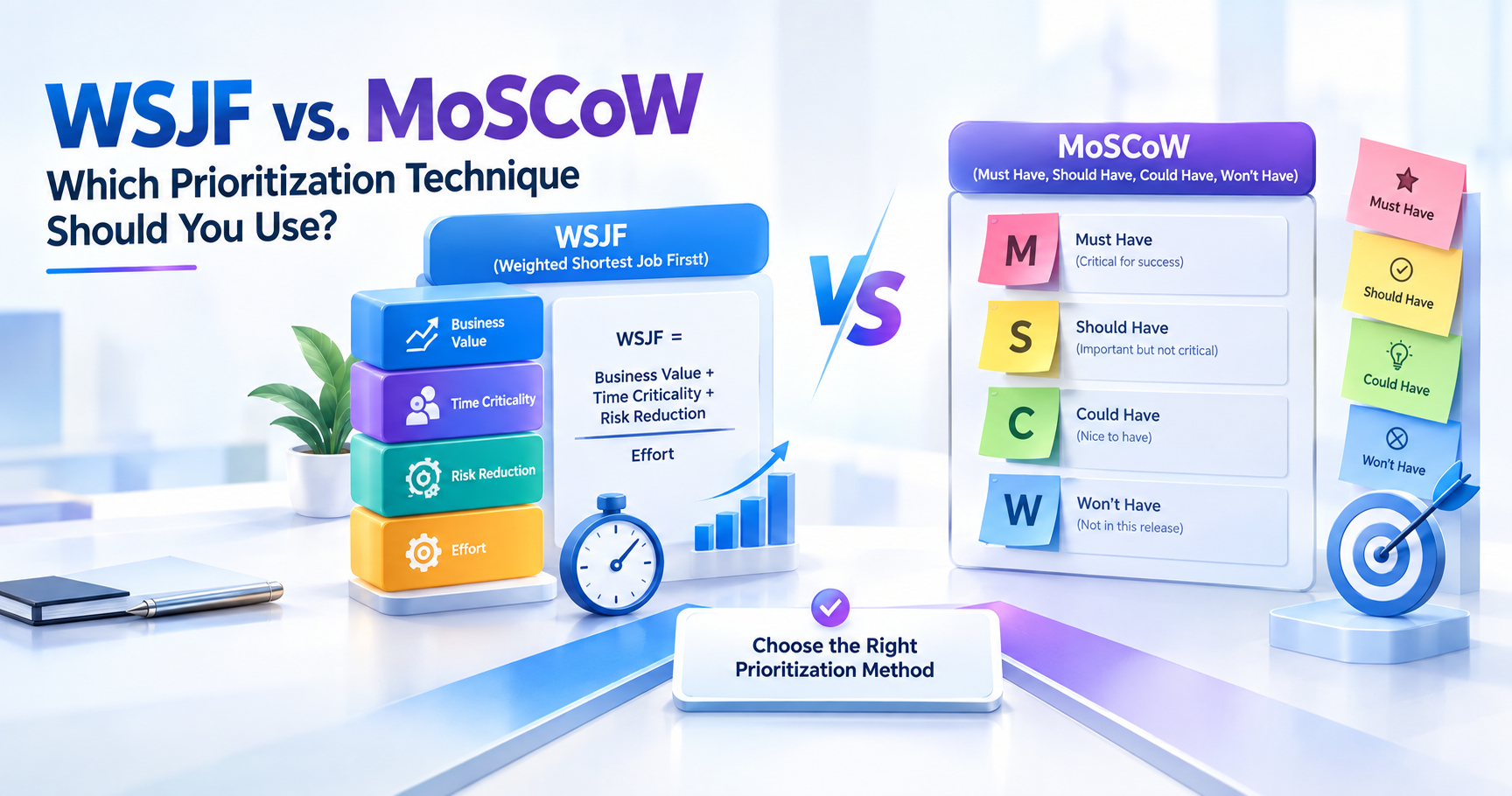
That’s where prioritization methods such as MoSCoW and Weighted Shortest Job First (WSJF) can help. Both of these methods help teams decide what to work on first, but they do it in different ways. MoSCoW divides work into four different priority categories. WSJF uses a scoring system based on the cost of delay and the size of the work. This results in a more direct comparison between items.
This is a particularly important decision for product owners because they closely link prioritization to backlog management. A CSPO, Certified Scrum Product Owner, must know what the customers want, what stakeholders expect, what is valuable to the business, and the sequence of work. According to Scrum Alliance, the product owner is responsible for prioritizing the product backlog and maximizing the value of the product.
So, what method should you use?
Use MoSCoW when you need a simple way to distinguish between essential work and lower-priority work. Use WSJF when you want a finer-grained way to compare competing items on value, urgency, risk, and effort. That decision depends on your product, your team, the data you have available, and the decision you need to make.
Quick Answer: WSJF vs. MoSCoW at a Glance
MoSCoW and WSJF solve similar problems but are intended for different levels of prioritization.
MoSCoW breaks work down into four categories:
- Must Have: Work that is required.
- Should Have: Important but not urgent work.
- Could Have: Useful work that can be skipped if needed.
- Won't Have: Work that will not be in the current scope or time period.
The method is easy to understand and effective when a team needs to come to an agreement on what is critical for a release.
WSJF calculates a relative score with this formula:
WSJF = Cost of Delay / Size of Job
Cost of Delay is broken into three areas:
- User Value to Business
- Criticality of Time
- Risk reduction and/or opportunity facilitation
The score is then divided by the size of the work in relation to the total size of all the work.
WSJF asks simply:
“What work gives us the most value for the amount of work we have to do? Especially when waiting has a cost?”
MoSCoW asks:
“How important is this item for the current scope?”
This is the main difference between the two.
MoSCoW is mainly a categorical method. WSJF is a scoring methodology.
MoSCoW is typically easier to use. WSJF will usually be more detailed when you have multiple items to compare closely
Neither approach gives you an automatic 'right' decision. The quality of the deliverable is determined by how well the team identifies value, urgency, size, risk, and scope.
If you’re taking a CSPO and developing your product ownership skills, it’s useful to understand this difference, because product backlog ordering is more than simply putting items into a list.
What Is MoSCoW?
MoSCoW is a prioritization method that is utilized to categorize requirements or work items based on their importance.
The name is derived from four categories:
Must Have, Should Have, Could Have, Won't Have This Time.
This approach is often associated with DSDM, in which teams needed a pragmatic way of managing requirements within set time constraints.
Instead of calculating a score for each item, the team discusses the importance of each item and puts it in the right category.
For example, imagine a team preparing to develop the first iteration of an online booking product.
The backlog consists of:
- Registering a user
- Processing Payments
- Search criteria
- Nite Mode
- Profile Custom Themes
- Improved Reporting
Sometimes user registration and payment processing are Must Haves because the team decides that the product cannot deliver its core service without them.
Search filters can be a Should Have as they improve the experience but don’t stop the product from working.
Dark mode and profile themes could be Could Haves.
Advanced reporting could be a Won’t Have for the current release.
The value of MoSCoW is that it forces the team to discuss what is really needed. It doesn’t treat every request as equal.
The Four Categories (Must, Should, Could, Won't)
Must Have
Must Have items are critical to the current delivery.
A Must Have requirement is a true must-have requirement because if it is not included, the release does not fulfill its basic purpose, business need, legal requirement, or agreed minimum scope.
Teams need to be careful with this category. When almost everything becomes a Must Have, the method stops being helpful to the team in making trade-offs.
For instance, a payment function could be a Must Have for an online purchase system. Without it, customers might not be able to do the main thing the product is supposed to do.
The important question is not:
"Who in the hell wants this?"
The more pertinent question is:
"Will the intended release serve its purpose without this?”
That distinction helps keep Must Have inflation in check.
Should Have
Should Have items are important but not critical to the functioning of the release.
These things may add meaningful value, improve user satisfaction, reduce problems, or meet an important business goal. But the product can be delivered without them.
For example, a saved search option might be useful for customers but not essential for the first usable version of a product.
Should Have items are often the first to move if the team has time or capacity limits.
Could Have
Could Have items are helpful but have less impact than Must Have and Should Have items.
They could be convenience features, minor upgrades, or enhancements that customers would like.
If the team has enough capacity, they can be added. If not, omitting them should not materially affect the primary reason for the release.
This helps teams not waste too much time on small improvements when more important work needs to be done.
Won’t Have
Won't Have means the work will not be part of the current scope or time.
It does not always mean the idea will never be built.
Maybe a useful feature is just not the right thing for this release.
This is important because the decision is made visible. Instead of leaving all requests open and having false expectations, the team can clearly communicate that some work is out of scope for the moment.
DSDM – Origin and Why Teams Use It
MoSCoW is associated with the Dynamic Systems Development Method (DSDM), which is a form of Agile that placed great emphasis on delivering within agreed time and cost constraints whilst managing scope.
The idea behind the method was to help teams understand which requirements were most important when it was not possible to deliver everything at once. The idea is still good today.
Product teams rarely have unlimited time to build. Customer requests, technical work, compliance needs, bugs, business goals, and new opportunities can all compete for the same capacity.
MoSCoW gives teams a common language to discuss these trade-offs.
It also helps facilitate stakeholder conversations.
The team can then articulate that the feature is a Must, Should, Could, or Won’t for the current scope, instead of simply stating it is “low priority”.
This can be especially helpful when planning a release or when a team has to cut scope but still wants to keep the core purpose of the product.
MoSCoW Advantages
The biggest strength of MoSCoW is its simplicity.
You don’t need a complicated score sheet to start a discussion as a team. These four categories are easily understood by people.
Other strengths include:
- Simple communication: Stakeholders will be able to understand the categories without having to learn a complex formula.
- Fast application: Teams can classify a reasonable number of items without calculating many separate scores.
- Helpful with scope conversations: When time or capacity is limited, it's easier to see what can be cut out.
- Clear release boundaries: The Won't Have category can help establish expectations on what is out of the current scope.
- Good for early conversations: Without that information, a numerical score is too ambitious. A category-based system is more realistic.
MoSCoW can also help product owners in the face of competing stakeholder requests. The product owner has the right to not say yes to every request and to steer the conversation toward the purpose and scope of the product.
Dead Zones of MoSCoW
MoSCoW has its own drawbacks. The first big issue is that it doesn’t sort items of the same category by default. If a team has five “Must Have” items. MoSCoW tells you that all five are important but does not tell you which Must Have should have been first.
Should Have and Could Have items are likely to suffer the same problem.
That is, once the categories are established, a team may need to find a different way to sequence work.
Second, the question of Must Have inflation.
Stakeholders might say their requests are critical because they want them delivered. And if the team keeps adding items to the Must Have group, the category becomes meaningless.
One way to minimize this problem in practice is to define clear rules before starting the categorization process.
Ask yourself why you need a thing. What if you take it away? Does the product not fulfill its main task? Is there a genuine business, customer, legal, or operational reason for it?
The aim is to ensure that “Must” is perceived as essential, not just very desirable
What Is WSJF (Weighted Shortest Job First)?
Weighted Shortest Job First (WSJF) is a prioritization model for sequencing work based on economic benefit.
It is tightly integrated with the Scaled Agile Framework and with Lean economics.
The basic idea is quite simple:
Lower the cost of delay and increase the size significantly. Work on the high cost of delay and relatively small size first.
The usual formula is: WSJF = Cost of Delay / Job Size
A higher WSJF score indicates that an item has a higher relative priority in the model.
It does not attempt to calculate an exact financial return for each item. Teams use relative estimates instead to compare things.
This is important because product teams rarely have accurate financial information for each backlog item.
For example, if two features are about the same value.
Feature A is to be completed in 2 weeks.
They are saying Feature B will take eight weeks.
If the cost of delay to deliver either feature is similar, Feature A may have a higher WSJF score because the team can deliver the value with less work.
In this way, the method accounts for the cost of waiting as well as the work done.
The Formula: Cost of Delay/Job Size
The WSJF formula is:
WSJF = Cost of Delay / Job Size
Cost of Delay consists of three components:
Cost of Delay = User Business Value + Time Criticality + Risk Reduction or Opportunity Enablement
These factors are usually rated relatively by the team.
Job size is the relative size of the work. The numbers don’t have to be exact dollars, days, or hours. What counts is that the team applies the scale consistently. In this example, feature A would have the highest relative WSJF score because it has a high cost of delay relative to its size. The numbers only matter if the team has a shared understanding of what the scores represent.
Breaking Down Cost of Delay (User-Business Value, Time Criticality, Risk Reduction/Opportunity Enablement)
The Cost of Delay has three parts to help the team look beyond just the customer demand.
User-Value to Business
User-Business Value: The value of a product to the user and the business.
The team might look at questions like:
Will customers gain from this product?
- Does it support a critical product goal?
- Can it drive better business outcomes?
- Does it solve a real problem for customers?
- Does it support an important business requirement?
This means that prioritization is more than merely a development effort.
Some things are easy to build but don't offer much value. One more may take more work, but it solves a critical customer problem.
Criticality of Time
Time criticality considers whether the value of the item changes over time. Some work is less valuable if it is delayed. For example, a feature for a specific market event may be more time-critical than a general product enhancement. There may also be a deadline for a compliance-related requirement. Time criticality isn’t just about someone wanting the feature quickly. It asks if it is worth the price of waiting. Here’s where WSJF differs from simply ranking by importance. Two features may have equal value today, but one may lose value if it is delayed by a few months.
Opportunity Enablement and Risk Mitigation
This factor is a combination of two related ideas. The first is reducing risk. Some work reduces technical, operational, security, or business risk. For example, an item could resolve a known technical vulnerability or lower the risk of a future problem. The second is opportunity-enabling. Some work accumulates a capability to do something of value later. For example, a technical capability may allow for future product features. This means that an item doesn’t need to have immediate customer value for it to be valuable. It might matter because it mitigates a risk or creates an opportunity.
Source (SAFe / Lean Economics)
WSJF is a technique for sequencing work for economic advantage (Scaled Agile Framework).
Its logic is based on lean thinking and the cost of delay.
The basic economic problem is:
What does it cost you to wait for us?
If the cost of delaying a piece of work is high but the piece of work itself is relatively small, then it may be worth doing it sooner.
Therefore, WSJF is not only about which item is “most valuable.”
It also asks how quickly that value or avoided cost needs to be addressed compared with the amount of work involved.
This is especially useful when teams have several competing initiatives and want a more complex way of comparing them.
WSJF Strengths
WSJF has a number of useful strengths.
It orders them in rank: WSJF produces scores that can help teams order items, unlike simple categories.
It takes into account time: Time Criticality introduces the cost of waiting into the conversation.
It takes size into account: large items do not automatically win, even if they have a high value.
It includes risk and opportunity: Work that reduces risk or opens up opportunities for the future can be given appropriate attention.
It supports economic thinking: The model forces teams to think about value and delay, not just react to the loudest request.
WSJF can be especially useful if you have many items in your backlog, and they all seem important. Instead of grouping ten items into “high priority," a team can use relative scores to achieve a finer ordering.
WSJF Oversights
WSJF isn’t a magic mathematical answer. The biggest weakness is that the scores are still estimates. A team might estimate user-business value at 8, time criticality at 6, and risk reduction at 5, but those numbers don't automatically make those values objective facts. People can disagree on the numbers. Cost of Delay scores can also be gamed.
If someone really wants a particular item to be done first, they might give it higher value or urgency scores. And the other way around. A team might underestimate work because it wants to make a feature look attractive. False precision is another problem.
For example, a WSJF score of 6.2 feels a lot more precise than 5.8. But the underlying estimates may not be good enough to warrant treating this difference as a precise measurement. So, WSJF should be thought of as a decision support method, not a machine that decides for the team. Strategy, product goals, dependencies, constraints, and new info still matter.
What are the Key Differences of WSJF vs. MoSCoW?
The main differences are in the way each approach handles priority.
MoSCoW categories
WSJF compares and calculates.
Quantitative vs. Categorical Method
Categories MoSCoW uses.
An item is either must, should, could, or won't.
WSJF is based on numerical estimates.
The team scores factors like value, time criticality, risk reduction, opportunity enablement, and job size.
That doesn’t mean WSJF is perfectly objective.
Both methods rely on judgement from the team; WSJF just articulates that judgement in a numerical form.
If the key question is “Is this work critical for a given release?” then MoSCoW can be easier to use.
When the team needs to compare several competing items in more detail, WSJF may be more helpful.
Ranking Precision (ranking by score vs. ranking by bucket)
This is one of the more obvious differences. MoSCoW makes groups.
If there are eight items tagged "Must Have," the method doesn’t automatically create an order from one to eight. WSJF gives a score to each item. This can make generating a ranked sequence easier.
But do not confuse the ranking precision with the decision accuracy.
It makes the differences easier to see when you express them as numerical scores, but this does not mean the underlying estimates are correct.
Time and Effort to Apply
MoSCoW is usually faster. A team can discuss an item and place it in a category.
WSJF requires additional steps. The team has to estimate a few things: the cost of delay, the size of the job, and then come up with a score. It can be worth the extra effort when the decision is complicated. It may not be necessary for every little choice.
Data Requirements
MoSCoW works with limited information. The team just needs enough context to understand if an item is a must-have, should-have, could-have, or not-have for now.
The more information, the better WSJF gets. The team needs to make reasonable estimates of value, urgency, risk or opportunity, and job size. That doesn’t mean WSJF requires perfect data. It uses relative estimates. But the final score can be less useful if the assumptions are weak.
Handling Time-Sensitivity and Cost of Delay
MoSCoW does not have a separate numerical factor for time criticality.
Depending on the circumstances, a time-sensitive item may be classified as a must-have or should-have. WSJF includes time criticality directly in the cost of delay. This makes the time dependence explicit in the calculation.
Imagine two features with similar value to the user. They can arrive at any time. The other is tied to a specific event and loses value if delivered late. This difference is reflected in the time criticality score of WSJF. MoSCoW can capture this through discussion, but the method does not calculate it separately.
Head-to-Head: Scoring the Same Features with Both Methods
The product team is working on a new customer portal.
There are four possible features for the team:
- Quicker login
- More search options
- Personalized Dashboard
- Downloadable reports
The team could use MoSCoW to classify them like this:
- Must Have
- Quicker Sign-in
Should Have
- Search Options
- Reports for download
Could Have
- Custom dashboard
Won't Have
- Nothing yet
This gives the team a clear sense of scope.
But the team still has to narrow down which Should Have comes first.
For example, downloadable reports have become important because customers rely on them for a set reporting cycle. Advanced search is still useful, but it doesn’t have the same time pressure.
MoSCoW can pick this topic up in a further discussion, but the original four categories do not give you the detailed ordering automatically.
Now let’s look at WSJF.
The team managed to estimate:
- User-Business Value
- Time Criticality
- Risk Mitigation or Opportunity Enablement
- Job Length
For example, downloadable reports score higher on time criticality because of the reporting deadline. Advanced search has a lower time criticality score but high user-business value.
Once scoring is done, the team might find that downloadable reports have a higher WSJF score.
So the two methods answer slightly different questions. MoSCoW helps define the priority of the scope. WSJF is a relative sequence based on economic factors.
The team could first use MoSCoW to separate essential work from optional work and then use another prioritization method to order the items within the selected scope.
What matters is that the numbers support the conversation; they do not replace it.
For example, if the team knows a feature is dependent on another piece of work, that dependency needs to be accounted for as well. A score alone can’t eliminate a real technical or product dependency.
When to Use MoSCoW?
MoSCoW can be a good choice if the team needs a simple and fast way to define priorities.
It can work well when:
You define the scope of a release.
The four categories give a good structure to the question of what must be in a release.
Stakeholders need an accessible framework.
Not all of them want to work with scoring models. MoSCoW is an easy way for stakeholders to talk about importance.
You don’t have much data.
At the early stage of product development, teams may not know enough to make detailed numerical estimates. Prioritization by category may be more practical.
You have to narrow the scope.
If a release is running out of room, the team can look at Must, Should, Could, and Won’t items to see what can go out.
You’re prioritizing a smaller set of requirements.
MoSCoW is good if the team doesn’t need a very detailed ranking.
The MoSCoW method can be a useful conversation starter for Product Owners. The product owner can attempt to get stakeholders to explain the rationale behind putting a request into a particular category instead of taking every request as being equally important.
When to Use WSJF?
WSJF is helpful when you have multiple competing items that the team needs to compare to create a relative order.
It can be very effective when:
Many things seem important.
If a backlog includes several high-value initiatives, plain categories might not be sufficient.
Time is important.
WSJF explicitly models time criticality and cost of delay.
Work varies greatly in size.
A small thing of meaningful value may be more worthy of attention than a big thing that takes much longer.
It’s important to reduce risk.
Customer and business value work can be looked at in conjunction with important risks.
The team has enough information to make relative estimations.
When the team has a robust discussion of value, urgency, risk, opportunity, and size, WSJF is more effective.
The team needs a ranked order.
When the question is not only "What matters?" but also "What should we do first?" WSJF can give more detail. WSJF is especially helpful when prioritization involves economic trade-offs and the cost of waiting matters. However, teams should still weigh the result against product strategy and dependencies.
Can You Use WSJF and MoSCoW Together?
Yes.
The two methods are not competing.
They can be used at different points in the prioritization process.
For example, a team can use MoSCoW to set release boundaries first.
The team could find:
- What is required?
- What is important but negotiable?
- If capacity permits, what would be helpful?
- What is beyond the present scope?
The team can then apply WSJF to a prioritized set of items to help prioritize those items relative to each other. Another choice is to use MoSCoW for stakeholder conversations and WSJF for deeper prioritization. For example, stakeholders could first categorise a set of requests. Then the product owner and team can examine more closely the items that are vying for the same capacity development.
This can cut down on unnecessary scoring. It also avoids the use of a complex model for each small decision. But teams need to be careful not to create a process that’s too heavy.
If each backlog item is scored multiple times, prioritization can become more time-consuming than useful. The objective is not to use the most number of frameworks. The objective is to make better decisions, with sufficient structure to allow for meaningful discussion.
This is a core skill for product ownership as a CSPO. The Product Owner must work alongside stakeholders and the development team to order the backlog based on value and product goals. A prioritization framework can help support that work, but accountability for the decision still matters.
What are the Common Mistakes with Both Methods?
Both methods can be ineffective when teams use them without clear rules.
MoSCoW: Must Have inflation, no prioritization in buckets.
The first big mistake is “Too many items in Must Have."
When almost every stakeholder request is a must-have, the method ceases to produce meaningful trade-offs.
The solution is to define "must" before you start.
The team also needs to remember that MoSCoW does not automatically score items in each group.
If there are 10 Must Have items, a further discussion may be needed to decide what order they should be in.
The second error is to treat the categories as permanent.
Customer needs, business conditions, technical info, or product goals change; priorities change.
Categories should be reviewed as the context evolves.
WSJF: gaming cost of delay scores, false precision, scoring without strategy
The first big WSJF mistake is score gaming. People will fudge numbers to support the result they want. For example, an item could receive a very high time criticality score just because someone wants it delivered faster. The solution is to make the scoring transparent and to discuss the rationale behind each estimate.
The second error is false precision. An 8.4 score might sound very precise. But if the input estimates are uncertain, then the difference between 8.4 and 8.1 may not be significant.
The third mistake is scoring without a strategy. Just because an item has a high WSJF score doesn’t mean it should be built if it doesn’t support the product goal. Always connect prioritization to the purpose of the product, the outcome the team is trying to create.
Another mistake is to use old scores for too long. Things can change. Customer requirements change. Risks evolve. New information is being received. WSJF works best when estimates are revisited as the situation changes.
Decision Checklist: WSJF or MoSCoW?
Use this checklist before selecting a method.
Use MoSCoW if:
- You need a simple way to prioritize.
- You are defining the release scope.
- Stakeholders want a simple way to discuss priorities.
- You don’t know much.
- The main thing you need to do is separate essential work from optional work.
- You have to make quick scope calls.
- Detailed numerical ranking will not be necessary.
Use WSJF when:
There are several equally important issues.
- You need a ranked list.
- Promptness is important.
- The cost of delay is important.
- Work items vary widely.
- Risk reduction must be taken into account.
- Some work provides opportunities for the future.
- Your team can do sensible relative estimates.
- You want prioritization to include economic thinking.
Use them both when:
- First, you need to define release boundaries.
- Then you have to rate the work within those limits.
- Stakeholder alignment is critical.
- Your backlog is a mix of must-have and nice-to-have work.
- Different levels of prioritization are required.
Conclusion
WSJF and MoSCoW are both effective prioritization techniques, but they are meant to answer different questions. MoSCoW helps teams to decide the priority of an item in a given scope. WSJF helps teams understand the relative economic priority of competing work by considering both Cost of Delay and job size. MoSCoW can give you a simple structure if your main challenge is deciding what has to be in a release.
If your problem is that you have several valuable things and you need to decide which to do first, WSJF can give you a more fine-grained comparison.
There is also no rule that a team has to choose only one. MoSCoW helps define the boundaries of a release, while WSJF helps prioritize the work selected within those boundaries.
The bigger lesson for product owners is that prioritization is not about assigning labels or calculating scores. This means understanding customer needs, product goals, business value, timing, risk, effort, and the trade-offs in determining what comes next.
This is very closely related to the skills you learn from a Certified Scrum Product Owner (CSPO) certification. The product owner prioritizes the product backlog. The product owner is accountable for decisions that maximize the value of the product. Being aware of different prioritization techniques can help them communicate better with interested parties and teams and make decisions about the backlog based on more than personal preference.
A good prioritization technique should, in the end, make decisions simpler, not more complex. Use MoSCoW when a simple grouping by scope is sufficient. Use WSJF when you want to compare value, delay, risk, opportunity, and effort in more detail. Most importantly, keep the method aligned with the product goal and be ready to revisit priorities when new information changes the picture.









 Lowest-Price Challenge











 Personalized Path


.webp)


 USA
USA  Canada
 India
India UK
UK Australia
 Singapore


