


 Call Us




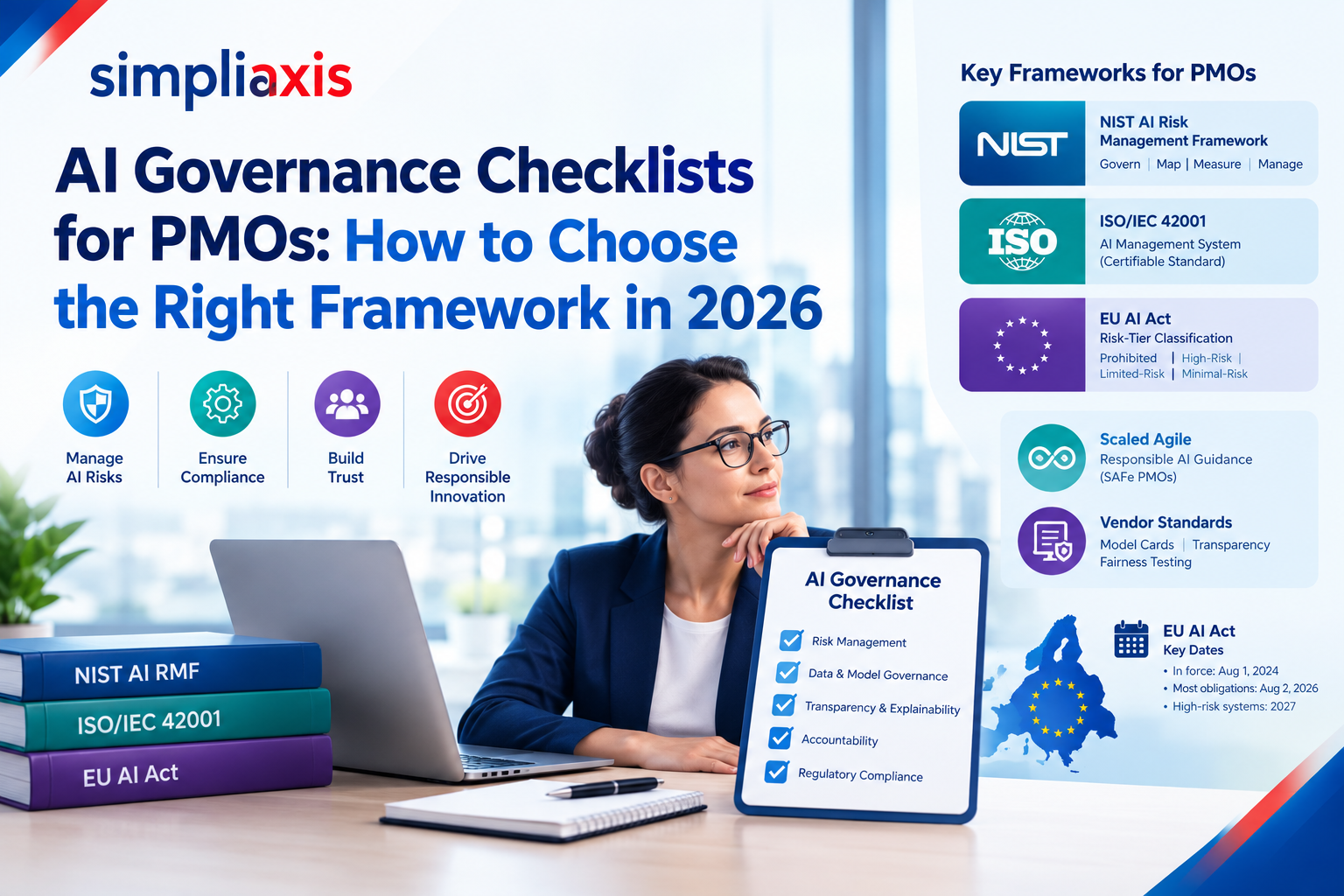
The best AI governance checklists for PMO adoption in 2026 combine three anchor frameworks: the NIST AI Risk Management Framework (Govern, Map, Measure, Manage), ISO/IEC 42001 for a certifiable AI management system, and the EU AI Act's risk-tier classification for any PMO operating in or selling into Europe. A PMO does not need to adopt all three at once. Most mid-market organizations start with NIST AI RMF as an internal operating checklist, then layer ISO 42001 certification on top only if a client or regulator specifically requires third-party assurance. The right starting point depends on whether your organization needs internal discipline, external certification, or legal compliance in a specific region.
Key Highlights of Best AI Governance Checklists for PMO
- NIST released the AI Risk Management Framework on January 26, 2023, and it remains the most widely referenced voluntary AI governance checklist in the United States
- ISO/IEC 42001, published in December 2023, is the first international standard for a certifiable AI management system
- The EU AI Act entered into force on August 1, 2024, with most obligations applying from August 2, 2026, and high-risk system obligations phasing through 2027
- NIST's AI RMF is structured around four functions: Govern, Map, Measure, and Manage, which map cleanly onto how a PMO already runs risk registers and stage gates
- The three major frameworks are complementary, not competing. ISO 42001 provides management system structure, NIST provides risk function structure, and the EU AI Act adds legally binding obligations inside its jurisdiction
- Organizations mature in NIST AI RMF typically find ISO 42001 certification largely a documentation and audit exercise, not new program work
Why PMOs Need an AI Governance Checklist Now, Not Later
If your PMO has approved even one project involving a large language model, a predictive model, or an AI-powered vendor tool, you already have an AI governance gap whether or not anyone has named it yet. Most PMOs still route AI-related work through the same intake process built for traditional software projects, and that process does not ask the right questions.
AI projects carry risks a standard project charter does not capture: model drift after deployment, training data bias baked in before anyone reviews the output, and unclear accountability when an AI system makes a wrong call that affects a customer. A generic project risk register was never built to catch any of these, because it was designed for problems with a clear cause and a clear owner, and AI failures often have neither at first glance. PMO leaders holding a Program Management Professional (PgMP) certification already have the program-level governance instincts this gap calls for, they just need to point them at AI-specific risk categories.
Regulation is also catching up quickly, and it is no longer a distant compliance concern. The EU AI Act entered into force on August 1, 2024, and most of its obligations apply from August 2, 2026. If your organization operates in or sells into Europe, that deadline is close enough to matter for this year's PMO roadmap, not a future planning cycle you can defer.
This guide ranks the AI governance checklists and frameworks worth building into your PMO intake and stage-gate process in 2026, what each one actually requires, and how to sequence adoption without stalling every AI project behind a compliance bottleneck nobody asked for.
Quick Comparison: AI Governance Frameworks for PMOs
| Framework | Type | Best For | Key Structure |
| NIST AI Risk Management Framework | Voluntary US framework | Internal operating checklist, fastest to adopt | Govern, Map, Measure, Manage functions |
| ISO/IEC 42001 | Certifiable international standard | Organizations needing third-party audit assurance | Formal AI management system (AIMS) requirements |
| EU AI Act | Binding regulation | Any PMO operating in or selling into the EU | Risk-tier classification: prohibited, high-risk, limited-risk, minimal-risk |
| Scaled Agile Responsible AI guidance | Agile-specific micro-credential | SAFe PMOs embedding governance into existing ceremonies | Applied within existing SAFe roles and events |
| Vendor-published responsible AI standards | Procurement due-diligence signal | Screening AI tools and vendors during sourcing | Model cards, transparency documentation, fairness testing disclosure |
1. NIST AI Risk Management Framework (AI RMF)
The NIST AI RMF is the most practical starting point for most PMOs because it is voluntary, free, and structured around four functions your PMO likely already has some version of: Govern, Map, Measure, and Manage.
Govern establishes the organizational environment and accountability structures for responsible AI. Map identifies context and potential risks for a specific AI use case before development starts. Measure tracks performance, bias, and risk indicators once a model is running. Manage covers ongoing risk response and incident handling after deployment.
Federal contractors and several US regulators, including the FTC and the SEC, now reference NIST AI RMF principles in their enforcement guidance, even though formal adoption remains voluntary. That gives the framework real weight beyond its non-binding status.
PMO adoption checklist:
- Add a Govern-stage question to your project intake form: who is accountable for this AI system's outcomes?
- Add a Map-stage risk category specifically for AI use cases, separate from your standard project risk register
- Require a Measure-stage monitoring plan before any AI feature goes live, not after
- Build a Manage-stage incident response path specifically for AI failures, distinct from standard IT incident response
2. ISO/IEC 42001 AI Management System
ISO/IEC 42001, published in December 2023, is the first international standard built specifically for managing AI systems at an organizational level, and it is certifiable through third-party audit, unlike NIST's voluntary framework.
The standard follows the same clause structure as other ISO management system standards like ISO 27001, covering top management commitment, internal audit, management review, and corrective action. If your PMO has already run an ISO 27001 or ISO 9001 certification cycle, most of that documentation discipline transfers directly.
PMO adoption checklist:
- Map your existing quality or security management system documentation against ISO 42001's clause structure before starting from scratch
- Assign a named AI management system owner inside the PMO, distinct from your general project sponsor structure
- Schedule an internal audit cycle specifically for AI-related projects, even before pursuing formal certification
- Pursue full certification only once a client or regulator specifically requires third-party assurance, since certification adds audit cost without changing your actual risk posture. Portfolio-level PMOs already running Lean Portfolio Management certification training can fold this decision into their existing investment governance cadence rather than treating it as a separate initiative
3. EU AI Act Risk-Tier Classification
The EU AI Act is not a voluntary checklist. It is binding regulation, and it classifies AI systems into four risk tiers: prohibited, high-risk, limited-risk, and minimal-risk. Each tier carries different obligations for providers and deployers.
Most obligations apply from August 2, 2026, with high-risk system obligations phasing in through 2027. A PMO evaluating any AI-powered vendor tool or building any AI feature for a European market should classify the use case against these tiers at intake, not after the project is already underway.
PMO adoption checklist:
- Add an EU market question to every project intake form: does this AI system touch EU users, employees, or data?
- Classify each AI use case against the four risk tiers before development begins, not retroactively
- Flag high-risk classified systems for a mandatory legal and compliance review gate before any budget approval
- Track the phased 2026 to 2027 obligation timeline against your existing project roadmap so compliance deadlines do not surprise a live project
4. Scaled Agile Responsible AI Guidance
For PMOs running SAFe, governance frameworks work better when embedded into ceremonies teams already run rather than added as a separate compliance layer. Scaled Agile's guidance on responsible AI focuses on exactly this: weaving AI risk checks into existing PI planning, system demos, and inspect-and-adapt events instead of creating a parallel governance track.
PMO adoption checklist:
- Add an AI risk checkpoint to your PI planning agenda for any epic involving an AI capability
- Include AI-specific risk items in your existing program-level RAID logs rather than a separate AI risk register
- Use inspect-and-adapt sessions to review AI-related incidents or drift alongside standard delivery retrospectives, a practice Simpliaxis covers in more depth in its Generative AI for Agile Leaders training
Simpliaxis's Achieving Responsible AI with SAFe micro-credential builds this exact capability for SAFe-based PMOs.
5. Vendor-Published Responsible AI Standards
Beyond government and standards-body frameworks, major cloud and software vendors publish their own responsible AI standards, and PMOs sourcing AI tools should check whether a vendor follows one before approving procurement. These standards typically cover fairness testing, transparency about model limitations, and human oversight requirements built into the vendor's own development process.
Checking a vendor's published responsible AI standard is not a substitute for your own governance checklist, but it is a fast due-diligence signal during procurement. A vendor with no public responsible AI documentation at all is a reasonable amber flag during your Map-stage risk assessment under NIST AI RMF. PMO leads building this discipline into their own team often pair it with SimpliAxis's AI-Native Foundations certification training, so vendor due diligence sits inside a formal AI competency practice rather than an ad hoc checklist one person remembers to run.
PMO adoption checklist:
- Add a vendor responsible AI documentation check to your procurement checklist for any AI-powered tool
- Request the vendor's model card or system documentation before approving a new AI integration into a live project
- Treat the absence of published responsible AI documentation as a risk flag requiring extra scrutiny, not an automatic disqualifier
How to Sequence Adoption Without Stalling Every AI Project
A common PMO mistake is trying to implement all four frameworks simultaneously, which creates a compliance bottleneck that stalls every AI project waiting for sign-off. A more workable sequence, built around your actual exposure rather than every framework at once:
- Start with NIST AI RMF as your internal operating checklist. It costs nothing to adopt and gives your intake process the four core functions it is currently missing. Most PMOs can add the Govern and Map questions to an existing intake form within a single sprint.
- Add vendor due-diligence checks immediately. Since most PMOs are consuming AI capability through third-party tools rather than building models in-house, checking a vendor's published responsible AI documentation during procurement is one of the fastest wins available with almost no process overhead.
- Layer EU AI Act risk-tier classification onto intake immediately if you operate in or sell into Europe. The 2026 deadline is close enough that this cannot wait for a future planning cycle, and retrofitting classification onto an already-approved project is far more disruptive than screening at intake.
- Pursue ISO 42001 certification only when a client or regulator specifically requires it. Certification adds audit overhead without changing your actual governance discipline if you have already implemented NIST AI RMF well, so treat it as a response to external pressure, not a default next step.
- Embed the checkpoints into existing ceremonies, not a new parallel process. Whether you run SAFe, standard Agile, or waterfall gates, AI governance checks belong inside your existing stage gates, not bolted on as a separate approval chain that teams learn to route around.
The organizations that get this wrong usually make one of two mistakes: they either ignore AI governance until a regulator or client forces the issue, or they build such a heavy compliance layer that teams quietly stop reporting AI use to avoid the paperwork. Neither outcome actually reduces risk. The goal is a checklist light enough that project teams actually use it every time, not a document that exists mainly to satisfy an audit once a year.
The 6-Question Checklist to Add to Every Project Intake Form
Pulling the frameworks above together, most PMOs can capture 80 percent of the governance value by adding these six questions to their existing project intake form, rather than building four separate approval workflows.
- Who is accountable for this AI system's outcomes? This answers NIST's Govern function and should name a person, not a team.
- Does this AI system touch EU users, employees, or data? This triggers EU AI Act risk-tier classification before development starts, not after.
- What risk tier does this use case fall into? Prohibited, high-risk, limited-risk, or minimal-risk, following the EU AI Act's classification even for non-EU projects, since the exercise itself surfaces risks worth knowing about regardless of jurisdiction.
- What is the monitoring plan once this goes live? This answers NIST's Measure function and should exist before launch, not get added after an incident.
- Has the vendor published responsible AI documentation? For any third-party AI tool, missing documentation is a flag requiring extra scrutiny during procurement.
- Where does this checkpoint live inside our existing ceremonies? PI planning, sprint review, or a standard stage gate, so the check does not become a parallel process teams route around.
A PMO that consistently asks these 6 questions at intake captures most of the practical benefit of NIST AI RMF, EU AI Act awareness, and vendor due diligence without building a separate governance bureaucracy that competes with delivery speed. Review the checklist itself every two quarters, since AI regulation and vendor standards are both moving fast enough in 2026 that a static checklist written once will fall out of date within a year.
Conclusion:
AI governance doesn't have to slow your PMO down, it just needs to live inside the process you already run, not beside it. Start with the six-question intake checklist, add EU AI Act classification only if Europe is in scope, and treat ISO 42001 as a later step, not a first one. The PMOs that get this right build the discipline into the team first, which is why many pair this rollout with Simpliaxis's AI-Native Foundations certification training to formalize AI competency across the portfolio. Review your checklist every two quarters, 2026's regulatory pace won't wait for a stale one.







 Lowest-Price Challenge












 Personalized Path



.webp)


 USA
 Canada
 India
 UK
 Australia
 Singapore


