


 Call Us




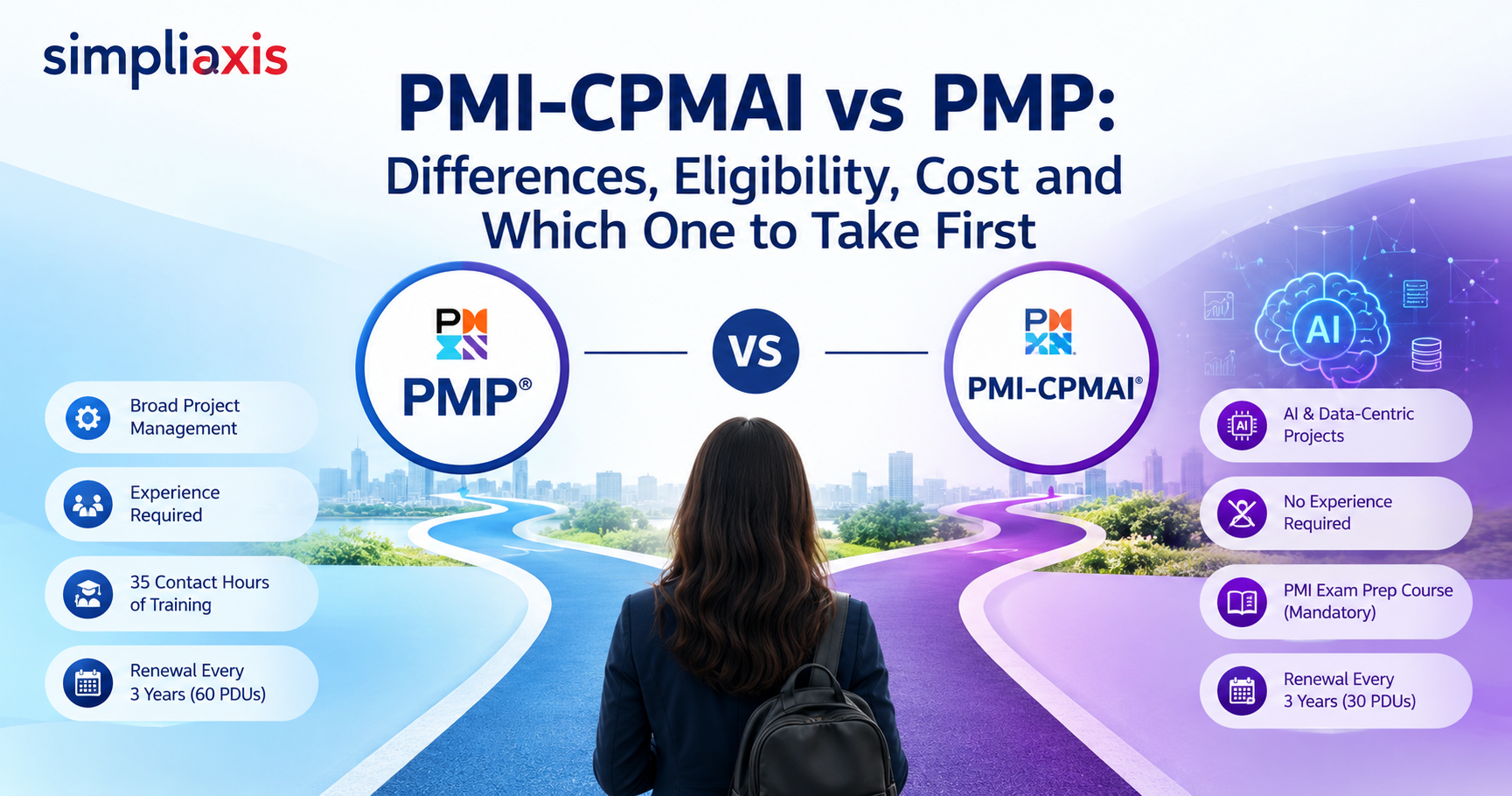
Project managers are being asked a new question: you run projects well, but can you run an AI project? PMI now offers two credentials that sound related and solve different problems. The PMP is a broad, experience-based certification for managing projects of any kind. The PMI-CPMAI is a newer certification for managing AI and data-driven projects, and it has no experience requirement.
This guide compares the two side by side: what each one proves, who can apply, what the exams look like, how renewal works and how to decide which one to take first. It also explains when it makes sense to hold both. Where figures come from PMI, they should be rechecked on PMI's site before you pay, because exam details and fees change.
Key Highlights of CPMAI vs PMP
- The PMP proves broad project management competence across predictive, agile and hybrid work. The PMI-CPMAI proves you can lead AI and machine learning projects using a six-phase method.
- The PMP requires project leadership experience and 35 contact hours of training. The PMI-CPMAI requires completing PMI's exam prep course and has no experience prerequisite.
- Both are PMI credentials that must be renewed every three years, using PDUs.
- They are complementary. Many professionals earn the PMP first for a broad foundation and add the PMI-CPMAI when AI work arrives.
- Choose by your current work: general delivery leadership points to the PMP, an AI or data initiative on your desk points to the PMI-CPMAI.
What Are PMI-CPMAI and PMP? A Direct Answer
The PMP (Project Management Professional) is PMI's flagship certification for experienced project managers, and the PMI-CPMAI (PMI Certified Professional in Managing AI) is PMI's newer certification for people who lead AI and data projects. One covers how to run projects in general. The other covers how to run a specific, harder-to-manage kind of project.
PMI describes the PMP on its page for the PMP certification and the AI credential on its page for PMI-CPMAI. The CPMAI method was originally developed outside PMI and came into PMI's portfolio after PMI acquired Cognilytica in 2024, which is why older study material still uses the name CPMAI without the PMI prefix. Our article on whether PMI-CPMAI is worth it covers that history and the value question in more detail.
PMI-CPMAI vs PMP at a Glance: Comparison Table
The table summarises the main differences. Treat numbers as a snapshot and confirm them with PMI.
| Factor | PMI-CPMAI | PMP |
| Focus | Leading AI, machine learning and data-centric projects | Managing projects of any type and industry |
| Method | Six-phase CPMAI approach, built on the CRISP-DM data project process with iteration | Predictive, agile and hybrid approaches, aligned with PMI's current standards |
| Experience required | None beyond completing the exam prep course | 36 months leading projects with a four-year degree, or 60 months without one |
| Training required | PMI's PMI-CPMAI exam prep course, mandatory before the exam | 35 contact hours of project management education, or a CAPM |
| Exam size | 120 questions, of which 100 are scored | 180 questions |
| Exam length | 160 minutes | About four hours, with breaks, under the July 2026 outline |
| Renewal | 30 PDUs every three years | 60 PDUs every three years |
| Best for | Project managers, product owners, analysts and data leads who run AI initiatives | Project managers who want a broad, senior credential |
Two details deserve care. The PMP exam length is 230 minutes in older materials and 240 minutes under the outline that took effect in July 2026, so check which version a source describes. And the PMI-CPMAI exam changed substantially in 2025, so any guide that lists 100 questions in 120 minutes is describing the retired version.
PMI-CPMAI vs PMP Eligibility and Prerequisites
This is the biggest practical difference. The PMP is gated by experience. The PMI-CPMAI is gated by a course.
PMP eligibility
To apply for the PMP you need either a four-year degree and 36 months of experience leading projects, or a secondary diploma and 60 months, plus 35 hours of project management education. A CAPM can stand in for the education requirement. Our guide to PMP certification requirements walks through how experience is counted, and the overview of how to get PMP certified covers the application steps.
PMI-CPMAI eligibility
For the PMI-CPMAI you must complete the PMI-CPMAI exam prep course before you can schedule the exam. There is no requirement for prior project management, AI or coding experience. That makes it accessible to people early in their careers, and also to experienced managers who have never led an AI project.
PMI-CPMAI vs PMP Exam Format and Syllabus
The exams test different things. The PMP tests how you behave as a project leader. The PMI-CPMAI tests how you run the stages of an AI project.
What the PMP exam covers
The July 2026 outline reorganised the PMP's three domains: People, Process and Business Environment, with Business Environment gaining weight. Questions are scenario based and span predictive, agile and hybrid work. Our guide to the 2026 PMP exam content outline explains the changes and the new weightings.
What the PMI-CPMAI exam covers
Based on PMI's September 2025 content outline as recorded by our team, the exam has five domains.
| PMI-CPMAI domain | Approximate weight |
| Support Responsible and Trustworthy AI Efforts | 15% |
| Identify Business Needs and Solutions | 26% |
| Identify Data Needs | 26% |
| Manage AI Model Development and Evaluation | 16% |
| Operationalize the AI Solution | 17% |
Business needs and data needs together make up just over half the exam, which tells you something about the credential. It spends more time on whether an AI project should be done and whether the data exists than on algorithms. You can test your understanding with the PMI-CPMAI practice test.
What You Actually Learn: Methodology and Skills Compared
The PMP teaches a toolkit that applies to almost any project: stakeholder engagement, scheduling, cost, risk, quality, team leadership and governance, in predictive and agile styles. Our overview of project management methodologies shows how those styles differ.
The PMI-CPMAI teaches a single method for a particular type of work. The phases are Business Understanding, Data Understanding, Data Preparation, Model Development, Model Evaluation and Model Operationalization. The approach builds on the well-known CRISP-DM process for data projects, and it is deliberately iterative: if a model reveals a data problem, the team goes back to the data phases instead of pushing on. That is the core difference from a fixed-scope project. In AI work, scope and feasibility are discovered during delivery, a point our article on why enterprise AI pilots stall develops.
Neither credential makes you a data scientist. The PMI-CPMAI teaches management-level understanding of machine learning, data readiness and responsible AI, so that you can ask the right questions, not build the models.
PMI-CPMAI vs PMP Cost, PDUs and Renewal
Costs have several parts: PMI's fees, the training you choose and any membership. Check PMI's pricing before budgeting because fees vary by region and change over time.
| Cost item | PMI-CPMAI | PMP |
| PMI exam fee | Bundled with the mandatory exam prep course at PMI's list prices | Separate exam fee, lower for PMI members |
| Training | Exam prep course is mandatory. Instructor-led training is optional | 35 contact hours required, usually through a provider |
| PDUs earned from training | 21 PDUs from the training course | Varies by course |
| Renewal | 30 PDUs every three years | 60 PDUs every three years |
Renewal is worth planning for. If you hold the PMP, the PDUs you earn from AI-related learning can count toward renewal, which makes the PMI-CPMAI a reasonable way to keep learning while you maintain the PMP. PMI's rules on which activities count change, so verify them in PMI's current handbook.
Which Should You Take First? A Decision Guide by Role
Use your current work, not job title prestige, to decide.
| Your situation | Suggested choice | Why |
| Managing general projects and want a recognised senior credential | PMP | It validates broad delivery leadership |
| Just been handed an AI or machine learning initiative | PMI-CPMAI | It teaches the method for that specific work |
| Early career with no project leadership experience yet | PMI-CPMAI or CAPM first | The PMP's experience requirement is not met yet |
| Product owner or analyst working on data products | PMI-CPMAI | Experience is not required and the method fits the work |
| Already hold a PMP and AI work is growing | Add the PMI-CPMAI | It builds on your foundation and counts toward development |
| PMO or portfolio leader overseeing several AI pilots | Consider both | Governance and delivery both matter |
If you are unsure, ask which question you hear more often at work: "can you deliver this?" or "can you deliver this AI project?". The first is a PMP question and the second is a PMI-CPMAI question.
Can You Hold Both? A Sensible Certification Path
Yes, and many people do. A common path is PMP first for a broad foundation, then PMI-CPMAI when AI projects become part of the portfolio. The reverse can also work for people entering project work through data teams: PMI-CPMAI first because it has no experience requirement, then the PMP once the experience hours are built up.
Other certifications fit into the same picture. If you work in agile teams, our comparison of PMP vs PMI-ACP explains how the agile credential sits beside the PMP. If you are just starting out, the guide to CAPM vs PMP shows how the entry-level credential leads to the PMP.
Beyond certification, practical skills matter. Short courses such as generative AI for project managers teach how to use AI tools in day-to-day project work and prompt libraries give starting points. Those are different from the PMI-CPMAI, which is about managing AI projects, not using AI as a productivity tool.
Career Value: What Each Credential Signals to Employers
The PMP is widely recognised in many markets as evidence of project leadership. The PMI-CPMAI is newer, so fewer job descriptions name it, and its value depends on whether your organisation runs AI projects. Be wary of claims that quote a precise salary uplift for either credential. Pay depends on role, industry, location and experience, and many published figures come from training providers.
A more reliable way to judge value is to look at the jobs you want. Search for roles in your market, note which credentials appear and how often, and compare. Our article on AI in project management shows where the profession is heading, and the piece on AI in project portfolio management covers the portfolio view. A credential helps most when it matches work you are already doing or about to do.
Three Realistic Scenarios: How Different Professionals Should Choose
Abstract advice only goes so far, so here are three fictional professionals and how the reasoning applies to each.
| Professional | Situation | Likely choice | Reasoning |
| Meera, delivery manager | Eight years running ERP rollouts, now asked to lead a demand-forecasting model project | PMI-CPMAI | She already has the delivery foundation and lacks the AI project method. She can later add a PMP if she wants the broader credential |
| Arjun, business analyst | Four years in analytics teams, no formal project leadership role yet | PMI-CPMAI, then PMP later | He cannot meet the PMP experience requirement yet, but he can apply the AI method in his current work |
| Sofia, PMO director | PMP holder overseeing a portfolio that now includes six AI pilots | PMI-CPMAI | Her broad credential is in place. The gap is a common method for judging AI project health |
In each case the deciding factor is a gap in the person's current toolkit, not the status of the credential. Meera and Sofia are missing method. Arjun is missing experience hours. That is also a good test for you: write down the gap you are trying to close, and choose the certification that closes it.
Another useful check is the time horizon. If your next role change is likely to involve AI work within a year, the PMI-CPMAI is timely. If your next move is into a general program or portfolio leadership role in a regulated industry, the PMP may carry more weight with hiring managers who screen for it. Neither choice locks you in, since the two credentials are designed to coexist, but sequencing them well saves money and effort.
How to Prepare: Study Approach for Each Certification
The two exams reward different preparation, so do not reuse one study plan for both.
| Preparation area | PMP | PMI-CPMAI |
| Starting point | Official exam content outline, then a structured course | PMI's mandatory exam prep course, then supporting practice |
| Core skill to build | Judging the best action in a project scenario | Applying the six phases to an AI project scenario |
| Heaviest topics | People, Process and Business Environment, with agile and hybrid questions | Business needs and data needs, which together carry about half the exam |
| Practice style | Long scenario sets, matching and graphic questions | Scenario questions about phase decisions, data readiness and evaluation |
| Common trap | Memorising terms without practising judgement | Treating it as a technical exam and skipping the business framing |
| Review habit | Full-length timed mock exams | Walking a real or imagined AI project through all six phases |
For the PMP, most of the work is learning to read a scenario, spot what is really being asked and choose the response a professional project leader would give. Practice with full mock exams and review every wrong answer for the reasoning, not only the result.
For the PMI-CPMAI, the most useful exercise is to take one AI idea, for example predicting equipment failure, and write what you would do in each phase: the business question and success measure, the data you would need, how you would prepare it, how the model would be built and evaluated, and how it would run in production with monitoring. If you can do that for one example, you are close to the exam's way of thinking.
Whichever credential you choose, allow time to refresh your knowledge before the exam date and recheck PMI's current exam content outline, since both exams have changed recently. Using study material written for an older version is one of the most common avoidable mistakes.
Common Mistakes When Choosing Between PMI-CPMAI and PMP
- Treating them as substitutes. One does not replace the other.
- Using outdated exam details. Old CPMAI guides describe a retired exam, and pre-2026 PMP guides miss the new outline.
- Taking the PMI-CPMAI with no AI work in sight. The skills fade without practice.
- Assuming the PMP is easier to get. Its experience requirement can take years to meet.
- Expecting technical depth. The PMI-CPMAI is about managing AI projects, not building models.
- Ignoring renewal. Both need PDUs every three years.
- Choosing by fee alone. The better choice is the one that fits your work in the next two years.
Conclusion
The PMP and the PMI-CPMAI answer different questions. The PMP shows you can lead projects of any kind. The PMI-CPMAI shows you can lead AI and data projects through an iterative method, with no experience requirement. Choose the PMP for broad leadership credibility, choose the PMI-CPMAI when AI work is in front of you, and consider both if your career is moving toward AI-enabled delivery.
Move into AI project leadership: Prepare for PMI's AI credential with the PMI-CPMAI certification training.
Build a broad project management foundation: Prepare for the PMP with the PMP certification training.






 Lowest-Price Challenge












 Personalized Path



.webp)


 USA
 Canada
 India
 UK
 Australia
 Singapore


