


 Call Us




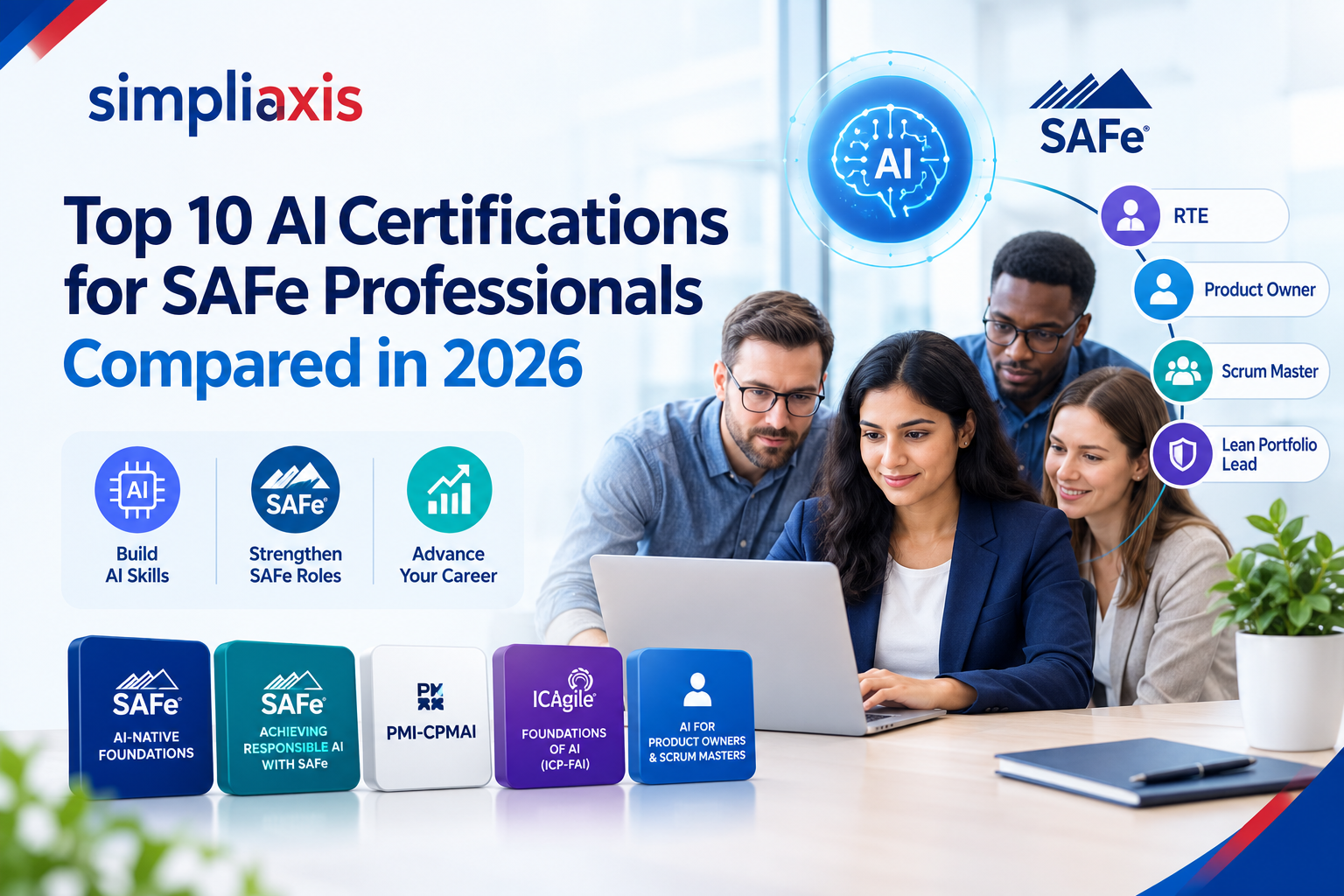
The top AI certifications for SAFe professionals in 2026 center on Scaled Agile's own AI-Native Foundations and Achieving Responsible AI with SAFe credentials, paired with role-specific training like AI for Product Owners, AI for Scrum Masters, and PMI-CPMAI for professionals who also own AI project delivery. If you already hold a SAFe role certification, the fastest path is layering an AI-specific microcredential onto it rather than starting over with a generic AI course built for a general business audience. Your best pick depends on your SAFe role: Release Train Engineers need portfolio-level AI governance training, while Product Owners and Scrum Masters need tool-level and team-adoption training instead.
Key Highlights of AI Certifications for SAFe Professionals
- Scaled Agile has built AI-specific offerings directly into the SAFe ecosystem rather than treating AI as an external add-on, including AI-Native Foundations and Achieving Responsible AI with SAFe
- PMI acquired Cognilytica in September 2024, and PMI-CPMAI now carries 21 PDUs, relevant for SAFe professionals who also hold a PMP
- ICAgile's Foundations of AI (ICP-FAI) works as a vendor-neutral layer underneath any SAFe role, since it does not assume Scrum Alliance or Scaled Agile-specific vocabulary
- Role-specific AI microcredentials, including AI for Product Owners and AI for Scrum Masters, target the two SAFe roles that interact most directly with day-to-day AI tool adoption
- Most SAFe professionals benefit more from one applied, role-specific AI certification than from a generic AI overview course disconnected from their actual ceremonies
- The EU AI Act's phased obligations through 2026 and 2027 make governance-focused certifications, not just tool-usage ones, increasingly relevant for Release Train Engineers and Lean Portfolio leads
Why AI Certifications Look Different Inside a SAFe Organization
A generic AI certification teaches you how AI tools work in isolation. It does not teach you how to introduce an AI capability into a Program Increment without disrupting the cadence your Agile Release Train already runs on, or how to explain a model's risk profile during a system demo to business owners who care about outcomes, not architecture.
That gap matters more inside SAFe than in a loosely structured Agile team, because SAFe organizations run on synchronized cadences across multiple teams. An AI adoption effort that ignores PI planning, the Lean Portfolio, and existing value stream structures creates friction that a standalone AI course never prepares you to navigate, and that friction shows up as delayed features or confused stakeholders rather than a clean rollout.
Scaled Agile has responded by building AI-specific offerings directly into the SAFe ecosystem rather than leaving practitioners to bolt on external, disconnected AI training. This guide compares the ten AI certifications worth considering if you already work inside, or are building toward, a SAFe role in 2026, ranked by how directly each one connects back to the ceremonies and artifacts you use every Program Increment.
Quick Comparison: 10 AI Certifications for SAFe Professionals
| Certification | Issuing Body | Best SAFe Role Fit | Format |
| SAFe AI-Native Foundations | Simpliaxis | RTEs, Product Managers | Instructor-led or self-paced |
| Achieving Responsible AI with SAFe | Scaled Agile | RTEs, Lean Portfolio leads | Micro-credential, applied within SAFe ceremonies |
| AI for Product Owners | Simpliaxis | Product Owners | Self-paced microcredential |
| AI for Scrum Masters | Simpliaxis | Scrum Masters | Self-paced microcredential |
| Generative AI for Product Owners & Managers | Simpliaxis | Product Owners, Product Managers | Instructor-led |
| Generative AI for Agile Leaders | Simpliaxis | Agile coaches, RTEs | Instructor-led |
| PMI-CPMAI | PMI | RTEs and Product Managers who own AI project delivery | Self-paced, proctored exam |
| ICAgile Foundations of AI (ICP-FAI) | ICAgile | Any SAFe role needing vendor-neutral AI literacy | Accredited course, competency assessment |
| Certified Artificial Intelligence for Agile Leaders | Simpliaxis | Scrum Masters, Agile coaches leading team AI adoption | Instructor-led with applied exercises |
| Prompt Engineering Certification | Simpliaxis | Any SAFe role using AI tools daily | Self-paced or instructor-led |
1. SAFe AI-Native Foundations
This is Scaled Agile's own foundational AI credential, built specifically for teams operating inside a SAFe implementation. It covers how AI changes value stream design, team topology, and program-level planning, connecting directly to concepts SAFe practitioners already use rather than treating AI as a bolt-on external topic disconnected from daily work.
The curriculum walks through how AI capabilities get planned as features and enablers inside a Program Increment, how AI-related dependencies get surfaced during PI planning, and how to communicate AI risk to business owners in the same system demo format used for standard features. That grounding in existing SAFe artifacts is what separates it from a generic AI overview course.
Best for: Release Train Engineers and Product Managers who need a shared AI vocabulary across an entire Agile Release Train.
Simpliaxis delivers AI-Native Foundations certification training built around this framework.
2. Achieving Responsible AI with SAFe
Where AI-Native Foundations covers the "what," this micro-credential covers the "how do we govern it responsibly" question, weaving AI risk checkpoints directly into PI planning, system demos, and inspect-and-adapt sessions instead of building a separate compliance track.
With AI regulation like the EU AI Act phasing in obligations through 2026 and 2027, this credential gives RTEs and Lean Portfolio leads a practical way to fold compliance checkpoints into ceremonies they already run, rather than standing up a parallel governance process that competes with delivery speed.
Best for: Release Train Engineers and Lean Portfolio Management leads accountable for AI risk across a program.
Simpliaxis offers the Achieving Responsible AI with SAFe micro-credential for exactly this role.
3. AI for Product Owners
Product Owners sit closest to day-to-day feature decisions, and this microcredential focuses on using AI tools for backlog refinement, acceptance criteria drafting, and translating stakeholder input into testable stories faster.
The training covers where AI genuinely speeds up story writing versus where it introduces ambiguity a human reviewer needs to catch, since a poorly drafted acceptance criterion that slips through review costs far more time downstream than it saves at the drafting stage.
Best for: Product Owners who want practical AI tool fluency mapped directly onto backlog management work.
Simpliaxis's AI for Product Owners microcredential course targets this exact use case.
4. AI for Scrum Masters
Scrum Masters increasingly use AI for sprint retrospectives synthesis, identifying recurring blockers across sprints, and drafting facilitation materials. This microcredential focuses squarely on that layer of the role rather than general AI literacy that does not connect back to daily facilitation work.
The training covers practical applications like clustering retrospective feedback into themes automatically, spotting patterns across multiple sprints that a single retrospective would miss, and drafting agenda materials that free up facilitation time for the actual team conversation rather than logistics.
Best for: Scrum Masters who want to apply AI directly to team facilitation and delivery coaching.
Simpliaxis offers the AI for Scrum Masters microcredential course for this purpose.
5. Generative AI for Product Owners & Managers Training
This broader instructor-led program goes deeper than the microcredential above, covering generative AI use across the full product management lifecycle, from discovery through roadmap communication, for professionals who own product strategy rather than just backlog execution.
Where the AI for Product Owners microcredential focuses on execution-level backlog tasks, this training extends into strategic work: synthesizing customer research with AI assistance, drafting roadmap narratives for executive stakeholders, and using AI to pressure-test prioritization decisions before they reach a PI planning session.
Best for: Product Owners and Product Managers who want a comprehensive, instructor-led AI curriculum rather than a shorter microcredential.
Simpliaxis's Generative AI for Product Owners & Managers training covers this scope.
6. Generative AI for Agile Leaders Training
Built for Agile coaches and RTEs guiding AI adoption at the program or portfolio level, this training covers change management alongside tool usage, addressing the organizational resistance that often blocks AI adoption more than the technology itself.
Rolling out AI across an entire Agile Release Train involves more than a tool announcement. Different teams adopt at different speeds, some resist entirely, and a rollout that ignores this variance usually stalls halfway through a Program Increment. This training addresses sequencing, communication, and how to measure adoption progress without creating a compliance burden that slows delivery.
Best for: Agile coaches and RTEs leading AI adoption across multiple teams, not just one Scrum team.
Simpliaxis delivers Generative AI for Agile Leaders training for this scope.
7. PMI-CPMAI
PMI-CPMAI matters for SAFe professionals who also own end-to-end AI project delivery, not just tool adoption inside existing ceremonies. PMI acquired Cognilytica, the credential's original creator, in September 2024, and the certification now carries 21 PDUs toward PMP renewal, relevant if you hold both a SAFe role and a PMP.
The seven-module curriculum covers business alignment, data infrastructure, iterative model development, and responsible operationalization, a scope that goes well beyond feature-level AI tool adoption into owning an AI initiative's full delivery lifecycle, including the governance work that follows deployment.
Best for: Release Train Engineers or Product Managers who also own full AI project lifecycle delivery outside standard SAFe feature work.
Simpliaxis offers CPMAI certification training and a CPMAI practice test for exam preparation.
8. ICAgile Foundations of AI (ICP-FAI)
This vendor-neutral credential from ICAgile works well as a foundation underneath any SAFe role, since it does not assume Scaled Agile-specific vocabulary and instead builds general AI literacy that transfers across any Agile context, including teams that later move between Scrum, Kanban, and SAFe implementations over a career.
Best for: Any SAFe practitioner who wants a lighter, framework-agnostic AI foundation before layering on SAFe-specific training.
Simpliaxis runs the ICAgile Foundations of AI (ICP-FAI) certification training for this path.
9. Certified Artificial Intelligence for Agile Leaders
This credential targets the harder half of AI adoption: leading a team through the change, not just using the tools individually. It addresses resistance, skill gaps across a team, and sequencing AI adoption so it does not disrupt delivery mid-sprint, which is often the part a purely technical AI course skips entirely.
Best for: Scrum Masters and Agile coaches responsible for rolling out AI adoption across their own team.
Simpliaxis delivers this as Certified Artificial Intelligence for Agile Leaders training.
10. Prompt Engineering Certification
Every role on this list benefits from reliable, repeatable AI output, and this foundational skill sits underneath all the certifications above. Knowing how to structure prompts consistently affects the actual quality of AI-assisted work across every SAFe ceremony, from sprint planning summaries to PI planning readiness reports.
Best for: Any SAFe professional already using AI tools daily who wants measurably better, more consistent output.
Simpliaxis runs a dedicated Prompt Engineering course covering this in depth.
How to Choose Based on Your SAFe Role
Match your certification to what you are actually accountable for inside your Agile Release Train, not to a generic ranking that treats every SAFe role the same way.
- Release Train Engineers and Lean Portfolio leads should start with Achieving Responsible AI with SAFe, since governance and risk accountability sit squarely in this role, and the phased EU AI Act obligations through 2026 and 2027 make this timing relevant now rather than later.
- Product Owners get the most direct value from the AI for Product Owners microcredential, since it maps onto backlog work they do every sprint, not a theoretical AI overview they have to translate into their own context afterward.
- Scrum Masters should start with AI for Scrum Masters, then layer on Certified Artificial Intelligence for Agile Leaders if they are also driving team-wide adoption, not just personal tool use for their own facilitation work.
- Anyone who also owns full AI project delivery outside standard feature work should add PMI-CPMAI on top of their SAFe-specific credential, since the two cover genuinely different scopes rather than overlapping content.
A mistake worth avoiding: choosing a generic AI certification with no connection to SAFe ceremonies simply because it is cheaper or faster to complete. A credential disconnected from PI planning, value streams, and your existing role structure teaches concepts you then have to re-translate into your actual work yourself, which defeats much of the point of getting certified in the first place. The strongest signal a certification will actually help you is whether its curriculum references PI planning, system demos, or value streams by name, rather than treating AI as a topic that exists independently of how your organization actually delivers work.
Conclusion:
AI certifications for SAFe professionals are most valuable when they solve a real gap in your role rather than simply adding another credential to your profile. RTEs and Lean Portfolio leaders may benefit more from responsible AI and governance training, while Product Owners and Scrum Masters can gain immediate value from role-specific AI courses.
Professionals managing larger AI initiatives may also find PMI-CPMAI useful alongside their SAFe experience. Before choosing, check the course content, assessment method, renewal requirements, and how closely it connects with the work you actually do. The right AI certification should help you apply AI more confidently within your existing SAFe responsibilities not make your learning path unnecessarily complicated.







 Lowest-Price Challenge











 Personalized Path



.webp)


 USA
 Canada
 India
 UK
 Australia
 Singapore


