


 Call Us



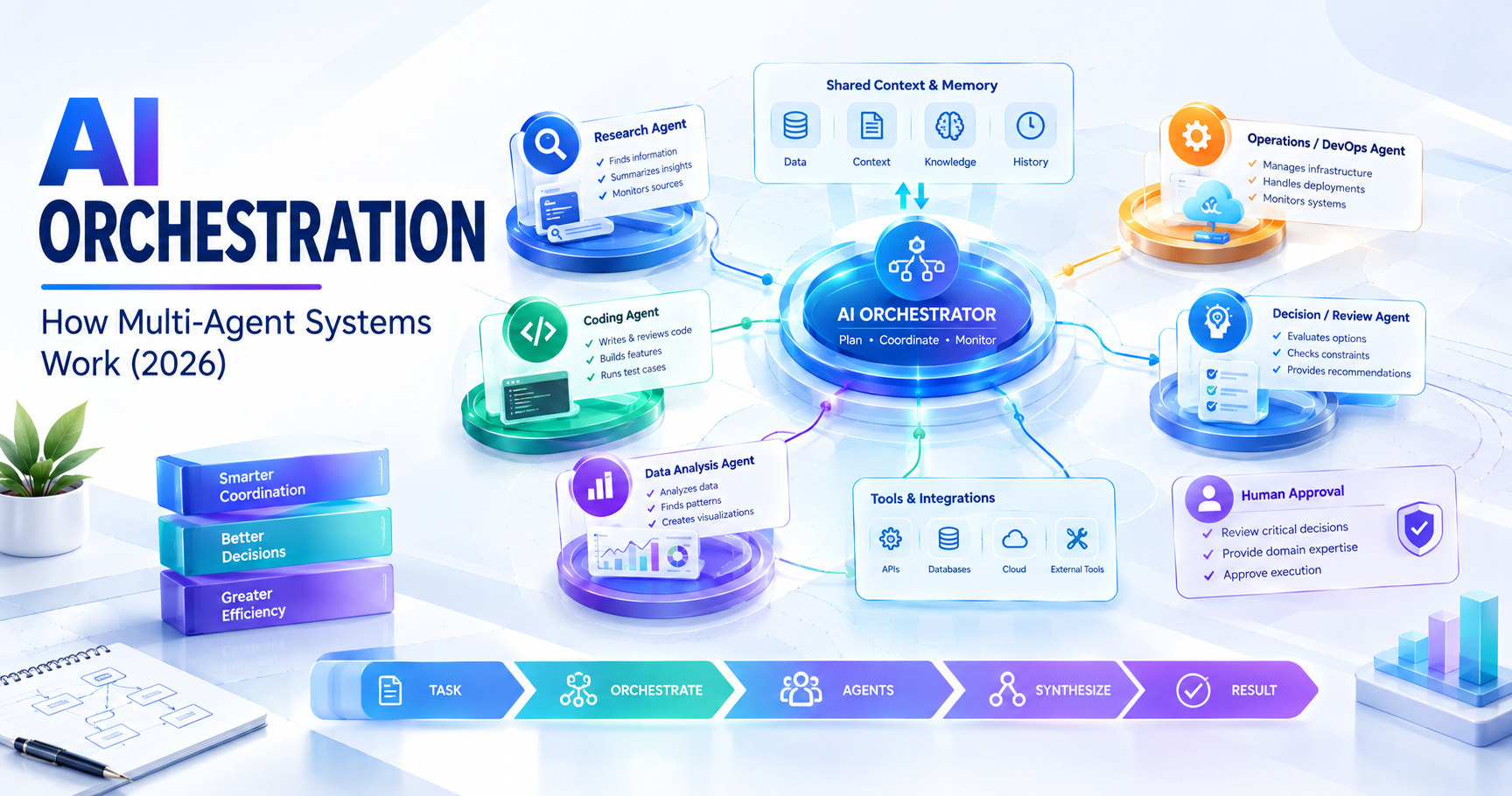
AI orchestration is the coordination layer that manages multiple specialized AI agents so they work together on a task no single agent could handle alone, deciding which agent acts, in what order, with what shared information, and where a human needs to approve or intervene. It sits above individual agents, similar to how a conductor coordinates musicians who each play their own instrument. Production orchestration in 2026 typically runs on frameworks like LangGraph, CrewAI, and AutoGen, and Gartner projects that over 40 percent of enterprise applications will embed task-specific AI agents by the end of 2026.
Key Highlights of AI Orchestration
- Orchestration only matters once you have two or more agents that depend on each other. A single agent answering questions does not need it.
- Multi-agent system inquiries surged 1,445 percent between Q1 2024 and Q2 2025, one of the sharpest adoption curves recorded in recent enterprise AI history.
- Orchestration is distinct from RAG (retrieval), workflow automation (deterministic, no reasoning), and single-agent chatbots (no coordination between systems).
- The four major production frameworks in 2026 are LangGraph, CrewAI, AutoGen, and Microsoft's Agent Framework, each with different strengths for control versus flexibility.
- Despite the hype, McKinsey research shows only about 23 percent of organizations experimenting with AI agents have actually scaled them across the enterprise.
What AI Orchestration Actually Means
Think of orchestration the way you would think of an actual orchestra. Each musician (agent) is genuinely skilled at their own instrument, but without a conductor deciding who plays when, at what volume, and in what sequence, you get noise, not music. AI orchestration is that conductor role, applied to software: a coordinating layer that decides which specialized agent runs next, what information they share, how tool calls get dispatched, and when a human needs to step in and approve a decision.
This distinction matters because the term "AI agent" gets used for very different levels of sophistication. An individual AI agent perceives, reasons, and acts toward a goal. Orchestration is what happens once you have several of those agents, a planner, a researcher, an executor, a verifier, and need them to hand off work reliably rather than stepping on each other.
AI Orchestration vs RAG vs Single-Agent Chatbots
These three terms get confused constantly, and the confusion causes real project scoping mistakes.
| Concept | What it actually does | When you need it |
| RAG (Retrieval-Augmented Generation) | Retrieves relevant documents and feeds them into a single AI response | When accuracy depends on grounding answers in your own data, not general model knowledge |
| Single-agent chatbot | Responds to one prompt at a time, no independent multi-step action | Simple Q&A, support, or lookup tasks with no complex workflow behind them |
| AI orchestration / multi-agent system | Coordinates several specialized agents across a multi-step task with handoffs and shared state | Complex workflows exceeding one agent's context, expertise, or ability to act alone |
For a deeper look at how a single agent works before layering on coordination, see our guide on agentic AI vs generative AI, and our broader primer on what is agentic AI.
The Core Patterns Behind AI Orchestration
- Sequential orchestration: one agent's output feeds directly into the next, like a research agent handing findings to a drafting agent, which hands its draft to an editing agent. Simple and reliable, but slower.
- Parallel orchestration: multiple agents run simultaneously on independent subtasks, with a synthesis agent combining results, faster when subtasks are genuinely independent, but harder to debug when they are not.
- Hierarchical orchestration: a top-level agent manages mid-level agents, who in turn manage smaller specialist agents, mirroring a typical company org chart. Strong for scaling to hundreds of agents with clear oversight.
- Event-driven orchestration: agents activate in response to real-world triggers, a production error, an incoming support ticket, rather than a fixed schedule, enabling near-real-time response instead of waiting for a human to notice a problem.
- Federated orchestration: independent systems or organizations collaborate through standardized protocols without fully sharing private data or internal logic, a newer 2026 pattern for cross-company agent collaboration.
The AI Orchestration Production Stack
A working orchestration system in 2026 typically layers together several distinct components, not just "an AI model."
- Specialist agents: usually 3 to 8 agents, each with a focused prompt, tool access, and narrow responsibility, rather than one agent trying to do everything.
- Multi-layer memory: working memory for the current task, semantic memory in a vector database for retrieval, and episodic memory for tracking what happened across a longer session.
- A tool dispatcher: the layer that routes agent decisions into real actions, calling APIs, executing code, running searches, or hitting internal company services.
- An LLM router: choosing which underlying model handles which task, since a smaller, cheaper model is often sufficient for routine steps while a larger model handles complex reasoning.
- Observability and evaluation: logging, tracing, and testing that catches an agent behaving unexpectedly before it causes damage, arguably the single most under-invested layer across real deployments.
Standards like the Model Context Protocol (MCP) are increasingly the connective tissue here, letting an orchestrated system access external tools and data sources through a shared, interoperable standard rather than custom integration code for every tool.
Real AI Orchestration Use Cases by Industry
Customer Onboarding in Banking
A common example: one agent verifies documents, another checks credit scores, a third generates the agreement, and a final agent sends the welcome email, each working independently but in a fixed, orchestrated order, with the whole chain running without manual triggers at each step.
DevOps Incident Response
Multi-agent orchestration has been shown to transform incident response, with one study finding a 100 percent actionable-recommendation rate in trials, compared to just 1.7 percent for single-agent approaches, a striking gap that shows why coordination, not just capability, is often the real bottleneck.
Healthcare Multidisciplinary Reasoning
Frameworks now bring together agents dedicated to medical imaging analysis, patient history retrieval, and treatment planning to support multidisciplinary reasoning, echoing how a real tumor board of human specialists collaborates on a difficult case.
Coding Agents and Software Delivery
Orchestration-based coding assistants internally decompose a request into subtasks delegated to worker agents, a pattern behind tools built by Anthropic, Cognition, and others. For teams applying this to delivery and reporting work specifically, see our guide on AI in Agile.
Why AI Orchestration Became a 2026 Priority
For most of 2024 and 2025, "AI agents" mostly meant a single assistant looping over tools: search, write, call an API, repeat. Useful for demos, but it breaks down fast once you need something reliable, scalable, and auditable across a real business workflow.
Enterprise platforms now expose robust APIs, and cloud-native architectures allow real-time data exchange, which is exactly what makes it feasible for agents to operate across multiple systems rather than staying isolated inside one tool. Adobe's 2026 enterprise AI report found 75 percent of organizations cite data integration and quality as the top challenge in implementing agentic AI, which is really an orchestration problem in disguise: the model is rarely the bottleneck, the plumbing between systems is.
Choosing an AI Orchestration Framework
The right framework depends on your team's technical capacity and how much control versus flexibility you need.
- LangGraph: strong for complex, stateful workflows where you need fine-grained control over how agents transition between steps.
- CrewAI: organizes agents into role-based "crews," a natural fit for teams that think in terms of job functions rather than low-level state machines.
- AutoGen (Microsoft): built for event-driven, scalable agent systems, with both a high-level conversational API and a lower-level Core API for teams needing precise control over message routing.
- Microsoft Agent Framework: designed for organizations needing strong governance out of the box, including policy-as-code, cost control, and audit logging for compliance-heavy environments.
Building in-house gives maximum customization but carries real engineering overhead and a higher error rate on first deployment. Most teams moving fast in 2026 start with a proven open-source framework rather than building an orchestration layer from scratch.
Common AI Orchestration Failure Modes
Most orchestration problems are not about model capability. They are architectural.
- Conflicting optimization goals: one agent optimizes for speed, another for safety, a third for completeness, and they can conflict without anyone realizing it until the output is already wrong.
- Partial state visibility: each agent sees only part of the system state, so small inconsistencies, one agent calling an API, another overriding the result, a third caching outdated information, accumulate silently.
- Invisible orchestration risk: in most deployed systems, worker agents and end users do not know an orchestrator exists behind the scenes, which can suppress appropriate escalation behavior if not designed carefully.
- Over-granular decomposition: breaking a task into too many tiny agent handoffs increases the number of failure points faster than it improves specialization.
- Skipping observability until something breaks: teams that treat monitoring as an afterthought consistently struggle to diagnose why an orchestrated system produced a wrong result.
Who Builds and Owns AI Orchestration in an Organization
Ownership typically splits across three groups, and confusion about who owns what is itself a common source of failed deployments. Platform or infrastructure engineers usually own the orchestration framework and observability tooling. Application or product engineers own the individual agents and their prompts. And a governance function, sometimes formal, sometimes just a designated senior engineer, owns the guardrails: what an orchestrated system is allowed to do without human approval, and what always requires a person in the loop.
Skipping that third role is one of the most common early-stage mistakes. Teams that ship fast without assigning clear guardrail ownership tend to discover the gap only after an agent takes an action nobody intended, which is a far more expensive way to learn the lesson than defining it up front.
How to Build Skills in AI Orchestration
Orchestration sits one level above single-agent development, so it helps to have a working understanding of large language models and basic agent design before tackling multi-agent coordination. From there, the practical skills are framework fluency (LangGraph, CrewAI, or similar), state and memory design, tool integration, and evaluation pipeline construction.
Simpliaxis's Applied Agentic AI Training Course covers agent design and orchestration patterns hands-on. For professionals building specifically on Claude's ecosystem, the Agentic AI Engineering with Claude training and Claude Certified Architect - Foundations course go deeper into production-grade architecture. For those aiming at the most advanced generative AI system design roles, the Generative AI Architect Advanced Program is the natural next step.
Conclusion
AI orchestration is what turns a collection of capable individual agents into a system that can actually be trusted with a real, multi-step business process.
If you want to build these systems, Simpliaxis's Applied Agentic AI Training Course covers orchestration hands-on.
For the named, real-world deployments this coordination layer makes possible, see our companion guide, Agentic AI Examples.
Start with the failure modes above before your first build, since avoiding them is cheaper than fixing them after launch.

_1787555924.webp)






 Lowest-Price Challenge











 Personalized Path


.webp)


 USA
USA  Canada
 India
India UK
UK Australia
 Singapore


