


 Call Us



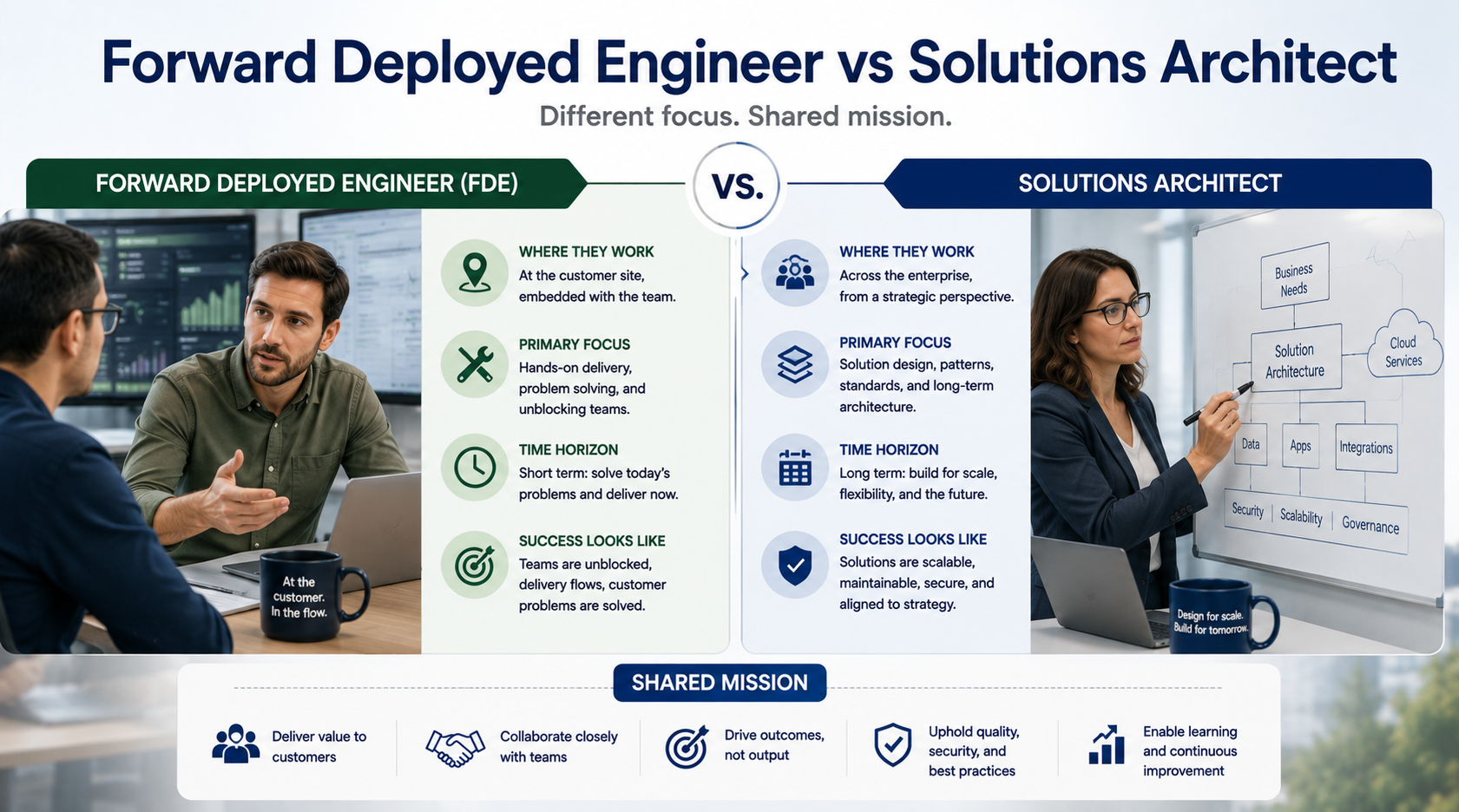
These two roles get confused more than almost any other pair in enterprise technology, and the confusion costs people real career decisions. Both are customer-facing, both are technical, both sit between a product and the organisations that use it. But they are genuinely different jobs with different centres of gravity, and mistaking one for the other leads engineers to take a role that does not match what they actually want. The short version is that a solutions architect mainly designs and advises, while a forward deployed engineer mainly builds inside the customer's environment. This piece draws the distinction properly, so you can tell which role you are looking at and which one fits you.
Getting this right matters because the two roles diverge in what you spend your days doing and what your skills become over time. If the build-heavy version appeals, the Forward Deployed Engineering Program is built for exactly that, but the honest first step is understanding how the roles differ so you choose deliberately rather than by job title alone.
Key Highlights
- A solutions architect primarily designs solutions and advises on them, while a forward deployed engineer primarily builds them inside the customer's environment.
- The defining difference is who writes the production code: the forward deployed engineer does, the solutions architect often does not.
- Both are customer-facing and technical, which is why they are confused, but their day-to-day work and skill trajectories diverge sharply.
- A solutions architect can succeed without shipping code for long stretches, while a forward deployed engineer cannot, because the deliverable is working software.
- The right choice depends on whether you want to design and guide or to build and ship, which is a genuine preference rather than a matter of seniority.
The core difference is who builds
Strip away the overlap and one distinction separates these roles cleanly: who is responsible for producing the working software. The forward deployed engineer builds it, inside the customer's environment, against their real constraints. The solutions architect designs how it should be built and advises the people who build it, which are often the customer's own team or a separate implementation group. The architect owns the design and the guidance. The forward deployed engineer owns the delivery.
This is not a small difference, it shapes everything else about the two roles. Because the architect's deliverable is a design and a set of recommendations, they can do their job largely through diagrams, documents, and conversations. Because the forward deployed engineer's deliverable is working software running in the customer's environment, they have to actually write and ship code against messy reality. One role can succeed at a whiteboard, the other cannot. When you are trying to tell the two apart, the question that cuts through is simple: does this person build the thing, or design it for others to build? That single question resolves most of the confusion, and it is the same test that distinguishes a genuine forward deployed role from a diluted one.
What a solutions architect actually does
To understand the contrast, it helps to see the solutions architect role clearly on its own terms. A solutions architect is responsible for designing how a product or technology should be deployed to solve a customer's problem. They understand the customer's requirements, map them to the capabilities of the product, design an architecture that fits, and guide the implementation, whether that implementation is done by the customer, a partner, or an internal team.
The architect's value is in the design and the judgement. They know the product deeply, they understand common patterns and pitfalls, and they can look at a customer's situation and produce a sound architecture that others then build. Much of their work is advisory: recommending approaches, reviewing designs, resolving technical questions, and ensuring the eventual implementation follows a sound plan. A strong solutions architect can be enormously valuable without personally writing the production code, because their contribution is the architecture and the guidance rather than the implementation. This is a real and skilled role, and for people who love designing systems and advising on them, it is a genuinely good fit, distinct from the build-centric forward deployed path.
What a forward deployed engineer actually does
The forward deployed engineer, by contrast, is defined by building inside the customer's environment. They embed with the customer, understand the real problem, and then actually build the solution against the customer's systems, data, and constraints. The deliverable is not a design or a recommendation, it is working software that runs in the customer's world and solves their problem.
This means the forward deployed engineer spends their time doing the full arc of delivery: discovery to understand the real problem, scoping against unfamiliar systems, building the solution, debugging it in the customer's environment, and handing it off so it lasts. It is deeply technical and hands-on, and it happens inside the messy reality of the customer rather than at a design remove from it. Where the architect can advise from a whiteboard, the forward deployed engineer has to make software actually work in an environment they do not control. This build-inside-the-customer nature is the essence of the role, and it is why the forward deployed engineer needs the whole span of skills from customer discovery through technical scoping to shipping and handoff, rather than the design-and-advise focus of the architect.
Where the two roles overlap and blur
The reason these roles get confused is that they genuinely overlap, and being honest about the overlap makes the distinction clearer rather than muddier. Both are customer-facing, so both require the ability to work with customers, understand their needs, and communicate technically. Both are technical, so both require real understanding of the product and the technology. Both sit between a product and the organisations using it, translating between what the product does and what the customer needs.
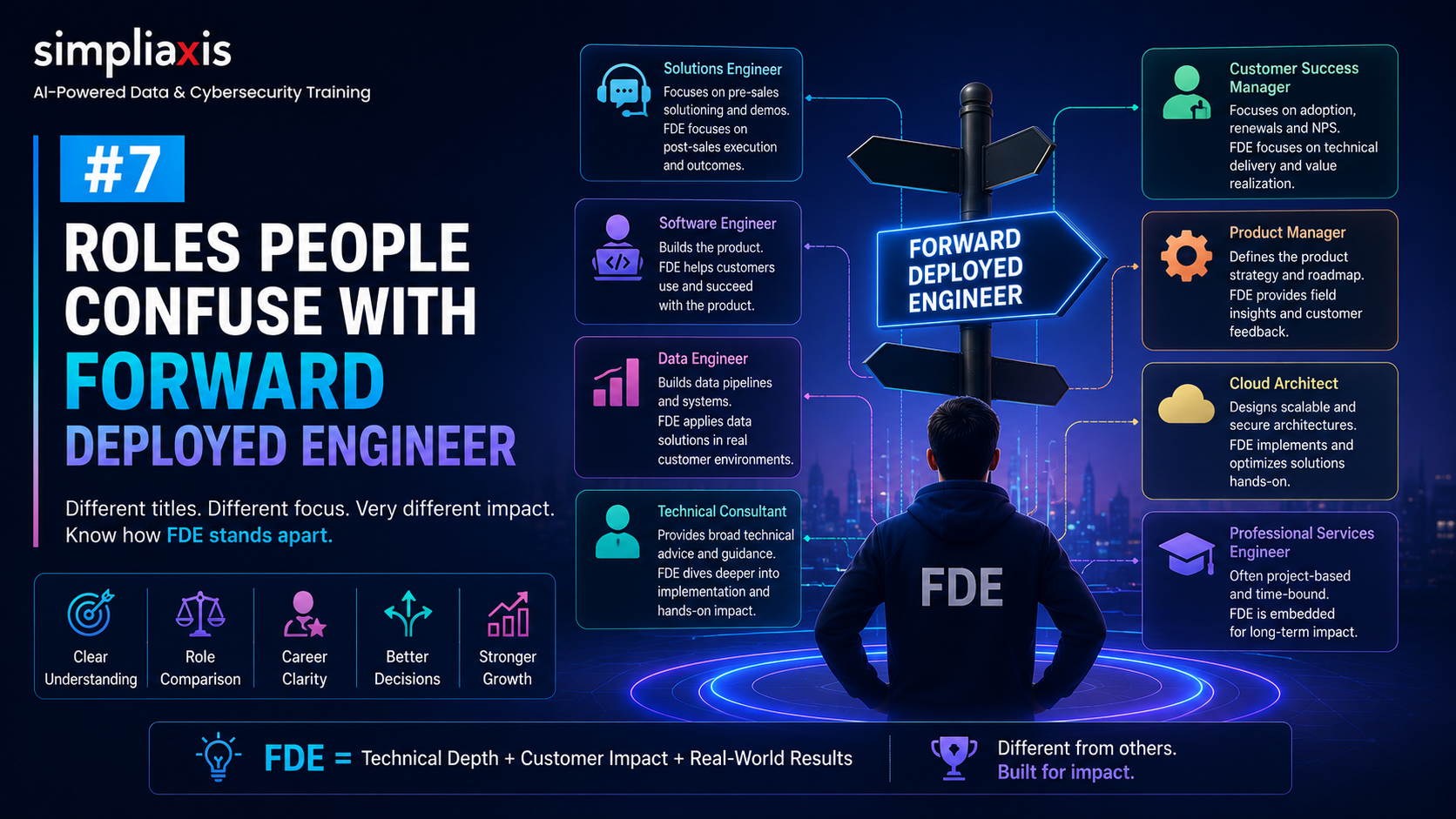
In practice, the roles can also blur at the edges. Some solutions architects do write code, especially in smaller organisations or hands-on cultures. Some forward deployed engineers do significant design work as part of their build responsibility. The titles are not standardised across companies, so one company's solutions architect may look like another's forward deployed engineer. But even with the overlap and the blur, the centre of gravity differs: the architect's centre is design and advice, the engineer's centre is building and delivery. When a specific role blurs the line, the way to resolve it is to look at where the majority of the time and the core deliverable sit, which is exactly the screening a candidate should do. This blurring is one reason the broader family of roles confused with the forward deployed engineer is worth understanding as a set.
How the skills diverge over time
Over a few years, these two roles build different professionals, and understanding the divergence helps you choose the one whose trajectory you want. The solutions architect deepens in design, architecture, and advisory judgement. They become expert at looking at a customer situation and producing a sound architecture, at knowing the product and its patterns deeply, and at guiding implementations to success. Their value grows in the direction of design wisdom and breadth of pattern knowledge.
The forward deployed engineer deepens in hands-on delivery across many environments. They become expert at building inside unfamiliar systems, at making software work against messy real constraints, at the full craft of taking a solution from problem to production in a customer's world. Their value grows in the direction of delivery capability and adaptability under real conditions. Neither trajectory is superior, they are different, and they suit different people. If you are energised by design and advice and comfortable not always being the one who ships the code, the architect path fits. If you want to build and ship and be the one who makes the thing actually work, the forward deployed path fits. Knowing which growth you want is the real basis for the choice.
A side-by-side comparison
To make the distinction concrete, here is how the two roles line up across the dimensions that matter for the decision.
| Dimension | Forward deployed engineer | Solutions architect |
| Core deliverable | Working software in the customer's environment | A design and guidance for others to build |
| Who writes production code | The engineer, as the main job | Often not, the implementation team does |
| Centre of gravity | Building and delivery | Design and advice |
| Typical week | Discovery, building, debugging, handoff | Requirements, architecture, review, guidance |
| Can succeed from a whiteboard | No, the deliverable is running software | Largely yes, the deliverable is design |
| Skill growth over time | Delivery craft across many environments | Design and architectural judgement |
| Best fit for | People who want to build and ship | People who want to design and advise |
Read the table as a way to locate a specific role and to locate yourself. A role that has you building software in the customer's environment is a forward deployed role whatever it is called. One that has you designing and advising while others build is a solutions architect role whatever it is called. And your own preference across these dimensions tells you which one to pursue.
Can you move between the two roles
A fair question for anyone weighing this choice is how reversible it is, and the encouraging answer is that movement between the two roles is common, though it is easier in one direction. A forward deployed engineer can move into solutions architecture relatively naturally, because the deep hands-on delivery experience gives them a strong foundation for design work, and having built many systems in the real world makes their architectural judgement grounded rather than theoretical. Engineers who have shipped in messy environments often make excellent architects precisely because they know what actually works in practice.
Moving the other way, from solutions architect into forward deployed engineering, is possible but requires developing or refreshing the hands-on building ability, since the architect role may not have kept those skills sharp. An architect who has spent years designing rather than building has to demonstrate they can actually ship, which is a real but bridgeable gap. This asymmetry is worth knowing, because it suggests that if you are genuinely unsure, starting on the build-heavy forward deployed side keeps more doors open, since building skills transfer readily to design but design skills do not automatically confer building ability. Either way, the two roles are close enough that the choice is not a life sentence, which takes some pressure off getting it perfect the first time. What matters most is developing real capability, and the agentic AI foundations that underpin modern forward deployed work are valuable whichever of the two roles you end up in.
Why the confusion costs people real decisions
It is worth dwelling on why getting this distinction right matters practically, because the confusion is not harmless. People take roles based on titles, and when the title does not reliably indicate the work, they can end up in a job that does not match what they wanted. An engineer who wanted to build and took a role labelled forward deployed engineer that was really a solutions architect position can find themselves designing and advising when they wanted to ship, quietly frustrated without quite knowing why. The reverse happens too, someone who prefers design ending up in a build-heavy role that leaves them uncomfortable.
This is why the screening question, does this role have me building software or designing it for others to build, is so valuable, and why understanding the distinction is worth the effort. It lets you look past the title to the actual work and choose deliberately. The titles are not standardised, so the responsibility falls on you to determine which role a given opportunity really is, and the way to do that is to ask concrete questions about how you would spend your time and what you would produce. This is the same screening discipline that protects you across the whole family of roles the forward deployed engineer gets confused with, and it is one of the most practically useful skills a candidate can develop, because it prevents the expensive mistake of optimising your career for a job that is not the one you thought you took.
Which one should you choose
The decision comes down to a genuine preference rather than a ranking, and being honest with yourself about that preference is what leads to a good choice. Ask what you actually want to spend your days doing. If the answer is designing solutions, advising on architecture, and guiding others to build, the solutions architect path is likely a better fit and you should not force yourself into a build-heavy role out of a sense that building is more prestigious. If the answer is building the thing yourself, shipping working software, and being the one who makes it work in the customer's messy reality, the forward deployed path is where you belong.
There is also a market consideration worth naming honestly. The forward deployed engineer role is currently in extraordinary demand as enterprises struggle to get AI into production, which has made it one of the most sought-after roles in technology. But demand should inform the choice, not override the preference, because taking a build-heavy role you do not actually enjoy for the market alone is how people end up well paid and miserable. If the build-centric work genuinely appeals, the demand is a strong tailwind, and building the capability through the Forward Deployed Engineering Program positions you well. If it does not, the architect path is a fine and valuable career in its own right.
There is a simple diagnostic worth carrying into any conversation about one of these roles: listen for whether the person describing it talks mostly about designs and recommendations or mostly about shipping software. The vocabulary gives the role away long before the title does, because people who design speak in artefacts and options while people who build speak in systems shipped and problems solved. Training your ear to hear that difference is a quiet but reliable way to place a role correctly, and it protects you from the mismatch that a shared job title so easily hides.
The bottom line
The forward deployed engineer and the solutions architect are confused because both are customer-facing and technical, but they differ at the core: the forward deployed engineer builds working software inside the customer's environment, while the solutions architect designs solutions and advises the people who build them. The single clearest test is who writes the production code, the engineer as the main job, the architect often not at all. Their days, their deliverables, and their long-term skills diverge from there.
The right choice is a matter of genuine preference. If you want to design and guide, the architect path fits. If you want to build and ship in the customer's real environment, the forward deployed path fits, and it happens to be in exceptional demand right now. Let the preference lead and the demand support it rather than the reverse, and if the build-centric work is what you want, develop the capability deliberately through the Forward Deployed Engineering Program so you can command the genuine version of the role rather than a diluted title.
Building the capability either way
Whichever of these two roles you choose, real technical capability is what makes you credible, and for the build-heavy forward deployed path it is non-negotiable. Developing genuine skill across the modern AI stack, through hands-on agentic AI engineering and the bridge from writing code to shipping AI features, is what lets you command the genuine version of the role rather than a diluted title. The solutions architect path values design judgement, and the forward deployed path values delivery capability, but both are strengthened by the ability to actually build, which never loses its value in a field defined by getting AI into production.








 Lowest-Price Challenge











 Personalized Path


.webp)


 USA
USA  Canada
 India
India UK
UK Australia
 Singapore


