


 Call Us



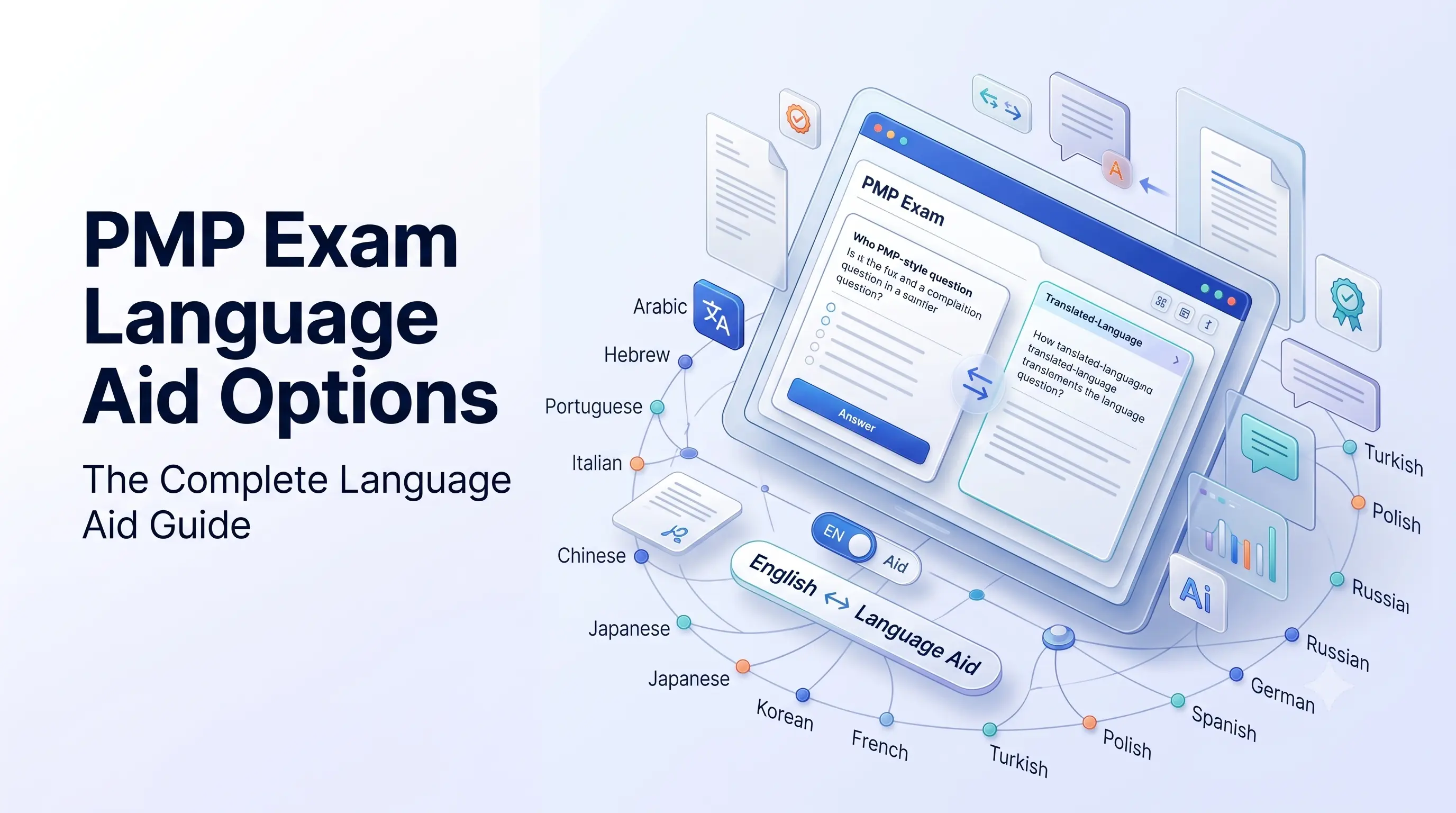
Yes, you can take the PMP exam with help in a language other than English, but not as a fully separate translated exam. PMI lets eligible candidates attach a free "language aid" to their PMP exam booking, which displays a translated version of each question and answer alongside the original English text. The exam itself is still administered in English at its core, the pre-exam tutorial and post-exam survey stay English-only, and only 14 language aid options currently exist. Whether you should use one at all depends on your own English proficiency and is a genuinely debated question among past candidates.
Key Highlights of PMP Exam Language Aids
- PMI offers a PMP exam language aid in 14 languages: Arabic, Hebrew, Brazilian Portuguese, Italian, Chinese (Simplified), Chinese (Traditional), Japanese, Korean, French, Russian, German, Spanish, Polish and Turkish.
- A language aid is not a separate translated exam. It places translated question and answer text next to or beneath the original English text on the same screen, and you can toggle back to English at any point.
- The pre-exam tutorial and the post-exam satisfaction survey are administered in English only, regardless of which language aid you select.
- There is no additional fee for a language aid. You request it during the PMP application and payment step, not on exam day.
- PMI's July 2026 PMP exam update changed the domain weightings, question count of pretest items and content emphasis, but no PMI communication or independent source reviewed for this article indicates any change to the language aid list or mechanism.
- Experienced practitioners are split on whether to actually use a language aid: it can slow you down and occasionally mistranslate a technical term, so many candidates with solid English still sit the exam English-only.
- Candidates training in English-medium programmes in India, the Middle East, Latin America and East Asia can still request a language aid at the exam itself, and the two decisions (training language and exam language aid) are entirely independent.
What Exactly Is a PMP Exam Language Aid?
A PMP exam language aid is a built-in translation overlay, not a separately written exam paper. PMI's own certification handbooks and multiple independent test-taker accounts converge on the same description: when a candidate requests a language aid, the computer-based exam displays the original English question and its answer choices, with a translated version of that same question and those same answer choices placed directly beneath or alongside it on the same screen. Some accounts describe it as a genuine split-screen view, others describe a "Translate" button that reveals the second language on demand, and the exact on-screen presentation appears to vary slightly by delivery software version, but the underlying mechanic is consistent: English stays present throughout, and the second language is layered on top of it rather than replacing it.
This distinction matters because several secondary sources blur it, implying PMI runs a fully independent Spanish exam or a fully independent Chinese exam. It does not. Every PMP exam sits on the same English item bank; the language aid is a translation layer applied to that same set of questions. A candidate who selects Spanish, for example, still sees the English original question and can switch back to it at will, and is still working from the same 180 scored and unscored questions every other candidate that day receives.
It is also worth being precise about what the aid does not cover. The pre-exam tutorial, which walks new test-takers through the software's navigation and flagging tools, is delivered in English only. The same is true of the short satisfaction survey PMI presents after the final question. Neither of those affects your score, but candidates who assume the entire testing session will be translated are sometimes caught off guard when the tutorial screens appear in English regardless of the language aid chosen.
Which Languages Does PMI Offer as a PMP Exam Language Aid?
PMI currently supports 14 second languages for the PMP exam language aid, and that list has been stable across the sources reviewed for this article, including PMI's own certification handbook language and third-party summaries from consulting.ky and Oliver Lehmann's exam-preparation resources. The table below lists every option.
Language Aid | Region Typically Associated With It |
|---|---|
| Arabic | Middle East and North Africa |
| Hebrew | Israel |
| Brazilian Portuguese | Brazil |
| Italian | Italy |
| Chinese (Simplified) | Mainland China |
| Chinese (Traditional) | Taiwan, Hong Kong |
| Japanese | Japan |
| Korean | South Korea |
| French | France, French-speaking Africa, parts of Canada |
| Russian | Russia, parts of Eastern Europe and Central Asia |
| German | Germany, Austria, Switzerland |
| Spanish | Spain, Latin America |
| Polish | Poland |
| Turkish | Turkey |
Notice which major exam markets are absent from that list. There is no dedicated Hindi, Vietnamese, Thai, Indonesian or Portuguese-for-Portugal language aid, so a candidate in India, Vietnam, Thailand or Indonesia sitting the PMP exam is working in English only unless they qualify for one of the 14 languages above through a different first language. This is a genuine gap that PMI has not closed as of this update, and candidates in those markets should plan their exam-language decision around English rather than assuming an aid exists for their mother tongue. If you are weighing your overall eligibility before you even get to the language question, Simpliaxis's guide to PMP certification prerequisites is a useful starting point, since the experience and education requirements are identical regardless of which exam language you eventually choose.
How Do You Select a Language Aid During the PMP Application Process?
You choose your PMP exam language aid when you submit your application and payment, not at the test centre and not on exam day. PMI builds the selection into the online application workflow itself, and the steps below reflect how that process runs in practice.
- Application: your project experience, education and the 35 contact hours of project management education have to be submitted first, and this part has nothing to do with language, it is the standard eligibility step covered in Simpliaxis's breakdown of the PMP certification exam pattern.
- Payment step: once your application is approved and you move to pay the exam fee, PMI's online system presents a language aid selection field as part of that same transaction.
- Language selection: pick your preferred second language from the list of 14. If you are submitting a paper application instead of the online form, the same choice is made as part of that paper submission rather than afterwards.
- Scheduling: after PMI approves your application and payment, you are directed to Pearson VUE, PMI's testing partner, to book your actual seat or online proctored slot, and Simpliaxis's PMP exam schedule guide walks through that booking flow in more detail.
- Final check: confirm the exam and language shown on the Pearson VUE confirmation screen before you finalise. Multiple candidate accounts describe being prompted to confirm both the exam and the language on the booking page, and this is your last chance to catch a wrong selection before the appointment is locked in.
There is no fee attached to choosing a language aid. PMI treats it as a standard accessibility feature of the exam rather than a paid add-on, and it is bundled into the same application and exam fee every candidate pays. The main restriction candidates report is timing rather than cost: because the choice is tied to the application and scheduling stage, it cannot be added retroactively once your exam is booked and confirmed. If you realise partway through scheduling that you want a language aid you did not originally request, the more reliable path is to contact PMI customer care before your appointment date rather than assuming it can be changed at the test centre.
Does the Language Aid Work the Same Way at a Test Centre and in an Online Proctored Exam?
The underlying language aid mechanic does not change based on where you sit the exam, since both a Pearson VUE test centre and an OnVUE online proctored session run on the same PMI exam delivery software. The visible difference candidates report is procedural rather than linguistic: in an online proctored session, the scheduling flow explicitly asks you to confirm your preferred language on a dedicated screen before the exam begins, whereas at a physical test centre that same confirmation happens earlier, during check-in and seat assignment.
No source reviewed for this article documented a substantive difference in how the translated text itself is displayed between the two formats. What does change between formats is everything unrelated to language: at a test centre, staff handle your identity check and environment; in an online proctored exam, you are responsible for a private room, a stable webcam and microphone, and an internet connection that meets Pearson VUE's minimum bandwidth requirements. If your work situation spans multiple countries or time zones, that logistical difference is often the bigger decision than the language one.
Did PMI's July 2026 PMP Exam Update Change Anything About Language Aids?
No change to language aid availability or mechanism was found in connection with PMI's July 2026 PMP exam update. That update, which took effect on 9 July 2026, rebalanced the three exam domains so that Business Environment rose from roughly 8% to 26% of scored content, while People fell from 42% to 33% and Process fell from 50% to 41%, added scenario and graphic-based question formats, introduced more AI and sustainability content, and widened the qualifying experience window from eight to ten years.
None of the PMI materials or independent breakdowns of that update reviewed for this article mention any change to the 14-language aid list, the translation display mechanic, or the process for requesting a language aid at application time. If PMI has since made an unannounced change, it has not surfaced in the sources available at the time of writing, and candidates should treat the language aid system as unchanged by the July 2026 update rather than assume otherwise.
Should You Actually Use a Language Aid? A Decision Framework
Whether to use a PMP language aid is a judgement call, not a default, and experienced practitioners disagree on the right answer. Project management educator Oliver Lehmann, whose exam-preparation resources are widely referenced in PMP candidate forums, frames the decision around one variable: your genuine, honest command of English rather than your comfort with your native language.
His guidance, echoed across PM PrepCast forum discussions and candidate blog posts, is that a candidate who reads and reasons through English technical material comfortably should sit the exam in English only, because working bilingually through every question adds time pressure without adding accuracy.
The case against a language aid, made repeatedly across forum threads on projectmanagement.com and PM PrepCast, comes down to three recurring complaints from past candidates.
- Translation quality varies question by question, and a handful of candidates report a translated phrase that shifted a question's meaning or even reversed it compared with the English original, which is disorienting mid-exam.
- Reading two versions of the same long scenario-based question takes longer than reading one, and the PMP exam is already tightly timed at 180 questions across 240 minutes under the July 2026 format.
- PMP terminology (concepts like float, crashing, fast-tracking or earned value) sometimes lacks a clean one-to-one equivalent in the target language, so the translation can introduce ambiguity around exactly the technical vocabulary the question is testing.
The case for a language aid is just as genuine for the population it is built for. Candidates who report struggling with dense, multi-clause English scenario questions, which the PMP exam relies on heavily, often find that seeing a translated version resolves confusion faster than re-reading the English three times.
Forum consensus among candidates who used a language aid successfully suggests a middle path works best in practice: read the English version first, and drop down to the translated version only when a specific sentence is unclear, rather than running every question through both languages by default. That approach preserves the safety net of a second language without paying the full time cost of double-reading every item.
A practical self-test before you decide is not "can I have a conversation in English" but "can I read a 120-word technical scenario in English, under time pressure, and correctly identify what it is asking." If that specific skill feels shaky, request the aid. If it does not, the honest answer for most candidates is that English-only is faster and safer.
What This Means If You Trained in English but Sit the Exam Elsewhere
Your training language and your exam language aid are two completely separate decisions, and candidates frequently mix the two without issue. Whether you eventually study through a general PMP certification training programme or a market-specific one, the training language you choose has no bearing on which exam-day language aid you are entitled to request. It is entirely normal, for example, for a candidate based in India to complete PMP exam preparation through an English-medium programme and still request no language aid at all, since English-medium project management training is the norm across much of South Asia, the Gulf and East Africa.
Simpliaxis's own PMP certification training for India illustrates how this works in practice: candidates are trained in English throughout, which reflects both the working language of most Indian project environments and the fact that Hindi is not itself one of PMI's 14 supported language aids, so an India-based candidate who does want a translation safety net would typically be choosing among languages tied to a different first language entirely, not their own.
The calculation looks different for candidates from Latin America, parts of the Middle East, and East Asia, where a genuinely matching language aid does exist. A Spanish-speaking candidate training through a Simpliaxis programme can still sit the PMP exam with the Spanish language aid enabled if their English reading speed under time pressure is a concern, without it affecting their eligibility, their certification, or how the credential is recognised afterwards. The certification itself carries identical global standing regardless of which language aid, if any, a candidate used, a point PMI has been consistent about across its handbooks.
This question also comes up at organisational scale, not just for individual candidates. A multinational employer or PMO standardising PMP certification across project staff spread over several countries, some working primarily in Spanish, some in Mandarin, some in Arabic, some in English, cannot assume a single training language will suit everyone, and needs a programme that can prepare a mixed-language cohort while still pointing each candidate toward the correct exam-day language aid choice for their own comfort level.
Simpliaxis's corporate group training option is built for exactly this scenario: it lets an organisation certify a distributed, multilingual team together on a consistent syllabus, while leaving each individual free to make their own English-only-versus-language-aid decision when they get to the actual PMI application step. Getting that group logistics right, and getting the language aid choice right for each person, are separate problems, and conflating them is a common planning mistake for HR and PMO teams running certification at scale.
Conclusion
The honest answer to "can you take the PMP exam in a language other than English" is yes, with an important caveat: you are getting a translation overlay on an English exam, not an independently written exam in your own language. PMI's 14-language aid list, its no-cost application-time selection process, and its English-only tutorial and survey have all stayed consistent through the July 2026 exam update, so the mechanics you read about from a candidate who sat the exam a year or two ago should still hold true today.
What has not stayed simple is the decision of whether to actually use the aid. That choice rests on a specific, testable skill (reading dense technical English quickly under pressure) rather than general fluency, and the most reliable path is to be honest with yourself about that skill before application day rather than defaulting to your native language out of comfort. Whichever way you decide, the choice affects only how the exam is presented to you on screen. It changes nothing about your eligibility, your study plan, or the credential you end up holding once you pass.






 Lowest-Price Challenge











 Personalized Path


.webp)


 USA
USA  Canada
  India
India  UK
UK  Australia
  Singapore


