


 Call Us



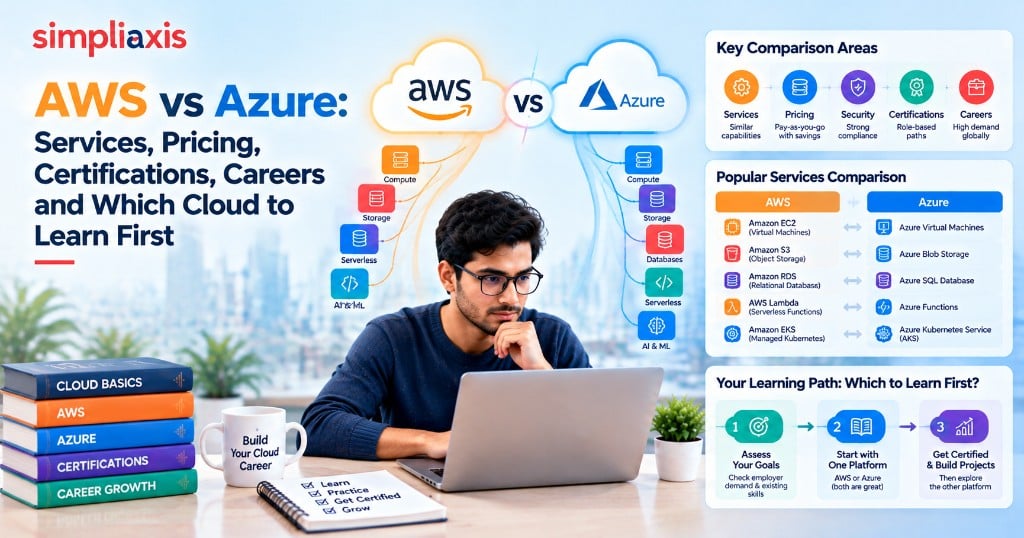
Amazon Web Services (AWS) and Microsoft Azure are the two largest cloud platforms. Both offer almost every service you are likely to need, from virtual servers and storage to databases, containers, serverless and AI. AWS is the longer-established platform with the broadest catalogue, while Azure is closely tied to the Microsoft ecosystem. The better choice depends on your employer, your existing skills and your goals, not on a single winner.
This AWS vs Azure comparison covers market position, services, pricing, security, hybrid and AI offerings, certifications and careers, and gives you a simple way to decide which to learn first.
Key Highlights of AWS vs Azure
- Synergy Research puts AWS first and Microsoft second in worldwide cloud infrastructure services, with Google Cloud third.
- The two platforms offer equivalent core services under different names, so skills transfer well between them.
- Pricing on both is pay-as-you-go with discounts for commitment, so costs depend on your design and usage more than on the platform.
- Azure often fits organisations that already use Microsoft tools such as Windows Server, SQL Server and Microsoft Entra ID. AWS often attracts startups and teams that want the widest service range.
- For learners, either is a safe start. Choose the one your target employers use, and learn the concepts that apply to both.
AWS vs Azure at a Glance: Which Cloud Is Better?
| Factor | AWS | Azure |
| Owner | Amazon | Microsoft |
| Position | Largest by market share in Synergy Research data | Second largest |
| Strengths | Broad and mature service catalogue, large community, many third-party integrations | Strong fit with Microsoft software and identity, hybrid options, enterprise relationships |
| Common users | Startups, digital-native companies, enterprises of all sizes | Enterprises with Microsoft estates, public sector, organisations using Microsoft 365 |
| Entry certifications | AWS Certified Cloud Practitioner | AZ-900 Azure Fundamentals |
| Typical learning curve | Large service catalogue to navigate | Easier if you already know Microsoft tools |
These are general tendencies, not rules. Both platforms serve every size and type of organisation. If you are new to the idea of cloud platforms, our guide to what AWS is and the cloud computing reference model give useful background, and the vendors' own pages on AWS cloud computing and Azure cloud computing explain the basics from each side.
AWS vs Azure vs Google Cloud Market Share: Who Leads in 2026?
Synergy Research Group reported that worldwide enterprise spending on cloud infrastructure services reached $143 billion in the second quarter of 2026, and that the market shares were about 28 percent for Amazon, 20 percent for Microsoft and 15 percent for Google (Synergy Research, Q2 2026). Synergy also noted that Microsoft and Google were growing faster than Amazon.
| Provider | Approximate Q2 2026 share (Synergy Research) | Common positioning |
| Amazon Web Services | About 28 percent | Broadest catalogue and longest track record |
| Microsoft Azure (Microsoft) | About 20 percent | Microsoft ecosystem, enterprise and hybrid strength |
| Google Cloud | About 15 percent | Data analytics, machine learning and Kubernetes-centred work |
Two cautions apply. First, market share studies from different firms use different definitions, so their numbers should not be mixed. Second, share is not quality. The best platform for a project is the one that fits its needs, skills and cost limits.
AWS vs Azure Services Comparison: What Is the Equivalent of Each Service?
Both platforms offer the same categories of services under different names. This table maps the common ones, and Microsoft publishes a fuller AWS to Azure services comparison on Microsoft Learn. Product names and features change, so check the current documentation.
| Category | AWS | Azure |
| Virtual machines | Amazon EC2 | Azure Virtual Machines |
| Object storage | Amazon S3 | Azure Blob Storage |
| Block storage | Amazon EBS | Azure Managed Disks |
| Relational databases | Amazon RDS, Aurora | Azure SQL Database, Azure Database for PostgreSQL and MySQL |
| NoSQL databases | Amazon DynamoDB | Azure Cosmos DB |
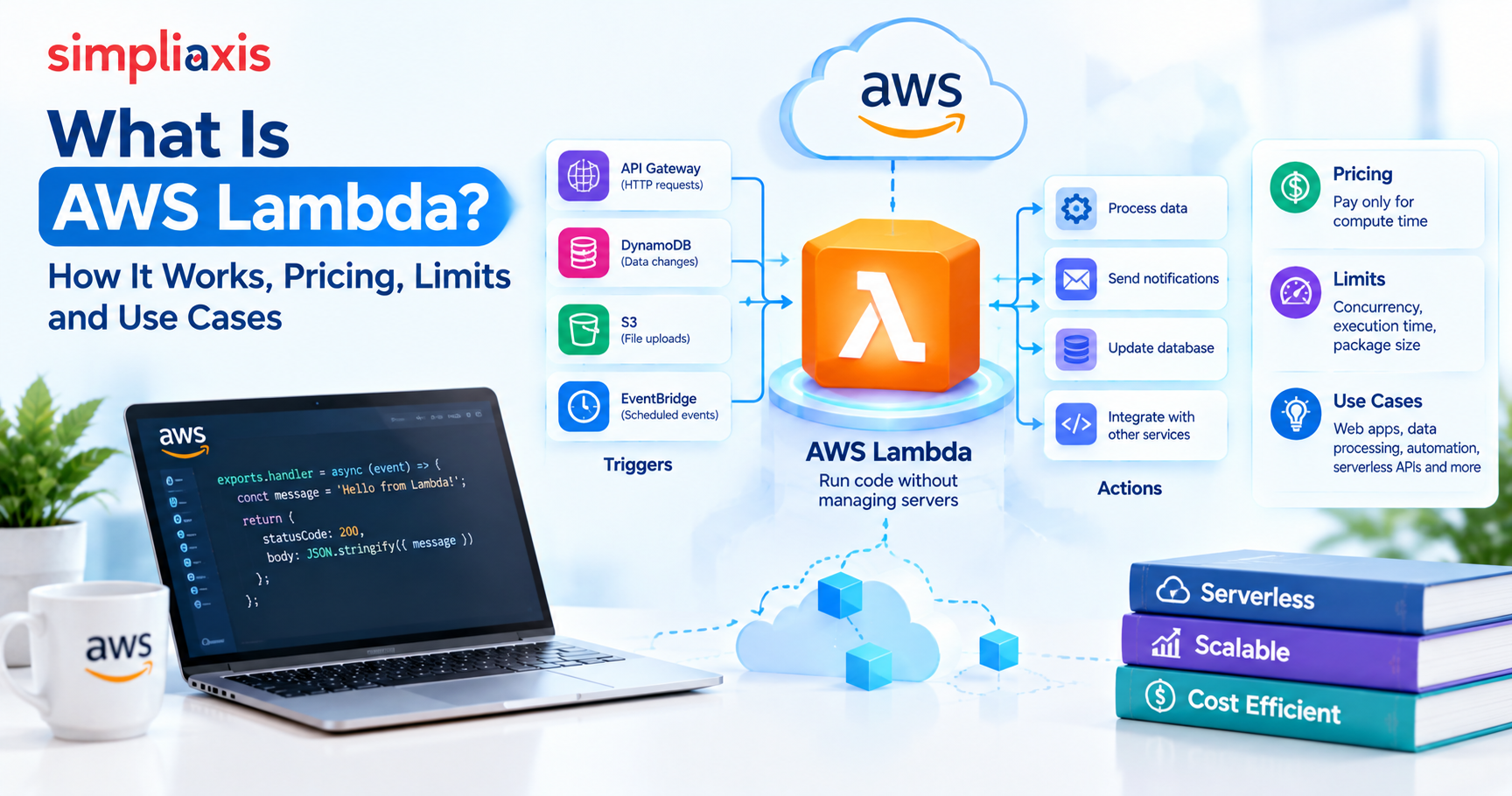
| Serverless functions | AWS Lambda | Azure Functions |
| Managed Kubernetes | Amazon EKS | Azure Kubernetes Service (AKS) |
| Virtual network | Amazon VPC | Azure Virtual Network |
| Identity and access | AWS IAM | Microsoft Entra ID and Azure role-based access control |
| Monitoring | Amazon CloudWatch | Azure Monitor |
| Infrastructure as code | AWS CloudFormation | Azure Resource Manager templates and Bicep |
| DNS | Amazon Route 53 | Azure DNS |
| Content delivery | Amazon CloudFront | Azure Front Door and Azure CDN |
| Messaging and queues | Amazon SQS, SNS | Azure Service Bus, Queue Storage, Event Grid |
| Data warehouse and analytics | Amazon Redshift | Azure Synapse Analytics and Microsoft Fabric |
If you learn the concept behind a service, for example object storage or a virtual network, you can pick up the other platform's version with little extra effort. Container skills transfer especially well, so our guides to Docker vs Kubernetes and Kubernetes basics apply on both.
AWS vs Azure Pricing: Which Cloud Is Cheaper?
Both use pay-as-you-go pricing: you pay for the resources you use, billed by time or volume, with no upfront cost. Both offer ways to lower costs.
| Pricing feature | AWS | Azure |
| Pay-as-you-go | Yes | Yes |
| Commitment discounts | Savings Plans and Reserved Instances | Reservations and Savings Plan for compute |
| Spare capacity discounts | Spot Instances | Spot Virtual Machines |
| Licence benefits | Bring-your-own-licence options | Azure Hybrid Benefit for eligible Windows Server and SQL Server licences |
| Cost estimation | AWS Pricing Calculator | Azure Pricing Calculator |
| Free offers | AWS Free Tier | Azure free account with credits and free services |
Which is cheaper depends on your workload. Compute type, region, storage class, data transfer, support plan and licensing all matter, and the two vendors adjust prices and offers often. A workload built around Windows Server and SQL Server licences may benefit from Azure's licence benefits, while others may find AWS cheaper with the right commitment plan. The only reliable method is to model your actual workload in both calculators and review real bills.
Because data transfer out of a cloud, support plans and idle resources are common sources of surprise costs, cost governance matters on either platform. Our overview of multi-cloud FinOps for AWS, GCP and Azure covers this discipline, and the article on green cloud computing shows how efficient design also reduces cost and emissions.
AWS vs Azure Security and Compliance: How Do They Compare?
Both platforms follow a shared responsibility model: the provider secures the underlying infrastructure, and you secure what you build on it, such as identities, data, configuration and applications. Both hold a broad range of industry certifications and offer tools for threat detection, key management and policy enforcement.
| Security area | AWS | Azure |
| Identity | AWS IAM, IAM Identity Center | Microsoft Entra ID, Azure RBAC |
| Key management | AWS Key Management Service | Azure Key Vault |
| Threat detection | Amazon GuardDuty | Microsoft Defender for Cloud |
| Policy and governance | AWS Organizations, Service Control Policies | Azure Policy, management groups |
| Security posture | AWS Security Hub | Microsoft Defender for Cloud |
Check each provider's compliance documentation for the standards and regions you need. For the wider security picture, see our article on cloud-native security and the DevSecOps evolution.
AWS Outposts vs Azure Arc: How Do Hybrid and Multi-Cloud Options Compare?
Many organisations run workloads both on premises and in the cloud, so hybrid tools matter.
| Aspect | AWS | Azure |
| Hybrid hardware | AWS Outposts brings AWS infrastructure to your site | Azure Stack family brings Azure services to your site |
| Management across environments | AWS Systems Manager and related tools | Azure Arc extends Azure management to servers, Kubernetes and data services elsewhere |
| Typical reason to choose | Consistent AWS experience on premises | Consistent Azure management and licensing across environments |
Azure's hybrid story is often cited as a strength for organisations mid-migration, but both are capable. Always check which services are available in your target regions and deployment model.
AWS vs Azure for AI and Machine Learning: What Does Each Offer?
Both vendors invest heavily in AI. AWS offers Amazon SageMaker for building and deploying machine learning models and Amazon Bedrock for access to foundation models. Azure offers Azure Machine Learning and Azure AI Foundry, which includes access to models through Microsoft's services. Product names and model catalogues change quickly, so verify current options before committing.
| Capability | AWS | Azure |
| Machine learning platform | Amazon SageMaker | Azure Machine Learning |
| Foundation model access | Amazon Bedrock | Azure AI Foundry |
| Pre-built AI services | Services for language, vision, speech | Azure AI services for language, vision, speech |
If AI agents are your focus, our workshops on agentic AI with AWS Bedrock and agentic AI with Azure AI Foundry show how to build on each. Our article on the impact of AI on cloud computing gives wider context.
Strengths of AWS
- Breadth and maturity. AWS has the longest history as a public cloud and a very wide service catalogue.
- Community and ecosystem. There are many tutorials, partners, tools and engineers with AWS experience.
- Flexibility for cloud-native design. It is a common choice for startups and teams building new, cloud-native systems.
- Widely recognised credentials. AWS certifications are recognised across industries, and routes such as the AWS Solutions Architect Professional training lead to senior architect roles.
Points to watch: the number of services can overwhelm beginners, and pricing and configuration options can be complex.
Strengths of Azure
- Microsoft integration. It works closely with Microsoft Entra ID (formerly Azure Active Directory), Microsoft 365, Windows Server, SQL Server and .NET tools.
- Hybrid options. Services such as Azure Arc help manage on-premises and multi-cloud resources, which suits organisations that are mid-migration.
- Enterprise relationships. Many enterprises already have Microsoft agreements, which can simplify procurement.
- Developer tools. It connects with Visual Studio, GitHub and Azure DevOps, and the Azure architect design course covers solution design at expert level.
Points to watch: service names and portals change from time to time, and some features differ in depth from their AWS equivalents.
AWS vs Azure Certifications: Which Exams Should You Take?
Both vendors offer role-based certifications at several levels. See the official AWS certification pages and the Microsoft Learn credentials catalogue for current exams.
| Level | AWS | Azure |
| Foundation | AWS Certified Cloud Practitioner | AZ-900 Microsoft Azure Fundamentals |
| Associate or administrator | AWS Certified Solutions Architect Associate, SysOps Administrator, Developer | AZ-104 Azure Administrator, AZ-204 Azure Developer |
| Advanced or expert | AWS Certified Solutions Architect Professional, DevOps Engineer Professional | AZ-305 Azure Solutions Architect Expert, AZ-400 DevOps Engineer Expert |
Exam names and codes are updated from time to time, so confirm them on the vendor's site before you register.
Simpliaxis offers training for both paths:
- AWS: the cloud computing with AWS course builds core skills.
- Azure: the AZ-104 Azure Administrator training covers day-to-day administration.
- DevOps on either platform: see our list of the best DevOps certifications.
AWS and Azure Salary and Careers: Which Cloud Has More Jobs?
Both platforms have strong demand for cloud engineers, architects, DevOps engineers and administrators. We have not found a reliable, dated source that compares AWS and Azure salaries like for like, so we do not quote figures here. Pay depends more on role, experience, location and employer than on the platform. Instead of relying on averages, look at current job listings in your city for each skill and compare the roles and ranges you see.
Practical points:
- Job demand varies by region and industry. Microsoft-heavy enterprises, banks and public sector bodies often list Azure, while product companies and startups often list AWS. Many postings list both.
- Skills transfer. A cloud engineer who is strong on one platform usually becomes productive on the other within weeks or months.
- Multi-cloud is common. Many organisations use more than one provider, so knowing the concepts that apply to both is valuable.
- Certifications help you stand out, but projects and hands-on skills carry more weight in interviews.
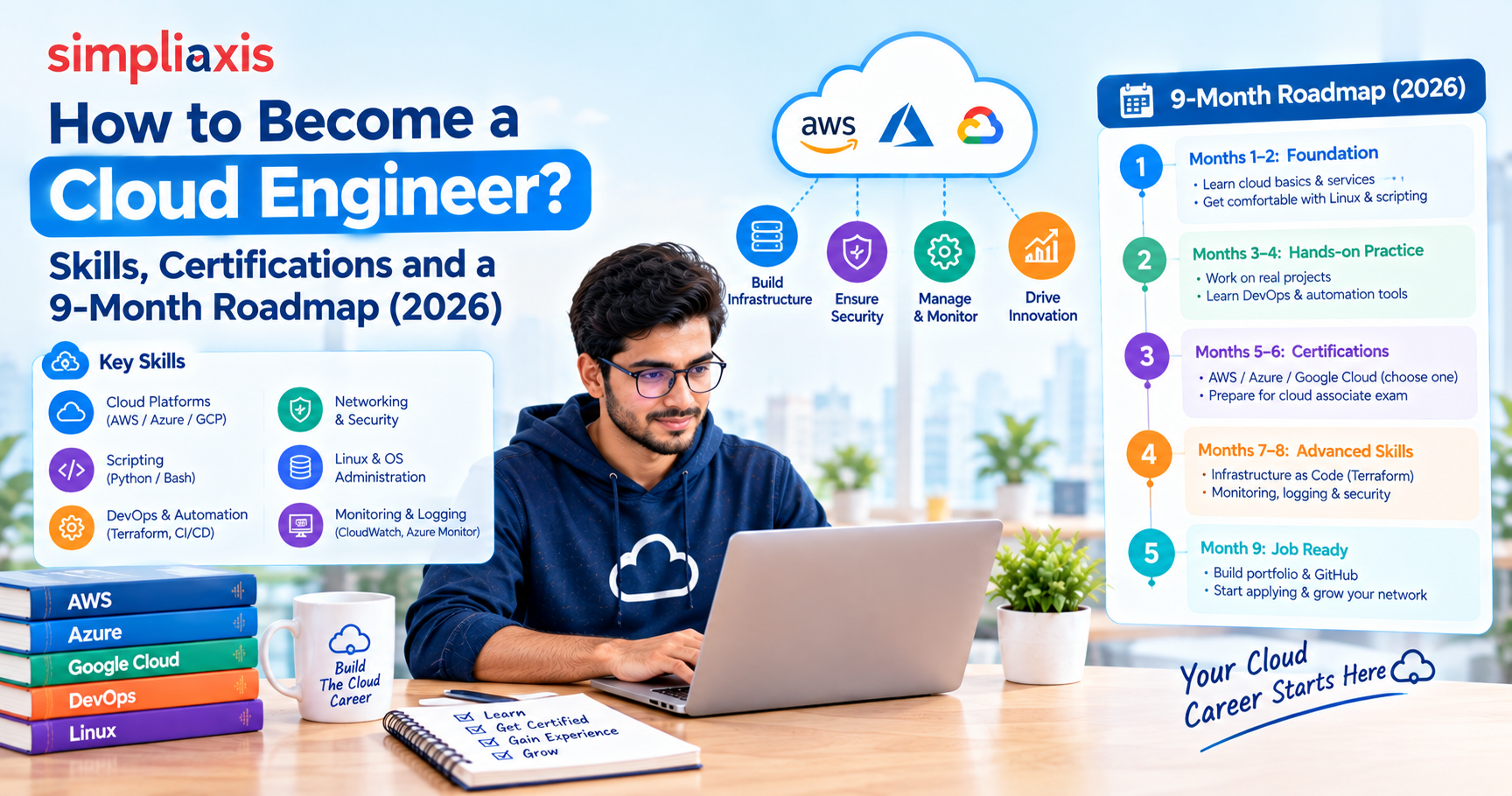
If your goal is a DevOps career, our guides on how to become a DevOps engineer and DevOps engineer roles and responsibilities show the skills that apply on either cloud.
Azure vs AWS for Beginners: Which Should You Learn First?
Use this guide.
| Your situation | Suggested starting point |
| Your employer or target employers use AWS | AWS |
| Your employer or target employers use Microsoft products | Azure |
| You work with Windows Server, SQL Server or .NET | Azure |
| You are a developer joining a startup or building cloud-native apps | AWS is a common choice |
| You are a complete beginner with no target employer | Either. Pick one, learn the concepts and build a project |
| You want to move into DevOps | Either, plus Linux, containers, Git and infrastructure as code |
| You want the widest job posting coverage in your market | Check local job listings for both and follow the data |
Start with the foundation certification of your chosen platform (our AWS Solutions Architect Associate guide shows the usual next step on AWS), build two or three small projects and then learn the equivalent services on the other platform. That gives you platform skills and cloud fundamentals together.
What Are the Most Common Mistakes When Choosing Between AWS and Azure?
- Choosing by market share alone. The right choice is the one that fits your goals and employers.
- Comparing prices without modelling the workload. Headline rates mislead.
- Learning service names instead of concepts. Concepts carry over between platforms.
- Ignoring existing licences and skills. They can change the cost and effort significantly.
- Overlooking governance. Without cost and security controls, any cloud becomes expensive and risky.
- Skipping hands-on practice. Free accounts and small labs teach more than reading.
Conclusion
AWS and Azure are both strong, mature platforms, and neither is universally better. AWS leads in market share and breadth, and Azure fits especially well with Microsoft-centred organisations. Decide by your target employers, existing skills and workload, start with one foundation certification and build real projects. The concepts you learn will carry across platforms.
Start with AWS: Learn core cloud concepts, services and pricing with the AWS Cloud Practitioner certification training.
Start with Azure: Build the same foundations on Microsoft's platform with the Microsoft Azure Fundamentals AZ-900 course.







 Lowest-Price Challenge











 Personalized Path


.webp)


 USA
USA  Canada
 India
India UK
UK Australia
 Singapore


