


 Call Us




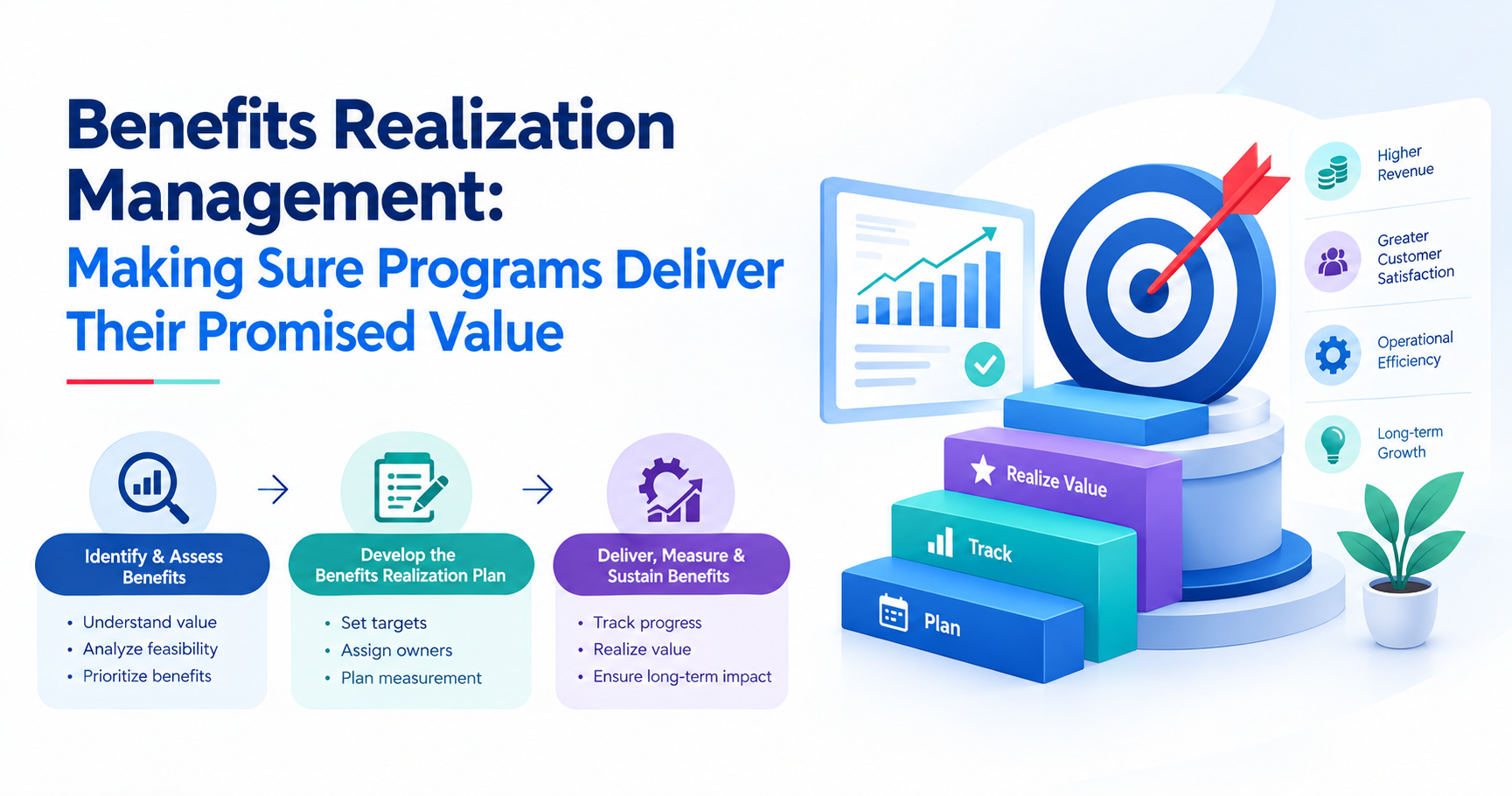
Benefits realization management (BRM) helps organizations translate their investments into tangible business outcomes. It includes articulating the benefits, planning for realization, measuring performance, and maintaining improvements after delivery.
A BRM plan identifies the benefits, assigns accountability, and indicates how they will be measured. A benefits register logs each benefit and tracks its status. Program managers who are preparing for PgMP certifications should be aware that this step is critical to program success.
Key Highlights of Benefits Realization Management
- Purpose: Connect program investments with measurable business outcomes.
- Process: Identify benefits, plan delivery, measure results, and sustain improvements.
- Ownership: Benefit owners are accountable for specific benefits, while program managers coordinate delivery across related projects.
- Measurement: Baselines, targets, and KPIs help determine whether expected improvements have occurred.
- Documentation: The benefits realization plan sets out the approach, and the benefits register tracks individual benefits.
- PgMP relevance: Benefits management supports program strategy, governance, and business value delivery.
Introduction
A company can invest heavily in new technology and still struggle to see a meaningful return. The software works, employees have completed their training, and the implementation team has moved on. Operational costs, however, continue to be high, and customers are unable to notice the difference.
And this is where benefits realization management has a part to play. It allows an organization to go further instead of just looking at projects that have been completed to determine whether their investments are making the desired impact.
In a program with multiple projects, the outcome of those projects is seldom contingent on one single deliverable. A digital transformation program might rely on new IT systems, redesigned ways of working, and business buy-in to realize its value.
By defining specific benefit targets and monitoring results, program managers can understand the gaps, inform their decisions, and remain focused on business outcomes during delivery.
What Is Benefits Realization Management?
Benefits realization management is the discipline that includes the identification, definition, planning, measuring, and realization of the business improvements and value that will accrue from a program or an investment. The benefits might be increased revenue, reduced costs, improved service, or reduced risk.
Think: invoice automation.
The input: installing the software.
The result: reducing the processing time from five days to one.
The potential benefit: 1,000 employee hours saved every year, assuming the organization has some way of quantifying the time saved.
The distinction matters: delivering a solution does not automatically create business value.
A benefits realization approach helps in finding answers to five practical questions:
- What should improve? Identify benefits that support organizational objectives.
- What will make the improvement possible? Determine the required changes and dependencies.
- Who is responsible? Assign an owner to each benefit.
- How will results be measured? Establish baselines, targets, and suitable KPIs.
- How will improvements last? Build ongoing monitoring and ownership into business operations.
The concept also clarifies the relationship between program management vs project management. Projects generally deliver defined outputs, whereas programs coordinate related projects and activities to achieve broader outcomes and benefits.
Why Benefits Realization Matters in Program Management
Program managers may not have direct authority over all of the projects, business teams, technology changes, and operational dependencies that comprise the program. The lack of delivery on objectives does not necessarily mean that the benefits have not been realized.
Imagine a bank launching a digital lending proposition. One initiative might be focused on the design of a mobile app; another might be on developing credit scoring; another on customer onboarding. The speed of loan approval hinges on all three elements.
Benefits realization management encourages keeping that link between project delivery and the rest of the business.
1. Synchronizes Programs to Business Strategy
Each program needs to correspond with a business goal, for instance, generating more profit, creating a better customer experience, or strengthening compliance. Connecting each anticipated benefit to a strategic goal allows managers to determine if the program still applies when priorities shift.
2. Improves Investment Decisions
Actual results provide much better perspective to decision makers as to whether the investment is providing the intended value.
For instance, a logistics initiative might call for Rs.2 crore of savings a year but capture only Rs.40 lakh in the pilot. In this case, rather than accepting the initial prediction, managers might analyze transportation routes, procurement contracts, and use of new procedures for clues.
3. Strengthens Accountability
Benefits are delivered when no single one of the teams taking part is the owner of delivering benefits. The program manager will be responsible for managing the process as a whole, but business leaders and managers should take ownership of benefits within their domain.
4. Makes Change Adoption Visible
A new employee self-service portal can make HR more efficient, but it has to be used by employees rather than maintained by HR staff. Monitoring adoption in combination with processing times indicates if the right ‘efficiency’ objective is being met. Successful adoption also depends on clear change management roles.
5. Promotes Better Governance
Regular benefits reviews enable sponsors and governance to identify progress, risk, dependencies, and business assumptions that have changed.
This is the point where the project vs. program distinction becomes useful: projects, on their own, provide capabilities; it is the program that organizes those capabilities to provide broader benefits.
The Benefits Realization Process and Framework
A benefits realization framework gives program teams a practical way to move from strategic objectives to measurable results. The approach generally involves three stages: identifying benefits, planning their achievement, and delivering and sustaining the improvements.
Identify and Assess Benefits
Begin by asking what the program should change for the business. Collaborate with sponsors, financial teams, other leaders of operations, and other executives; a stakeholder analysis helps determine enhancements that align with organizational objectives.
A retail program, for example, might aim to:
- Increase online sales.
- Reduce order fulfillment costs.
- Improve customer retention.
- Provide better inventory visibility.
Consider each opportunity on its cost, likelihood, time, and risk. For instance, online sales may be low risk but have to be promoted; you might need stock, a website, and access to customers.
How can this be impacted by what I do in this program plan? Am I able to do this? What resources or operations do you need to implement this? Can it have negative effects?
One benefit that significantly underpins the business strategy may warrant disproportionate weight over a secondary benefit that would be expensive and/or would not emerge.
Develop the Benefits Realization Plan
Once the expected benefits have been agreed upon, document how the program intends to achieve them.
A benefits realization plan should normally include:
- Benefit descriptions and links to business objectives.
- Baselines, targets, and KPIs.
- Benefit owners and supporting stakeholders.
- Data sources and measurement frequency.
- Expected realization dates and dependencies.
- Risks, assumptions, and constraints (track these in a risk register).
- Reporting and escalation arrangements.
- Actions required to maintain benefits after delivery.
Suppose a hospital launches an electronic medical records system. The purpose of the project is to cut record retrieval times from 10 minutes to three minutes within 6 months. The plan would list the benefit owner as the operations director, and the data collection methods, frequency of reviewing the collection, and ongoing training would be outlined.
The plan must be revised as needed by changes in the environment. If a project is late, adoption is low or the project is no longer a priority in business, update the forecast. Program governance keeps expectations reasonable.
Deliver, Measure, and Sustain Benefits
Once implementation begins, compare actual performance with the agreed targets and monitor a balanced set of project management KPIs. Instead of a single KPI, customer service programs could be monitoring the number of issues resolved, customer satisfaction, or cost per interaction.
Applying many measures discourages the wrong conclusions. Lower costs of service, for example, might be no improvement if the customers were very unhappy.
Advantages might not be noticed instantly, perhaps years later, as long as they rely on customers or employees to make use of them. Make those who own the day-to-day operations check efficiency periodically and fix issues.
However, if a program claims it will generate 1 crore in savings each year, then the savings must be verified against financial records. Installing a new system alone is not evidence that the savings have occurred.
Benefits Realization Plan: Template and Key Components
A benefits realization plan explains how the program will manage its expected business improvements. It defines success, measurement methods, ownership, and the process for responding when results fall short.
A benefits register complements the plan by recording details of each individual benefit.
Benefits Register Template
The following example shows how a customer service transformation program might track one benefit.
| Field | Example |
| Benefit ID | B-01 |
| Benefit | Reduced customer response time |
| Strategic objective | Improve customer experience |
| Baseline | Average first response time of 24 hours |
| Target | Average first response time of 8 hours |
| KPI | Average time to first response |
| Benefit owner | Customer service director |
| Data source | Customer support platform |
| Target date | Six months after implementation |
| Dependencies | Workflow automation and staff training |
| Measurement frequency | Monthly |
| Status | In progress |
This is a sample template rather than a mandatory standard. Organizations can add fields for financial value, realization costs, risk ratings, confidence levels, disbenefits, or links to supporting projects. For a public-sector example of benefits management practice, see the UK Government’s Guide for Effective Benefits Management in Major Projects. For a public-sector example of benefits management practice, see the UK Government’s Guide for Effective Benefits Management in Major Projects.
The register should reflect actual performance. If a benefit is at risk, its status should show that clearly even when all project milestones remain on schedule.
How to Define Baselines, Targets, and Benefit Owners
Baselines establish the starting point for measuring improvement. If a program aims to shorten procurement cycle time, it should first establish how long the process currently takes and define exactly when the measurement begins and ends.
Targets indicate the goal you want to accomplish and the time frame. For instance, decrease procurement cycle time from 15 days to eight days in nine months.
Benefit owners are tasked with realizing and maintaining benefits. They require adequate authority and access to performance data, as well as influence over the necessary business processes.
For example, one entity (the procurement director) might be responsible for the cycle-time benefit, while the program manager would manage related dependencies and project managers would provide the capabilities.
Before implementation, decide upon the methods of measurement, data sources, reporting frequency, and validation arrangements. This prevents arguments about whether a benefit has actually been realized at a later date.
Types of Benefits: Tangible and Intangible
Benefits can be tangible or intangible. Both matter when assessing whether a program has delivered value.
| Aspect | Tangible benefits | Intangible benefits |
| Definition | Can generally be measured directly | Harder to quantify directly |
| Examples | Cost savings, revenue growth, faster processing | Reputation, employee confidence, customer trust |
| Measurement | Financial records and operational KPIs | Surveys, feedback, and proxy indicators |
| Valuation | Often expressed numerically or financially | May require qualitative assessment |
| Main challenge | Verifying actual impact and attribution | Establishing credible evidence of improvement |
Cost savings could be in the form of: Saving 50 lakh annually in operating costs. 2% reduction in defect rate, 2% increase in production.
That said, a measurable improvement does not necessarily translate into a cash saving. Saving 2,000 employee hours provides extra capacity, but that would generate a cash saving only if the costs reduce or the available capacity generates a further measurable value.
Intangible benefits can be just as valuable. The cybersecurity initiative could increase stakeholder confidence, and the leadership development initiative could contribute to team collaboration. The impact can be determined through surveys, retention, patterns in incidents, and formal feedback.
In addition to benefits, a program should also be considering disbenefits, the negative impact that would come with a change. For example, a new digital workflow might reduce processing time, but it would also temporarily increase workload, as users would need to undergo training.
Benefits Realization Examples
The following examples show how different programs can define and measure their expected benefits.
Example 1: Digital Transformation Program
A financial services company launches projects to digitize customer onboarding, automate document verification, and integrate customer data.
Its intended benefit is faster onboarding, but that depends on employee adoption and process redesign.
- Baseline: Five business days per customer.
- Target: Two business days within six months.
- KPI: Average time from application submission to account activation.
- Benefit owner: Head of customer operations.
- Measurement: Monthly review of onboarding records.
If employees continue performing manual checks outside the new platform, the target may be missed. The program team must investigate adoption, training, and workflow design instead of focusing only on technical delivery.
Example 2: Supply Chain Optimization Program
A manufacturer coordinates warehouse automation, route optimization, and supplier integration to reduce logistics costs and improve delivery reliability.
Suppose annual logistics costs are ₹10 crore and the program targets a 10% reduction.
The expected annual saving is:
₹10 crore × 10% = ₹1 crore.
The logistics director owns the benefit, while the program manager coordinates the related projects.
When validating savings, the company should account for shipment volumes, fuel prices, and changes in business activity. Otherwise, lower expenditure could reflect reduced demand rather than better logistics performance.
Example 3: Employee Experience Program
An organization introduces an HR portal, automates leave approvals, and standardizes employee onboarding. It expects to reduce administrative work and improve employee satisfaction.
Useful measures include:
- Average leave approval time.
- Number of requests resolved through self-service.
- Employee satisfaction scores.
- Administrative hours spent on routine requests.
If leave approvals fall from three days to one, system records can verify the operational improvement. Employee surveys can then help determine whether the new process has made the experience better.
Across all three examples, the important step is to define the expected result in advance and agree on how it will be verified.
Roles, Responsibilities, and Program Governance
Benefits realization involves several teams, each with a distinct responsibility. Clear ownership makes it easier to identify gaps and take action.
Key Roles and Responsibilities
- Program Sponsor: Sets strategic direction, approves major investments, and resolves issues affecting the business case.
- Program Manager: Coordinates benefits across projects, manages dependencies, and reports progress.
- Project Managers: Deliver the outputs and capabilities needed to support program benefits.
- Benefit Owners: Monitor specific benefits, validate results, and maintain improvements within their operational areas.
- Finance Teams: Establish financial baselines and verify savings or revenue gains.
- Operational Teams: Adopt new processes, maintain improvements, and provide performance data.
- PMO and Governance Teams: Maintain benefits registers, reporting standards, and review procedures.
Program Governance
Governance establishes who can make decisions, how often benefits are reviewed, and when issues must be escalated (see project governance).
Regular reviews help sponsors assess actual performance against targets and decide whether corrective action, revised forecasts, or changes to the program are needed. Significant changes in risk or business assumptions should also trigger a review.
Common Benefits Realization Mistakes and How to Avoid Them
Programs can deliver their planned outputs and still fall short of their business objectives. These mistakes often explain why.
- Treating deliverables as benefits. Installing a platform does not prove that business performance has improved. Define the expected outcome and how it will be measured.
- Setting vague targets. Replace objectives such as “improve customer satisfaction” with a measurable target, baseline, and deadline.
- Leaving ownership unclear. Assign a named benefit owner who has the authority and resources to influence results.
- Stopping measurement at program closure. Some benefits emerge months later. Schedule post-implementation reviews or a project audit when necessary.
- Ignoring adoption. Include training, communication, and employee or customer adoption measures in the plan.
- Overstating financial gains. Distinguish actual savings from costs avoided, time saved, and capacity released. Involve finance teams when validating monetary benefits.
- Failing to revisit assumptions. Market conditions, regulations, and business priorities can change. Review forecasts and update them through appropriate governance.
Addressing these issues early gives organizations a better chance of realizing the value set out in their business cases.
Benefits Realization Management and the PgMP Exam
Benefits realization management is relevant to the Program Management Professional (PgMP) certification because it connects program strategy, governance, and delivery with measurable business outcomes.
PgMP candidates should understand the following areas:
- Benefits identification and planning: Align benefits with strategic objectives, baselines, targets, and the benefits realization plan.
- Delivery and measurement: Assess actual performance and identify corrective actions when targets are missed.
- Benefits sustainment: Understand why operational ownership and post-delivery monitoring matter.
- Governance and accountability: Distinguish the responsibilities of sponsors, program managers, project managers, and benefit owners.
Scenario-based questions may also describe a program that successfully delivers its projects but doesn't realize the expected benefits. In the case of an inventory management platform that shows little reduction in carrying costs, candidates should look at data quality, process adoption, and replenishment process design rather than assume that implementing the platform equals savings.
The difference between project delivery and program-level benefits can be significant. The project manager delivers the outputs or deliverables, whereas the program manager brings all related parts together to deliver outcomes. For further info, you can check out PgMP vs. PMP and is PgMP worth it.
Because test content can change, check the latest PgMP test specifications published by PMI , and see these PgMP exam preparation tips. Test your knowledge of benefits management concepts by providing scenarios in which they would be used, rather than from memorizing definitions.
Conclusion
A program's value depends on what changes for the business, not simply on whether its projects finish successfully. Benefits realization management gives organizations a way to define those changes, measure results, and address gaps when expected improvements fail to appear.
A clear benefits realization plan, an up-to-date register, and accountable benefit owners help keep business outcomes visible throughout delivery and beyond. For program managers and PgMP aspirants, the goal is to understand how coordinated projects contribute to results the organization can demonstrate and sustain.
Benefits Register and Benefits Management Plan
Although the benefits register and benefits management plan work together, they serve different purposes.
The benefits management plan explains how benefits will be identified, measured, reported, governed, and sustained. The benefits register records individual benefits and tracks their progress.
| Comparison | Benefits management plan | Benefits register |
| Purpose | Defines the management approach | Tracks individual benefits |
| Content | Processes, responsibilities, governance, and reporting | Benefit details, KPIs, baselines, targets, owners, and status |
| Main use | Guides planning and reviews | Supports monitoring and reporting |
| Updates | When the management approach changes | As benefit forecasts and results change |
Organizations may maintain these documents separately or manage them through a combined reporting system. The important point is that the plan establishes how benefits will be managed, while the register shows what the program expects to achieve and how each benefit is progressing.
Organizations using portfolio-level governance can also connect benefits information with lean portfolio management to assess investments against strategic priorities.








 Lowest-Price Challenge












 Personalized Path



.webp)


 USA
 Canada
 India
 UK
 Australia
 Singapore


