


 Call Us



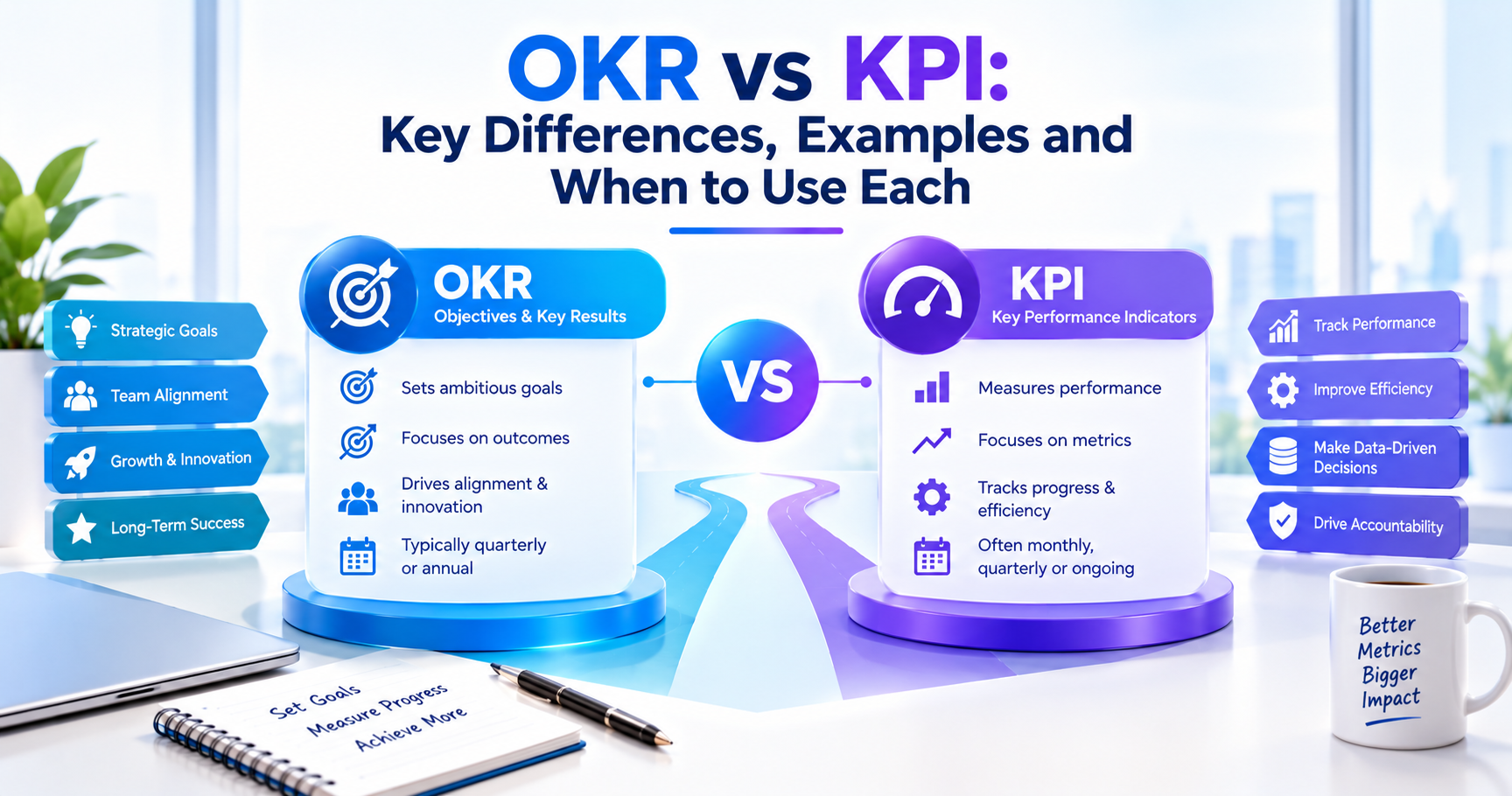
The core OKR vs KPI difference: OKRs push toward something new, KPIs track something that already exists. They work best together, often with a KPI becoming a Key Result inside an OKR when it needs deliberate improvement.
Key Highlights of OKR vs KPI
- An OKR (Objective and Key Results) is a goal-setting framework built to drive ambitious change over a fixed period, usually a quarter.
- A KPI (Key Performance Indicator) is a single, ongoing metric that tells you how healthy a process, team, or business function is right now.
- The core OKR vs KPI difference comes down to purpose. OKRs push you toward something new. KPIs monitor something that already exists.
- OKR and KPI systems are not rivals. Most mature product and business teams use both together, often with a KPI sitting inside an OKR as a Key Result.
- A North Star metric sits above both, acting as the single measure that best reflects the value your product delivers to customers.
- In SAFe and Agile environments, OKRs and KPIs help Product Owners and Product Managers connect PI Objectives to real business value.
Introduction
If you have sat through a planning meeting where someone confidently says "let's set some OKRs" and someone else replies "don't we already track that as a KPI," you are not alone. The OKR vs KPI debate shows up in every function, from product and marketing to sales and HR. It usually comes from a genuine mix-up about what each framework is actually for.
Both are measurement tools. Both use numbers. But they answer very different questions.
A KPI tells you how something is performing today. An OKR tells you where you are trying to go and by when. Confusing the two leads to two common failures. Teams either set OKRs that are just renamed KPIs with no ambition attached, or they track KPIs so loosely that nobody notices when performance quietly slips.
This guide breaks down the OKR vs KPI comparison in plain terms. You will see clear definitions, simple examples, a side-by-side comparison table, and practical guidance on when to use each. We will also look at how OKRs and KPIs work together in Agile and SAFe environments. This matters if you are a Product Owner, Product Manager, or anyone responsible for product strategy and outcomes.
By the end, you should be able to walk into your next planning cycle and confidently decide whether you need an OKR, a KPI, or both.
OKR vs KPI: Side-by-Side Comparison Table
| Dimension | OKR | KPI |
| Full form | Objectives and Key Results | Key Performance Indicator |
| Purpose | Drive strategic change and growth | Monitor ongoing performance and health |
| Structure | Qualitative objective plus 2 to 4 measurable key results | Single quantifiable metric |
| Ambition level | Stretch goal, 60 to 70 percent achievement is a success | Realistic target, close to 100 percent expected |
| Time frame | Usually quarterly, sometimes annual | Continuous or ongoing, tracked without a fixed end |
| Indicator type | Leading indicator, points to what should happen next | Lagging indicator, reflects what has already happened |
| Example | Objective: become the top-rated app in our category | Monthly active users: 500,000 |
| Owner | Cross-functional team or department | Function, team, or process owner |
What is an OKR?
OKR stands for Objectives and Key Results. It is a goal-setting framework popularized by Intel and later made famous at Google, where investor John Doerrintroduced it in the late 1990s. The structure has two parts, and in Agile teams it is often adapted further, as covered in our guide to Agile OKRs vs traditional OKRs.
The Objective is a qualitative statement of what you want to achieve. It should be ambitious, clear, and inspiring. Think of it as the "what." The Key Results are two to four quantitative, measurable outcomes that tell you whether you actually achieved the objective. These are the “how.”
A good OKR is deliberately a stretch goal. Many organizations that follow the original Google OKR model expect teams to hit only 60 to 70 percent of their key results. Hitting 100 percent every single time often signals that the goals were not ambitious enough to begin with.
OKRs are typically set on a quarterly or annual cadence. They are reviewed regularly, often weekly or biweekly, to track progress and course-correct.
A Simple OKR Example
Objective: Make our app the go-to tool for daily task management.
- Key Result 1: Increase daily active users from 40,000 to 65,000.
- Key Result 2: Improve seven-day retention from 35 percent to 50 percent.
- Key Result 3: Reduce average time to complete onboarding from 6 minutes to 2 minutes.
Notice that the Objective describes a direction and an ambition. The Key Results are specific numbers with clear starting and ending points. None of these numbers exist as ongoing dashboards before this quarter. They represent a deliberate push toward a new outcome, which is the heart of any strong OKR example.
What is a KPI?
A KPI, or Key Performance Indicator, is a quantifiable metric used to track the ongoing health of a business process, team, or function. Unlike an OKR, a KPI does not describe a destination. It describes a current state, measured continuously against a target or a historical baseline.
A well-defined KPI usually has four components. It needs a measurable target, a defined timeframe, a reliable data source, and a set frequency for monitoring.
For example, "customer churn rate" only becomes useful once you attach a target such as "keep churn under 3 percent monthly." You would also need a data source, such as your billing system, and a review cadence, such as weekly reporting.
KPIs are lagging or steady-state indicators. They tell you whether something that used to work is still working. When a KPI drops or spikes unexpectedly, it is usually the first signal that something in the business needs attention.
A Simple KPI Example
A customer support team might track the following KPIs on a rolling basis.
- First response time: stay under 2 hours.
- Customer satisfaction score (CSAT): maintain above 4.2 out of 5.
- Ticket resolution rate: keep above 90 percent within SLA.
None of these numbers describe a new initiative. They describe the ongoing performance of a function that already exists. If the first response time creeps up to 5 hours, that KPI has done its job. It flags the problem early, well before it turns into a wave of unhappy customers.
OKR vs KPI: The Key Differences
Understanding the OKR vs KPI difference gets much easier once you separate purpose, ambition, and time frame. These three dimensions explain almost every practical distinction between the two frameworks.
Purpose: Driving Change vs Monitoring Health
An OKR exists to create change. It pushes a team toward a goal that does not yet exist in the current state of the business. If your objective is "expand into the enterprise segment," you are describing a future your company has not reached yet.
A KPI exists to monitor health. It answers the question, "Is this part of the business still working the way it should?" Website uptime, average order value, and employee attendance rate are all KPIs because they describe an ongoing condition rather than a fresh ambition.
This is the single most useful lens for the OKR vs KPI comparison. Ask yourself if you are trying to change something or watch something. That answer usually tells you which framework fits.
Ambition: Stretch Goals vs Steady Targets
OKRs are intentionally aggressive. A key result that gets hit at 100 percent every quarter without fail is a warning sign, not a success story. It usually means the target was set too low.
KPIs work the opposite way. You want to hit your KPI targets consistently, because a KPI usually protects something that already matters, such as uptime, safety, or customer trust. There is no reward for an aggressively risky KPI target. A hospital does not want a stretch goal for patient safety incidents. It wants that number as close to zero as possible, every single time.
Time Frame and Cadence
OKRs typically reset every quarter, though some organizations use annual OKRs broken into quarterly milestones. Once the quarter ends, the OKR is retired, evaluated, and replaced with a new one, even if the underlying objective carries forward in a modified form.
KPIs are continuous. They do not reset. A KPI dashboard for customer churn keeps running month after month, year after year, because the underlying process it measures, in this case customer retention, never really goes away.
This cadence difference is often the fastest way to catch a mislabeled goal. If a "KPI" gets rewritten every quarter with a completely new target and new context, it is probably behaving more like an OKR key result.
How OKRs and KPIs Work Together?
The OKR vs KPI conversation often gets framed as an either-or choice, but that framing misses the point. The two frameworks are designed to complement each other, not compete.
Using a KPI as a Key Result
One of the most practical ways OKRs and KPIs work together is when an existing KPI becomes a Key Result inside a new OKR. Suppose your company already tracks "customer churn rate" as a standing KPI, sitting steady at 5 percent monthly.
If leadership decides churn needs to drop significantly this quarter, that KPI can become a Key Result inside a new Objective. For example: Objective, build a retention engine that keeps customers longer. Key Result, reduce monthly churn from 5 percent to 3 percent by the end of the quarter.
The KPI itself has not changed. It is still the same metric, tracked the same way. What changed is the ambition wrapped around it. This is a common and effective pattern for how OKRs and KPIs work together, especially in product and growth teams that already have solid OKR KPI metrics in place.
When to Use Which?
Use an OKR when you are launching something new, trying to break out of a plateau, or aligning a team around a specific push for the next quarter. Use a KPI when you need to keep a permanent eye on something that already matters to the business, such as revenue, uptime, or customer satisfaction.
A simple rule of thumb applies here. If the number needs to exist forever, it is a KPI. If the number describes a specific, time-bound achievement you are chasing this quarter, it is an OKR key result. Teams that are new to structured goal setting, including those exploringproduct strategy for the first time, often benefit from starting with a small set of KPIs before layering OKRs on top once the baseline is stable.
OKR Examples for Product Teams
Product teams tend to get the most value from OKRs because product work is inherently about driving change, whether that is new features, better retention, or expanded reach. Here are a few practical OKR examples tailored to product management.
Objective: Deliver a best-in-class onboarding experience.
- Key Result 1: Reduce time-to-first-value from 10 minutes to 3 minutes.
- Key Result 2: Increase activation rate from 45 percent to 70 percent.
- Key Result 3: Cut onboarding-related support tickets by 40 percent.
Objective: Establish the product as the preferred choice for mid-market customers.
- Key Result 1: Grow mid-market customer base from 200 to 500 accounts.
- Key Result 2: Increase average contract value by 25 percent.
- Key Result 3: Achieve a Net Promoter Score of 45 or higher among mid-market users.
Objective: Build a data-informed product culture.
- Key Result 1: Instrument tracking for 100 percent of core user flows.
- Key Result 2: Launch a weekly product metrics review with 90 percent attendance from the product team.
- Key Result 3: Use experiment data to inform at least 5 major feature decisions this quarter.
These OKR examples share a pattern. Each objective is aspirational and each key result is a number you did not already have locked in before the quarter started.
KPI Examples for Product Teams
Where OKRs describe the push forward, KPIs describe the steady pulse of the product. These OKR KPI examples show how product teams typically monitor health alongside their quarterly goals.
- Monthly active users (MAU): tracked continuously to understand overall product reach.
- Customer retention rate: measured monthly to catch early signs of churn.
- Feature adoption rate: percentage of users engaging with a released feature within 30 days.
- Average session duration: signals whether users find ongoing value in the product.
- Net Promoter Score (NPS): a recurring pulse check on customer sentiment.
- Customer acquisition cost (CAC): watched to keep growth spend efficient.
- App crash rate or uptime percentage: a technical health KPI that protects user trust.
Product teams often build these into an OKR KPI dashboard that sits alongside quarterly OKR tracking, giving leadership a combined view of steady-state health and active strategic pushes. When a KPI dips outside its normal range, it frequently becomes the trigger for a new OKR the following quarter. This is exactly how OKRs and KPIs work together in a healthy planning cycle.
Common Mistakes With OKRs and KPIs
Even experienced teams fall into a handful of predictable traps when adopting the OKR KPI framework.
Setting OKRs that are really just KPIs in disguise is the most frequent mistake. An objective like "maintain 99.9 percent uptime" is not ambitious or time-bound in the OKR sense. It is a steady-state target and belongs in your KPI dashboard instead.
Tracking too many metrics at once causes another common failure. When a team tries to manage 15 KPIs and 10 key results simultaneously, focus disappears. Most experts recommend limiting active OKRs to three to five objectives per quarter, each with no more than four key results, a discipline taught in structured Agile OKRs training.
Treating 100 percent OKR completion as the goal undermines the entire framework. If a team consistently hits every key result, leadership should ask whether the targets were too conservative rather than celebrating perfect execution.
Ignoring the connection between OKR and KPI systems is another gap. Teams that set OKRs in isolation, without checking whether existing KPIs support or contradict the new objective, often end up chasing a goal that quietly damages another part of the business. A common example is pushing sales volume while ignoring a KPI for customer satisfaction.
Finally, many teams forget to close the loop. An OKR that is never reviewed at quarter-end, scored honestly, and used to inform the next cycle loses most of its value. The review conversation matters as much as the goal-setting conversation.
OKRs, KPIs and Metrics in Agile and SAFe
Agile and SAFe environments add another layer to the OKR vs KPI conversation because they already have their own structured goal-setting rhythm, particularly around Program Increment planning.
Aligning Objectives With PI Objectives and Business Value
In the Scaled Agile Framework, teams set PI Objectives during Program Increment planning. Each objective is assigned abusiness value score, typically on a scale of 1 to 10, in collaboration with business owners, as defined in SAFe's official guidance onPI Objectives. This mirrors the OKR structure closely. A PI Objective functions much like an OKR objective, while the associated acceptance criteria and metrics function similarly to key results.
Product Managers and Product Owners often use OKRs at a higher, strategic level to set direction for multiple Program Increments. They then translate that direction into specific PI Objectives that Agile Release Trains commit to each increment. This keeps day-to-day sprint work connected to a bigger product strategy rather than operating in isolation. Professionals building this skill set often pursueSAFe POPM Certification Training to learn how to translate strategic objectives into actionable PI Objectives and prioritized backlogs.
UnderstandingSAFe POPM roles and responsibilities helps clarify who owns which part of this alignment. The Product Manager typically owns the broader vision and strategic themes, similar to OKR objectives. The Product Owner focuses on translating that vision into team-level backlog items and iteration goals, which behave more like the tactical execution layer beneath a key result.
Outcome Metrics for Product Owners
A Product Owner working within SAFe benefits from a blended approach to product metrics. Team-level KPIs, such as sprint velocity, defect escape rate, and cycle time, provide the ongoing health signals a Product Owner needs to spot problems early.
At the same time, outcome-focused OKRs help the Product Owner and the broader team stay anchored to the value being delivered rather than just the volume of work completed. A north star metric, such as weekly active users for a consumer product or activated accounts for a B2B tool, can sit above both. It gives the team a single unifying signal that connects daily execution to long-term product strategy.
This is also where a well-maintainedproduct roadmapbecomes essential. The roadmap shows how individual PI Objectives, KPIs, and OKRs connect over time. It gives stakeholders a shared view of where the product is headed and why specific priorities were chosen for each increment. Without this connective layer, teams risk optimizing for isolated product metricsthat do not add up to meaningful product strategy.
Conclusion
The OKR vs KPI debate does not need to end in a winner. OKRs and KPIs solve different problems, and the strongest teams use both deliberately rather than picking one and ignoring the other.
Reach for an OKR when you want to drive a specific, ambitious change over the next quarter. Reach for a KPI when you need a steady, ongoing signal that tells you whether a part of your business or product is healthy right now. When you combine the two, using KPIs to spot the problems worth solving and OKRs to organize the push toward solving them, you get a measurement system that covers both the present and the future.
Whether you are a marketer building a content calendar, a Product Owner running a SAFe team, or a founder setting company-wide goals, the same principle holds. Know what you are measuring and why. Let that answer decide whether you need an OKR, a KPI, or both working together.








 Lowest-Price Challenge











 Personalized Path


.webp)


 USA
USA  Canada
  India
India  UK
UK  Australia
  Singapore


