


 Call Us




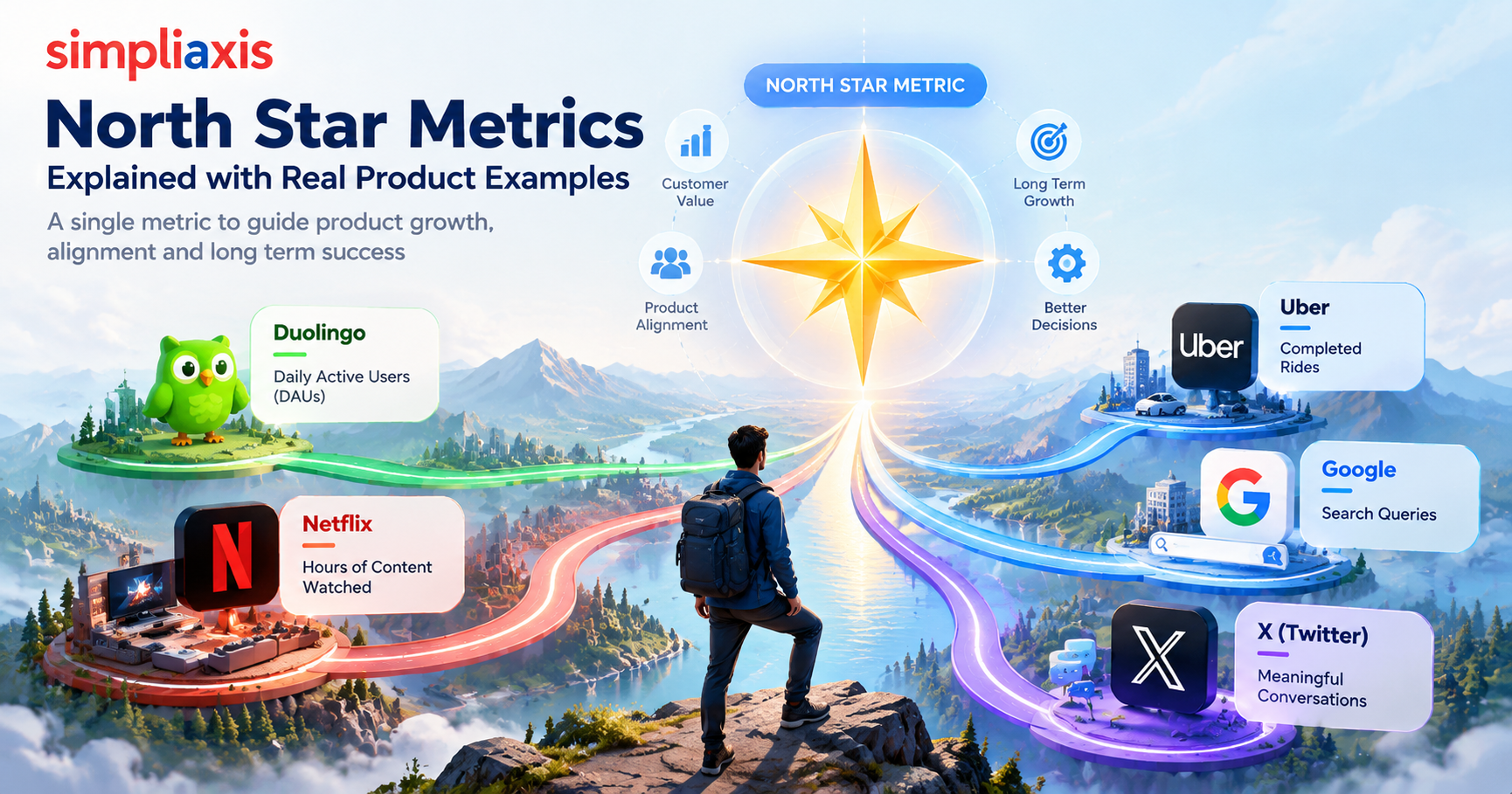
The North Star Metric (NSM) is an important measurement tool that captures the value that a company desires to achieve while also keeping successful business revenue in consideration.
The term ‘north star', taken from the cosmic star Polaris, which has been a guiding light for sailors for centuries, perfectly describes what the metric does. It acts as a navigation tool for the company and helps teams focus their efforts towards a particular goal.
This article will talk about the North Star Metric in depth, from its significance to real product examples. Product teams will learn why this tool is important for their business and learn how to implement it into their workflow.
What is a North Star Metric and Why Does it Matter?
The NSM helps companies align their workflow towards a specific goal. What makes this measurement stand out is its duality: it supports the interests of both customers and the business. It identifies how much value users get from a product while also ensuring that the business gets the best revenue out of it.
Unlike vanity metrics, which measure superficial trends like the amount of website traffic or software downloads, the North Star metric strives to measure something significant that supports the overall interests of the company and especially its long-term success. But to do so, the metric should aim to do these things:
- Boost company revenue
- Prioritise customer value
- Be measurable
When a company defines a metric that addresses these points and follows through with developing products that aim for that metric, it has better chances of growing and becoming sustainable.
What Is a North Star Metric in Product?
In product development, the North Star Metric is a valuableproduct metric that measures and captures the primary value that a product delivers to its customer. It acts as a compass for a team’s product strategy and aims to make business growth sustainable.
Unlike a north star metric in business, which could aim to improve the overall quality of a business through metrics like ‘Improving customer satisfaction’ and push a company towards a positive direction, the North Star metric in product development needs to be a lot more definite. This metric should be a measurable indicator of a company’s success, meaning that if a team fails to meet the criteria, they should reconsider how they approach theirproduct strategy.
What is a North Star strategy?
The North Star strategy is a product-based strategy which helps businesses ensure that all the tasks that they work towards revolve around one overarching business objective, which becomes the metric by which work is evaluated. By focusing on a single goal, they can avoid utilising resources on unessential tasks and prevent themselves from working on goals that can be conflicting with what the business wants to achieve.
The North Star strategy typically involves these elements:
Research
While working on a North Star strategy, businesses need to be aware of their customers’ behaviours and what products, processes, and services are most relevant in the business. Thus, it is important for them to do market research and study customer behaviours and patterns to understand what their customers truly need and choose the right business objective accordingly.
The North Star Metric
The North Star metric is the main element of the strategy. It is the one objective or goal an organisation works to achieve. The metric is usually quantitative and becomes a point of comparison for all the work, processes, and methods that a business uses for their product.
Supporting Factors
Aside from being a primary goal, the North Star metric needs to be supported with inputs that directly affect it. A North Star strategy usually has three to five inputs depending on their relevance towards the primary goal.
Customer Impact
While the north star metric guides all the work done in a north star strategy, the success of these efforts is ultimately determined by the impact that they make on the customers. If the north star strategy fails to enhance the products in any way which is beneficial for the customers, businesses will need to look into their approaches again.
Why are North Star Metrics Important?
Singular Objective
The North Star metric becomes the primary objective of an entire organisation’s efforts. Instead of having multiple goals and objectives to focus on, the NSM helps ensure that all organisational processes work on a central goal.
Better Alignment
When an organisation has one common goal, different teams have the same objective to work towards. These help in alignment across the organisations and thus enable these different teams to collaborate with each other more effectively.
Refined Workflows
When an organisation aligns towards a singular objective, the strategies and techniques used by different teams become a lot more refined since they aim to meet the NSM. This helps organisational teams save time and other resources which could otherwise have been spent on irrelevant reasons.
Improved Outputs
The NSM takes account of both customer needs and business revenue, ensuring that, by following it, organisations can achieve steady business growth and success. When teams work together, the quality and value of their outputs improve.
What are the Characteristics of a Good North Star Metric?
Customer Centric
The core of a good NSM is that it aligns with the values and requirements of customers. When an organisation’s metric does not address these, then the products that they deliver will fail to enhance or support their users in the right way, thus reducing their value. A good north star metric is relevant and helps in addressing the overall needs of their users.
Unique
It is important that the north star metric chosen by an organisation aligns with their unique needs. Organisations need to understand their products and how they benefit customers and support the overall mission of the company. Creating an NSM that aligns with these needs becomes specific and can help an organisation measure their progress better.
Although some organisations can also have generic north star metrics, they might not exactly meet the unique needs of an organisation and can become vague measurements which might not be able to evaluate the quality of work done.
Feasible
When a north star metric is chosen, it should be achievable for everyone in the organisation. Different teams should be able to implement this metric into their workflows and be able to work towards it. Therefore, it is also important that they are not overly complicated so that teams find it difficult to implement.
Revenue Driven
When factors like customer value are aligned on, a good NSM becomes revenue-driven directly. Increased product quality, enhancing customer experience and retention. The prolonged use of a product like this generates revenue for an organisation.
Therefore, an organisation that uses a good north star metric implemented should increase in their revenue. If they do not, then it is not a good metric to use.
Quantative
The north star metric chosen by an organisation should be measurable and should depict a count, percentile, or ratio that reflects customer values and income generated as a result of it. Having a quantifiable metric allows teams to clearly understand whether the tactics they use for their products work or not.
Should a Company Only have One North Star Metric?
Typically, a company should only have one NSM; this is because it helps multiple teams align towards a common goal and become a guiding tool for them. The north star metric accounts for customer value and ensures that it can help quantify revenue growth as well, thus helping an entire company’s endeavours work towards those measurements. Having multiple metrics can become confusing.
However, there are also exceptions to this exclusiveness. Large organisations and enterprises with diverse products and divisions and different product departments and target audiences can have different North Star Metrics, each with their own specifications.
How do You Select a Good Product North Star?
To ensure that the North Star Metric a company chooses is ideal for a business, they should consider these factors in mind:
- Activity: The amount of time customers spend interacting with a product
- User Experiences: How enjoyable and convenient a customer feels after using a product
- Engagement: How many customers actively use a product or invest their time into it.
- Revenue: The amount of money a company makes based on how willing customers are to use their product
- Growth: The number of new customers that are interacting with or using a company’s product.
A company should keep these factors in mind while selecting its north star metric. However, it should also be noted that not all of these factors may be applicable to different companies. Therefore, it is important to choose the ones that can drive business growth most significantly.
How to implement the North Star Metric Framework?
Establish Business Objectives and Vision
Before a north star metric is chosen, businesses should already have business objectives and an overall product vision in place. This includes talking about how the business strives to achieve its goals, the aim of the product for its users, and how they see the trajectory of the business in the long term.
Identify the North Star Metric
The most important thing for businesses to do before going ahead with their strategy is to identify their NSM. This is important because the metric dictates every endeavour of the company and the quality of work, methods, and strategies they use to achieve their target. This measurement also determines the quality of the product delivered, which, in turn, dictates its user experience and revenue.
Have Supporting Metrics
Once a North Star metric is established for a company, different teams can develop support metrics to help work towards it. These support metrics can be specific to the nature of each team and can become their key performance indicators (KPIs) as to whether the overarching goal is being achieved.
Gather and Align Teams
It is important that different teams work towards the north star metric. This requires them to collaborate with each other and utilise their resources to achieve their goals.
Measure and Modify
Once a company implements their north star pole, they ought to track and measure their performance and iterate their strategies based on what is working and what is not. Tracking and modifying tasks based on feedback help improve business performance and product output.
What are the Key Benefits of Having a Clear North Star Metric?
Improved Decision Making
Having a North Star metric improves the way in which companies make decisions regarding the tasks that they do. The NSM becomes a determiner for the work that matters and the ones that do not.
Better Prioritisation of Tasks
The north star metric helps teams prioritise the tasks that actually help achieve it. This helps them move from unnecessary targets like vanity metrics and from expediting resources where it is unnecessary.
Measurable Progress
Since the north star metric acts as a quantitative measurement for all of the tasks done by a company, it can be measured and helps indicate whether teams are doing the right things to ensure that a product is achieving its desired outcome.
Increased Customer Focus and Business Value
The north star metric establishes a relationship between a company’s customer value and the revenue that it generates for them. When these factors are taken into consideration, a business will likely have steady growth.
Improves Collaboration
Having a clear NSM means that all teams and departments in a company have a common goal. Since different teams have the same goal, they align better with each other and can collaborate more easily.
Learn how Agile teams define and track value-driven outcomes with Simpliaxis CSPO Training, helping you connect product metrics to real customer impact.
What are the Challenges and Considerations when Choosing a North Star Metric?
Avoid Stagnating the North Star Metric
Once an NSM is chosen by a company, it does not become the ultimate determining factor for business growth. Companies should conduct their research and measure the impact made once the metric is implemented. If there is no impact made on growth and product quality, teams need to reassess their north star metric again.
Choose a Realistic Metric
The north star metric that is chosen by a company should be realistic enough to be used by different teams. Having unrealistic metrics can make it difficult for departments to take any type of measurable action towards them, thus stagnating progress and overall business growth.
Companies should also ensure that the NSM chosen matches the capacity of a company’s infrastructure and resources. Excessive or elaborate metrics can make it difficult for teams to work towards and can also overwork them.
The North Star Metric Should Not Be the Only Metric
The NSM is supposed to serve as a guiding principle for the company and not the only definitive indicator of progress throughout all teams. Since the work nature of every team and department is different, it is important that there are more focused metrics, such as KPIs, in place that are measurable and support the specific nuances of the team while also supporting the overall north star metric.
Have Reliable Measurements
It is important for a company to make sure that the measurements and analytical tools a company uses to track the North Star metric are dependable. Having poor or unreliable metrics can be consequential for business growth.
Recognise the Need for Other North Star Metics
While it is ideal to have a singular NSM, companies with diverse product ranges and specific teams for products and developments and audience bases could benefit from multiple north star metrics.
Since products may be diverse, a single metric will be inadequate to understand the needs of different customer values. Multiple NSMs help solve this by defining metrics that are specific to different needs.
Avoid too Many Supporting Metrics
Just like how having fewer metrics can be restrictive for a company with diverse teams, having too many metrics can dilute the significance of the primary north star metric. When too many measurements and metrics are set in place, teams may focus on tasks that are irrelevant to the primary goal of the company. This also leads to teams utilising their resources on work that does not contribute to business growth.
How Does the North Star Compare to Other Metrics?
North Star Metric vs. KPI (Key Performance Indicator)
North Star Metric | KPI |
Functions as a guiding principle for a company which emphasises its working on customer value and revenue growth. | Helps measure the performance of tasks against a specific business objective. |
Time duration is usually long-term. | Time duration is usually short- or medium-term. |
Usually consists of one primary measure | Can have multiple KPIs across teams |
This metric is followed all across the organisation | The KPI is specific to the team or goal |
North Star Metric vs. OKRs (Objectives and Key Results)
North Star Metric | OKR |
Functions as a guiding principle for a company which emphasises its working on customer value and revenue growth. | Establishes and tracks specific goals and outcomes |
Usually one primary metric to measure with | |
Does not change frequently, based on the impact that the metric makes | Frequently reviewed and changes quarterly or periodically |
This metric is followed all across the organisation | Can exist at an organisational, team, and individual level |
North Star Metric vs. Input and Output Metrics
North Star Metric | Input and Output Metrics |
Ensures that customer value is effectively delivered during output | The input metric measures specific activities that influence results,, while the output metric measures the results caused by the specific actions |
Prioritises customer value and sustainable, revenue growth | Input metrics measure behaviours and driving factors, while output metrics measure the outcome and performance |
The metric established cannot be controlled by teams; instead, theyhave to work towards the measurement | The input metric is controlled by the teams directly, and the output metric is usually determined by the way the input is handled |
Usually a metric used to measure for a long duration | The input and output metrics are used to measure for shorter durations |
North Star Metric vs. Vanity Metrics
North Star Metric | Vanity Metric |
Measures the value that is delivered to customers | Measures metrics that do not necessarily indicate meaningful business progress |
Influences the overall product strategy and decisions. | Helps generates actionable insights |
Closely connected to the success of a product | Does not loosely ties to the success of a product |
Values customer value and business growth | Focus on surface-level performance |
How to Track Measuring and Tracking Progress with a North Star Metric Over Time?
Measure Real-Time Progress
Once a north star metric is established, companies should begin tracking their continuous progress through tools like live dashboards that continuously update on the progress that teams have made towards their goals.
Since different teams work on different tasks, these dashboards can also track how effectively a team reaches their KPIs and hence can become good indicators of progress.
Reflect Current Strategy
A good way to measure the progress made with the implementation of a north star metric is how a company’s current strategy to promote a product works with respect to the metric. If it fails to align or does not make any significant impact on product value, user experience, and revenue growth, companies can modify or change their approach accordingly.
Another factor to keep in mind is whether teams can realistically achieve the goals set by the NSM and if a company’s capacity supports the same.
Continously Align with Business Objectives
As the north star metric continues to guide the company towards its ultimate goal, it is important to continuously align the progress made with the objectives of a business. Often, because of factors like feedback and priority shifts, business objectives may change, which may result in the company having to improvise with their metric or modify it with respect to the new objectives.
Identify New Ways to Enhance Value
Another way to track progress once an NSM is set in place is by continuously identifying new methods and strategies that can enhance output value and help companies achieve their goals sooner and more effectively.
What are the Real Product Examples of North Star Metrics?
Here are some examples of north star metrics used by popular organisations for their products and services:
X (Formally known as Twitter) - Number of Users Active Daily
X is a popular social media platform where users can come and post images, videos and texts and interact with users across the globe. Its north star metric is the number of daily active users on its platform.
This metric helps understand user behaviour and interests, which improves the algorithm's relevance and helps personalise user experience. It also helps understand what features users may require and measure the impact of features that have already been implemented.
Duolingo - Weekly Engaged Users
Duolingo is a famous language-learning application that helps users learn different languages using simple daily lessons to gradually improve their knowledge.
This company’s NSM is the number of users engaged weekly. While this is the overarching metric, it is achieved through techniques like daily 'streaks', which encourages users to use the app daily, and ‘badges’ that are rewarded to users after completing a certain target within the app. This metric helps boost user engagement through enhancing their experience on the app while simultaneously boosting the revenue growth.
Netflix - Total Hours Watched
Netflix is a renowned subscription-based streaming platform that provides an array of movies and shows for a user to watch and enjoy. The north star metric used by this company is the total number of hours a user spends watching movies/shows on their platform.
This metric helps in understanding if the user enjoys watching content on the platform or whether it is relevant, which prompts further personalisation for better user experience. This metric also helps determine their retention and becomes an indicator of possible membership renewal or cancellation.
Uber - Weekly Active Riders
Uber is a transportation platform that provides taxis and other modes of transportation to users anywhere immediately at affordable rates. Its north star metric is the number of riders active each week.
This metric helps identify the regions in which the company’s services are in demand and helps enhance their prices and assignment of drivers. These metrics further analyse patterns like rider behaviours, and calcuate phenomenons like peaks hours
Google - Number of Searches per User
Google is one of the world’s most popular search engines, helping users get access to any type of information in seconds. The north star metric that the company uses is the number of searches a user has made.
This metric helps Google refine their searches and curate the most relevant answers based on the searches already made by the user before. This also gives them insight into possible search trends and user preferences.
How Do Companies Choose Their North Star Metric?
Identify Customer Value
For a company to pick the right north star metric, it is important that they first understand what their customers require. Once this is understood, identifying an appropriate metric becomes a lot more convenient.
Choose Possible Metrics
Once companies understand their customers, they should list down potential north stars and judge them according to these criteria:
- Revenue-driven: Does the metric help support revenue growth while also reflecting customer value?
- Applicable: Can this metric be utilised by everyone in the company? Can different teams influence the metric and work towards achieving it?
- Complexity: Is the metric straightforward, or is it elaborate and may require several steps or processes that are outside the scope of the company?
- Measurable: Can this potential north star be measured and accurately represent the impact it makes and how much the company progresses towards it?
What are the Common Mistakes to Avoid?
Confusing a North Star Metric with a Vanity Metric
A common mistake that a company can make is turning a vanity metric into a north star metric. Vanity metrics, like traffic and downloads, are short-term impressions that may feel gratifying and easy to achieve but fail to give any long-term insight to business growth. A good way to distinguish between the two is by:
- Determining what it measures: Vanity metrics often measure action, whereas NSM measures value. For example, the number of people who have followed a company page is a vanity metric, whereas the duration of time a customer spends using their product becomes a north star metric.
- What the Nature of Growth Looks Like: Since vanity metrics usually measure action, it will tend to only chart an upward trend, for example, the number of social media likes or the amount of traffic generated. These upward trends could give a false impression on business growth, making it look healthy even when it is not.
- Contribution to revenue growth: Vanity metrics do not directly affect the revenue of a company, which can hinder its growth. North star poles take both customer value and revenue growth into consideration, ensuring that there is a balance between both.
Over-Prioritisation of Revenue
While North Star Metrics help in revenue growth and become good indicators of the same, focusing solely on them makes companies lose focus on the goal that their product aimed to achieve, which compromises on the customer value. It is important to ensure that the metric is able to accommodate both requirements simultaneously while also remaining sustainable.
Using Lagging Indicators
North Star Metrics help as indicators of how a business will grow in the future; they do not account for what has already happened in the company; those become lagging indicators. Lagging indicators account for things that happen in the past and cannot help chart future predictions, which can affect company growth and make it stagnant.
For example, metrics like annual recurring revenue (ARR) and monthly recurring revenue (MRR) are lagging indicators.
Take the next step in your product leadership journey—joinSimpliaxis’ SAFe POPM Certification and apply North Star Metric thinking in real-world Agile environments.
Conclusion
By connecting customer value with sustainable business growth, the North Star Metrics provide organisations with clear directions to work towards. The metric is not just something quantitative but also helps teams within organisations align priorities, make better decisions, measure progress and focus their efforts on the tasks that matter the most for increased customer value. But choosing the right NSM needs a clear understanding of customer needs, the objectives of a business, and the right factors to improve product success.
A good North Star Metric should be measurable, customer-centric, connected to long-term business growth, and need to be realistic. However, it also needs support metrics and KPIs so that diverse teams can convert the overarching goal into actionable items best suited for their type of business. Frequent measurements and reassessments ensure that the metric continues to align with changing business objectives and customer requirements.
The North Star Metric, when determined and applied with the right consideration, becomes a shared direction for the company to work towards creating products that enhance customer value and lasting business growth.









 Lowest-Price Challenge












 Personalized Path



.webp)


 USA
 Canada
 India
 UK
 Australia
 Singapore


