


 Call Us




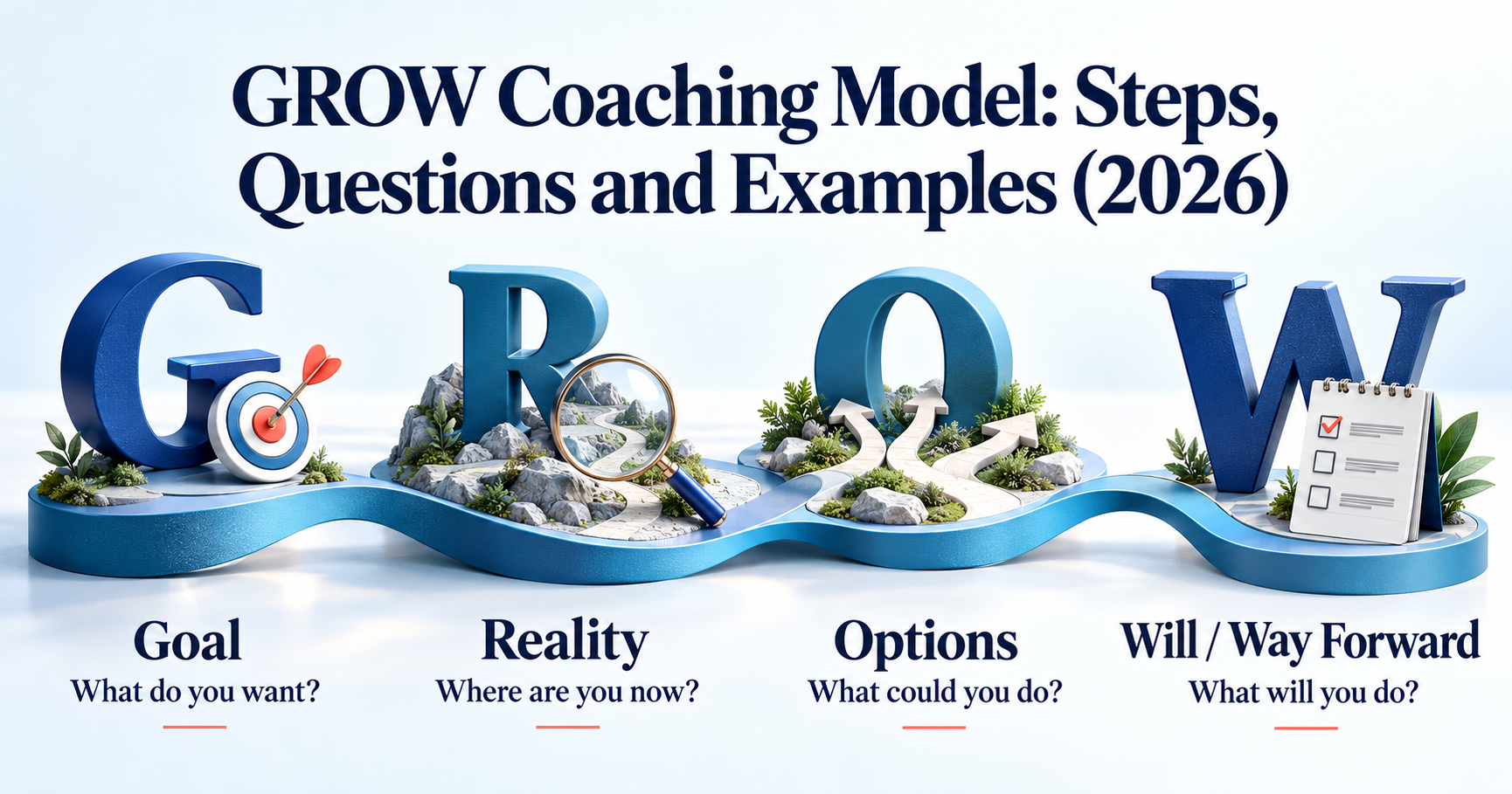
The GROW coaching model is a four-stage framework for coaching conversations: Goal, Reality, Options & Will. The coach asks questions that help the other person decide what they want, look honestly at where they are now, explore ways to close the gap, and commit to specific next steps. It was developed in the UK in the 1980s by Graham Alexander and Sir John Whitmore. Whitmore made it famous in his 1992 book Coaching for Performance.
Key Highlights of the GROW Coaching Model
- GROW stands for Goal, Reality, Options and Will (or Way Forward).
- It works through questions, not instructions. The person being coached finds their own answers.
- A complete session can take an hour; a quick version can take a 15-minute one-on-one session.
- The stages are a guide, not a script. Good coaches move back and forth between them.
- It is used by managers, executive coaches, HR teams, sports coaches and Scrum Masters, as part of their wider Scrum Master roles and responsibilities.
- Its biggest weakness is misuse, rushing from Goal straight to Will and skipping the thinking in between.
Introduction
Most managers are promoted because they were good at the work, not because they were good at helping other people do the work. Strong Agile leadership principles put coaching ahead of solving. So when a team member walks in with a problem, the instinct is to solve it for them. That feels efficient. Over time, though, it creates a team that waits for answers instead of thinking for itself.
The GROW coaching model gives managers and coaches a different option. Instead of handing over a solution, you guide a short, structured conversation that helps the other person work it out. It is simple enough to remember in the middle of a tense one-on-one, yet it has held up in boardrooms, sports clubs and Agile teams for more than three decades.
This blog covers the four GROW coaching model steps, the questions that work at each stage, a full workplace example, where the model falls short, and how Scrum Masters can use it with their teams in 2026.
What Is the GROW Coaching Model?
Definition and What GROW Stands For
The GROW coaching model is a structured way to run a coaching conversation. It moves through four stages, and each letter names one of them:
| Stage | The question it answers | Useful output |
| Goal | What do you want to achieve? | A clear purpose & success indicator |
| Reality | Where are you right now? | Evidence, strengths, constraints, and assumptions |
| Options | What could you do? | Alternative worth considering |
| Will / Way Forward | What will you do, and when? | An Action, support, timing, & review |
Origins With John Whitmore and Graham Alexander
GROW grew out of UK business coaching in the 1980s. Graham Alexander and Sir John Whitmore, a former racing driver turned coach, were both influenced by Timothy Gallwey, whose book The Inner Game of Tennis argued that performance improves when people learn to quiet self-doubt and notice what is actually happening.
Who deserves credit is still debated. Whitmore acknowledged Alexander's claim to have originated the model and said Max Landsberg came up with the GROW name in a conversation with Alexander. Alan Fine, who later founded InsideOut Development, also says he co-developed it. What is not in dispute is that Whitmore brought it to a wide audience in Coaching for Performance.” Swap in the publisher’s page for your region if you prefer, a book that remains standard reading for coaches today.
Why GROW Is So Widely Used
Three things keep GROW in use when many other frameworks have faded.
- It is easy to remember: Four letters, one word. You can recall it mid-conversation without notes.
- It fits any topic: Sales targets, career moves, a conflict with a colleague, a missed deadline. The structure doesn't care about the subject.
- It suits busy leaders: The GROW coaching model in leadership settings often runs as a ten-minute hallway chat, not a formal session. That makes it practical for managers who coach alongside their day jobs.
The Four Stages of the GROW Model
Each stage has its own job. Skip one and the conversation usually ends with a plan that sounds fine but never happens.
Goal: Defining What Success Looks Like
The Goal stage sets the direction. It often has two layers: the goal for this conversation ("I want to leave with a plan for the client call") and the bigger goal behind it ("I want to keep this account").
A good goal is specific enough to know when it has been reached. Whitmore recommended goals that are SMART, and also ones the person finds challenging and genuinely wants. If the goal comes from the manager rather than the coach, expect weak commitment later. It is worth slowing down here, because many coaching sessions go wrong simply because the real goal was never named.
Reality: Understanding the Current Situation
Reality is where the coach describes what is actually going on. What has happened so far? What have they tried? Who else is involved? What is getting in the way?
The coach's task is to separate facts from assumptions. "My manager never listens to me" is a feeling; "My last two proposals were rejected without feedback" is something you can work with. This stage also tends to change the goal. Once people see their situation clearly, they often realise they were trying to solve the wrong problem, and that is a good outcome, not a setback.
Options: Exploring Possible Paths
Once the gap between Goal and Reality is clear, the coach brainstorms ways to close it. Quantity matters more than quality at first. The coach keeps the list growing before anyone starts judging ideas.
This is where coaches are most tempted to jump in with their own advice. Resist it for as long as you can. If you do have a useful idea, offer it as one option among many and let the coach decide whether it fits. Once the list is long enough, help them weigh the options against effort, risk and likely impact.
Will (Way Forward): Committing to Action
The final stage turns ideas into commitments. The coach chooses what they will actually do, sets a date, identifies support they need and thinks about what could stop them.
A simple test of a strong Will stage: could someone else read the action list and know exactly what happens next? "Talk to finance" fails that test. "Email Priya in finance by Thursday to book 30 minutes on the Q1 budget" passes. Many coaches finish by asking the person to rate their commitment from 1-10. Anything below 8 is a sign the plan needs adjusting.
Powerful GROW Coaching Questions
The quality of a GROW conversation depends almost entirely on the questions. Simple questions starting with "what" and "how" work best. Be careful with "why”, which can sound like an accusation. Treat the GROW coaching model questions below as a menu, not a checklist. Two or three good questions per stage are usually enough.
Questions for the Goal Stage
- What would you like to get out of our conversation today?
- What does success look like, specifically?
- How will you know you have achieved it?
- Why does this matter to you right now?
- If this went really well, what would be different in three months?
- Is this goal fully within your control? If not, which part is?
Questions for the Reality Stage
- What is happening at the moment?
- What have you already tried, and what happened?
- On a scale of 1 to 10, where are you today?
- Who else is affected or involved?
- What is getting in the way?
- What is working that you want to keep?
- What assumptions might you be making?
Questions for the Options Stage
- What could you do?
- What else? (Ask this more than once)
- What would you try if you knew it couldn't fail?
- What would someone you admire do in your position?
- What has worked for you in a similar situation before?
- What are the pros and cons of each option?
- Would it help if I shared an idea?
Questions for the Will Stage
- Which option will you go with?
- What is the first step, and when will you take it?
- What support do you need, and from whom?
- What could get in the way, and how will you handle it?
- How will I know you've done it?
- On a scale of 1 to 10, how committed are you to this plan?
How to Run a GROW Coaching Session Step by Step
Setting Up the Conversation
A little preparation makes the rest of the session easier.
- Agree that it's a coaching conversation: Say it out loud: "I'd like to help you think this through rather than tell you what to do. Is that okay?" This tells the person their ideas are wanted.
- Pick the right setting: A quiet room or a camera-on video call with notifications off. Coaching over chat messages rarely works for anything difficult.
- Agree on time: Fifteen minutes for a focused issue; 45 to 60 minutes for something bigger like a career decision.
- Check your own mindset: If you already have the answer in your head and are just waiting to reveal it, the conversation will feel staged.
Moving Through the Four Stages
Start with a Goal, but don't be rigid about the order. It is normal for Reality to reveal a better goal, or for the Options stage to send you back to check a fact. Treat the four stages as a loop you can revisit.
As a rough guide, spend about half the time on Goal and Reality combined. Inexperienced coaches tend to race through these and spend most of the session on solutions, which leaves the person with ideas that don't fit their real situation.
Throughout, listen more than you speak. Reflect back what you hear ("So the deadline isn't the issue; it's that the scope keeps changing?") and summarise before moving to the next stage. Here is a simple GROW coaching model template you can keep on one page:
| Stage | Notes to capture | Time (60-min session) |
| Goal | Session goal, longer-term goal, how success will be measured | 10 min |
| Reality | Facts, actions taken so far, obstacles, people involved | 20 min |
| Options | Full list of possible actions, pros and cons of the top three | 15 min |
| Will | Chosen actions, owner, deadline, support needed, commitment score | 10 min |
| Close | Summary in the coachee's words, follow-up date | 5 min |
Closing With Clear Commitments
Ask the coach, not yourself, to summarise what they will do. Hearing it in their own words is a good check that the plan belongs to them. Write down the actions, owners and dates, and agree when you'll check in.
End by asking what was useful about the conversation. The answer helps you improve, and it reminds the coach that they did the thinking. At the follow-up, ask what happened and what they learned, rather than simply whether they did it.
GROW Coaching with Examples
Here is a GROW model example from a typical workplace. Meera manages a support team. Arjun, one of her senior analysts, has missed two report deadlines this month. Rather than issuing a warning, Meera books a 30-minute coaching conversation.
Goal
Meera: What would you like to get out of the next half hour?
Arjun: Honestly, I want to stop missing the monthly report. It's embarrassing.
Meera: What would "fixed" look like?
Arjun: The report goes out by the 3rd working day every month, without me working late the night before.
Reality
Meera: Walk me through what happens in the week before it's due.
Arjun: The data from the billing team arrives late, usually on day 2. Then I'm also covering tickets because we're one person short.
Meera: How much of the delay is the data and how much is the ticket load?
Arjun: (pause) Probably 70% is the data. I hadn't really separated them before.
Options
Meera: What could you do about the data timing?
Arjun: Ask billing for a partial extract on day 1. Or build the report template in advance, so I only plug in numbers. Or ask someone else to cover tickets on day 2.
Meera: What else?
Arjun: I could automate the pull from the billing system. That's bigger, though.
Will
Meera: Which of these will you start with?
Arjun: I'll message Kiran in billing today to ask for a day-1 extract, and I'll prepare the template this Friday. I'll ask you to keep me off the ticket queue on day 2 next month.
Meera: How committed are you, 1 to 10?
Arjun: Nine. The automation can wait until next quarter.
Benefits of the GROW Model
Simple, Flexible, and Memorable
You don't need a certification to start using GROW. A first-time manager can learn it in an afternoon and use it in their next one-on-one. It also scales: the same four stages work for a five-minute check-in about a stuck task and a six-month executive coaching engagement. Because it is a general GROW coaching framework rather than a topic-specific tool, it travels well across functions and cultures, and it fits remote and hybrid teams where most conversations happen on video.
Builds Ownership and Accountability
People follow through on plans they made themselves. When the coach names the goal, spots the obstacles and picks the action, they own the result in a way they never do with instructions passed down. Over time, team members start asking themselves GROW-style questions before they come to you, which is exactly the point. Whitmore’s firm, Performance Consultants, defines coaching as unlocking potential by building awareness and responsibility.. This mostly focuses on helping others grow and also align with Servant Leadership Principles.
Limitations of the GROW Model
Not Ideal for Every Situation
GROW assumes a reasonably clear goal and a person who can work towards it. It struggles when:
- The person needs information, not reflection: A new hire who doesn't know the expense policy needs to be told, not coached.
- There is a crisis: During a production outage or a safety incident, direct instruction is the right call.
- The issue is open-ended: Questions like "What do I want from my career?" may need broader exploration before a goal can form. Pushing for a SMART goal too early can shut down useful thinking.
- The root cause is emotional or personal: Grief, burnout or a mental health concern needs a different kind of support, and sometimes a professional referral.
Depends on Coaching Skill and Trust
Whitmore himself warned that anyone, even a dictator, can walk someone through the four stages. The model only works with a genuine coaching mindset behind it, the kind of skill developed in ICAgile Certified Coach (ICP-ACC) training.
Trust matters too. If an employee thinks an honest Reality conversation will end up in their appraisal, they will give you the safe answer instead of the true one. Managers coaching their own direct reports should be clear about what stays in the room. The other common failure is speed: under time pressure, new coaches jump from Goal to Will in two minutes and call it coaching.
GROW Coaching vs Mentoring
The mentoring vs GROW coaching question comes up often because both involve one person helping another grow. The difference is where the answers come from.
| Aspect | GROW coaching | Mentoring |
| Main tool | Questions | Advice and experience |
| Who has the answers | The coachee | Largely the mentor |
| Expertise needed in the topic | Helpful, not essential | Essential |
| Typical focus | A specific goal or problem | Long-term career and growth |
| Duration | One session to a few months | Often a year or more |
GROW vs Other Coaching Frameworks
| Framework | Stages | Best used when |
| GROW | Goal, Reality, Options, Will | You need a simple structure for goal-focused conversations |
| CLEAR (Peter Hawkins) | Contract, Listen, Explore, Action, Review | You want more emphasis on agreement up front and review at the end |
| OSKAR (Jackson and McKergow) | Outcome, Scaling, Know-how, Affirm and action, Review | You prefer a solution-focused approach that builds on what already works |
| FUEL (Zenger and Stinnett) | Frame, Understand, Explore, Lay out a plan | Managers need a tight, conversational structure for feedback |
| WOOP (Gabriele Oettingen) | Wish, Outcome, Obstacle, Plan | Self-coaching and habit change, with a strong focus on obstacles |
The GROW Model for Scrum Masters
The Scrum Guide describes the Scrum Master as someone who serves the team by coaching members in self-management and cross-functionality, and who helps the Product Owner with Product Goal definition and backlog management. That is a coaching role, and GROW is one of the most practical tools a Scrum Master can carry into it. Helping team members find their own answer also explains Why Is Scrum Master A Servant Leader.
Coaching Team Members and the Product Owner
When a developer says, "Testing always becomes difficult at the end of the sprint," the easy move is to suggest a fix. A Scrum Master using GROW would instead ask what a good sprint end would look like (Goal), what happens to testing today and where the work piles up (Reality), what the team could change (Options), and what the developer will raise at the next Daily Scrum (Will).
With the Product Owner, GROW works well for backlog and stakeholder problems. Suppose the Product Owner feels the backlog is a wish list rather than a plan. The Scrum Master might ask:
- Goal: What would a backlog you’re confident about look like by the next Sprint Review?
- Reality: How many items are refined right now? Which stakeholders add items without context?
- Options: What could change about how requests come in, or how often you hold backlog refinement?
- Will: What will you try before the next refinement session?
The Scrum Master doesn't own the backlog, and GROW keeps it that way. The Product Owner leaves with decisions that are clearly theirs.
Using GROW in One-on-Ones and Retrospectives
In one-on-ones, GROW gives a Scrum Master a light structure without turning the chat into a formal review. The same applies to chapter leads and Agile coaches in organisations that use the Spotify model where people often get career coaching from someone outside their day-to-day team.
GROW also maps neatly onto a Sprint Retrospective, whose purpose is to find ways to improve quality and effectiveness:
| Retrospective step | GROW stage | Example prompt |
| Set the focus | Goal | What would make our next sprint feel smoother? |
| Gather data | Reality | What actually happened? What did the burndown and our notes show? |
| Generate ideas | Options | What could we try? Which ideas have the most impact for the least effort? |
| Decide what to do | Will | Which one or two improvements will we commit to, and who will own them? |
Using GROW this way keeps retrospectives from becoming complaint sessions. The team ends with one or two owned improvements, which is far more useful than a long list nobody acts on.
Conclusion
The GROW coaching model has lasted for more than 30 years because it does one thing well: it gives a helpful conversation a shape. Goal sets the direction, Reality grounds it in facts, Options opens up choices, and Will turns those choices into action.
The model itself is the easy part. The skill lies in asking open questions, staying quiet long enough for real answers to surface, and resisting the urge to solve the problem yourself. Try it in your next one-on-one with a single, small issue. Keep the question lists nearby, notice which ones open people up, and build from there. Whether you lead a department, coach clients or serve a Scrum Team, GROW is a reliable place to start. Scrum Master professionals working in SAFe environments, SAFe Scrum Master Certification is one of the best options for professional development.






 Lowest-Price Challenge












 Personalized Path



.webp)


 USA
 Canada
 India
 UK
 Australia
 Singapore


