


 Call Us



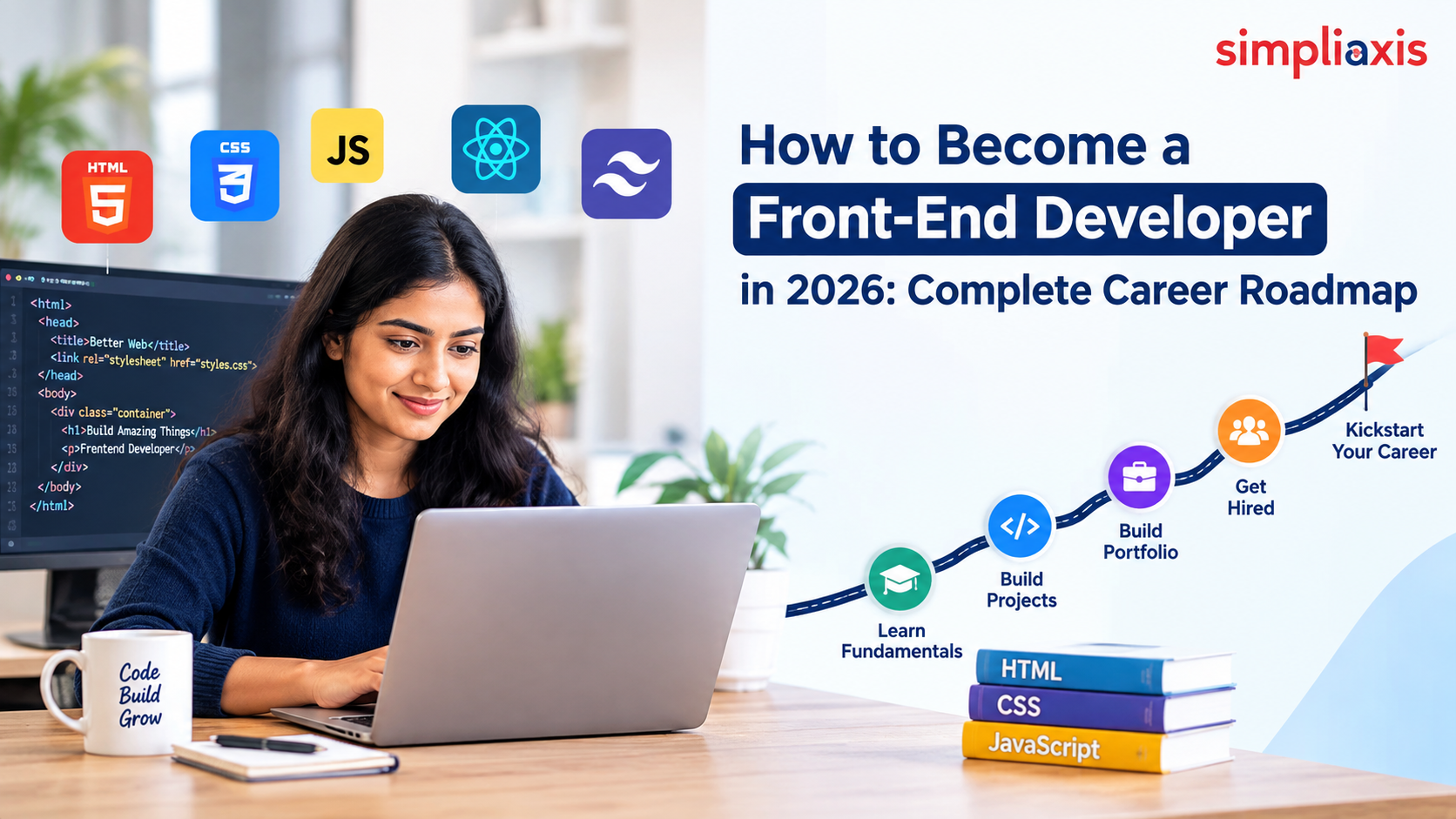
To become a front-end developer, start with HTML, CSS, and JavaScript, then add a modern framework like React, build and deploy real projects, and assemble a portfolio with 3 to 5 live projects and a public GitHub profile. Most self-directed learners reach an entry-level, job-ready skill level in 6 to 12 months of consistent practice, while a computer science degree or a structured program can take longer but adds credibility for some employers. A four-year degree is not required; employers increasingly hire based on demonstrated skills, a strong portfolio, and the ability to pass a practical coding assessment.
Key Highlights of How to Become a Front-End Developer
- The foundation is always HTML, CSS, and JavaScript; everything else, including frameworks, builds on these three.
- React remains the dominant framework, used by roughly 44.7% of developers according to the 2025 Stack Overflow Developer Survey, and TypeScript has overtaken plain JavaScript on most professional codebases.
- The US Bureau of Labor Statistics expects web developers and digital interface designers to grow 7% from 2024 to 2034, with more than 16,000 job openings expected each year through 2033.
- A degree is optional; a portfolio of 3 to 5 deployed projects, a GitHub history, and the ability to pass a live coding or take-home assessment matter more to most hiring managers.
- Core Web Vitals (LCP, INP, and CLS) and WCAG 2.2 accessibility standards are now baseline expectations, not optional extras, for professional front-end work.
- Realistic timelines range from 6 months (intensive, full-time self-study) to 18 to 24 months (part-time alongside a job or studies) before landing a first role.
What Is a Front-End Developer?
A front-end developer builds the part of a website or web application that users see and interact with directly in the browser, the layout, visual design, navigation, forms, animations, and responsiveness across devices. This is distinct from back-end development, which handles servers, databases, and business logic, and from full-stack development, which covers both. Front-end work sits at the intersection of design and engineering: a front-end developer takes a design file (often from Figma) and turns it into functioning, accessible, performant code that talks to APIs and renders correctly on every screen size.
The role has grown more technical over the past decade. Back in the day , web pages were static HTML and CSS . Now we have complex , component-based single-page applications built with frameworks , state management libraries , build tools , and automated testing . Learning front-end web design means learning not just to write code, but also to understand how browsers render pages, how the DOM works, and how performance and accessibility affect actual users.
Front-End vs Back-End vs Full-Stack
| Role | Primary Focus | Typical Languages/Tools | What They Build |
| Front-End Developer | User interface, interactivity, browser rendering | HTML, CSS, JavaScript, React/Vue/Angular | Web pages, UI components, client-side logic |
| Back-End Developer | Servers, databases, APIs, business logic | Node.js, Python, Java, SQL, NoSQL | APIs, databases, authentication, server logic |
| Full-Stack Developer | Both front-end and back-end | Combination of the above | Complete applications end to end |
Core Skills You Need to Learn
Every front-end developer, regardless of specialty, needs a solid grip on the following, roughly in order of when you should learn them.
HTML, CSS, and JavaScript
These three are the non-negotiable basis. HTML defines the structure of content . CSS controls the visual presentation and layout ( including Flexbox and CSS Grid ). JavaScript implements interactivity and logic. The 2025 Stack Overflow Developer Survey shows that JavaScript, Python, and HTML/CSS are still among the most used languages by professional developers around the world, proving that this trio is not a beginner’s detour but the permanent core of the job.
Responsive Web Design and Accessibility
Sites should work well on phones, tablets and desktops . Responsive design techniques (media queries, fluid grids, mobile-first CSS) are de rigueur. This has made accessibility a hard requirement rather than a nice-to-have. In October 2023, theW3C Web Content Accessibility Guidelines (WCAG) 2.2 became an official W3C Recommendation. WCAG 2.2 adds new success criteria such as a minimum 24x24 CSS pixel target size for interactive elements, and not requiring users to reenter information they have already entered earlier in a process. Many employers, especially in government, finance, healthcare and large enterprises, now require WCAG 2.2 AA conformance by contract or law, giving front-end developers who understand semantic HTML, ARIA roles and keyboard navigation a real hiring advantage.
Version Control with Git and GitHub
Every professional team uses Git for version control and a platform like GitHub or GitLab for collaboration. Comfort with branching, pull requests, merge conflict resolution, and commit hygiene is assumed from day one on the job, and your public GitHub profile doubles as a portfolio and a credibility signal to recruiters.
A Modern JavaScript Framework
Understand the fundamentals well; master one framework rather than many at a shallow level. React continues to rule the roost: the 2025 Stack Overflow Developer Survey shows React usage at around 44.7% for professional developers, and separate 2025 State of JavaScript survey data shows that nearly half of React users are already on React 19 daily, with the rest mostly on React 18. Vue and Angular are still good options, especially Angular in large enterprise and government codebases. Pick whatever you want, but learn component architecture, state management (hooks, Context, or a library like Redux/Zustand for React) and client-side routing.
TypeScript
TypeScript has moved from optional to expected on most professional front-end teams. The 2025 State of JavaScript survey found 40 percent of respondents now write exclusively in TypeScript, up from 34 percent in 2024 and 28 percent in 2022, with an 84.1% satisfaction rate among developers who use it, the highest of any language surveyed. Among React developers specifically, TypeScript usage runs even higher than plain JavaScript. Learning TypeScript's type system, interfaces, and generics early will save you from having to retrofit it later.
Web Performance and Core Web Vitals
Google's Core Web Vitals are now a standard performance benchmark that front-end developers are expected to optimize for. The current "good" thresholds, measured at the 75th percentile of real visits, are Largest Contentful Paint (LCP) under 2.5 seconds, Interaction to Next Paint (INP) under 200 milliseconds, and Cumulative Layout Shift (CLS) under 0.1. INP is currently the hardest of the three to pass in practice, since it depends heavily on JavaScript execution time and main-thread blocking, which makes JavaScript performance tuning a core, testable front-end skill rather than a back-end concern.
Testing, Build Tools, and APIs
Round out your skillset with basic unit and component testing (Jest, Vitest, or React Testing Library), familiarity with a modern build tool (Vite has overtaken Webpack in popularity among surveyed developers in 2025), and the ability to consume REST or GraphQL APIs to connect front-end interfaces to back-end data.
Step-by-Step Roadmap
This is a realistic, sequenced path from zero experience to job-ready, whether you are self-taught, in a bootcamp, or supplementing a degree.
- Learn HTML and CSS fundamentals (2 to 4 weeks). Build several static pages by hand before touching any framework or tool. Understand the box model, Flexbox, and Grid thoroughly.
- Learn JavaScript fundamentals (4 to 8 weeks). Cover variables, functions, arrays and objects, the DOM, events, asynchronous code (promises and async/await), and fetch/API calls. Build small, interactive projects with vanilla JavaScript before adopting a framework, so you actually understand what the framework is abstracting away.
- Learn Git and GitHub (1 to 2 weeks, ongoing). Push every project you build to a public repository from the start. This becomes your portfolio and your proof of consistent work.
- Build 3 to 5 small vanilla-JS projects. A to-do app, a weather app calling a public API, a landing page clone, a simple game. Deploy each one publicly (Netlify, Vercel, or GitHub Pages all work and are free).
- Learn a framework, most commonly React, plus TypeScript (6 to 10 weeks). Learn component structure, hooks, state and props, routing, and how to consume APIs inside the framework. Rebuild one or two of your earlier vanilla projects in the framework to see the difference directly.
- Learn responsive design and accessibility properly. Rebuild an existing project mobile-first and audit it against WCAG 2.2 AA criteria: color contrast, keyboard navigation, semantic HTML, and screen-reader labeling.
- Build 2 to 3 portfolio-quality projects. These should look and function like real products, ideally solving a real (even small) problem, connecting to a real or mock API, and demonstrating testing, responsive design, and clean code organization.
- Learn the basics of testing and performance. Add unit tests to at least one project and run a Lighthouse or PageSpeed Insights audit on your deployed projects, then fix what it flags.
- Prepare for interviews. Practice explaining your projects, practice JavaScript fundamentals questions (closures, event loop, array methods), and practice at least basic algorithmic problem-solving.
- Apply, iterate, and network. Apply everyplace . Internships, junior or associate positions. Work on open source projects, or freelancing. Build real world experience. Use the feedback from rejections to fill the gaps in your skills .
Total realistic timeline: 6 to 9 months full-time and intensive, or 12 to 18 months part-time alongside a job, school, or other commitments. This roadmap mirrors the practical, project-first approach used by structured programs; for a broader view of whether the underlying career path is worth the time investment, Simpliaxis's own analysis on whether web development is a good career in 2026breaks down salary bands, demand, and long-term growth outlook for the field as a whole.
Tools and Technologies Front-End Developers Use in 2026
| Category | Common Tools | Notes |
| Code Editor | VS Code | Industry-standard, free, extensible |
| Frameworks/Libraries | React, Vue, Angular, Svelte | React leads adoption at roughly 44.7% per the 2025 Stack Overflow survey |
| Language | JavaScript, TypeScript | TypeScript used exclusively by 40% of surveyed developers in 2025 |
| Build Tools | Vite, Webpack | Vite has overtaken Webpack in developer preference surveys |
| Design Handoff | Figma | Standard for converting design files to code |
| Version Control | Git, GitHub, GitLab | Required baseline skill for any team environment |
| Testing | Jest, Vitest, React Testing Library, Playwright/Cypress | Unit, component, and end-to-end testing |
| Performance Auditing | Lighthouse, PageSpeed Insights, Chrome DevTools | Used to measure Core Web Vitals (LCP, INP, CLS) |
| Deployment | Vercel, Netlify, GitHub Pages | Free tiers suitable for portfolio projects |
Do You Need a Degree or Certification
No, a computer science or IT degree is not a strict requirement to become a front-end developer, and the industry has moved substantially toward skills-based hiring over the past several years. That said, credentials still matter in specific ways:
- A degree can help with visa sponsorship in some countries, with entry into large corporate graduate programs, and with roles at organizations that still gate hiring on formal education.
- Structured certificate programs, such as the Meta Front-End Developer Professional Certificate on Coursera, a roughly seven-month, nine-course program covering HTML5, CSS, JavaScript, React, and technical interview preparation, give self-taught learners a recognized credential and, in Meta's case, access to a job board connecting graduates with employers who have committed to sourcing from the program.
- A portfolio and GitHub history outweigh both of the above for most front-end hiring managers at small and mid-size companies, and increasingly at larger ones too, because they demonstrate actual working code rather than coursework completion.
If your background is in adjacent technical work, for example, software engineering roles that already touch coding standards, code reviews, and Agile delivery, credentials like the Certified Scrum Developer (CSD) certification can complement front-end skills by formalizing your understanding of Agile software delivery practices that most front-end teams operate under day-to-day.
Building a Portfolio That Gets You Hired
A portfolio matters more than almost anything else in an entry-level front-end job search. Hiring managers want to see:
- 3 to 5 deployed, functioning projects, not just source code sitting in a repository. Every project should have a live link.
- Variety: at least one project consuming a real external API, one demonstrating responsive/mobile-first design, and one showing state management complexity beyond a simple to-do list.
- Clean, readable code and commit history on GitHub, with meaningful commit messages rather than a single "final commit."
- A README on each project explaining the problem it solves, the tech stack used, and any tradeoffs made.
- Accessibility and performance basics visibly handled: semantic HTML, reasonable color contrast, and a passing or near-passing Lighthouse score.
- A personal portfolio site that is itself well-built, since it is often the first piece of your work a recruiter sees.
Contributing to open-source projects or building small freelance/volunteer projects for real clients (a local nonprofit, a friend's small business) adds credibility that toy projects alone cannot, because it demonstrates you can work with real constraints, feedback, and stakeholders.
Salary and Job Outlook
Front-end developer compensation varies significantly by experience level, location, and company size, but there is solid published data to set expectations. The U.S. The Bureau of Labor Statistics Occupational Outlook Handbook states that the median annual wage of web developers and digital interface designers is $98,090. The lowest 10 per cent earn less than $48,560, and the highest 10 percent earn more than $162,870. Employment of web developers and digital interface designers is projected to grow 7 percent from 2024 to 2034, faster than the average for all occupations. The BLS projects more than 16,000 annual job openings through 2033, largely due to growth in e-commerce and the continuing need for mobile-responsive, accessible web experiences.
Job Search and Interview Preparation
Front-end interviews typically combine several distinct formats, and preparing for each separately improves your odds substantially:
- JavaScript fundamentals questions: closures, the event loop, hoisting, array and object methods, and asynchronous code (promises, async/await).
- Live coding or take-home assignments: build a small UI component or feature under a time crunch or over a few days, usually graded as much on code quality and structure as whether it “works.”
- System or component design discussions: how you would structure a component, manage state, or handle a UI edge case at a larger scale.
- Portfolio walkthroughs: be ready to explain the "why" behind decisions in your own projects, not just the "what."
- Behavioral and collaboration questions: since most front-end work happens inside Agile teams with designers, product managers, and back-end engineers, expect questions about handling feedback, working through disagreements on implementation, and collaborating across roles.
Mock interviews, frequent contributions to a public GitHub profile, and a resume that emphasizes measurable results (page load improvements, accessibility fixes, features shipped) rather than just technologies all measurably increase response rates.
Career Progression: Junior to Senior and Beyond
Front-end development has a well-defined, if not perfectly linear, progression:
- Junior Front-End Developer (0 to 2 years):Implements well defined tickets, learns codebase conventions, works under review from senior engineers.
- Mid-Level Front-End Developer (2 to 4 years): Owns features end to end, makes architectural decisions within a component or module, mentors juniors informally.
- Senior Front-End Developer (4 to 7+ years): Owns the cross-cutting architecture decisions, performance and accessibility standards and formally mentors the team.
- Staff/Principal Engineer or Front-End Lead: Sets technical direction across multiple teams, often blends deep technical work with organizational influence.
- Lateral moves: Many front-end developers move into full-stack roles, UI/UX engineering, developer relations, engineering management, or specialized tracks like web performance or accessibility engineering.
Because front-end work sits close to product and design, it is also one of the more common engineering paths into product management or design engineering hybrid roles for developers who enjoy the user-facing side of the job.
Common Mistakes Beginners Make
- Jumping to a framework too early. Learning React before you understand plain JavaScript and the DOM makes debugging nearly impossible and leaves gaps that show up in interviews.
- Tutorial hopping without building original projects. Following along with tutorials builds recognition, not real problem-solving ability; you need projects where you had to make your own decisions and get stuck.
- Ignoring accessibility and responsive design until "later." These are graded as core competencies in real jobs and real interviews, not polish items.
- Treating Git as an afterthought. A messy or absent commit history is one of the fastest ways a portfolio loses credibility with a technical reviewer.
- Applying only when "fully ready." Most developers never feel fully ready; applying with a solid but imperfect portfolio and learning from real feedback moves faster than perfecting projects in isolation indefinitely.
- Underestimating soft skills. Front-end developers work constantly with designers, product managers, and other engineers; communication and the ability to take feedback well are evaluated as seriously as code quality in most interviews.
Key Takeaways
- Start with mastering HTML, CSS and JavaScript; these are the permanent foundation no matter what framework you end up specializing in
- React and TypeScript are the best skills to learn next - 2025 Stack Overflow and State of JavaScript survey adoption data
- Degree is less important than a portfolio of 3-5 deployed, well-documented projects. An active GitHub profile weighs heavily with most hiring managers.
- Accessibility (WCAG 2.2) and performance (Core Web Vitals: LCP, INP, CLS) are now baseline professional expectations, not advanced extras.
- The U.S. Web developers are projected to see strong job growth of 7 per cent through 2034, with a median wage of $98,090 across experience levels, according to the Bureau of Labor Statistics.
- The realistic time frame to be job-ready at an entry level is 6 to 9 months full-time or 12 to 18 months part-time. Consistent project building is the single biggest driver of readiness.










 Lowest-Price Challenge











 Personalized Path


.webp)


 USA
USA  Canada
  India
India  UK
UK  Australia
  Singapore


