


 Call Us



Quick Answer
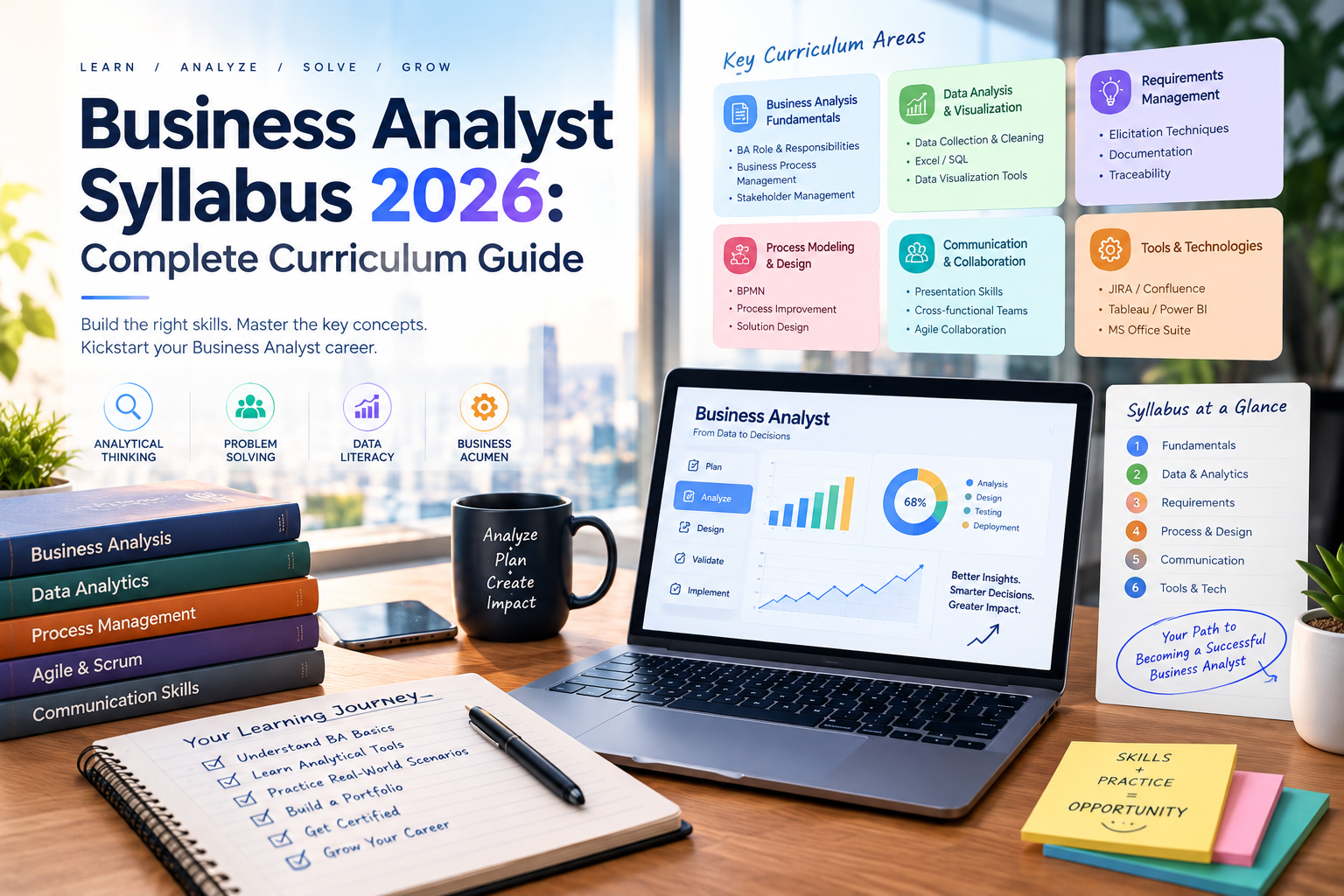
A modern business analyst syllabus is built around the six knowledge areas of the BABOK Guide (business analysis planning and monitoring, elicitation and collaboration, requirements life cycle management, strategy analysis, requirements analysis and design definition, and solution evaluation), the same framework used by IIBA's ECBA, CCBA, and CBAP certifications. Beyond BABOK theory, a well-designed 2026 syllabus adds practical modules in requirements elicitation, process modeling, use cases, wireframing, and stakeholder management, plus hands-on tool training in Excel, SQL, Power BI or Tableau, JIRA, and Confluence. The depth of coverage scales with certification level, from entry-level ECBA topics to case-study-driven CBAP and PMI-PBA content for experienced professionals.
Key Highlights of Business Analyst Syllabus
- Every credible business analyst syllabus maps back to the six BABOK knowledge areas defined by IIBA, which also form the study foundation for the ECBA, CCBA, and CBAP exams.
- Core skill modules typically include requirements elicitation techniques, business process modeling (often using BPMN), use case and user story writing, wireframing, and stakeholder management.
- A 2026-ready syllabus adds practical tool training: Excel, SQL, Power BI or Tableau for data analysis and dashboards, and JIRA plus Confluence for Agile documentation and collaboration.
- Agile business analysis, guided by the Agile Extension to the BABOK Guide, is now a standard syllabus component covering backlog management, user stories, and iterative elicitation.
- Syllabus depth differs sharply by certification level: ECBA is entry-level and knowledge-based, CCBA targets analysts with two to three years of experience, and CBAP and PMI-PBA are scenario-heavy credentials for senior practitioners.
- Choosing the right syllabus depends on your experience level, the certification you are targeting, and whether your role leans more toward IT-heavy technical analysis or business-process-focused analysis.
What Is a Business Analyst Syllabus, and Why It Matters
A business analyst syllabus is the structured curriculum that defines what a training program, certification prep course, or degree program teaches someone who wants to work as a business analyst (BA). Because business analysis sits between business stakeholders and technical teams, a syllabus has to cover two very different skill sets at once: the conceptual, framework-driven knowledge that lets a BA structure a problem correctly, and the practical, tool-based skills that let a BA execute day to day work such as writing requirements documents, building dashboards, and running stakeholder workshops.
Unlike a purely technical curriculum, a business analyst syllabus is not standardized by a single exam board the way, for example, an accounting syllabus is standardized by a national accounting body. Instead, most credible syllabi converge around the same reference source: the BABOK Guide (Business Analysis Body of Knowledge), published by the International Institute of Business Analysis (IIBA). This is why a syllabus review is genuinely useful before you commit to a course or a certification path. It tells you whether the program is teaching BABOK-aligned fundamentals, job-ready tools, or a mix of both, and whether that mix matches the certification and role you are aiming for.
If you are researching certification options directly, Simpliaxis' business analyst certification guide is a useful starting point for understanding how certifications, skills, and salary expectations connect before you look at syllabus detail.
The BABOK Framework: The Backbone of Every Business Analyst Syllabus
The BABOK Guide, as structured by IIBA, organizes business analysis practice into six knowledge areas and 30 underlying tasks. Nearly every serious business analyst syllabus, whether it explicitly says so or not, is teaching toward these six areas. Simpliaxis breaks down the same structure in its BABOK v3 guide, which is a good companion read alongside this syllabus overview.
- Business Analysis Planning and Monitoring. How a BA plans the analysis approach for an initiative, decides which stakeholders to engage, and governs the analysis work throughout a project.
- Elicitation and Collaboration. Techniques for drawing out requirements and information from stakeholders, and for confirming that what was captured is accurate and complete.
- Requirements Life Cycle Management. How requirements are traced, maintained, prioritized, and approved from the moment they are captured until they are retired or implemented.
- Strategy Analysis. Defining the future state a business wants to reach, assessing the current state, and identifying the risks and change strategy needed to get there.
- Requirements Analysis and Design Definition. Structuring, modeling, and specifying requirements in enough detail that a solution can actually be designed and built from them.
- Solution Evaluation. Assessing whether a delivered solution actually performs as intended and identifying the value it delivers, or the limitations that remain.
A syllabus that only lists these six names without going deeper is incomplete. Look for a course that pairs each knowledge area with the underlying tasks and named techniques (for example, brainstorming, document analysis, interviews, and workshops under elicitation), since those techniques are exactly what shows up in scenario-based CBAP and CCBA exam questions. Simpliaxis' overview of IIBA certifications lists how each credential maps back to this same BABOK structure.
Core Skills Modules Every Syllabus Should Cover
Beyond the BABOK knowledge areas themselves, a practical syllabus turns theory into applied modules. These are the modules that show up consistently across strong business analyst training programs.
Requirements Elicitation
Elicitation is the process of drawing requirements out of stakeholders who often cannot fully articulate what they need. A syllabus should cover named elicitation techniques such as structured interviews, requirements workshops, document analysis, observation, surveys, prototyping, brainstorming, and focus groups, along with guidance on when to use each one. Elicitation is not a single meeting; it is an iterative activity that continues throughout an initiative, and a syllabus that treats it as a one-time step is missing an important nuance.
Business Process Modeling
Process modeling, most commonly using BPMN (Business Process Model and Notation), teaches BAs to map how work actually flows through an organization today (the "as-is" process) and how it should flow after a solution is implemented (the "to-be" process). This module matters because process models frequently become the source from which functional requirements and use cases are derived, so a BA who models a process poorly will often produce incomplete requirements downstream.
Use Cases and User Stories
Use case modeling describes how different actors interact with a system to accomplish a goal, and it remains one of the most common notations for eliciting requirements from an actor's point of view. In Agile-influenced programs, this module also covers user stories, acceptance criteria, and how a single use case can be decomposed into several smaller stories for a backlog.
Wireframing
Wireframing teaches BAs to sketch low-fidelity layouts of screens or reports so stakeholders can react to a concrete visual before development starts, catching misunderstandings early and cheaply. This module usually introduces basic wireframing tools and the difference between a wireframe, a mockup, and a prototype.
Stakeholder Management
Stakeholder management modules cover how to identify stakeholders, assess their influence and interest, and plan a communication and engagement approach for each group. This is consistently one of the highest-weighted soft-skill topics in business analyst training because most real project failures trace back to poor stakeholder alignment rather than poor documentation.
Data Analysis Basics
Even non-technical BA roles increasingly expect basic data literacy: understanding data types, simple statistical concepts, and how to read a dataset well enough to support a business decision. This module typically serves as the bridge into the practical tool skills covered next.
Practical Tool Skills a 2026 Syllabus Must Include
Certification exams like ECBA, CCBA, and CBAP test BABOK knowledge, not specific software. But employers hiring business analysts in 2026 expect hands-on tool fluency on top of that knowledge, so a genuinely useful syllabus adds a practical tools track alongside the certification-aligned theory.
- Excel. Advanced formulas, pivot tables, and charting remain the baseline expectation for summarizing and presenting data to stakeholders who will never open a BI tool.
- SQL. Querying databases directly is now a standard expectation for BAs who need to validate data, pull their own reports, or work closely with data and engineering teams.
- Power BI or Tableau. Business intelligence and dashboarding tools that let a BA turn raw data into visual, decision-ready reports for stakeholders.
- JIRA. The dominant tool for tracking backlogs, epics, user stories, and sprints in Agile delivery environments.
- Confluence. Used alongside JIRA for documenting requirements, meeting notes, and process artifacts in a shared, searchable workspace.
- Process mapping tools. Software such as Visio, Lucidchart, or similar BPMN-capable tools used to build the process diagrams described earlier in a shareable, editable format.
Some 2026 syllabi are also introducing basic Python or R exposure and AI-assisted documentation tools, reflecting the broader shift toward AI literacy across business roles. Treat these as valuable additions rather than a substitute for the BABOK and tool fundamentals above; a BA role still lives or dies on requirements quality and stakeholder communication first.
Agile Business Analysis Topics in the Syllabus
Most business analysts today work inside Agile or hybrid delivery teams, so Agile business analysis has become a required syllabus section rather than an optional add-on. The reference framework here is the Agile Extension to the BABOK Guide, developed by IIBA in collaboration with the Agile Alliance. It maps the same six BABOK knowledge areas onto an Agile mindset and adds Agile-specific techniques.
- Backlog management. Structuring, prioritizing, and continuously refining a product backlog so the highest-value work is always ready for the next sprint.
- User stories and acceptance criteria. Writing requirements in a lightweight, iterative format that fits short delivery cycles instead of one large upfront requirements document.
- Business model canvas and business capability analysis. Lightweight strategic tools for framing a problem quickly before diving into detailed requirements.
- Iterative elicitation and continuous feedback. Running elicitation as an ongoing conversation across sprints, rather than a single upfront phase, to minimize waste and course-correct early.
A syllabus that covers Agile business analysis well will also explain how a BA's role shifts on Agile teams, often blending into a product owner or business proxy function, and where traditional BABOK planning and documentation practices still apply even inside a fast-moving Agile team.
How the Syllabus Changes by Certification Level: ECBA vs CCBA vs CBAP vs PMI-PBA
The same BABOK-based topics get taught at very different depths depending on the certification level you are preparing for. Here is how the four most recognized business analyst certifications compare.
| Certification | Issuing Body | Who It Is For | Experience Requirement | Exam Format
|
| ECBA (Entry Certificate in Business Analysis) | IIBA | Newcomers and career switchers with little or no BA experience | No prerequisite experience required | Knowledge- and recall-based multiple-choice exam |
| CCBA (Certification of Capability in Business Analysis) | IIBA | Practitioners with roughly two to three years of BA experience | Minimum 3,750 hours of BA work in the last 7 years, including at least 900 hours in two of the six knowledge areas or 500 hours in four of the six | 130 multiple-choice questions |
| CBAP (Certified Business Analysis Professional) | IIBA | Senior business analysts, typically five or more years of experience | Minimum 7,500 hours of BA work in the last 10 years, including at least 900 hours in four of the six knowledge areas, plus 35 professional development hours | 120 case-study and scenario-based multiple-choice questions, 210 minutes |
| PMI-PBA (Professional in Business Analysis) | PMI | BAs and project professionals who work heavily on requirements within project environments | Varies by education path (roughly 24 to 60 months of BA experience) plus 35 contact hours of business analysis training | Scenario-based multiple-choice exam |
In practice, this means an ECBA-focused syllabus spends most of its time explaining what each BABOK knowledge area and technique means, with straightforward recall-style practice questions. A CCBA or CBAP-focused syllabus assumes you already know the definitions, and instead drills you on applying the right technique to a messy, scenario-based situation, choosing between competing priorities, and defending a judgment call the way you would on a real project. Simpliaxis compares the three IIBA credentials in more depth in its ECBA vs CCBA vs CBAP certification guide, and PMI's own PMI-PBA certification page details the three eligibility paths for that credential.
If you are starting from zero, Simpliaxis' ECBA certification training is built around this entry-level syllabus depth, while its CCBA certification training and CBAP certification training step up to the applied, scenario-heavy syllabus that intermediate and advanced practitioners need. Simpliaxis also publishes a dedicated ECBA certification syllabus breakdown if you want the entry-level topic list in more detail.
A Sample Module-by-Module Business Analyst Syllabus
Putting the pieces above together, here is what a well-rounded, BABOK-aligned business analyst syllabus typically looks like when laid out module by module.
- Introduction to Business Analysis. The BA role, the BABOK framework, and how business analysis fits inside project and product delivery.
- Business Analysis Planning and Monitoring. Planning the analysis approach, stakeholder analysis, and governance of analysis work.
- Elicitation and Collaboration. Interviews, workshops, document analysis, brainstorming, and confirming elicited requirements.
- Requirements Life Cycle Management. Traceability, prioritization, and requirements approval and maintenance.
- Strategy Analysis. Current-state and future-state assessment, risk analysis, and change strategy.
- Requirements Analysis and Design Definition. Business process modeling with BPMN, use case and user story writing, and wireframing.
- Solution Evaluation. Measuring solution performance and identifying value delivered versus limitations.
- Stakeholder Management and Communication. Stakeholder mapping, facilitation, and conflict resolution.
- Data Analysis Fundamentals. Data types, basic statistics, and reading data to support decisions.
- Tool Labs. Hands-on practice in Excel, SQL, Power BI or Tableau, JIRA, and Confluence.
- Agile Business Analysis. Backlog management, user stories, and iterative elicitation using the Agile Extension to the BABOK Guide.
- Certification Exam Preparation. Mock exams, practice questions, and technique drills matched to the target certification (ECBA, CCBA, CBAP, or PMI-PBA).
Not every course will label modules exactly this way, but a syllabus missing more than one or two of these blocks is likely to leave a gap either in exam readiness or in on-the-job readiness.
Business Analyst Career Outlook and Why the Syllabus Matters
The U.S. Bureau of Labor Statistics does not track "business analyst" as its own distinct occupational code; the closest official category is management analysts, which overlaps heavily with business analysis work. According to the BLS Occupational Outlook Handbook, employment of management analysts is projected to grow 9 percent from 2024 to 2034, much faster than the average for all occupations, with about 98,100 openings projected each year on average over the decade, and a reported median pay in that category. That projected growth is one practical reason the syllabus question matters: as demand grows, employers filter candidates more heavily by demonstrated skill and recognized certification, not just a job title on a resume.
Because certifications like ECBA, CCBA, CBAP, and PMI-PBA are explicitly tied to a syllabus built on the BABOK Guide, completing that syllabus and earning the credential gives hiring managers a consistent way to verify what you actually know, rather than relying on self-reported experience alone.
How to Choose the Right Business Analyst Syllabus for Your Goals
Use these questions to evaluate any business analyst course or certification prep program before you enroll.
- Does it map explicitly to BABOK? If a syllabus cannot tell you which of the six knowledge areas each module supports, it will be hard to know how exam-ready you actually are.
- Does it match your experience level? An ECBA-depth syllabus will under-prepare a five-year practitioner for CBAP-style scenario questions, and a CBAP-depth syllabus will overwhelm a total beginner.
- Does it include tool labs, not just theory? A syllabus that never touches Excel, SQL, a BI tool, JIRA, or Confluence is teaching you to pass an exam, not to do the job.
- Does it cover Agile business analysis explicitly? Given how common Agile delivery is, a syllabus silent on backlog management and user stories is missing a large share of real-world BA work.
- Does it offer certification-specific practice? Mock exams and scenario drills matched to your target certification are what actually move the needle on exam day.
If your goal is a recognized IIBA credential, reviewing Simpliaxis' business analysis training overview alongside the specific ECBA, CCBA, or CBAP pages linked above is a practical way to compare syllabus depth against your current experience level before committing to a course.
Key Takeaways
- Every credible business analyst syllabus is anchored in the six BABOK knowledge areas defined by IIBA, regardless of which certification it targets.
- Core skill modules, requirements elicitation, process modeling, use cases, wireframing, stakeholder management, and data analysis basics, turn BABOK theory into applied capability.
- 2026 syllabi increasingly add tool labs in Excel, SQL, Power BI or Tableau, JIRA, and Confluence, since certification exams test knowledge but employers expect tool fluency.
- Agile business analysis, based on the Agile Extension to the BABOK Guide, is now a standard rather than optional syllabus section.
- Syllabus depth should match certification level: ECBA is entry-level and recall-based, while CCBA, CBAP, and PMI-PBA demand applied, scenario-based judgment tied to real experience hours.
- Choosing the right syllabus means matching your experience level and target certification against the modules a course actually offers, not just its marketing description.
Schema Recommendation and Source Verification
For publication, apply Article schema to the main content and FAQPage schema to the Frequently Asked Questions section above, since both are directly supported by the page's actual structure.
The following facts could not be independently verified through search in this environment and should be checked against primary sources before being treated as certain:
- The exact current median pay figure for "management analysts" cited in search results was not independently cross-checked against a freshly loaded BLS page in this session; the BLS Occupational Outlook Handbook page for management analysts was identified as the source, but the precise dollar figure should be re-verified directly before publishing if used as a standalone statistic.
- "Business analyst" is not a distinct BLS occupational category; the 9 percent growth (2024 to 2034) and 98,100 annual openings figures are reported under the related "management analysts" category, so applying them directly to "business analyst" roles is an approximation, not an exact match.
- The CCBA experience threshold was reported in search results as "900 hours in two of the six knowledge areas or 500 hours in four of the six knowledge areas"; this detail should be cross-checked against the current official IIBA CCBA handbook before publication, as certification hour requirements can be revised by IIBA over time.
- Specific instructor-led training hour figures (for example, 21 hours for ECBA and 35 hours for CBAP) reflect one training provider's current program length and may not represent a universal industry standard across all training providers.





 Lowest-Price Challenge











 Personalized Path


.webp)


 USA
USA  Canada
 India
India UK
UK Australia
 Singapore


