


 Call Us



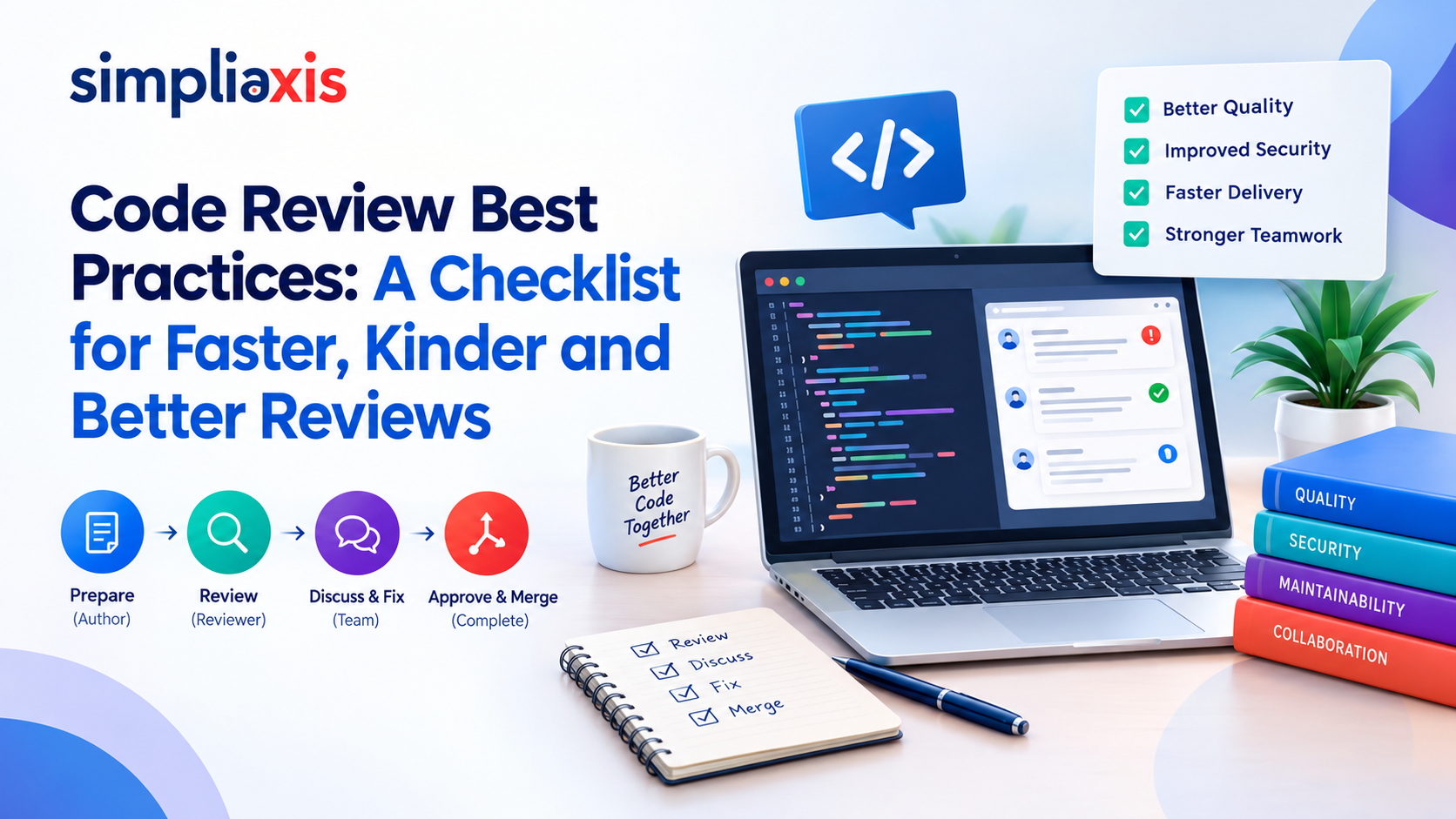
Code review is the careful examination of code changes before they are incorporated into a shared source code base to spot bugs, address security problems, and ensure quality. An ideal code review process involves a practical checklist, targeted pull requests, automated reviews, and timely responses. With an emphasis on high-risk issues, set expectations, and quick replies, reviews can be quicker, kinder and more useful without sacrificing quality.
Introduction
A review of code should help the developers to write good quality and bug-free software that moves things forward, increases an understanding of the product and code, and does not just get bogged down in lengthy debates.
But introducing too many changes in each review can obscure actual faults, while imprecise review comments can leave authors in the dark as to what should be modified. A good review process should therefore consider three factors: reasonable chunks of work, concrete review input, and respectful communication.
There is research to back these techniques up, however. In one case, aCisco Systems programming team studied 2,500 code reviews by 50 programmers over 10 months, looking at 3.2 million lines of code. The study's results focused on the significance of the size of the review and the speed of inspection, suggesting that about 100-300 lines should be reviewed in focused sessions of 30-60 minutes.
One aspect that is daunting for any individual is also the scale of code review. For example,a Google 2018 case study investigated the review logs for 9 million code changes , interview notes, and survey data to examine how developers review code and what gets in their way.
This guide includes actionable code review best practices, a checklist you can reuse, and four phases to make reviews faster, kinder, and better.
Why Code Reviews Matter
Code review allows developers to review code before it is integrated into the main codebase. Code review isn't about finding bugs; it's about providing other benefits, like helping developers understand unfamiliar code, setting engineering standards, and facilitating easier changes to the code in the future. The following are some of the key reasons why code reviews are such an important piece of the process.
Catch bugs early before deploying
Reviewers identify bad conditions, missed edge cases, variations, and cracks in exception handling, which never make it to the end user.
Security improvements
Security issues can be revealed through the examination of authentication, authorization, validation, and data handling and dependencies, which could be missed by the tool.
Better maintainability
Cleanly named data structures, straightforward abstractions, and understandable code aremore maintainable and have more eyes to spot issues. In the process of reviewing, team members will be introduced to different parts, design approaches, and possible solutions.
Consistency is key
Code will not turn into a difficult place if all teams play their part in applying common agreed coding conventions and architectural patterns. Review, a process that can run alongside testing andcontinuous integration, allows a team to identify problems before they are integrated.
But this method is not a replacement of automated tests, security scans, or proper design. It is best when combined with all those things.
The Code Review Process Step by Step
A good review process provides an author and reviewer with a set of expectations for a change before it goes in. This workflow keeps expectations clear, and you don't end up extending your reviews into an unneeded approval delay.
Author Preparation
It is the author's duty to file a change that can be made to make sense, is testable, and is ready for review. The reviewers should not need to piece together a new purpose from a series of unrelated changes.
Before submitting the pull request, the author needs to:
- Describe the issue you are solving and attach auser story, bug, or requirement that is related.
- Don't combine refactoring work and formatting changes with feature development.
- Run the appropriate unit, integration, and other relevant tests locally.
- Inspect the results of linting, formatting, type-checking, and security scans if they can be applied.
- Provide a meaningful PR description: Describe what changed, why it changed, and how it was tested.
- Include additional information such as screenshots, API examples, architecture diagrams, and migration considerations if they help reviewers understand your change.
- Delete debugging code, edited files, junk, and unrelated diffs.
Good PR descriptions answer these three questions: What has changed? Why change? How do I test?
Reviewer Pass
The reviewer evaluates the modification by its reason for being and by the team’sengineering norms. It is not about rewriting someone else's code to their preference but about judging if it is right, safe, clear, and suitable for the system.
A practical review can follow this order:
- Read the PR description, requirements, and relevant design decisions.
- Check if the solution is solving the problem and is not adding any needless complication.
- Map out critical logic paths and see how the change affects existing parts.
- Take into account security, data consistency, error handling, performance, and compatibility.
- Ensure the tests exhibit the expected behavior and handle critical failure cases.
- Focus on what specifically would be improved in one line or one action and tell why it could be changed.
Reviewers should make a distinction between whether an issue is a blocking issue or a suggestion. A bad security flaw or wrong business rule will prevent the check-in from being merged, but a non-critical want of names likely won't.
Discussion and Patch
The review comments should guide the author towards a better decision, not start a fight over who is right. When citing concerns, focus on the behavior, risks, and requirements of the code.
Here's the pattern of a fruitful conversation:
- The reviewer recognizes the problem and describes how it affects.
- If the problem or change appears to be unclear, ask for clarification.
- The parties agree that alternatives are reasonable when the matter is not clear.
- The writer revises the example or describes why the current method is good enough.
- The reviewer checks the resolution and renders the comment finished or not.
For example, instead of complaining, "This logic is wrong," a reader could criticize:
But can this condition deal with empty responses? What if the API has no record? This path could try to use an undefined value. Another point of failure that is suggested by the second comment, and which provides something tangible for the author to check out.
Authors should address substantial comments, revise implementation as appropriate, and rerun the tests. Reviewers should avoid reopening resolved issues unless appropriate evidence or a change in requirements justifies it.
Approval and Merge
The change that passed the team's review is approved. Do not treat it as a pass of tests or any presumption of security. Before merging, check that:
- All blocking review comments are resolved.
- Required approvals have been obtained.
- CI checks and required tests have passed.
- The final diff contains no unexpected changes.
- Provides all documentation, setup, configuration, and migration steps needed.
- You feed more than just snow information to the branch where the team's workflow demands it.
- The change passes the repository merge and branch-protection rules.
After these conditions are met, combine the PR according to the team's strategy; squash merge, merge commit, or otherwise. If your project needs to be verified after merging, verify that the change works as expected. A transparent completion process ensures approval isn't just a formality and makes the responsibility for the ultimate change obvious.
Code Review Checklist
Use this checklist as a practical reference during review. Not every item applies to every change, so reviewers should prioritize the checks relevant to the code's purpose and risk.

How to Use the Checklist Effectively
Start with correctness and security because defects in these areas can have significant consequences.
Check tests against the behavior being changed rather than judging coverage by the number of test files alone.
Apply performance checks according to the likely workload and the cost of failure.
Treat style preferences consistently through an agreed style guide and automated formatting.
Add project-specific checks when the application has special requirements, such as payment processing, healthcare data, or critical infrastructure.
The checklist should guide judgment, not replace it. A change can satisfy every generic item and still contain a problem specific to its business logic or architecture.
Keeping Pull Requests Small
Small pull requests are generally easier to understand, review, test, and discuss than changes that modify many unrelated parts of an application. They also make it easier to identify which change introduced a defect if something goes wrong.
A small PR is not defined by line count alone. A compact change involving authentication or database migrations may require more scrutiny than a larger, straightforward documentation update.
Best Practices for Managing PR Size
Separate unrelated changes: Keep formatting, refactoring, bug fixes, and new features in separate PRs when they can be reviewed independently.
Useincremental delivery: Break a large feature into logical steps that can be implemented and validated separately.
Separate preparation from behavior changes: If a refactor is needed before adding a feature, consider reviewing the refactor independently.
Use feature flags where appropriate: Deploy incomplete functionality safely without exposing it to users before it is ready.
Explain unavoidable complexity: If a change must be large, describe its structure, highlight high-risk areas, and provide a recommended review order.
Avoid artificial splitting: Do not divide tightly coupled changes into fragments that cannot be understood or tested independently.
For example, a new reporting feature might be divided into separate changes for the database model, service logic, API endpoint, and user interface, provided each step remains coherent and the team's integration approach supports it.
The aim is to reduce the mental effort required to understand a change without compromising correctness or creating unnecessary dependencies between PRs.
How to Give Feedback Respectfully?
Code review comments influence both code quality and team collaboration. Feedback is most useful when it is specific, technically justified, and focused on the implementation rather than the person who wrote it.
Principles for Constructive Feedback
1. Explain the reason behind the comment
Instead of saying, “Don't do this,” explain the technical concern.
Less helpful: “This is a bad approach.”
More helpful: “This approach repeats the database query for every item. Could we fetch the required records in one query to reduce unnecessary calls?”
2. Ask questions when clarification is appropriate
A question encourages the author to explain their reasoning and can reveal context the reviewer has missed.
For example: “Would using the existing validation method cover this case and keep the behavior consistent with the other endpoints?”
3. Separate requirements from preferences
Use clear language to distinguish between a blocking defect, a recommended improvement, and an optional suggestion.
4. Comment on the code, not the developer
Avoid remarks that question someone's competence or intent. Describe observable behavior and its consequences instead.
5. Keep discussions focused
When a conversation becomes complicated, use a short call or discussion to reach a decision, then record the conclusion in the PR so future maintainers can understand it.
6. Acknowledge good solutions
Pointing out a clear test, thoughtful edge-case handling, or a well-designed implementation reinforces the practices the team wants to encourage. Respectful feedback does not mean avoiding difficult findings. It means communicating them clearly, fairly, and with enough context for the author to act.
How to Receive Feedback
Reviewers and authors share responsibility for a successful review. Receiving feedback constructively helps resolve issues faster and makes technical discussions more productive.
Authors can use the following practices:
Make sure you understand the concern rather than reacting to its tone or wording.
If the risk or recommendation is unclear, request an example or explanation.
Check the behavior, requirements, and evidence before deciding whether to accept a suggestion.
Explain the change made or provide a concise technical reason for retaining the existing approach.
Reviewers can overlook context, so discuss alternatives when you have evidence for a different solution.
When a review reveals a missing edge case, add a suitable test if it can be tested reliably.
Follow the team's process for marking conversations resolved, and leave a brief explanation when useful.
For instance, if a reviewer recommends a different data structure, the author can compare the options against the actual access pattern and explain the trade-off. The goal is to reach a sound engineering decision, not simply to accept or reject feedback.
A healthy review culture allows authors to disagree respectfully and reviewers to revise their opinions when new information emerges.
Automating Checks Before Human Review
Automated checks handle repeatable verification so reviewers can focus on design, behavior, maintainability, and risks that require human judgment.
A typical pull request pipeline may include the following checks:

How to Integrate Automation into the Review Workflow
Run fast checks locally or during the initial PR validation.
Trigger the full required CI pipeline when a change is opened or updated.
Display results directly in the pull request so authors and reviewers can see failures.
Require critical checks to pass before merging, using branch protection where appropriate.
Investigate failures instead of bypassing them simply to unblock a merge.
Review automated findings in context because tools can produce false positives or miss problems.
Automation should reduce repetitive work, not create unnecessary barriers. Teams should maintain their rules, remove obsolete checks, and prioritize actionable findings.
Most importantly, a passing pipeline does not prove that the implementation meets the business requirement. A test suite may pass while the code still uses the wrong calculation, exposes an unauthorized operation, or introduces an architectural problem. Human review remains essential.
Code Review and the Definition of Done
TheDefinition of Done (DoD) describes the conditions a team agrees must be met before work is considered complete. Code review can form part of that agreement, alongside testing, documentation, security, anddeployment readiness.
For asoftware development team, the DoD might require that:
The implementation meets theacceptance criteria.
Required peer reviews and approvals are complete.
Relevant automated tests pass.
Identified blocking defects are resolved.
Applicable security and quality checks pass.
Necessary documentation and configuration changes are included.
The change can be merged according to repository policies.
These requirements should reflect the project's risk and delivery model. A small internal documentation change may need a different level of scrutiny from a change that affects authentication, customer data, or a payment workflow.
Code Review Is Not the Same as the Definition of Done
Code review is one activity within a broader completion standard. Approval alone does not establish that all acceptance criteria have been met, that the software has been tested adequately, or that it is ready for production.
Teams should also avoid adding so many approval steps that reviews become a bottleneck. Define who must approve which changes, what blocks a merge, and which checks are mandatory. This makes the DoD a practical quality agreement rather than an administrative checklist.
Common Code Review Anti-Patterns

Even teams with formal review policies can develop habits that reduce review quality. Recognizing these anti-patterns helps teams correct problems before they affect delivery, code quality, or collaboration.
How Teams Can Improve Their Review Culture
Start by identifying the problem rather than introducing more rules automatically. If reviews are slow, investigate reviewer availability, PR complexity, CI failures, and unclear ownership. If defects escape reviews, examine test quality, review focus, and the kinds of issues being missed.
Teams can monitor practical indicators such asreview turnaround time, time spent waiting for the first review, unresolved blocking comments, and defects discovered after merging. These measures should help identify workflow problems—not rank individual developers or encourage superficial approvals.
Conclusion
Effective code reviews depend on more than finding mistakes. They need a process to follow, clear expectations, narrow pull requests, positive feedback, and the right level of automation.
Authors should request a simple, well-tested change. Reviewers should check correctness, security, maintainability, and other applicable risks and communicate with courtesy. Teams should enforce automated and repeatable change verification and make tests for approval commensurate with risk.
The best code review process is the one that's designed to help developers learn and grow and grow better code together without slowing down production or shutting down dialogue. By applying these best practices, code reviews can be faster, kinder, and more effective.







 Lowest-Price Challenge













 Personalized Path






 USA
 Canada
 India
 UK
 Australia
 Singapore


