


 Call Us




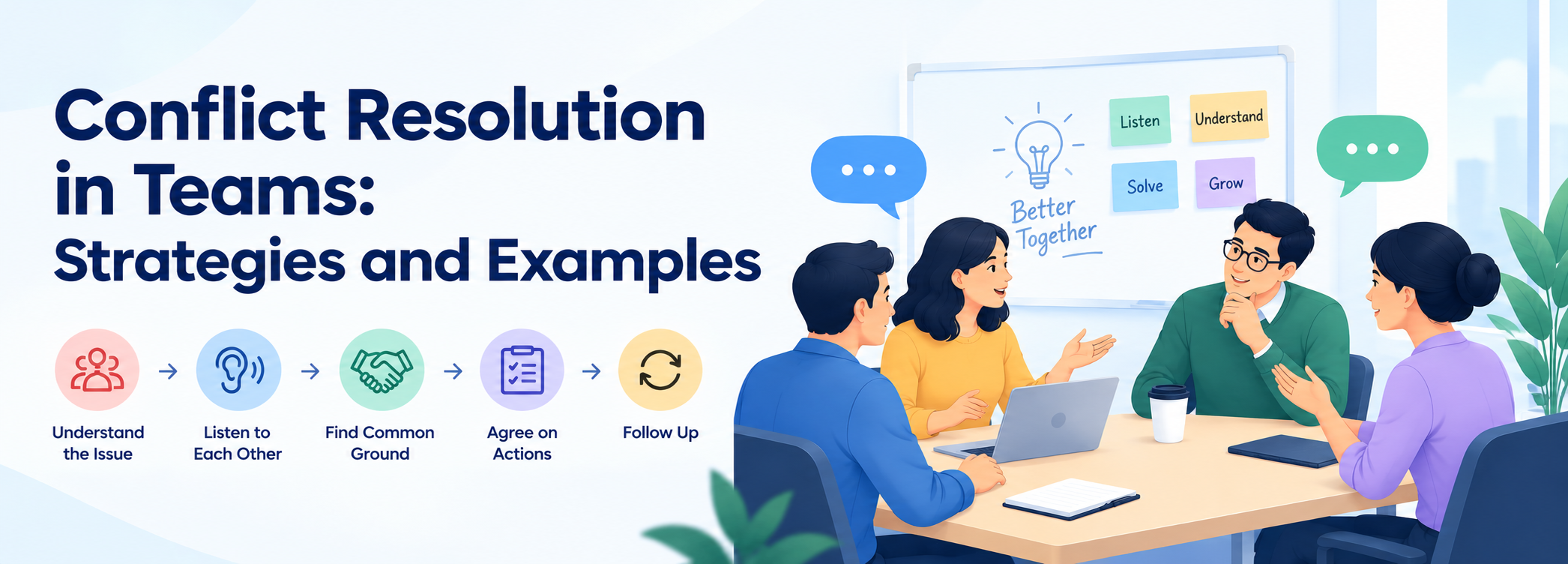
Conflict resolution in teams is the process of surfacing a disagreement, understanding each person's perspective, and agreeing on a way forward that protects the team's goals. Effective team conflict resolution follows five steps: acknowledge the issue, listen to each side, find common ground, agree on actions, and follow up. Teams can match one of five Thomas-Kilmann styles to the situation, and Scrum Masters facilitate the conversation without refereeing it.
Key Highlights of Conflict Resolution in Teams
- Name the type of conflict first: task, process, or relationship.
- Look for the root cause, which is usually goals, roles, resources, or communication.
- Choose a Thomas-Kilmann style that fits the stakes, not your habit.
- Use a five-step process so the discussion stays on the problem.
- Build psychological safety so people raise concerns early.
- Facilitate instead of deciding for the team, unless safety or policy demands a firm call.
- Conflict is not always useful, so keep task disagreements from turning personal.
Introduction
Two of your strongest developers have stopped talking in standup. Nobody argued openly. Yet reviews now take twice as long, and every message gets a cold reply.
Have you ever watched a small disagreement quietly harden into a standoff? Most teams have. The disagreement itself was rarely the problem. The silence around it was.
This guide explains how team conflict resolution works in practice. You will learn the types and causes of team conflict, the Thomas-Kilmann model, and a five-step process. You will also see worked workplace examples, how to build a culture that prevents destructive conflict, and what a Scrum Master can do.
What Is Conflict Resolution in Teams?
Conflict resolution in teams is a structured way of addressing disagreement between team members so they can keep working toward shared goals. It involves naming the issue, listening to each perspective, exploring options, and agreeing on next steps. The aim is a workable decision, not unanimous agreement.
Definition and Why It Matters
Left alone, conflict absorbs time that teams rarely budget for. A Harvard Business Review article by team researchersnotes that managers spend around 20% of their time managing team conflict (4 Common Types of Team Conflict – and How to Resolve Them, Peterson & Behfar, HBR).
Handled well, resolution brings clear benefits:
Better decisions: People test assumptions before the team commits.
Faster delivery: Decisions stop stalling inside conversations.
Stronger trust: Colleagues learn that disagreement is survivable.
Clearer accountability: Agreements name owners and dates.
Healthy vs Unhealthy Conflict
Not every disagreement signals trouble. So, how do you spot the line between a productive debate and a toxic argument? The difference lies in what the conflict targets.
| Aspect | Healthy conflict | Unhealthy conflict |
| Focus | Ideas, evidence, priorities | People, motives, past mistakes |
| Behavior | Questions and counterproposals | Interrupting, sarcasm, silence |
| Outcome | A decision or clearer understanding | The same argument on repeat |
| Aftermath | Respect survives | Resentment grows |
One caution matters here. A well-known meta-analysis found strong negative correlations between task conflict and team performance, not the positive link many textbooks suggested. The same study found task conflict was less damaging when it stayed weakly linked to relationship conflict.
In practice, then, disagreement about ideas can help, but only if it does not spill into personal friction. That is the real job of conflict resolution.
Common Types and Causes of Team Conflict
Knowing the types of team conflict helps you pick the right response. A dispute over priorities needs a different fix from a breakdown in trust.
Task, Process and Relationship Conflict
Researchers commonly separate task conflict from relationship conflict. Process conflict is often added as a third type. Let’s learn more about these:
| Type | What it is about | What it sounds like | Best first response |
| Task | Content of the work | "This design won't scale." | Compare evidence and criteria |
| Process | How work gets done | "Who approves this handoff?" | Clarify roles and workflow |
| Relationship | Personal tension | "You never listen to me." | Private conversation about behavior |
The types overlap with each other. A process gap, such as an unclear handoff, can become relationship conflict within weeks if nobody addresses it.
Values and Priority Conflicts
Team members may also disagree because they hold different beliefs about what deserves attention. One employee may prioritize customer satisfaction, while another focuses on cost control or regulatory compliance.
These differences become particularly challenging when the team has no agreed criteria for making trade-offs. A shared goal, clear decision rules, and transparent reasoning can help the team move forward without requiring everyone to share identical preferences.
Four Common Patterns: Who Is Involved
The type of conflict is one lens. Who is involved is another. The same HBR authors, drawing on thousands of team conflicts, describe four patterns:A well-known meta-analysis (De Dreu & Weingart, 2003) found strong negative correlations.
| Pattern | Share of team conflicts | Typical first move |
| Two members disagree | About 35 percent, the most common | Facilitated conversation between the two |
| Conflict centers on one member | 20 to 25 percent | Understand the pattern before judging the person |
| Two subgroups at odds | 20 to 25 percent | Re-anchor on a shared goal |
| Whole team disagrees | Under 15 percent | Revisit goals, roles, and decision rules |
The "first move" column reflects common practice, not the authors' wording. The takeaway is simple: handle conflict close to its source before it spreads.
Root Causes: Goals, Roles, Resources, and Communication
The visible trigger is rarely the cause. A missed deadline may look like a performance problem when the real issue is a late scope change.
Four root causes appear again and again:
- Goals: People define success differently.
- Roles: Two people believe they own one decision, or nobody does.
- Resources: Teams compete for time, people, or budget.
- Communication: Updates arrive late, incomplete, or unclear.
Other factors can also contribute, including unrealistic deadlines, unequal workloads, different working styles, unclear authority, and unresolved past disagreements.
Three questions help find the root: What happened? What made it hard? What would prevent it next time?
Conflict in Distributed and Cross-Functional Teams
Distance and departmental boundaries add friction. A remote colleague misses a decision made after the meeting. A finance partner optimizes cost while engineering optimizes reliability. Both are right, and neither knows the other's constraint.
Time zones, thin context in chat messages, and different cultural norms around feedback make small misunderstandings grow. Teams that span locations benefit from written decisions, named owners, and a clear rule for when a text thread becomes a call. See these best practices for Agile remote working.
For remote teams, it is also helpful to separate urgent discussions from routine updates. A complex disagreement may require a focused conversation instead of a long message thread in which tone and intent are easily misunderstood.
Cross-functional teams should agree on shared outcomes before debating individual departmental preferences.This makes it easier to assess proposals against the same criteria.
The Thomas-Kilmann Conflict Model
The Thomas-Kilmann Conflict Mode Instrument (TKI) is a framework developed by Kenneth Thomas and Ralph Kilmann. It describes five ways people respond to conflict: competing, collaborating, compromising, avoiding, and accommodating. These styles work as conflict resolution strategies for teams because each one fits a different situation.
The Two Dimensions: Assertiveness and Cooperativeness
The model plots styles on two axes. Assertiveness is how strongly you pursue your own concerns. Cooperativeness is how strongly you address the other person's.
| Style | Assertiveness | Cooperativeness | Works best when |
| Competing | High | Low | A fast, firm decision is needed |
| Collaborating | High | High | The issue is complex and important |
| Compromising | Medium | Medium | Time is short, and both sides can give |
| Avoiding | Low | Low | The issue is minor, or emotions are high |
| Accommodating | Low | High | The relationship matters more than the point |
The styles are options, not personality labels. Most people use all five.
Infographic - Thomas-Kilmann Conflict Model
Competing
Competing pursues your position firmly. It suits emergencies, safety issues, and policy requirements. Overuse teaches people to stop raising concerns, so explain your reasoning and stay open to new facts.
Collaborating
Collaborating digs into both sides' needs to find an option that serves both. It takes time, so reserve it for high-stakes issues where commitment matters, such as an architecture choice the whole team must live with.
Compromising
Compromising splits the difference. It works for practical trade-offs, like sharing a test environment during a busy week. If the same compromise repeats, ask why demand keeps exceeding capacity.
Avoiding
Avoiding delays the conversation. A deliberate pause helps when tempers are high, or facts are missing. Avoiding indefinitely is different: it lets resentment grow unseen.
Accommodating
Accommodating means letting the other person's preference win. It is gracious on low-stakes matters. If one person always accommodates, their concerns never get heard.
Choosing the Right Style for the Situation
Ask four quick questions:
- How high are the stakes? Safety and compliance call for firmness.
- How much time is there? Tight deadlines favor compromise or a clear decision.
- Does each side hold something the other needs? If yes, collaborate.
- Is the relationship at risk? Then slow down and listen first.
A useful rule: pick the least forceful style that still resolves the issue. Never use compromise or accommodation to bury a safety, ethics, or fairness concern.
How to Resolve Team Conflict Step by Step
Wondering how to resolve conflict in a team without it becoming personal? A repeatable conflict resolution process keeps the discussion on the problem. These five steps work for a manager, team lead, or peer.
Infographic: Five Steps to Resolve Team Conflict
Step 1: Acknowledge and Frame the Conflict
Name the issue early and describe it as an observable problem. Compare "Engineering never cooperates" with "The design handoff slipped twice because approval rules were unclear." The second can be investigated.
Pick a private setting if emotions are high.
Step 2: Understand Each Perspective
Give each person uninterrupted time. Ask open questions: What concerns you most? What outcome do you want? What do you need from the other side?
Then summarize what you heard and check that you got it right. If there is a power imbalance or repeated hostility, speak with people separately first.
Step 3: Find Common Ground and Options
Look for the shared goal beneath opposing positions. A sales team and a product team may both want satisfied customers while disagreeing on timing.
Generate several options before judging any. Compare them against agreed criteria such as cost, time, risk, and customer impact.
Step 4: Agree on a Way Forward
Write the agreement down. Include the action, the owner, the date, how you will know it worked, and what happens if it does not.
"Communicate better" is not an agreement. "Copy arrives two days before the design deadline" is. If the parties cannot agree, record the remaining gap and escalate to a decision-maker.
Step 5: Follow Up and Rebuild Trust
Schedule a short check-in a week or two later. Ask whether the problem recurred and whether anyone still feels unheard. Trust rebuilds through consistent follow-through, not a single good meeting.
Conflict Resolution Examples in the Workplace
These conflict resolution examples in the workplace are hypothetical. Each shows a different pattern and a different style.
Example 1: Two Colleagues Clash Over Priorities
Situation: Two employees share a project. One wants to ship a customer-requested feature, while the other wants to fix a usability problem first.
Resolution: The lead follows the five steps. Each person explains the impact of their option. Both agree on a shared criterion: effect on the main user journey. The usability fix wins this cycle, and the feature moves to the next one.
Style used: collaborating.
Lesson: Agree on decision criteria before debating solutions.
Example 2: Design and Engineering Pull in Different Directions
Situation: In a cross-functional team, designers want a richer interface, and engineers worry about performance. The disagreement has split the team into two camps.
Resolution: The team restates the shared goal: a fast, easy checkout. They test a simpler design against performance targets and keep two features that users value most.
Style used: collaboration, with a compromise on scope.
Lesson: Subgroup conflicts ease when the team returns to a common outcome.
Example 3: Quality vs Deadline in an Agile Team
Situation: Near the end of a Sprint, a tester flags open defects. Developers want to call the work done and fix the defects later.
Resolution: The Scrum Master asks the team to check the work against its Definition of Done. Two defects fail the agreed criteria, so the team defers one lower-priority item and fixes the failing ones. They also add a checkpoint earlier in the next Sprint.
Style used: collaboration anchored to a shared standard.
Lesson: Conflict resolution in agile teams works best when agreed standards, not seniority, settle the question.
Example 4: Conflict Between Managers and Team Members
Situation: A manager expects an employee to provide daily progress updates. The employee considers the repeated requests unnecessary and feels that the manager does not trust their work.
Cause of conflict: Both parties have different expectations about reporting, autonomy, and accountability.
Resolution strategy: Clarification and collaboration.
The manager explains the need to identify project risks early. The employee explains how frequent updates interrupt focused work. Together, they agree on a short daily update covering progress, blockers, and next steps, with detailed discussions reserved for issues that need attention.
Outcome: The manager receives the information needed to track progress, while the employee retains time for focused work.
Key lesson: Many disagreements between managers and employees become easier to resolve when both parties explain their underlying needs rather than judging each other's intentions.
Example 5: Unequal Workloads Within a Team
Situation: One team member repeatedly handles urgent requests while colleagues continue with their planned assignments. The employee eventually complains that the workload is unfair.
Cause of conflict: The team lacks a transparent method for assigning urgent work and reviewing capacity.
Resolution strategy: Problem-solving and process improvement.
The manager reviews current assignments, upcoming deadlines, and the frequency of urgent requests. The team agrees to use a shared Kanban board, rotate responsibility for urgent requests, and review workloads during weekly planning.
Outcome: Team members gain visibility into one another's responsibilities, and the manager can identify capacity problems earlier.
Key lesson: When conflict results from an uneven workload, address the allocation process instead of expecting individuals to tolerate the imbalance.
What These Examples Teach Us
| Workplace situation | Appropriate response | Long-term improvement |
| Different task priorities | Compare impact and agree on criteria | Establish a shared prioritization method |
| Manager-employee tension | Clarify expectations and autonomy | Agree on reporting and feedback practices |
| Unequal workloads | Review capacity and redistribute work | Make assignments and ownership visible |
| Remote communication gaps | Discuss the missed information and agree on channels | Document decisions and changes |
| Quality versus deadline disagreements | Evaluate risk and agreed quality standards | Align on the Definition of Done and escalation process |
The strongest resolution does more than settle the immediate disagreement. It helps the team prevent similar problems from returning.
Building a Culture That Prevents Destructive Conflict
Resolving single disputes is half the job. Team conflict management also means building conditions where concerns surface early and disagreements stay about the work.
Psychological Safety and Working Agreements
Psychological safety is, in Amy Edmondson's words, a shared belief held by members of a team that the team is safe for interpersonal risk-taking. People speak up, ask questions, and admit mistakes without fear of embarrassment.
It matters for conflict because people raise problems while they are still small. Google's Project Aristotle described psychological safety as the most important factor in building a successful team. You can read more about how psychological safety develops in teams.
Psychological safety is not the same as being nice or avoiding accountability. Leaders build it through small, consistent habits:
- Ask for views from quieter members first.
- Thank people who raise concerns, even when you disagree.
- Admit your own mistakes openly.
- Explain decisions, especially when you reject a suggestion.
- Challenge ideas, never people.
Working agreements make these habits concrete. A team might agree to question assumptions instead of motives, document decisions, and raise concerns directly to the person involved. Review them every few months.
Clear Roles and Decision Rights
Role confusion fuels process conflict. When two people believe they own a decision, they compete. When nobody owns it, work stalls.
Teams can settle this with a simple record of who decides, who gives input, and who is informed, a core part of project governance. Add a clear escalation path for decisions that stay deadlocked. Roles do not remove the need for discussion. They show where discussion ends, and a decision begins.
The Scrum Master's Role in Conflict Resolution
The Scrum Guide holds Scrum Masters accountable for the Scrum Team's effectiveness and for helping remove impediments. It also asks them to coach the team in self-management. Disagreement is part of that work, since it can appear in refinement, planning, reviews, and retrospectives.
Facilitating, Not Refereeing
A referee decides who wins. A facilitator, a skill built in Certified Agile Facilitator training, helps people reach their own decision.When developers disagree about refactoring during a Sprint, the Scrum Master can:
- Give each person room to explain their view.
- Keep the talk on the work, not on character.
- Surface assumptions, risks, and the Sprint Goal.
- Make trade-offs visible so the team decides with open eyes.
The Scrum Master should not rule in favor of seniority or end the argument just to move on. Harassment, discrimination, and serious misconduct go through formal channels, not facilitation.
Coaching the Team to Self-Resolve
Mature teams handle most disagreements themselves. A Scrum Master builds that capability with coaching questions:
- What outcome do you both want?
- What evidence would help you choose?
- What working agreement would stop this from recurring?
Retrospectives help spot patterns. If the same conflict returns every Sprint, the cause probably sits in the workflow or the roles.
Servant leadership shows up here in small, practical ways. See why the Scrum Master is a servant leader.
- Listening first before offering a view.
- Removing the blocker that triggered the disagreement.
- Giving the team credit for the resolution.
- Asking a question instead of issuing an instruction.
Scrum Masters who want to practice these facilitation skills in a scaled setting can explore SAFe Scrum Master Certification Training.
Common Mistakes to Avoid
Well-meaning teams still make conflict worse. Watch for these:
- Waiting it out: Minor friction may fade, but repeated friction rarely does.
- Guessing at motives: A missed message is not proof of carelessness.
- Criticizing the person: Describe the behavior and its effect instead.
- Forcing a quick truce: A rushed handshake leaves the real issue alive.
- Compromising by reflex: A middle ground is wrong when safety or ethics are involved.
- Taking sides early: Hear everyone before forming a view.
- Skipping follow-up: Without a check, the same dispute returns.
- Airing it in public: Discuss sensitive personal issues privately.
Best Practices for Team Conflict Resolution
Consistent habits make team conflict resolution easier before problems escalate.
- Address issues early: Raise concerns while they are still small.
- Separate facts from assumptions: Use observable behavior and project data.
- Anchor on shared goals: Bring the talk back to the outcome the team needs.
- Match the strategy to the situation: Use the Thomas-Kilmann questions.
- Document agreements: Record owners, dates, and review points.
- Review recurring conflicts: Repeat patterns point to workflow or role problems.
- Escalate when needed: Involve a manager or HR for misconduct or issues beyond the team's authority.
Develop the Skills Needed to Resolve Conflict
Strong conflict resolution skills make these habits easier. The most useful are active listening, emotional self-regulation, clear communication, empathy, negotiation, and facilitation. Teams can practice them through role-play and reflection after hard conversations.
| Skill | How it helps |
| Active listening | Helps people understand concerns before responding |
| Emotional self-regulation | Reduces impulsive reactions during tense discussions |
| Clear communication | Makes expectations, concerns, and requests easier to understand |
| Empathy | Helps team members consider perspectives different from their own |
| Problem-solving | Shifts attention from blame to workable solutions |
| Negotiation | Helps people identify acceptable trade-offs |
| Facilitation | Keeps discussions focused, balanced, and productive |
For a deeper, practice-based look, the Conflict Management Skills microcredential covers these skills in detail.
Conclusion
So, what happens in your team when two people disagree: does the issue get solved, or does it go quiet?
Remember three things. First, identify the type and root cause before choosing a response. Second, follow a clear process: acknowledge, listen, find common ground, agree, and follow up. Third, build psychological safety and clear roles so fewer disagreements turn destructive.
Conflict resolution in teams is a habit, not a one-time fix. Pick one unresolved tension in your team this week, and walk through the five steps with the people involved.








 Lowest-Price Challenge












 Personalized Path



.webp)


 USA
 Canada
 India
 UK
 Australia
 Singapore


