


 Call Us



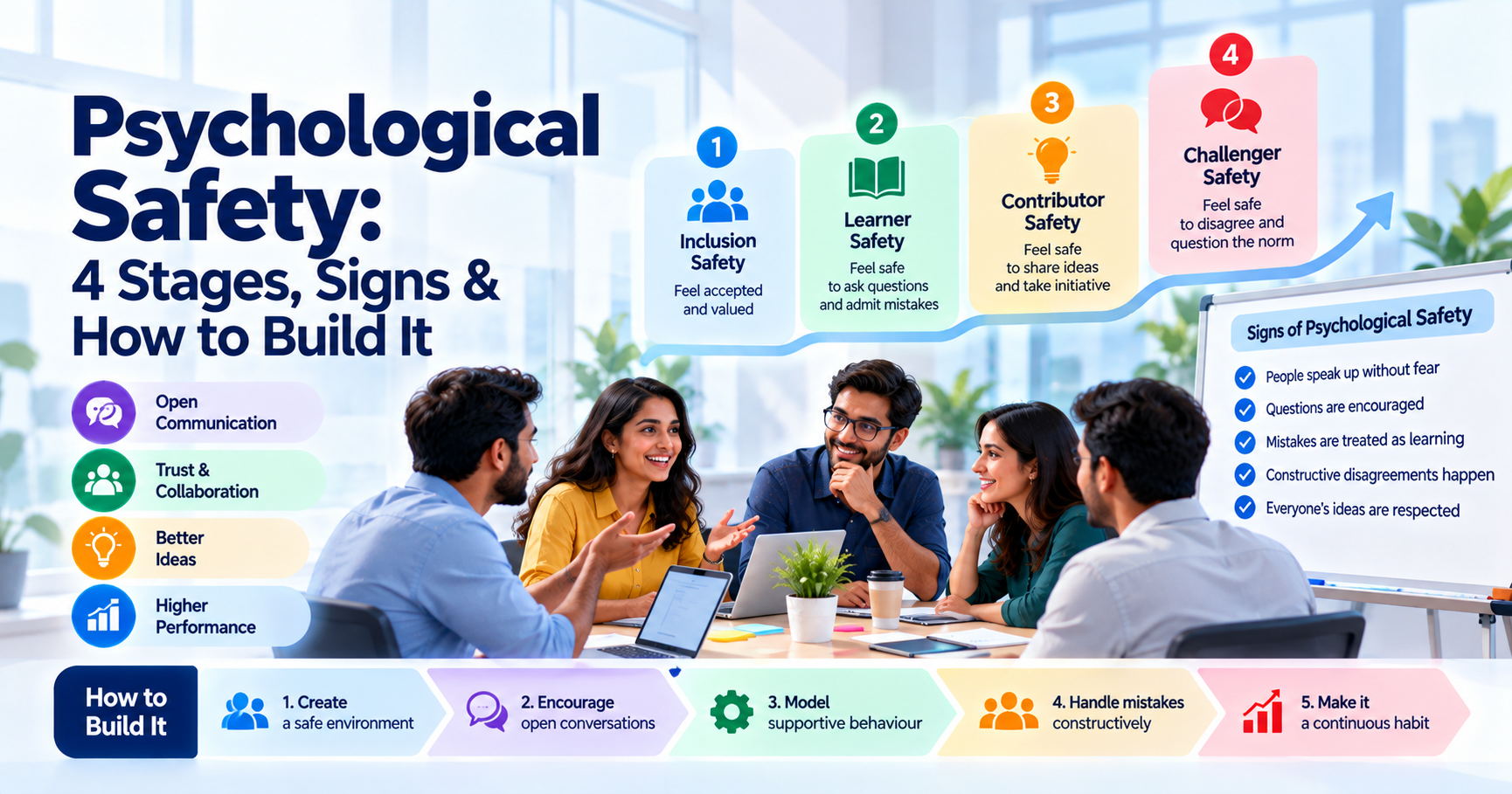
Psychological safety means you feel safe to speak up, ask questions, admit mistakes, share ideas, or disagree with others without being punished, humiliated, or marginalized. Amy Edmondson has coined the term “team psychological safety” to mean a shared belief that the team is a safe place for interpersonal risk-taking. Her research showed a connection between psychological safety, team learning, and performance.
Timothy Clark later described four stages of psychological safety: inclusion safety, learner safety, contributor safety, and challenger safety. Together, these stages show how people can move from simply feeling accepted to feeling confident enough to question the way things are done.
In simple terms, a psychologically safe workplace does not mean everyone agrees all the time. It means people can disagree without fear.
Key Highlights of Psychological Safety
- Psychological safety enables people to speak out without fear of humiliation or punishment.
- Amy Edmondson’s work connects psychological safety to team learning.
- Timothy Clark's model includes four stages: inclusion, learning, contribution, and challenge.
- Psychological safety is not about lax standards or avoiding difficult conversations.
- High psychological safety is most effective when paired with accountability.
- Teams can measure psychological safety through surveys, retrospectives, and regular team health checks.
- Scrum Masters can promote psychological safety by increasing the openness and productivity of team conversations.
- Psychological safety is a habit you practice, not a workshop you attend.
Introduction
Think about a team meeting where someone notices a serious problem.
They know something is wrong, but they stay quiet.
Maybe they are worried that the manager will think they are difficult. Maybe someone spoke up in the past and was ignored. Maybe mistakes are usually blamed on individuals. Or perhaps the team has simply become used to keeping quiet.
Now think about another team.
Someone notices the same problem and says, "I think we may have missed something here."
Nobody laughs. Nobody shuts them down. The team looks at the issue, asks questions, and decides what to do next.
The difference is not necessarily talent. It can be psychological safety.
Psychological safety at work matters for the small things – such as asking for help – and the big things, like reporting a mistake, challenging a decision, or suggesting a new idea. When people feel safe to take these interpersonal risks, teams are more likely to catch problems early and learn from them.
This is especially critical in the modern workplace, wherecross-functional teams have to work across roles, share information rapidly, and respond to change.
What Is Psychological Safety?
Psychological safety is a shared belief that you can take interpersonal risks within your team without fear of negative consequences.
Amy Edmondson introduced the concept of team psychological safety in her 1999 research. Her study of 51 work teams found that psychological safety was associated with learning behaviour, while learning behaviour helped explain the relationship between psychological safety and team performance.
So, what does that look like in everyday work?
It can be as simple as:
- "I don't understand this. Can you explain it?"
- "I think there is a mistake in this report."
- "I disagree with this approach."
- "I need help with this task."
- "I made an error. Here is what happened."
- "Can we try another way?"
- "I don't think this deadline is realistic."
These statements may sound ordinary. But in a team where people fear blame or embarrassment, they can feel risky.
Amy Edmondson's Definition
Edmondson describes psychological safety as a shared belief held by members of a team that the team is safe for interpersonal risk-taking.
The important word here is "team".
Psychological safety is not only about whether one person feels confident. It is about the environment created through repeated interactions between people.
For example, a manager who says, "Tell me if you see a problem," but reacts badly every time someone raises one is not creating much psychological safety.
People notice behaviour more than words.
What Psychological Safety Is Not
Psychological safety is sometimes misunderstood.
It does not mean:
- Everyone has to agree.
- Managers cannot give feedback.
- Employees can ignore deadlines.
- Poor work should be accepted.
- Nobody can question your decisions.
- People should never feel uncomfortable.
- Standards should be lowered.
In fact, psychological safety can support more honest and difficult conversations.
A safe team can say, "This work is not good enough yet," while still allowing the person receiving the feedback to ask questions and improve.
Why It Matters for Team Performance
When people are afraid to speak, important information can stay hidden.
A developer may not report a bug. A content writer may not question an unclear brief. A project manager may not mention a delivery risk. A junior employee may notice a problem but decide that it is better not to say anything.
That silence can become expensive.
Google's Project Aristotle research also found psychological safety to be the most important of the five team dynamics it identified. The study looked at 180 teams and found that how people worked together mattered more than factors such as seniority, team size, or individual performance.
The Research Behind Psychological Safety
Edmondson's Team Learning Studies
Edmondson's 1999 study was one of the key pieces of research behind the modern discussion of psychological safety.
She studied 51 work teams and looked at the connection between team psychological safety, learning behaviour, and performance. The findings showed that psychological safety was linked to learning behaviour, and learning behaviour helped explain the connection between psychological safety and team performance.
This matters because learning at work often requires people to admit what they do not know.
You cannot ask a useful question if you are scared of looking uninformed.
You cannot report a mistake if you expect punishment.
You cannot challenge an idea if disagreement is treated as disloyalty.
Google's Project Aristotle Findings
Google's Project Aristotle looked at what made teams effective. Researchers studied 180 teams and examined both team composition and team dynamics. Their findings placed psychological safety at the top of five key team dynamics, followed by dependability, structure and clarity, meaning, and impact.
Google's research also found that effective teams were not simply groups of talented individuals. The way people interacted with one another mattered greatly.
This is one reason psychological safety in teams has become such an important topic in leadership, Agile, project management, and workplace culture.
The Four Stages of Psychological Safety
Timothy Clark's four-stage model provides a practical way to understand how psychological safety can develop.
The four stages are:
- Inclusion safety
- Learner safety
- Contributor safety
- Challenger safety
Clark's model describes a progression from feeling accepted to feeling able to challenge the status quo.
Inclusion Safety
The first stage is about belonging.
People need to feel that they are accepted as members of the group. They should not feel that they have to constantly prove that they deserve to be there.
A new employee, for example, may need time to understand the team's culture and ways of working. Simple actions such as introducing them properly, asking for their views, and including them in conversations can make a difference.
Without inclusion safety, people may stay on the edge of the team.
Learner Safety
The second stage is about being able to learn.
People need to feel safe to ask questions, make reasonable mistakes, get feedback and try something new.
Think of a new employee who is afraid to ask how a process works because everyone else seems to have it figured out.
They may spend an hour trying to figure it out alone.
A psychologically safer response would be, "Ask whenever you are unsure. We'd rather clarify it early."
This is where learning becomes easier.
Contributor Safety
Stage 3 is about contributing something meaningful.
People should feel their work and ideas matter, once they understand their role.
They have to be able to take ownership, discuss, decide within their role and bring their skills to bear, the hallmark ofself-organizing teams.
Contributor safety is not about giving people unlimited freedom. It is about giving them enough trust and responsibility to participate properly.
Challenger Safety
The fourth stage is about challenging the status quo.
This is where a person can say:
"I don't think this process is working."
"Could we try something different?"
"I disagree with the decision."
"There may be a better way to solve this."
This stage is particularly important for improvement and innovation. A team may be friendly and supportive but still lack challenger safety if nobody feels comfortable questioning existing practices.
Psychological Safety and High Standards
Some managers worry that psychological safety will make teams too comfortable.
That concern usually comes from treating safety and accountability as opposites.
They are not.
A team can have high psychological safety and high accountability at the same time.
Edmondson's model places psychological safety and accountability on separate dimensions. High safety with high accountability creates the Learning Zone. High safety with low accountability creates the Comfort Zone, while low safety with high accountability can create the Anxiety Zone.
The Learning Zone vs the Comfort Zone
The Comfort Zone may be comfortable, but it is not always productive.
If nobody is challenged and standards are vague, people might feel okay without getting better.
The Learning Zone is different.
People know that good work is expected but can ask for help, report problems, and admit when something is not working.
That combination is powerful.
Combining Safety With Accountability
A manager can say:
"We need to meet this deadline. If you see a risk, tell me as soon as possible."
That message combines accountability with safety.
Compare it with:
"We cannot miss this deadline. I don't want to hear about problems."
The second message may actually make problems harder to solve because people have a reason to hide them.
Signs of High and Low Psychological Safety
What a Safe Team Looks Like
A team with strong psychological safety may show behaviours such as:
- People ask questions without hesitation.
- Team members admit mistakes.
- Problems are discussed early.
- Junior employees speak during meetings.
- People disagree respectfully.
- Managers ask for feedback.
- Team members ask for help.
- Ideas are discussed before being judged.
- Retrospectives lead to honest conversations.
- People can say "I don't know."
These are practical psychological safety examples because they show safety through behaviour rather than slogans.
Warning Signs of a Low-Safety Team
Low psychological safety can look different.
Watch for:
- Meetings where only senior people speak.
- Employees agreeing with everything.
- Problems appearing late.
- People avoiding difficult topics.
- Mistakes being hidden.
- Employees being afraid to ask questions.
- Feedback being taken personally.
- People discussing problems privately but not in meetings.
- New ideas becoming less frequent.
- Team members blaming one another after failures.
One quiet meeting does not prove that a team lacks psychological safety. Look for patterns over time.
How to Measure Psychological Safety
Measuring psychological safety can help teams understand what people are experiencing rather than relying on assumptions.
Edmondson's Seven-Item Survey
Amy Edmondson developed a seven-item psychological safety scale that has become one of the most widely used measures of the concept. A review of the research literature found Edmondson's 1999 seven-item scale was the most commonly used measure in the studies examined.
The questions cover areas such as:
- Whether mistakes are held against team members.
- Whether people can raise difficult problems.
- Whether differences are accepted.
- Whether it is safe to take interpersonal risks.
- Whether people can ask for help.
- Whether colleagues deliberately undermine one another.
- Whether individual skills and talents are valued.
A psychological safety survey should ideally be anonymous when people may fear that their answers could be traced back to them.
The goal is not to produce a nice score. The goal is to find areas that need attention.
Team Health Checks and Retrospective Signals
A psychological safety assessment does not have to happen only through a formal survey.
Teams can also look at everyday signals.
During asprint retrospective, ask:
- Did everyone get a chance to speak?
- Were problems raised early?
- Could people disagree openly?
- Did anyone hold back?
- How did we respond when someone made a mistake?
- Did we focus on fixing the issue or blaming the person?
These questions can reveal things that a simple score may miss.
How to Build Psychological Safety Step by Step?
So, how to build psychological safety in a real workplace?
It starts with small behaviours that happen consistently.
Frame Work as a Learning Problem
Instead of treating every challenge as a test that someone must pass, treat some work as a learning process.
For example, instead of asking, "Why did you get this wrong?" ask, "What happened, and what can we change next time?"
This does not remove accountability.
It changes the conversation from blame to understanding.
Model Curiosity and Admit Fallibility
Leaders have a strong influence on the tone of a team.
A manager can say:
"I may be missing something."
"I don't know the answer."
"What do you think?"
"I got that wrong."
These statements show others that admitting uncertainty is allowed.
Google's team effectiveness guidance also recommends acknowledging fallibility and modelling curiosity as ways to encourage psychological safety.
Invite Participation and Respond Productively
Asking for ideas is not enough.
The response matters.
If someone offers an idea and the manager immediately dismisses it, people will remember that interaction.
Instead, try:
"Tell me more."
"What problem would this solve?"
"What risks do you see?"
"How could we test it?"
Even when an idea is not used, treating the person with respect encourages future participation.
Make It Safe to Report Failure
Failure can contain useful information, especially when teams examine what happened without turning every mistake into a personal attack.
Edmondson's work on learning from failure stresses that organisations need ways to turn mistakes and problems into useful learning rather than simply labelling every failure as bad.
A useful question is:
"What can we change so this is less likely to happen again?"
That question moves the team towards learning.
The Scrum Master's Role in Psychological Safety
Psychological safety in agile teams matters because Agile ways of working depend heavily on communication, feedback, inspection, and adaptation.
A Scrum Master can help create the conditions for honest conversations.
Facilitating Safe Retrospectives and Daily Scrums
Retrospectives are a natural place to build psychological safety, and strongAgile facilitationskills make a big difference.
A Scrum Master can:
- Give everyone space to speak.
- Avoid letting one person dominate.
- Separate people from problems.
- Ask open questions.
- Prevent blame.
- Encourage specific examples.
- Follow up on agreed actions.
TheDaily Scrum can also be affected by team safety.
If people are afraid of being judged for delays, they may hide blockers. A healthy team should be able to say that something is stuck before the issue becomes bigger.
For those building their Scrum skills, SAFe Scrum Master Certification Training can provide additional context around the Scrum Master role and Agile ways of working.
Coaching Leaders and Protecting the Team
A Scrum Master is not there simply to run meetings.
The role can also involve coaching the team and helping leaders understand behaviours that make open communication easier or harder.
This connects closely with servant leadership.
You can read more about the connection in Why Is Scrum Master A Servant Leader. TheseAgile leadership principlesalso show what supportive leadership looks like in everyday situations.
PracticalServant Leadership Examplescan also help show what supportive leadership looks like in everyday situations.
Common Mistakes to Avoid
Confusing Safety With Being Nice
Being nice is not the same as psychological safety.
A team can be friendly but still avoid hard conversations.
For example, everyone may get along well, but nobody tells a colleague that their work has a serious problem.
Psychological safety allows people to be respectful and honest.
One-Off Efforts Instead of Habits
A single workshop will not fix a team where people have been afraid to speak for months.
Safety is built through repeated experiences.
If a manager asks for honest feedback today but reacts badly tomorrow, the workshop will not matter much.
The same applies to psychological safety training. Training can provide useful ideas, but leaders and teams need to apply those ideas in everyday work.
Best Practices for Sustaining Psychological Safety
Building psychological safety is only the first step. Keeping it strong requires regular attention.
Here are some practical habits:
Make speaking up the norm.
Ask for concerns before asking whether everyone agrees.
Thank people for bringing up issues.
The person who raises uncomfortable news may prompt others to speak, even when the news is uncomfortable.
Review mistakes without judgement.
What happened, why it happened, and what can be changed.
Equal space for people.
Make sure that the loudest voices are not the only voices that are heard in every conversation.
Make disagreement acceptable.
Contradiction does not have to be discord.
Unambiguously make standards.
Psychological safety works best when combined with clear expectations and accountability.
Use regular check-ins.
You can run a psychological safety survey or a team health check to see changes over time.
Try different types of discussions.
Liberating structures can offer teams simple ways to get more people into the conversation, rather than relying on a small number of contributors.
Observe leader behaviour.
Employees tend to follow the lead of their managers. When leaders get defensive, others may also become careful.
Most importantly, pay attention to what happens after someone speaks up.
That moment tells the team whether speaking honestly is actually safe.
Conclusion
Psychological safety is not about creating a workplace where nobody feels uncomfortable.
It is about creating a workplace where people can be honest even when the conversation is uncomfortable.
Amy Edmondson's research shows the connection between psychological safety and team learning, while Google's Project Aristotleresearch placed psychological safety at the top of its five key team dynamics.
Timothy Clark's four stages add another useful view: people first need to feel included, then safe to learn, then safe to contribute, and finally safe to challenge the status quo.
For organisations, the goal is not simply to make people feel comfortable. It is to create teams where people can ask difficult questions, report problems, challenge ideas, accept feedback, and still be held to high standards.
That is what makes psychological safety useful.







 Lowest-Price Challenge











 Personalized Path


.webp)


 USA
USA  Canada
 India
India UK
UK Australia
 Singapore


