


 Call Us



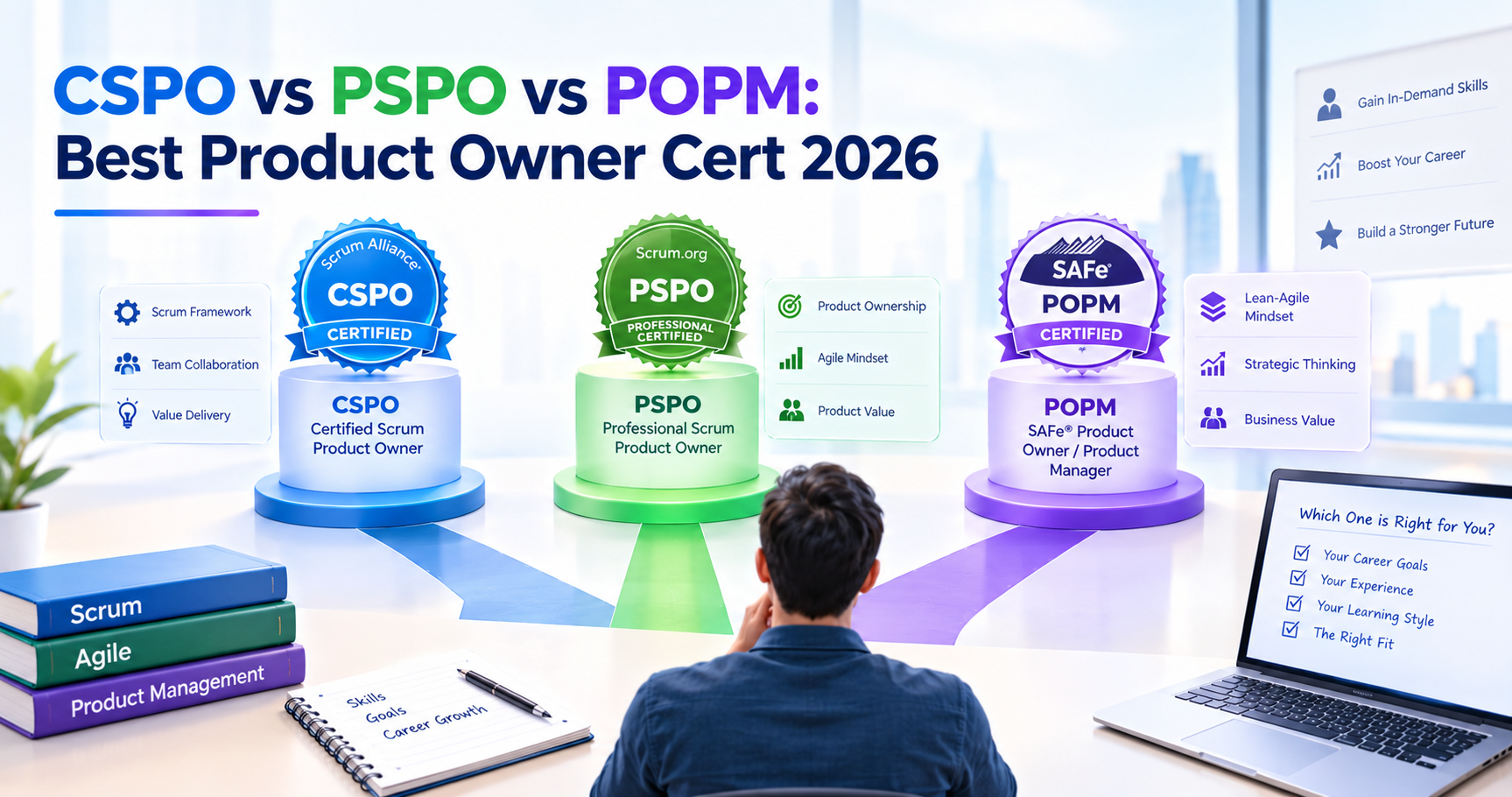
In the CSPO vs PSPO vs POPM debate, the right pick depends on your framework and how you like to prove your skills. Choose CSPO if you want a guided, course-based Scrum credential from Scrum Alliance.
Choose PSPO if you prefer to prove your knowledge through a tough, low-cost exam from Scrum.org. Choose SAFe POPM from Scaled Agile if you need to manage product work across many teams.
Key Highlights: CSPO vs PSPO vs POPM
- CSPO is earned by attending a two-day course. There is no exam. It renews every two years.
- PSPO I is earned by passing a 45-question exam with a score of 82%. It never expires.
- SAFe POPM focuses on product ownership at scale inside an Agile Release Train (ART). It renews every year.
- CSPO and PSPO suit single-team Scrum. SAFe POPM suits enterprises that coordinate value across teams.
- Upfront cost is lowest for PSPO, but course-based paths give you live coaching.
- Many professionals hold more than one credential as their career grows.
Introduction
Product ownership is now one of the most sought-after roles in agile teams. Companies want people who can shape a product vision, manage a backlog, and keep customers at the center of every decision. Certifications help prove that you understand the role.
The problem is choice. Three credentials appear on almost every job post and training page. They are CSPO, PSPO, and SAFe POPM. Each one is respected, yet each one is built for a different situation.
This guide breaks down the CSPO vs PSPO vs POPM question in plain terms. You will see who issues each credential, how it is earned, what it costs, and how long it lasts. You will also learn which one fits your role, your employer, and your career plan.
CSPO vs PSPO vs POPM: Side-by-Side Comparison
The table below gives a fast view of the three credentials. Details follow in later sections.
| Factor | CSPO | PSPO (Level I) | SAFe POPM |
| Full name | Certified Scrum Product Owner | Professional Scrum Product Owner | SAFe Product Owner/Product Manager |
| Issuing body | Scrum Alliance | Scrum.org | Scaled Agile, Inc. |
| How you earn it | Attend a two-day course | Pass an online assessment | Attend a course, then pass an exam |
| Exam | None | 80 questions, 60 minutes, 85% to pass | Online multiple-choice exam, the pass score is 82% |
| Typical cost | Course fee set by trainer | $200 per exam attempt | About $700 to $900 in some markets, less in others |
| Validity | 2 years | Lifetime | 1 year |
| Renewal | 20 SEUs and a $100 fee | None | $195 a year plus tax (SAFe Foundational membership) and 12 CEUs a year |
| Best for | Scrum teams that want guided learning | Self-driven learners who want exam proof | Enterprises using SAFe |
Product Owner Certifications at a Glance
Before you compare details, it helps to know who stands behind each credential. The issuing body shapes the learning style, the renewal rules, and even how employers see the badge.
The Three Credentials and Their Issuing Bodies
CSPO comes from Scrum Alliance. PSPO comes from Scrum.org. SAFe POPM comes from Scaled Agile, Inc. All three prepare you to lead product decisions. However, they do so through different philosophies.
Scrum Alliance stresses learning through a live class. Scrum.org stresses proving your knowledge through a rigorous assessment. Scaled Agile stresses applying product ownership inside a large, structured system.
Scrum Alliance, Scrum.org, and Scaled Agile
Scrum Alliance and Scrum.org both grew out of the Scrum movement. Both follow the Scrum Guide. Their product owner content overlaps a great deal, so the skills you gain are very similar.
Scaled Agile takes a different route. It created the Scaled Agile Framework, known as SAFe. SAFe adds layers such as Agile Release Trains, Program Increments, and portfolio-level planning. The POPM course teaches you how the product owner and product manager roles fit into that structure.
Why Does the Role Scope Differ Across Them?
In pure Scrum, the product owner is one person who owns the backlog for one team. The scope is tight and clear.
In SAFe, the work is split. A product owner works closely with a team. A product manager works at the program level and defines features and priorities for the whole train. The POPM credential covers both views. That is why its scope feels wider than CSPO or PSPO.
What Is CSPO (Certified Scrum Product Owner)?
CSPO is a foundational credential for people who will act as, or work closely with, a Scrum product owner. It is one of the oldest and best-known product owner certifications in the market.
Provider, Format, and Course Content
Scrum Alliance issues the CSPO certification. You earn it by completing CSPO certification trainingtaught by a Certified Scrum Trainer. Most courses run for two days, either online or in a classroom.
The class is hands-on. You practice writing user stories, ordering a backlog, and talking to stakeholders. You also learn how to define a product vision and how to measure value. Most learners say the group exercises are the best part.
Prerequisites and How It Is Earned
There are no formal prerequisites. Anyone can join a course, though some product or business experience helps you get more out of it.
CSPO is unusual because it has no exam. According to a breakdown, attending the mandatory two-day course and accepting the Scrum Alliance licence agreement is all that is needed. Your course fee is your main upfront cost. This makes the CSPO certification a good fit for people who dislike high-pressure tests.
Renewal, Cost, and Validity
CSPO is valid for two years. Scrum Alliance states that each certification runs on a two-year renewal cycle. Foundational credentials such as CSPO need 20 Scrum Education Units (SEUs) and a $100 fee at renewal, based on the officialScrum Alliance renewal page.
You can earn SEUs through webinars, events, community work, or extra training. If you move up to Advanced CSPO or a professional-level credential, your CSPO renews automatically when you renew the higher one.
Course fees differ by trainer and country. In India, prices are usually lower than in the United States. Always compare what the fee includes, such as materials, trainer access, and follow-up support.
What Is PSPO (Professional Scrum Product Owner)?
The PSPO certification is offered by Scrum.org. It has a reputation for being a serious test of your Scrum knowledge. Many hiring managers respect it because passing it takes real understanding.
Provider, Levels (PSPO I, II, III), and Exam Format
Scrum.org offers three levels. PSPO I shows you understand the Scrum framework and the product owner accountabilities. PSPO II is for people who apply product ownership with more depth. PSPO III is for advanced practitioners who can handle complex, real-world situations.
PSPO I is the entry point. According to the officialScrum.org PSPO I page, the exam has 80 questions and a 60-minute limit. The format includes multiple-choice, multiple-answer, and true or false questions. The passing score is 85%.
The Assessment-First Model
Scrum.org follows an assessment-first model. This means the certificate proves what you know, not what class you sat in. Training is optional. You can study on your own with the Scrum Guide, open assessments, and practice tests, then sit the exam.
Many learners still take a Professional Scrum Product Owner classto learn faster. The class is helpful but not required. This flexibility is a big draw for self-driven learners and for people on a tight budget.
Passing Score, Cost, and Lifetime Validity
The PSPO I exam costs $200 per attempt. Each password is valid for one attempt and does not expire until used. If you fail, you must buy another password.
The best part is that the credential is for life. The Scrum.org page confirms there is no annual renewal fee. You pay once and keep the badge. For anyone who wants a low-maintenance certificate, that is hard to beat.
What Is SAFe POPM (Product Owner / Product Manager)?
SAFe POPM is built for people who work in organizations that use the Scaled Agile Framework. It looks at product ownership from both the team level and the program level.
If you want a deeper look at the credential itself, readWhat Is SAFe POPM Certification?
Provider, Course, and Exam Format
Scaled Agile, Inc. issues theSAFe POPM credential. You attend the official SAFe Product Owner/Product Manager course, which usually runs over two days. After the class, you take an online exam.
The exam is multiple-choice and is taken online. One provider guide lists a passing mark of about 74%. Foundational SAFe exams such as POPM now include two attempts if you use them within 60 days of finishing the course. Extra retakes cost $50.
You can explore the training option here:SAFe POPM Certification Training.
Focus on Scaled Product Ownership on an ART
An Agile Release Train is a group of teams that plan and deliver together. The POPM course shows you how to work inside that train. You learn how to write and refine features, run backlog refinement, and support Program Increment (PI) Planning.
You also learn how to connect customer needs to team work. This includes using customer-centric practices, prioritizing with Weighted Shortest Job First (WSJF), and working with system architects and Release Train Engineers. The focus is on keeping many teams aligned around one flow of value.
For a role-by-role view, seeSAFe POPM Roles and Responsibilities.
Prerequisites, Renewal, and Cost
SAFe does not enforce strict prerequisites, but it recommends some experience with agile, product, or business analysis. Prior exposure to Scrum or Kanban is a plus.
Cost depends on the provider and region. Simpliaxis notes that theSAFe POPM certification cost generally ranges from USD 700 to USD 900, and it typically includes training, exam access, and a one-year community membership. Other providers list lower prices. Indian listings often sit near Rs. 33,500 to Rs. 35,400, according to AgileSeekers.
The certification is valid for 12 months. Renewal costs about $195 per year, paid to Scaled Agile. There is no re-exam for renewal.
Scope and Focus of Each Certification
The biggest difference is not the exam or the price. It is the scope. Each credential prepares you for a different working world.
CSPO and PSPO for Single-Team Scrum
CSPO and PSPO both center on the Scrum product owner. You learn to shape a product goal, order the backlog, and work with a single Scrum team. You also learn to talk with stakeholders and make value-based decisions.
The material is very similar because both follow the Scrum Guide. The main difference is how you get the certificate. CSPO rewards attendance and participation. PSPO rewards proven knowledge.
These two suit startups, product companies, and teams that follow pure Scrum. They also fit product managers who want a common language with their agile teams.
SAFe POPM for Coordinating Value Across Teams
SAFe POPM looks beyond one team. It teaches you how to align several teams that build one solution. You plan across sprints, manage dependencies, and connect work to strategic themes.
This scope is a better match for large firms in banking, telecom, insurance, healthcare, and government. These firms often run dozens of teams on shared products. A POPM helps keep all those teams pulling in the same direction.
To see why the credential is valued, reviewWhy Choose SAFe POPM Certification.
How Each Maps to Real Job Titles?
Job titles are not always neat, but patterns exist.
- Product Owner: All three credentials fit. CSPO or PSPO suits Scrum teams. POPM suits SAFe teams.
- Product Manager: SAFe POPM fits well in scaled setups. CSPO or PSPO helps in product-led companies.
- Business Analyst moving to product: CSPO is a gentle start. POPM helps if your employer uses SAFe.
- Scrum Master or Project Manager moving to product: PSPO or CSPO is a natural step.
- Program or Release roles in enterprises: POPM is often the better match.
This is why searches such as "safe popm vs cspo" and "cspo vs safe popm" are so common. People want to know which badge lines up with the job in front of them.
Exam Format and Difficulty Compared
The way you earn the badge shapes how hard it feels. Here, the three credentials differ a lot.
Course-Based vs Assessment-Based Paths
CSPO is course-based. You attend, take part, and receive the certificate. There is no pass or fail test. Your learning happens in the classroom.
PSPO is assessment-based. You must pass an 80-question test with an 85% score in 60 minutes. Training is optional, but the test is strict.
SAFe POPM is a hybrid. You must attend the official course, and then you must pass an online exam. The course prepares you for the exam, and the pass mark is lower than PSPO.
Relative Difficulty and Preparation Effort
Most learners rate PSPO I as the hardest to pass. The 85% bar is high, and the questions test how well you understand the Scrum Guide. Careful study and practice tests are needed.
SAFe POPM is moderate. The exam covers SAFe terms, roles, and events, so it rewards close attention in class. Reviewing the course workbook and practice questions usually gets learners ready.
CSPO is the lightest on testing. The effort lies in taking part in the class and applying what you learn. That said, its value depends on the quality of the trainer and your own practice afterward.
| Credential | Test pressure | Study effort | Main challenge |
| CSPO | None | Low to moderate | Applying ideas after class |
| PSPO I | High | Moderate to high | 85% pass mark |
| SAFe POPM | Moderate | Moderate | Learning SAFe terms and flow |
Cost and Renewal Compared
Price matters, but the total cost of ownership matters more. Think about upfront fees and long-term renewals together.
Upfront Cost and What Is Included
PSPO I has the lowest fixed price. The exam is $200 per attempt, and training is optional. If you buy a class, the total rises.
CSPO has no exam fee. You pay a course fee, which varies by trainer and country. The fee usually includes class time, materials, and often a first-year membership.
SAFe POPM bundles training and exam access. Simpliaxis lists a general range of USD 700 to USD 900 in 2026, which includes the official course, the first exam attempt, and community access. Other providers list lower starting prices, so compare the inclusions closely.
Ongoing Renewal Fees and Continuing Education
Renewal is where the three paths split.
| Credential | Validity | Renewal cost | Continuing education |
| CSPO | 2 years | $100 | 20 SEUs |
| PSPO I | Lifetime | None | None |
| SAFe POPM | 1 year | $195 a year plus tax (SAFe Foundational membership) and 12 CEUs a year | No re-exam |
Over ten years, PSPO costs nothing more after the exam. CSPO would need around five renewals. SAFe POPM would need ten annual renewals. Keep this in mind if you plan to hold the credential for a long time.
Some people accept the recurring fees because renewals keep them connected to a community and to fresh learning. Others prefer a one-time payment. Neither view is wrong.
Which Product Owner Certification Should You Choose?
There is no single best answer. The right choice depends on your workplace, your stage in your career, and your learning style.
Choosing by Company Framework (Scrum vs SAFe)
Start with your employer or target employer. Ask which framework the teams use.
- Pure Scrum or lightweight agile: Pick CSPO or PSPO.
- SAFe in use or planned: Pick SAFe POPM.
- Not sure yet: Look at job posts in your target industry. Note which credentials appear most often.
Enterprise job posts in India often list SAFe credentials. Product startups tend to ask for Scrum-based ones.
Choosing by Experience Level and Career Goal
Match the credential to where you are today.
- Beginner or career switcher: CSPO gives structure and live guidance. PSPO I is a strong alternative if you enjoy self-study.
- Mid-level product owner or BA: PSPO I adds proof of knowledge. POPM helps if your company is scaling.
- Product manager in a large firm: SAFe POPM is a strong fit.
- Senior leader or coach: Look at PSPO II or III, or advanced Scrum Alliance and SAFe credentials.
Also weigh learning style. If you thrive with a trainer and peers, choose a course-based route. If you prefer to study alone and prove your skill through a test, choose PSPO.
When to Hold More Than One Credential?
Yes, many professionals hold more than one. A common path is to earn CSPO or PSPO first to master Scrum basics. Later, they add SAFe POPM when their company adopts SAFe.
Another approach is to hold PSPO for its lifetime value and add POPM for enterprise projects. There is no rule against it. The key is to avoid collecting badges without using what you learn. Add a credential only when it supports a real goal, such as a new role or a new client.
Career Impact and Salary Outlook
A product owner credential can open doors. It shows employers that you understand the role and speak the language of agile delivery. It can also help you stand out when many applicants share similar experience.
Certification alone will not decide your pay. Salary depends on your experience, industry, location, and the size of the company. Still, professionals with recognized credentials often gain an edge in screening and interviews. Scaled roles at large firms tend to offer higher pay bands because the scope and responsibility are bigger. That is one reason SAFe POPM holders are in demand in enterprise settings.
You can also use the credential to move sideways. A business analyst, project manager, or Scrum Master can shift into product roles with a CSPO or PSPO. A product manager in a SAFe organization can grow into program or portfolio roles with POPM as a base.
Treat the certificate as a starting point. Your results, your stories, and your ability to deliver value will carry more weight over time. Pair the credential with a portfolio of real backlog work, roadmaps, and outcomes.
How to Prepare and Get Certified?
Good preparation makes any of the three paths easier. Follow these steps.
- Define your goal. Decide whether you need Scrum skills, SAFe skills, or both.
- Check your employer's framework. Match the credential to the way your teams work.
- Choose a trusted training partner. Look for certified trainers, real-world examples, and post-class support.
- Study the source material. For CSPO and PSPO, read the Scrum Guide. For POPM, review SAFe core concepts.
- Practice. Take mock tests for PSPO and POPM, such as the free SAFe POPM practice test. Write sample user stories and backlogs for CSPO.
- Book the exam or course. For POPM, remember the 60-day window for your included attempts.
- Apply what you learn. Use the tools at work right away, so the ideas stick.
- Plan renewals. Set reminders for SEUs or annual renewals so your badge stays active.
Keep your study sessions short and regular. Thirty to sixty minutes a day works better than one long weekend sprint.
Conclusion
Choosing among CSPO, PSPO, and POPM comes down to fit. CSPO offers guided learning and no exam. PSPO offers a rigorous test and a lifetime badge. SAFe POPM offers great skills for scaled product ownership.
Start with your framework, then look at your experience and learning style. If you work in Scrum, CSPO or PSPO will serve you well. If your company runs SAFe, POPM is the natural choice. Over time, you may add a second credential as your career grows.
Ready to take the next step? Simpliaxis offers instructor-ledSAFe POPM Certification Training taught by experienced professionals. You get official course material, exam guidance, and support that helps you pass with confidence. Explore the course today and move closer to your next product role.






 Lowest-Price Challenge










 Personalized Path


.webp)


 USA
USA  Canada
  India
India  UK
UK  Australia
  Singapore


