


 Call Us



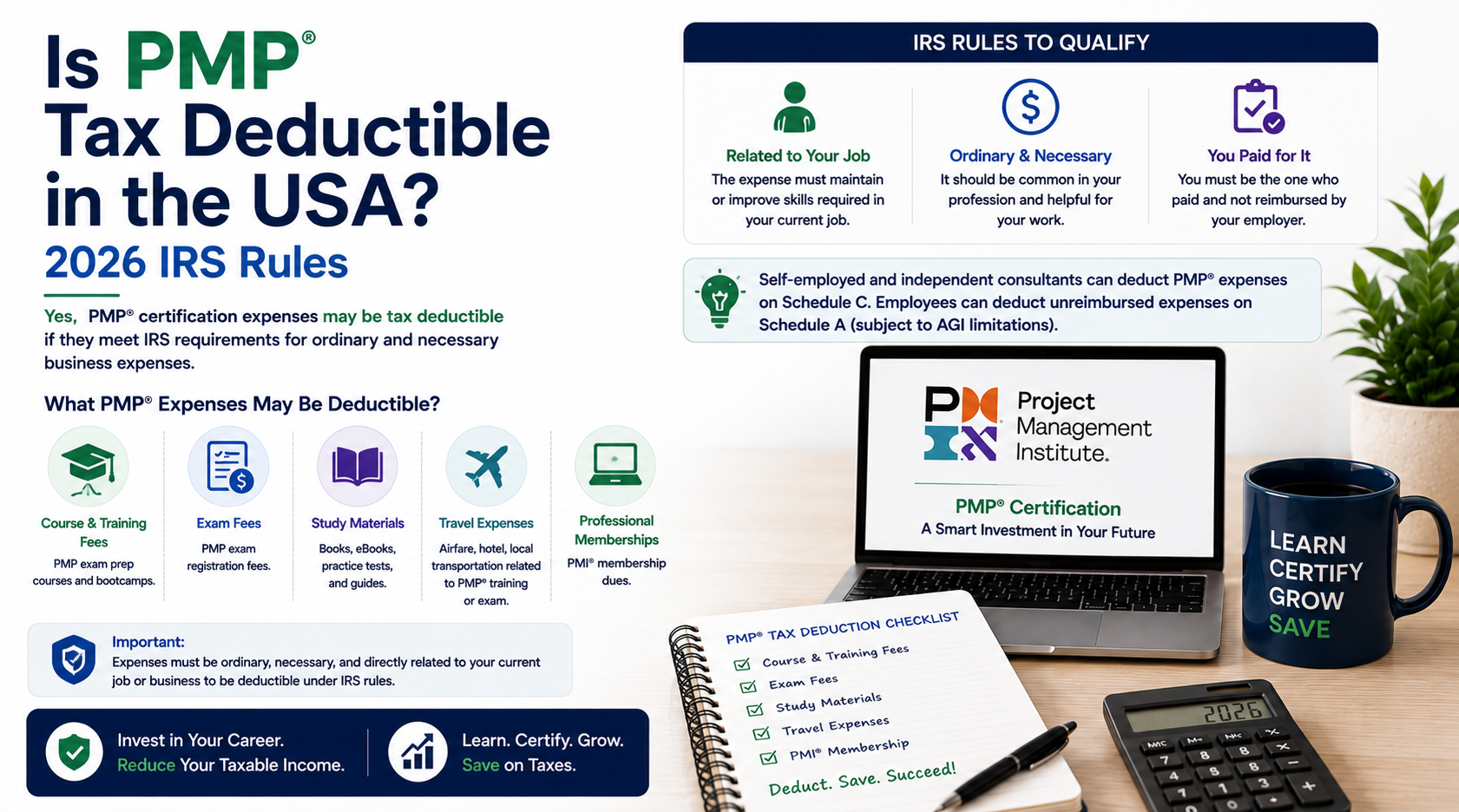
For most W-2 employees in the United States, PMP certification costs stopped being tax deductible on a personal return once the One Big Beautiful Bill Act permanently eliminated the miscellaneous itemized deduction for unreimbursed employee expenses. Self-employed project management consultants and independent contractors who file Schedule C can still deduct the exam fee, PMI membership, training and study materials as an ordinary business expense, provided the certification maintains or improves skills used in their current work rather than qualifying them for a new trade. The most reliable tax-advantaged route left for salaried employees is employer-paid or employer-reimbursed certification, which can be excluded from taxable income entirely under Internal Revenue Code Section 127.
Key Highlights: Is PMP Tax Deductible in the USA?
- The One Big Beautiful Bill Act, signed 4 July 2025, permanently eliminated the Schedule A miscellaneous itemized deduction that W-2 employees previously used for unreimbursed work expenses, including certification costs.
- Only a narrow list of workers, such as armed forces reservists, qualified performing artists, fee-basis government officials and educators, retain any form of unreimbursed employee expense deduction after 2025.
- Self-employed project managers, consultants and 1099 contractors filing Schedule C can still deduct the PMP exam fee, PMI membership and exam prep costs as ordinary and necessary business expenses.
- The IRS applies a strict test: the education must maintain or improve skills in your present work, not qualify you for a new trade or business or meet minimum requirements of a new role.
- Employer-paid or employer-reimbursed PMP training can be excluded from an employee's taxable income up to $5,250 per year under IRC Section 127, making it the strongest tax-efficient path available in 2026.
- PMI increased the PMP exam fee on 6 August 2026 to $425 for members and $675 for non-members, which changes the absolute dollar value at stake in this decision.
- State tax treatment can differ from federal rules in a handful of states that have not fully conformed to the TCJA/OBBBA changes, so the federal answer is not automatically the full picture.
What Changed for 2026: The One Big Beautiful Bill Act and PMP Tax Deductions
The single biggest reason this question has a different answer in 2026 than it did a few years ago is a piece of federal legislation, not anything PMI has done. The Tax Cuts and Jobs Act of 2017 suspended the miscellaneous itemized deduction for unreimbursed employee business expenses from 2018 through 2025, and most taxpayers assumed that suspension would simply expire and the old rules would return in 2026. Instead, the One Big Beautiful Bill Act, signed into law on 4 July 2025, made that suspension permanent for the general workforce. Practically, this means a salaried project coordinator who pays out of pocket for the PMP exam, PMI membership, an exam prep course and the PMBOK Guide can no longer list those costs as a Schedule A itemized deduction, regardless of how directly the certification relates to their current job.
A small number of occupational categories were carved out and kept some form of the deduction: members of the Armed Forces Reserve travelling for reserve duties, qualified performing artists, fee-basis state or local government officials, and eligible educators (whose expense deduction moved from an above-the-line $300 cap to an itemized Schedule A deduction with the cap removed). Project managers and PMO staff are not among these carve-outs, so for the overwhelming majority of PMP candidates who are traditional W-2 employees, the personal-return deduction route is now closed.
Can W-2 Employees Deduct PMP Certification Costs in 2026?
In direct terms, no. A W-2 employee who pays for the PMP exam fee, PMI membership, a prep course or a mock-exam subscription out of their own pocket cannot deduct that cost on their federal return for 2026, because the underlying deduction category, unreimbursed employee business expenses, no longer exists for ordinary employees. This is true whether the employee itemizes or takes the standard deduction, since the deduction category itself has been removed rather than merely capped.
This is a meaningful change from the general guidance still circulating online, which often repeats the pre-2018 rule that certification costs were deductible if they "maintained or improved skills in your current job." That test still exists in the tax code conceptually, but it is now almost entirely irrelevant to W-2 employees because the deduction vehicle that used to apply it, the Schedule A miscellaneous itemized deduction, is gone. The practical consequence is that an employed project manager's best move in 2026 is not to look for a personal deduction, but to negotiate employer funding or reimbursement before enrolling, which is addressed in detail later in this guide.
How Self-Employed Project Management Consultants Deduct PMP Costs on Schedule C
The picture is very different for anyone operating as a sole proprietor, independent consultant or single-member LLC who reports business income on Schedule C. For this group, the PMP exam fee, PMI membership dues, exam preparation courses, study materials and even related travel to a testing centre remain deductible as ordinary and necessary business expenses, exactly as they were before the OBBBA changes, because Schedule C business expense rules were not affected by the elimination of the employee-specific miscellaneous itemized deduction.
The IRS does not require the exam to be passed for the expense to qualify, only that the expense was ordinary and necessary for the business at the time it was incurred. This gives self-employed project management consultants a double financial benefit: the deduction reduces both ordinary income tax and self-employment tax, since Schedule C expenses lower net self-employment earnings before the 15.3 percent self-employment tax is calculated. A consultant in the 24 percent federal bracket who spends roughly $2,000 on the exam fee, membership and a structured PMP certification training course could realistically offset several hundred dollars in combined income and self-employment tax, materially lowering the net cost of certification.
Are 1099 Contractors Treated Differently From Employees?
Independent contractors who receive Form 1099-NEC rather than a W-2 are, for tax purposes, treated the same as any other self-employed individual, not as employees. If a project manager works as a 1099 contractor and reports that income on Schedule C, the same rules described above apply: the PMP exam fee, membership, and prep materials are deductible business expenses.
The confusion usually arises when someone works as a W-2 employee for one employer but also takes on 1099 consulting work on the side. In that mixed scenario, only the portion of the certification cost that can reasonably be tied to the 1099 business activity is deductible on that Schedule C; the portion connected to the W-2 job falls back under the now-closed unreimbursed employee expense rules.
What Exactly Counts as a Deductible PMP Expense?
Whether you qualify as a Schedule C filer or an employer is reimbursing you, the categories of eligible cost are broadly the same. The table below sets out how each cost component is typically treated.
Expense | Typical 2026 Cost (USD) | Schedule C (Self-Employed) | W-2 Employee, Personal Return |
| PMP exam fee (PMI member) | $425 | Deductible | Not deductible after OBBBA |
| PMP exam fee (non-member) | $675 | Deductible | Not deductible after OBBBA |
| PMI annual membership | $139-$159 | Deductible | Not deductible after OBBBA |
| 35-hour training course | $495-$895 | Deductible | Not deductible unless employer-reimbursed |
| Study materials and mock exams | $100-$300 | Deductible | Not deductible after OBBBA |
| Re-examination fee (if needed) | $285 (member) / $385 (non-member) | Deductible | Not deductible after OBBBA |
For anyone budgeting against these figures, it is worth reviewing the full PMP certification cost breakdown and the recent PMP exam fee increase before assuming a tax deduction will offset any particular share of the total.
The IRS "New Trade or Business" Test: Why Career-Changers Often Couldn't Deduct PMP Costs Even Before OBBBA
Even in years when the Schedule A route was open, the IRS applied, and still applies for Schedule C purposes, a test that disqualified a large share of PMP candidates from the outset. Under IRS Publication 970 and related guidance, education costs are only deductible if they maintain or improve skills required in the taxpayer's present work. If the education instead qualifies the taxpayer for a new trade or business, or meets the minimum educational requirements of a role they do not yet hold, the cost is not deductible under any filing status.
In practice, this means a business analyst who has never held a formal project management title and is pursuing the PMP specifically to break into project management for the first time would likely fail this test even as a Schedule C filer, because the certification is functioning as an entry credential into a new line of work rather than an upgrade to existing duties. An acting project coordinator, team lead or program analyst who is deepening skills already used day to day has a much stronger claim.
Employer-Paid PMP Certification: Section 127 and the Better Tax-Free Path for Employees
Given that the personal deduction route has closed for most W-2 employees, the most valuable mechanism left in 2026 is employer-funded certification under IRC Section 127, the educational assistance program exclusion.
Under Section 127, an employer can pay or reimburse up to $5,250 per employee per year toward qualified education, including PMP exam fees, PMI membership and training, and that amount is excluded from the employee's taxable wages entirely; it is not added to Box 1 wages and is not subject to federal income tax, Social Security or Medicare tax on either side. This is a meaningfully better outcome for the employee than the old Schedule A deduction ever was, since an exclusion from income is worth more than an itemized deduction that only reduced taxable income after clearing the standard deduction threshold.
This is also where employers and PMO or learning and development leaders have real leverage. A department that is certifying several project managers or an entire PMO cohort in the same budget cycle can structure the spend as an educational assistance plan and fund it through Section 127 for every participating employee, which is often more tax-efficient for both the company and its staff than issuing a bonus or stipend to cover the same course. Organisations evaluating this route for a group of employees, rather than a single hire, typically get better per-seat pricing and a more consistent curriculum by arranging corporate and group training directly with a training provider instead of reimbursing each employee's individually chosen course.
What if My Employer Only Reimburses Part of the Cost?
Partial reimbursement is common, particularly where a company caps annual learning and development spend per employee below the full cost of exam, membership and training combined. In that scenario, the reimbursed portion is still excluded from taxable wages up to the $5,250 Section 127 annual cap, and any employer reimbursement above that cap is generally added back to taxable wages as additional compensation.
The portion the employee pays out of pocket, however, falls back into the same closed door described above for W-2 employees: it cannot be claimed as a personal itemized deduction. This asymmetry is worth raising explicitly during a training-budget conversation with a manager or PMO lead, since structuring the full course cost through the employer's educational assistance plan, rather than splitting it between employer reimbursement and employee out-of-pocket payment, is what actually captures the available tax benefit.
It is also worth noting that Section 127 plans must be written, must not discriminate in favour of highly compensated employees, and generally need to be offered to a reasonably broad group of staff rather than a single hand-picked individual. A PMO or learning and development manager who wants to certify five, ten or twenty project coordinators in the same cycle is better positioned to set up a compliant plan than one that only ever covers a single employee's course on an ad hoc basis, which is one more reason organisation-wide certification initiatives tend to be more tax-efficient than one-off approvals.
State Tax Considerations
The OBBBA changes apply to the federal return. State income tax treatment can differ because not every state automatically conforms to federal itemized deduction rules. A handful of states maintain their own rules for employee business expense deductions that are decoupled from the federal Internal Revenue Code, which means a W-2 employee in one of those states could, in principle, still claim a state-level deduction for PMP costs even though the federal deduction is gone. Because state conformity rules change from year to year and vary considerably, project managers who paid for their own certification should check their specific state's current treatment of unreimbursed employee expenses, or consult a tax professional, rather than assuming the federal answer applies uniformly across all fifty states.
How Self-Employed Filers Claim the Deduction: Step by Step
- Confirm the skills-maintenance test: verify that the PMP certification maintains or improves skills already used in your current consulting or contracting work, rather than qualifying you for a new line of business.
- Keep itemised receipts: retain the PMI exam fee receipt, membership invoice, training provider invoice and any study material purchases, since each is a separate line item the IRS could ask about individually.
- Classify the expense correctly: report the costs as "Education" or "Contract labour/professional development" on Schedule C, Part II, depending on how your bookkeeping software categorises training spend.
- Track related travel separately: if you travelled to an in-person exam centre or training venue, log mileage or transport costs separately, since these are deductible in addition to the course and exam fees themselves.
- Reconcile against self-employment tax: remember that these deductions reduce net self-employment earnings before the 15.3 percent self-employment tax calculation, not just income tax, so the effective savings are usually larger than a simple marginal-rate estimate suggests.
PMP Certification Cost vs Tax Savings: Is It Still Worth It After OBBBA?
For W-2 employees, the removal of the personal deduction does not change whether PMP certification itself is worth pursuing, since the credential's career and salary impact was never primarily driven by a tax write-off. PMI's own 14th edition Earning Power salary survey found that PMP-certified project managers in the United States report a median annual salary of $135,000, compared with $109,157 for non-certified peers performing similar work, a gap that dwarfs the few hundred dollars a Schedule A deduction was ever worth. What has changed is the calculus around who should pay for the course.
Where an employee previously might have paid out of pocket and clawed some of it back at tax time, the more rational move in 2026 is to ask the employer to fund or reimburse the course under Section 127 before enrolling, since that route delivers a larger, cleaner tax benefit than the deduction it replaces. Candidates comparing providers before committing should also review the full comparison of PMP training providers to make sure the course an employer is being asked to fund is accredited and priced competitively.
Conclusion
The tax treatment of PMP certification costs in the United States changed meaningfully in 2026, and the change cuts against the average salaried candidate rather than in their favour. The One Big Beautiful Bill Act permanently closed the Schedule A miscellaneous itemized deduction that W-2 employees used to rely on, leaving only a narrow set of occupational exceptions untouched. Self-employed consultants and 1099 contractors filing Schedule C retain a genuine, IRS-recognised deduction, provided the certification maintains skills already used in their current work rather than launching them into a new trade.
For the much larger group of employed project managers, the smartest response to this rule change is not to search for a workaround on a personal return, but to make the case to an employer or PMO for Section 127 educational assistance funding before enrolling, since an income exclusion under that provision is worth more than the old itemized deduction ever was. Whichever path applies, the certification's real financial upside still comes from the salary premium it commands, not from what can be recovered at tax time.








 Lowest-Price Challenge











 Personalized Path


.webp)


 USA
USA  Canada
  India
India  UK
UK  Australia
  Singapore


