


 Call Us



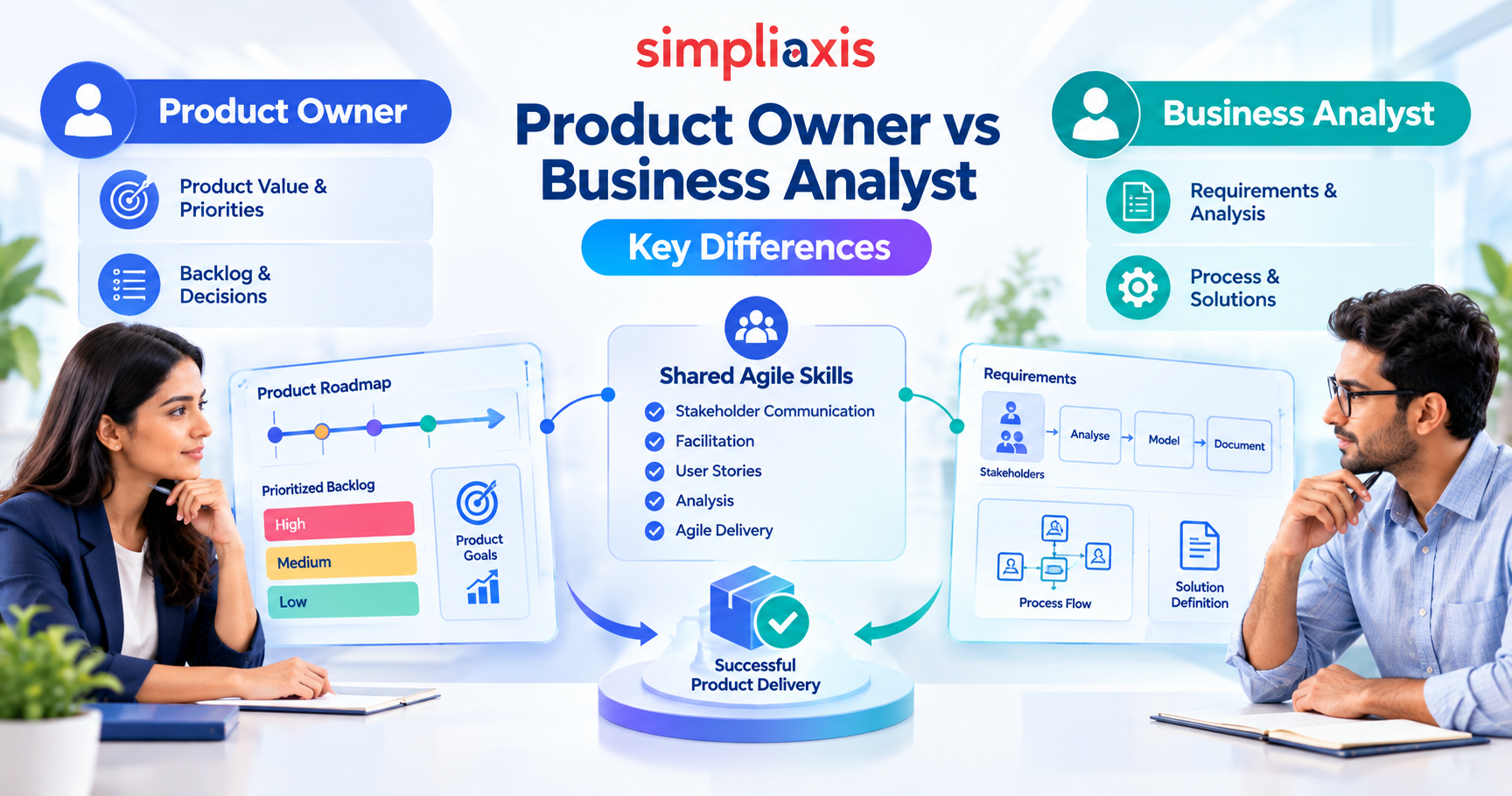
The Product Owner decides what the team builds next and maximizes the value of the product. The Business Analyst understands the needs of the business, analyzes requirements and defines what the solution needs to do. Both roles involve working with stakeholders and development teams, and their responsibilities can often be interchangeable, especially in smaller Agile organizations. You can also move from Business Analyst to Product Owner by developing your skills in prioritization, product strategy and decision-making.
Key Highlights of Product Owner vs Business Analyst
- In Scrum, Product Owners are responsible for maximizing the value of the product and managing the Product Backlog.
- Business Analysts understand needs, requirements, stakeholders, solutions and business outcomes. Product Owners are usually better at prioritizing and making decisions around product value, whereas BAs tend to spend more time on discovery, analysis, requirements, and solution definition.
- There is a lot of overlap in the roles around stakeholder communication, requirements analysis, facilitation and Agile delivery.
- In smaller organizations, a single professional may perform both roles.
- Current U.S. salary data from Indeed lists an average Product Owner base salary of $118,117, compared with $92,331 for Business Analysts as of September 2026. These figures are market benchmarks rather than universal salary rules. Business Analysts have a potential path into product ownership because many BA capabilities—especially stakeholder management, analysis, facilitation, and requirements management—transfer well.
Introduction
The question “product owner or business analyst?” often comes from people entering Agile, professionals considering a career change, or organizations trying to decide how to structure their product teams.
The confusion is understandable.
A Business Analyst may write user stories. A Product Owner may conduct stakeholder interviews. A BA may prioritize requirements. A PO may analyze business processes. Both may attend backlog refinement, sprint planning, demos, workshops, and customer discussions.
The distinction becomes clearer when you look at accountability.
In Scrum, the Product Owner has explicit accountability for maximizing the value of the product and managing the Product Backlog. The role is deliberately positioned as a decision-making accountability rather than simply a requirements-writing function. Business analysis is broader than requirements documentation.IIBA defines it as a practice of identifying needs, recommending solutions and enabling change in organizations. The framework comprises activities including requirements elicitation and collaboration, requirements life cycle management, strategy analysis, requirements analysis and design definition and solution evaluation. Picture a banking app with lots of abandoned loan applications.
A Business Analyst might research the reasons why customers leave the process, interview loan officers, review workflows, look at regulatory constraints, map the current process and document potential requirements.
The Product Owner might take those findings, combine them with customer research, business goals, technical considerations, and product data, and decide that simplifying income verification should be prioritized ahead of several other improvements.
That is the central difference: the BA helps establish what is needed and why; the PO is accountable for deciding what product work gets prioritized to create value.
Who Is a Product Owner?
Definition and Place on the Scrum or SAFe Team
A Product Owner is an Agile product role responsible for maximizing the value generated by a product and, in Scrum, managing the Product Backlog.
The Scrum Guide states that the Product Owner is accountable for maximizing product value and for effective Product Backlog management. This involves establishing and communicating the Product Goal, creating and communicating items on the backlog, ordering the items, and making the backlog transparent and understood. The Product Owner is one of three accountabilities on the Scrum Team; the other two are Developers and the Scrum Master. The Scrum Guide also makes an important point: the Product Owner is one person, not a committee. In SAFe, the context is broader. Product Owners work within Agile teams and coordinate with Product Management and other stakeholders. Current SAFe guidance describes Product Owner/Product Manager responsibilities around backlog management, customer-centricity, roadmaps, PI Planning, and connecting strategy with execution. For professionals considering a move into the role, Simpliaxis also provides a useful overview ofWhat Is A Product Owner.
Core Responsibilities: Vision, Backlog, and Value
The exact responsibilities vary by organization, but a Product Owner commonly works on:
- Translating product goals into actionable backlog items,
- Product Backlog Prioritization and Ordering.
- Specifying expected results and acceptance criteria
- Engaging with customers and stakeholders.
- Delivery by working with designers and developers.
- Making sure the final product solves the problem it was designed to solve.
- Balancing customer value, business goals, risk, dependencies and technical considerations.
- Supporting decisions for the product roadmap.
- Outcomes are measured, and feedback is used to change priorities.
The important word is value.
A PO is not simply responsible for maintaining a list of features. The role involves making trade-offs.
For example, suppose a SaaS company has capacity for only one major initiative this quarter:
- Build a reporting dashboard requested by enterprise customers.
- Improve onboarding, which could reduce customer drop-off.
- Upgrade an internal administrative workflow.
A requirements-focused conversation may establish what each initiative requires. The Product Owner must then help determine which work should receive priority based on product goals, customer needs, evidence, risk, and expected value.
The Single Point of Accountability for the What
One common misconception is that the Product Owner tells developers how to build a feature.
Generally, that is not the intended division.
The Product Owner is accountable for the what and why at the product level, while the delivery team determines the technical approach.
The Scrum Guide describes the Product Backlog as an ordered list of what is needed to improve the product. The Product Owner remains accountable for its management even when some activities are delegated. That distinction matters because a Product Owner needs enough technical understanding to make informed decisions without becoming the team's technical architect.
For example, a PO might say:
“Customers need to complete checkout without re-entering their delivery information.”
The developers and designers then work out the best technical and interaction design approach.
Who Is a Business Analyst?
Definition and Where the Role Sits
ABusiness Analysthelps organizations understand problems, opportunities, needs, requirements, processes, and potential solutions.
IIBA describes the BA as an agent of change and notes that business analysis can span strategy, requirements, solution definition, process improvement, and solution evaluation. Unlike the Product Owner role, the Business Analyst title is not tied to a single Agile framework. BAs can work in Agile, Waterfall, hybrid, project-based, product-based, or enterprise environments, and therole of the Business Analyst in Agilehas evolved significantly.
Their position may vary considerably.
A BA could report into:
- Product management.
- A project or program organization.
- An IT or technology department.
- Business operations.
- A transformation office.
- A consulting organization.
This flexibility is one reason the BA role can look very different from one company to another.
Core Responsibilities: Eliciting and Documenting Requirements
Typical Business Analyst responsibilities include:
- Conducting stakeholder interviews and workshops.
- Identifying business needs and problems.
- Gathering and validating requirements.
- Documenting functional and non-functional requirements.
- Modeling business processes.
- Analyzing current and future states.
- Identifying dependencies, risks, and constraints.
- Supporting solution evaluation.
- Facilitating communication between business and technical teams.
- Managing requirements through their life cycle.
IIBA's Business Analysis Standard identifies elicitation and collaboration, requirements life-cycle management, strategy analysis, requirements analysis and design definition, and solution evaluation among the major areas of business analysis practice.
The BA is therefore more than a documentation specialist.
The Investigator, Fact-Checker, and Facilitator
A useful way to picture the BA is as an investigator.
Suppose a retailer says, “We need a mobile app.”
A BA should not immediately turn that statement into a list of app features.
Instead, the BA might ask:
- What business problem is the app intended to solve?
- Who will use it?
- What happens today?
- Where are customers experiencing friction?
- Which processes are affected?
- What regulations or policies apply?
- What data is required?
- How will success be measured?
This investigative approach helps separate a stakeholder's requested solution from the underlying business need.
IIBA specifically describes elicitation as obtaining information from stakeholders and confirming the results, while collaboration involves reaching shared understanding among people working toward a common goal.
Product Owner vs Business Analyst: Side-by-Side Comparison
Area | Product Owner | Business Analyst |
| Primary focus | Product value and priorities | Business needs, requirements, and solutions |
| Core accountability | Product value and Product Backlog in Scrum | Quality and usefulness of business analysis |
| Main question | What should we build next and why? | What problem are we solving and what does the solution need? |
| Stakeholder role | Makes and communicates product decisions | Elicits, analyzes, and validates stakeholder needs |
| Backlog | Owns or is accountable for ordering it | May contribute to refinement and requirements |
| Requirements | Defines and clarifies product backlog items | Elicits, analyzes, models, and documents requirements |
| Product strategy | Usually closely involved | May contribute analysis and evidence |
| Documentation | Enough to support value-focused delivery | Often more detailed, depending on context |
| Delivery team | Prioritizes work and clarifies product intent | Clarifies requirements and facilitates understanding |
| Success lens | Product outcomes and value | Business outcomes, needs, solution fit, and stakeholder value |
| Typical tools | Jira, Azure DevOps, Productboard, Aha!, roadmapping and analytics tools | Jira, Confluence, Visio, Miro, Lucidchart, SQL, modeling tools |
| Career direction | Product Owner → Product Manager → senior product leadership | BA → Senior BA → Lead BA, Product Owner, Product Manager, consultant, or specialist roles |
The table should be viewed as a general pattern, not a universal job description. Companies frequently combine or redistribute these responsibilities.
Key Responsibilities Compared
Backlog Ownership and Prioritization
This is one of the most evident differences.
In Scrum the Product Owner is responsible for the ordering of the backlog. A Business Analyst can help with backlog refinement by decomposing requirements, identifying dependencies, clarifying acceptance criteria, and helping stakeholders to understand implications.
For example:
BA: “Customers struggle to upload documents because the current process requires five separate steps.”
PO: “Given our product goal and available capacity, simplifying document upload is more valuable to address this quarter than redesigning the account settings page.”
The BA supplies analysis and evidence. The PO makes the product prioritization decision.
Requirements Elicitation and Documentation
This is traditionally an area where BAs have deeper specialization.
A BA may use:
- Interviews.
- Workshops.
- Observation.
- Surveys.
- Process mapping.
- Data analysis.
- Use cases.
- User stories.
- Acceptance criteria.
- Decision tables.
- Prototypes.
- Business process models.
A Product Owner may use some of these techniques too, but BAs typically apply them in more depth, giving the PO the evidence needed to make prioritization decisions.
Stakeholder Communication and Alignment
Both roles can spend substantial time with stakeholders, but their accountability differs.
The BA typically seeks to establish shared understanding.
The PO often seeks to establish direction and decision clarity.
Think about a healthcare platform where compliance, clinicians, patients, sales teams and engineers all have different goals.
A BA could help with discovery and expose conflicts between stakeholder needs.
Then the PO has to help translate that information into product priorities and make trade-offs in the product backlog.
Strong communication is therefore important for both roles, but the conversations can have different purposes.
Working With the Development Team
A BA often acts as a bridge between business stakeholders and technical specialists.
The BA helps ensure that developers understand requirements, business rules, workflows, constraints, and edge cases.
The Product Owner works with the team to ensure that the work being selected and delivered supports the product goal.
In mature Agile teams, neither role should operate as a handoff point where requirements are thrown “over the wall.”
Instead, both should collaborate continuously with developers, designers, testers, architects, customers, and other specialists.
Skills and Tools for Each Role
Product Owner Skills
Strong Product Owners typically need:
- Product vision and strategy.
- Backlog management and prioritization.
- Value-based decision-making.
- Stakeholder management and negotiation.
- Customer and market understanding.
- Writing clear user stories and acceptance criteria.
- Product metrics and data analysis.
- Roadmap planning.
Common Product Owner tools include Jira, Azure DevOps, Productboard, Aha!, Miro, roadmapping tools, and product analytics platforms.
Business Analyst Skills
Business Analyst skills commonly include:
- Requirements elicitation.
- Critical thinking.
- Business process analysis.
- Stakeholder analysis.
- Facilitation.
- Documentation.
- Data analysis.
- Process modeling.
- Problem solving.
- Communication.
- Negotiation.
- Requirements validation.
- Solution evaluation.
IIBA's competency guidance highlights capabilities such as listening, adaptability, organization, stakeholder collaboration, negotiation, conflict resolution, and effective communication. Common BA tools include Jira, Confluence, Microsoft Visio, Miro, Lucidchart, Excel, SQL, BPMN tools, and requirements-management platforms.
Overlapping Skills That Blur the Line
The overlap explains why the product owner vs business analyst distinction can feel confusing.
Both professionals may:
- Facilitate workshops and stakeholder discussions.
- Write user stories and acceptance criteria.
- Analyze data, processes, and customer feedback.
- Take part in backlog refinement and sprint reviews.
- Bridge communication between business and technical teams.
- Negotiate trade-offs between competing stakeholder needs.
Where the Roles Overlap or Merge
When One Person Plays Both Roles
In smaller organizations, employing separate people for every specialized responsibility may not make economic or operational sense.
One person may therefore act as:
- Business Analyst.
- Product Owner.
- Customer representative.
- Requirements analyst.
- Process analyst.
For example, a 30-person software company might have one Product Owner responsible for customer discovery, requirements, backlog management, roadmap input, stakeholder communication, and sprint-level clarification.
This is not necessarily a problem.
The risk appears when the person becomes overloaded and cannot adequately perform either responsibility.
How Company Size and Maturity Shape the Split
Small company: One person can fulfill both PO and BA responsibilities.
Mid-sized company: A Product Owner may work closely with one or more BAs, especially on complex products.
Large Enterprise: Product Managers may be responsible for larger product strategy, Product Owners manage team-level backlogs, BAs help with detailed analysis.
Industry regulated: Additional analysis and documentation may be required to meet compliance, audit, safety or risk requirements.
SAFe adds another layer because product roles operate across different levels of planning and execution. Current SAFe POPM guidance covers responsibilities including backlog management, PI Planning, roadmaps, customer-centric features, dependencies, risks, and iteration execution.
Product Owner vs Business Analyst vs Product Manager
Area | Business Analyst | Product Owner | Product Manager |
| Primary focus | Needs, requirements, processes, solutions | Product backlog and value delivery | Product strategy, market, customers, and product direction |
| Typical horizon | Current initiative and solution lifecycle | Near-to-mid-term delivery | Mid-to-long-term product direction |
| Core question | What does the business need? | What should the team build next? | Where should the product go? |
| Stakeholders | Business and technical stakeholders | Customers, stakeholders, delivery team | Customers, executives, sales, marketing, engineering |
| Backlog | Contributes | Accountable in Scrum | Often owns/oversees higher-level product backlog |
| Roadmap | Provides analysis | Contributes and aligns delivery | Typically owns product roadmap |
| Strategy | Analyzes and supports | Connects work to product goals | Defines or drives product strategy |
| Customer research | May participate | Often participates | Typically significant responsibility |
| Delivery | Supports clarity | Closely involved | Oversees product outcomes |
| Common progression | Senior BA, Lead BA, PO, PM, consultant | Senior PO, Product Manager | Senior/Lead/Principal PM, product leadership |
The distinction between Product Owner and Product Manager is also contextual. In some organizations, the titles represent clearly different levels of responsibility; in others, they are used almost interchangeably.
For a deeper comparison, see our Product Manager vs Business Analyst guide.
Salary and Career Outlook
Typical Compensation Ranges
Salary comparisons need context because Product Owner and Business Analyst titles are not standardized across employers, countries, industries, or seniority levels.
For a current U.S. benchmark, Indeed reported an average base salary of $118,117 per year for Product Owners as of September 20, 2026, based on approximately 2,500 salaries from job postings over the previous 36 months. The reported range was approximately $76,430 to $182,541.
For Business Analysts, Indeed reported an average base salary of $92,331 per year, with a reported range of approximately $60,911 to $139,960, based on about 6,600 salaries from job postings over the same period.
So, in this particular U.S. dataset, average product owner vs business analyst role salary figures vary. But that’s not to say Product Owners are always better paid. Pay varies widely based on location, industry, experience, company size, technical domain, job level, bonuses and equity.
By way of context, the U.S. Bureau of Labor Statistics reported a May 2025 median wage of $101,860 for management analysts, an occupation that overlaps with some—but not all—Business Analyst work. BLS projected 10% employment growth for management analysts from 2025 to 2035.
These figures illustrate why salary comparisons should be treated as market benchmarks rather than fixed career ladders.
Demand and Growth for Both Roles
There is no single official BLS occupational category that perfectly maps to “Product Owner,” so Product Owner demand should not be inferred directly from a BLS category.
However, adjacent professional categories continue to show substantial demand. BLS projects 10% growth for management analysts from 2025 to 2035, compared with 3% for all occupations, and approximately 94,100 management-analyst openings per year on average over that period.
For project management specialists, BLS projects 7% employment growth from 2025 to 2035, with approximately 76,500 openings per year on average.
For people evaluating a product owner vs business analyst career, the practical takeaway is to look beyond the title. Skills in product thinking, business analysis, Agile delivery, stakeholder management, data analysis, and technology are transferable across multiple career paths.
How to Move From Business Analyst to Product Owner?
For those who would rather make product decisions than just analyze and gather requirements, the transition from BA to PO is a natural progression.
The transition does not mean restricting BA skills.
It means adding a stronger product ownership mindset.
Transferable Skills and the Mindset Shift
A Business Analyst already brings several valuable capabilities:
- Stakeholder management.
- Requirements analysis.
- Facilitation.
- Problem solving.
- Process analysis.
- Communication.
- Domain knowledge.
- Agile delivery experience.
- User-story writing.
The biggest shift is from analysis to accountability.
A BA may say:
“Here are the requirements and the trade-offs identified through stakeholder analysis.”
A Product Owner needs to move toward:
“Based on the product goal, customer evidence, business value, risk, and team capacity, this is what we should prioritize.”
That means developing stronger capabilities in:
- Product strategy.
- Customer discovery.
- Prioritization frameworks.
- Product metrics.
- Roadmap development.
- Outcome measurement.
- Market awareness.
- Backlog ownership.
- Value-based decision-making.
It also means becoming comfortable making decisions with incomplete information.
Certifications That Help, Including SAFe POPM
Certifications can help a BA to gain structured knowledge and to demonstrate familiarity with a product framework, but experience still counts. Many BAs start with CSPO certification for Business Analystsbefore moving into scaled roles.
For someone specifically targeting a SAFe environment, the SAFe Product Owner/Product Manager (POPM) certification is directly aligned with the transition.
Scaled Agile's current certification covers product-role responsibilities, PI Planning, solution and PI roadmaps, customer-centric features, ART backlogs, iteration execution, backlog refinement, risks, dependencies, and value delivery.
The current certification page describes the credential as foundational for professionals new to SAFe and states that the exam is 90 minutes, with a passing score of 82%.
For detailed information, check the SAFe POPM Certification Training page.
A practical business analyst to product owner roadmap could look like this:
- Build product thinking: learn product strategy, prioritization frameworks, and product metrics.
- Take on PO-adjacent work: support backlog refinement, write user stories, and help order backlog items.
- Get closer to customers: join discovery sessions, usability tests, and customer interviews.
- Earn a relevant certification: CSPO for Scrum teams or SAFe POPM for SAFe environments.
- Seek a stretch role: act as a proxy or associate Product Owner before moving into the full role.
Which Role Is Right for You?
There is no universal answer to product owner or business analyst because the better fit depends on the type of work you want to do.
A Product Owner may suit you if you enjoy:
- Making prioritization decisions.
- Connecting customer needs to product direction.
- Owning outcomes.
- Working closely with delivery teams.
- Balancing competing stakeholder demands.
- Thinking about product strategy and value.
- Making decisions with imperfect information.
A Business Analyst may suit you if you enjoy:
- Investigating complex problems.
- Understanding business processes.
- Asking detailed questions.
- Modeling requirements and workflows.
- Facilitating stakeholder discussions.
- Analyzing data and business rules.
- Translating between business and technical audiences.
There is also a third possibility: build both skill sets.
A BA with strong product skills can become a valuable Product Owner. A PO with strong business-analysis capabilities can conduct better discovery and make better-informed decisions.
The important thing is to understand which responsibilities you want to own rather than choosing based only on the job title.
Conclusion
The product owner vs business analyst comparison is not really about choosing between two completely separate professions. The roles share a large common foundation, particularly in stakeholder communication, requirements analysis, facilitation, Agile collaboration, and problem-solving.
The key distinction is accountability.
The Product Owner is accountable for product value and, in Scrum, Product Backlog management. The Business Analyst is primarily concerned with understanding needs, analyzing requirements, facilitating stakeholder collaboration and helping to define solutions that deliver value.
In a small Agile organization, you may have someone who does both sets of responsibilities. In a larger enterprise, the roles could be purposefully separated into Product Owners, Business Analysts, Product Managers, and other specialists.
The move to Product Owner is particularly interesting for BAs looking at the next stage in their career, as many of the existing skills are transferable. The primary areas of development are product strategy, prioritization, customer discovery, roadmap thinking, metrics, and decision-making.
All in all, understanding the business analyst product owner difference helps organizations build more clarity in their teams and enables professionals to choose a career path based on the kind of accountability and work they want.







 Lowest-Price Challenge











 Personalized Path


.webp)


 USA
USA  Canada
 India
India UK
UK Australia
 Singapore


