


 Call Us



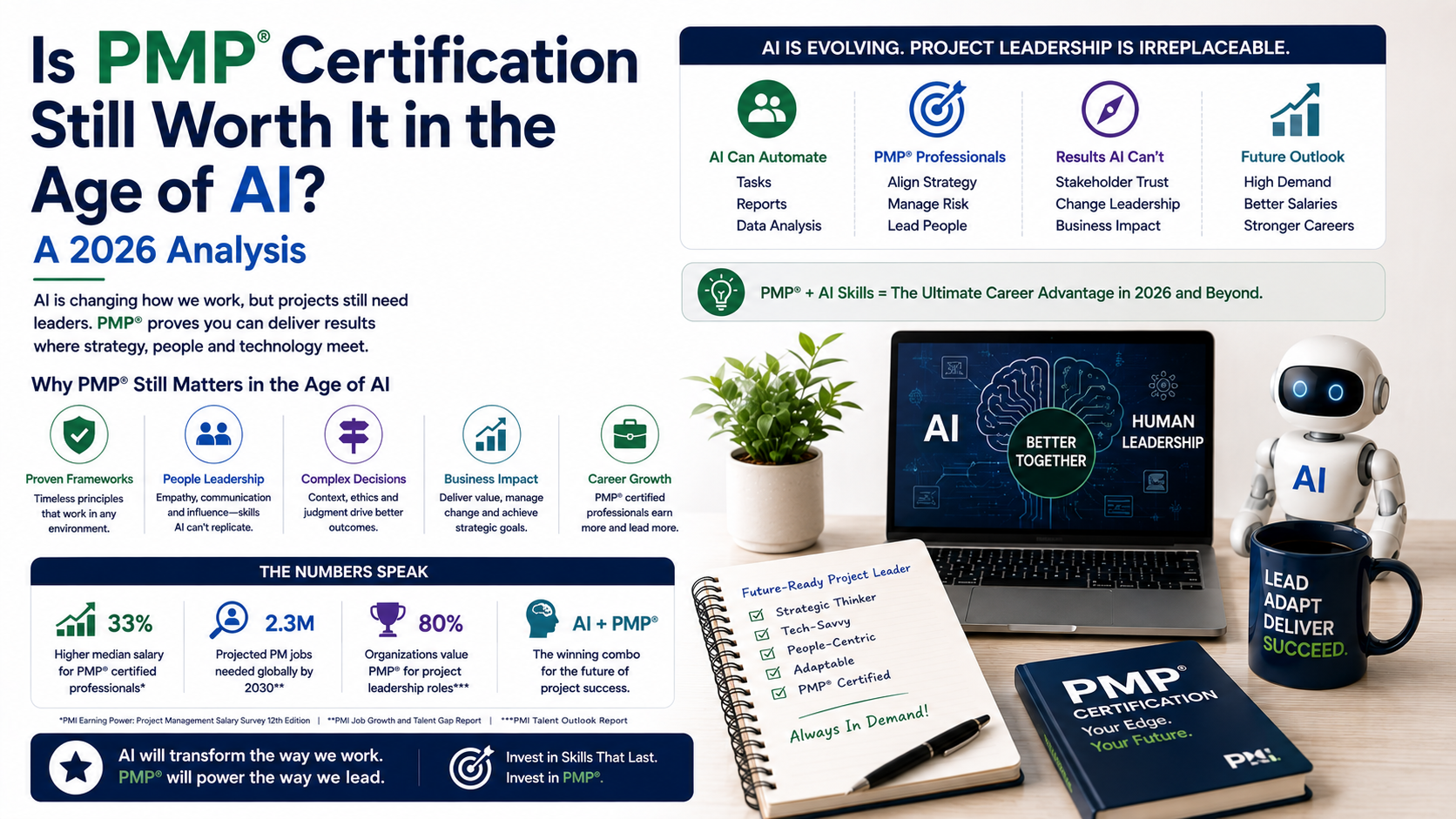
Yes, PMP certification is still worth it in 2026, but the reason has shifted. AI is automating the mechanical parts of project management, status reporting, schedule tracking, basic risk flagging- while demand for the judgment, stakeholder leadership and decision-making that the certification validates is rising. PMI's own July 2026 refresh of the PMP exam was built explicitly around this shift, and its release data shows certification volumes and salary premiums both climbing rather than shrinking. The honest answer depends less on whether AI exists and more on which half of the job you actually spend your time doing.
Key Highlights: Is PMP Certification Still Worth It With AI in 2026?
- PMI refreshed the PMP exam on 9 July 2026 under the banner "judgment is the new job security", explicitly designed to validate skills AI cannot easily replicate.
- PMP certifications granted rose 36% year-on-year in the first five months of 2026, according to PMI, the opposite of what you would expect if the credential were losing relevance.
- US-based PMP holders report a median salary of $135,000, around 24% higher than non-certified peers, per PMI's own figures.
- 69% of PMP holders say the credential gives them a competitive advantage, and among those certified in the past 36 months, 75% report at least one concrete career benefit.
- The updated exam content outline shifts weight toward the Business Environment domain, up from roughly 8% to around 26%, reflecting more scenario questions on judgement calls involving AI-assisted work rather than AI tool mechanics.
- Independent research on task automation suggests AI is absorbing status reporting, scheduling, forecasting and risk flagging first- the administrative half of the role, not stakeholder negotiation or accountability.
- PMI separately forecasts a global shortfall of up to 30 million project professionals by 2035, a demand signal that sits alongside, not against, the automation trend.
What Is Actually Driving the "Is PMP Still Worth It" Question in 2026?
The question is being driven by a specific, recent event rather than general AI anxiety. On 9 July 2026, the Project Management Institute released an updated version of the PMP exam alongside a press statement titled "In an AI Economy, Judgment is the New Job Security," distributed via PMI's own press and media page and carried by Businesswire. That timing matters because it is PMI, the credential's own accrediting body, publicly stating that AI is a live enough threat to the profession's tool-specific skills that the flagship exam needed rebuilding around it.
Anyone searching for a straight answer in August 2026 is really asking two separate things at once: has AI already reduced what a certified project manager does day to day, and has PMI's response been substantive enough to keep the credential meaningful. Both deserve a direct, evidence-based answer rather than a marketing one, which is the gap this article is written to close, since Simpliaxis's existing ROI pieces on PMP address cost-versus-benefit generally but were written before this specific AI-driven exam refresh and its accompanying data existed. If you are new to the credential itself, Simpliaxis'scomprehensive guide to what PMP certification actually covers is a useful primer before working through the AI-specific questions below.
If you are still deciding how to prepare, structured PMP certification trainingnow builds around this refreshed content outline rather than the pre-2026 version, which matters more than it sounds given how much the domain weighting has moved.
What Does AI Actually Automate in Project Management Today?
AI is automating the repeatable, data-heavy parts of project management, not the role itself. Multiple independent 2026 sources on AI adoption in project delivery converge on a similar list: status reporting, meeting-notes-to-task conversion, schedule and dependency tracking, budget alerts, resource allocation suggestions, and predictive risk flagging based on historical project data. These are the tasks that consume hours of a project manager's week without requiring judgement about people, politics or trade-offs.
Project management activity | Current AI exposure in 2026 | Why |
| Status reporting and dashboards | High | Structured, repetitive, pattern-based data aggregation |
| Schedule tracking and variance detection | High | Rule-based comparison against baseline, well suited to automation |
| Risk flagging from historical data | Moderate to high | Predictive models trained on past project data can surface likely risks early |
| Resource allocation suggestions | Moderate | AI can propose assignments, but final sign-off still needs human judgement |
| Stakeholder negotiation and conflict resolution | Low | Depends on trust, context and emotional read that current tools cannot replicate |
| Accountability and decision ownership under uncertainty | Low | Someone has to own the consequence of a call; software does not carry that liability |
| Governance decisions on where and how to use AI itself | Low | This is a new PM responsibility, not something AI can decide about itself |
The pattern across every credible source reviewed for this article is consistent: automation is concentrated in the mechanical, reporting-heavy layer of the job, while the layer PMP has always tested, stakeholder management, integration, leadership and risk judgement, remains stubbornly human. That does not mean the role is untouched. A project manager who spends most of their week compiling status decks and chasing schedule updates is more exposed than one who spends it negotiating scope with a sponsor or coaching a struggling team lead, and the certification is now explicitly weighted to reward the latter set of skills over the former.
Why Did PMI Refresh the PMP Exam Around AI in July 2026?
PMI refreshed the PMP because it concluded that testing tool-specific competency was becoming a losing strategy as those tools change faster than any certification cycle can track. According to Dr Kelly Heuer, PMI's Vice President of Learning, quoted in the July 2026 press release, professional capability sits on a spectrum of three layers: perishable skills, the specific tools, platforms and techniques that are essential today but have a shrinking half-life; durable skills, the frameworks and fluency that carry over from one tool to the next; and enduring capabilities, the judgement and mindsets that compound across an entire career. PMI's stated rationale is that AI is accelerating the decay of perishable skills specifically, which raises rather than lowers the value of certifying the durable and enduring layers.
That framing directly answers the "will AI make PMP obsolete" question from PMI's own side of the table: the credential was never primarily testing which software you know how to click through, so a shift in tooling does not erode its core value proposition. What it does require is that the exam content itself evolve so it keeps testing judgement in scenarios that actually reflect how AI-assisted projects run in practice, which is the second half of PMI's stated reasoning for timing the refresh to 9 July 2026, the same date the updated exam became available to candidates.
How Does the Updated Exam Content Outline Reflect the AI Shift?
The refreshed exam content outline redistributes weight toward the Business Environment domain, reportedly moving from roughly 8% of the exam to around 26%, with a corresponding reduction in the Process domain's share. In practice this means more scenario-based questions about organisational strategy, value delivery and context-driven decision-making, and fewer pure process-mechanics questions that can be answered by memorising a formula or a step sequence.
Reporting on the update is consistent that PMI has not made AI tool usage a standalone testable topic, and candidates are not quizzed on how to operate a specific AI platform. Instead, scenario questions increasingly describe projects where AI is already in use, generating a forecast, flagging a risk, drafting a report, and then ask what the project manager should decide next: whether to trust the output, what governance to apply, how to communicate the limitation to a sponsor, or when to override the model.
That is a deliberate design choice: it tests judgement about AI rather than fluency with AI, which is consistent with PMI's stated durable-versus-perishable framing. New question formats introduced alongside the content change, including case sets and drag-and-drop scenario items, are built to test exactly this kind of applied reasoning rather than single-fact recall.
For anyone recalibrating a study plan around this shift, it is worth treating the Business Environment domain as a first-class priority rather than an afterthought, since it now carries roughly a third of the weight it used to.
What Do PMI's 2026 Numbers Actually Show About Demand?
If AI were quietly making the PMP redundant, certification volumes and salary premiums would be the first places it showed up, and PMI's own July 2026 figures show the opposite trend. The table below summarises the verified figures from PMI's press release, all attributed directly to PMI rather than to a third-party estimate.
Metric | Figure | Source |
| PMP certifications granted, year-on-year change (first five months of 2026) | Up 36% | PMI, July 2026 press release |
| US PMP holders, median salary | $135,000 | PMI, July 2026 press release |
| Salary premium over non-certified peers | Approximately 24% higher | PMI, July 2026 press release |
| PMP holders reporting a competitive advantage from the credential | 69% | PMI, July 2026 press release |
| Certified within the past 36 months reporting at least one career benefit | 75% | PMI, July 2026 press release |
| Of those, reporting increased confidence in decision-making | 53% | PMI, July 2026 press release |
| Of those, reporting new career opportunities | 40% | PMI, July 2026 press release |
| Projected global project talent shortfall by 2035 | Up to 30 million professionals | PMI, Global Project Management Talent Gap report |
A 36% jump in certifications granted in the first five months of a year in which the exam itself became measurably harder to game with rote memorisation is a strong signal, not a coincidence. It suggests candidates and employers alike are treating the AI-refreshed version of the credential as more valuable, not less, likely because it now more visibly maps to the exact capabilities employers say they cannot get from software: judgement, accountability and cross-functional leadership.
The separate talent gap projection, a possible shortfall of up to 30 million project professionals globally by 2035 as demand for project delivery skills grows across construction, IT services, manufacturing and healthcare, reinforces that the constraint in the profession is people who can be trusted with ownership, not a surplus of PMs waiting to be replaced by software.
Which Project Managers Are Most Exposed to AI Automation, and Which Are Not?
Exposure to AI automation correlates closely with how much of a given PM's actual workload is administrative reporting versus judgement-based decision-making, rather than with seniority or industry alone. A junior coordinator whose main function is compiling weekly status updates from five different tools is more exposed than a senior PM negotiating scope changes with an executive sponsor, regardless of years in the role.
- Highest exposure: project coordinators and junior PMs whose work is dominated by status compilation, timeline updates and basic reporting, tasks that current AI tools already automate reasonably well.
- Moderate exposure: mid-level PMs who split time between reporting and stakeholder coordination, where AI can absorb the reporting half but the coordination half still needs a person.
- Lower exposure: senior PMs and programme leads whose primary output is negotiation, prioritisation, escalation handling and organisational judgement calls that carry real consequences.
- Growing responsibility, not shrinking one: PMs are increasingly asked to govern how AI is used on their own projects, deciding what an AI-generated forecast is allowed to influence and what still requires human sign-off, a responsibility that did not exist five years ago and that AI itself cannot perform.
This is a realistic reason to take the risk seriously rather than dismiss it. If your current role is genuinely dominated by the first category, the honest advice is not that PMP is worthless; it is that the certification alone will not protect a role that was already mostly administrative. Pairing structured PMP study with hands-on exposure to how AI is actually used in delivery work, for example through a short course such as generative AI for project managers training, addresses the actual risk more directly than either credential alone.
Is PMP Different From an AI-Specific Credential Like PMI-CPMAI?
PMP and PMI-CPMAI answer different questions and are not competing for the same purpose. PMP certifies general project management competency, leadership, integration, risk, and stakeholder management, across any industry or delivery method, and now explicitly tests judgement in AI-influenced scenarios without requiring AI tool expertise.
PMI-CPMAI, by contrast, is a narrower, PMI-owned credential focused specifically on managing AI, machine learning and data-centric projects using a defined methodology, aimed at PMs who are directly responsible for delivering AI initiatives rather than merely working alongside AI tools.
For the "is PMP still worth it" question specifically, the practical takeaway is that PMP remains the broader, more portable credential, and it is the one that has just been rebuilt around the AI-era judgement question this article is answering. CPMAI is a genuinely useful add-on for PMs who move into AI-project-heavy roles, but it does not replace the case for PMP, and for most working project managers evaluating whether to start or renew a certification path in 2026, PMP is still the more defensible first investment.
How Should You Weigh the Decision If You Are Still Undecided?
The decision comes down to matching your actual day-to-day work against what AI has already automated and what the refreshed exam now rewards, rather than reacting to headline anxiety about AI in general. Three practical checks help make that concrete.
- Audit your current workload honestly: if reporting and scheduling dominate your week, treat that as a signal to shift responsibilities toward judgement-heavy work, not a reason to skip certification.
- Check the maths against PMI's own salary data: a 24% premium on a $135,000 median US salary is a substantial return relative to the cost and time of preparing for the exam, even before accounting for the 36% year-on-year growth in candidates that suggests employers are still actively rewarding it.
- Study the refreshed outline, not the old one: given the Business Environment domain's much larger share of the exam, preparation built for the pre-2026 version will leave real gaps, so check the updated PMP certification exam patternand confirm any course or provider has updated its material to the July 2026 content outline before enrolling.
A useful sanity check is to compare your own week against a rough time audit rather than a gut feeling. If a plain diary of your last two working weeks shows that most hours went into compiling updates, chasing sign-offs already agreed in principle, or reformatting the same data for different audiences, that is the exposed layer PMI itself acknowledges AI is already handling well. If instead most hours went into resolving disagreement between teams, making a call with incomplete information, or explaining a delay to a sponsor in a way that preserved trust, that is the layer the refreshed exam was specifically built to certify.
Most working project managers will find their week is a mix of both, which is precisely why the realistic advice is conditional rather than absolute: the certification protects and rewards the second category, and it is up to the individual to keep shifting their own time toward it rather than assuming the credential does that work automatically. None of this requires resolving the broader philosophical debate about how much AI will eventually change knowledge work.
It only requires an honest look at your own role today against verifiable, current data, which is a much narrower and more answerable question than the headline "will AI replace project managers" framing usually implies. For a broader look at ROI beyond the AI angle specifically, Simpliaxis's dedicated piece on whether PMP certification is worth it covers cost, time investment and general career return in more depth.
Conclusion
PMP certification is still worth it in 2026 specifically because of the AI shift, not despite it. AI is measurably automating the administrative layer of project management, status reporting, scheduling, basic forecasting, exactly the tasks that used to consume disproportionate time without testing real capability. PMI's response was not to defend the old exam but to rebuild it, moving weight toward business judgement and away from process mechanics, and its own July 2026 data- 36% growth in certifications granted, a $135,000 US median salary carrying a 24% premium, and 69% of holders reporting a competitive advantage, shows the market has not treated the credential as declining.
The realistic risk sits with individual roles that remain heavily administrative, not with the credential itself, which makes the honest 2026 answer conditional but firmly positive: worth pursuing if your work, or the work you want, is built around judgement, accountability and leading people through uncertainty, precisely the layer PMI states AI cannot replicate.






 Lowest-Price Challenge











 Personalized Path


.webp)


 USA
USA  Canada
  India
India  UK
UK  Australia
  Singapore


