


 Call Us



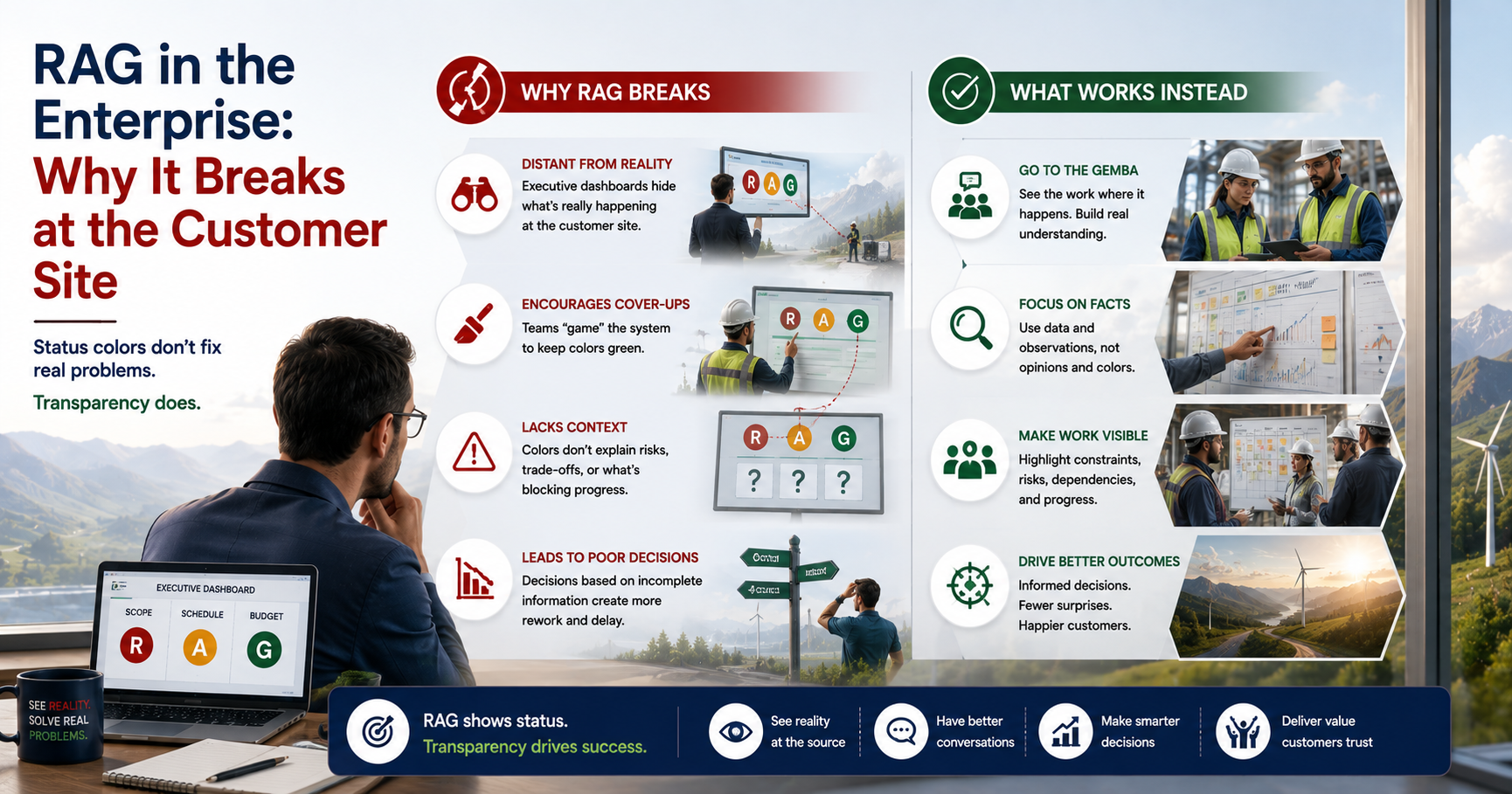
Retrieval-augmented generation is the technique behind most enterprise AI that actually needs to know something specific, and it is also where a huge share of enterprise AI projects quietly fail. The gap is stark. A RAG demo, built on a clean set of documents in a controlled setting, works beautifully and convinces everyone. The same approach, moved into a real enterprise with messy data, awkward systems, and strict access rules, falls apart in ways the demo never hinted at. This piece is about why enterprise RAG breaks at the customer site, and what it takes to build retrieval systems that survive contact with real organisations rather than only impressing in a demo.
Understanding this is central to forward deployed work, because RAG is one of the most common things an engineer is asked to deploy inside a customer, and the demo-to-production gap for RAG is exactly the gap the role exists to close. It draws on the context engineering that determines what a model sees, and it is a core skill the Forward Deployed Engineering Program teaches, because retrieval that works on real enterprise data is far harder than the tutorials suggest.
Key Highlights
- RAG demos succeed on clean, curated documents, while enterprise RAG fails on the messy, half-documented, access-controlled reality of a real organisation.
- The retrieval half is where most failures live: if the system retrieves the wrong material, no amount of model quality produces a good answer.
- Enterprise data is dirtier, more scattered, and more restricted than any demo dataset, and each of those differences breaks naive RAG in a specific way.
- Evaluating a RAG system is genuinely hard, so many enterprises deploy without knowing whether retrieval is actually working until it fails visibly.
- Building enterprise RAG that works is a discipline of engineering for the messy reality, not a matter of wiring together a tutorial pipeline.
Why RAG demos lie to you
The trouble with RAG is that it demos exceptionally well, which sets a trap. To build a demo, you take a clean, curated set of documents, index them, and connect them to a model, and the result answers questions from those documents impressively. Everyone in the room concludes that the hard part is done and production is a formality. It is not, and the ease of the demo is precisely what makes the eventual failure so surprising.
The demo lies because it removes every difficulty that production imposes. The demo documents are clean, well-structured, and complete. The demo has no access restrictions, no stale data, no scattered sources, no scale. The demo question is one the documents clearly answer. Production has none of these luxuries. The gap between the demo and the deployment is where enterprise RAG lives and dies, and an engineer who mistakes a working demo for a nearly-finished system is walking into exactly the failure that stalls so many pilots. This is a specific instance of the broader reason enterprise AI pilots stall: the demo had clean conditions, and production did not.
The retrieval half is where it breaks
The generation in retrieval-augmented generation gets the attention, but the retrieval is where enterprise RAG usually fails, and understanding that shifts your effort to the right place. The model can only answer from what it is given, so if the retrieval step pulls the wrong documents, or misses the right ones, the model produces a confident answer grounded in the wrong material. No quality of model compensates for bad retrieval, because the model never sees what it needed.
This matters because retrieval is genuinely hard on real data. Getting the right chunk of the right document in response to a real query, across a large and messy corpus, is a difficult information-retrieval problem that the clean demo hides. The demo corpus is small and tidy enough that naive retrieval works. The enterprise corpus is large, heterogeneous, and full of near-duplicates, outdated versions, and awkwardly structured documents, so naive retrieval returns marginal or wrong material. Since the retrieval determines what the model sees, and what the model sees determines the answer, retrieval quality is the binding constraint, which is why enterprise RAG is fundamentally a context engineering problem: it is about getting the right information into the model's context on real data, not about the model itself.
Enterprise data is dirtier than any demo dataset
The single biggest reason RAG breaks in production is that enterprise data is far messier than the curated corpus of a demo, and each kind of mess breaks retrieval in its own way. Real enterprise documents are inconsistent in structure, riddled with formatting that confuses chunking, full of tables and images and layouts that plain text extraction mangles, and written in domain-specific language the retrieval system was not tuned for.
Beyond structure, there is the problem of quality and duplication. Enterprises accumulate multiple versions of documents, outdated material that was never removed, near-duplicates that differ in small but important ways, and content that contradicts other content. A retrieval system on this corpus can confidently pull an outdated policy, a superseded specification, or one of several conflicting documents, and the model will answer from it as if it were authoritative. The demo corpus has none of this, which is why the demo works and the deployment does not. Handling real enterprise data means confronting the dirtiness directly, cleaning and structuring where possible, handling versioning and conflicts deliberately, and accepting that the corpus will never be as tidy as the demo. This is unglamorous work, and it is exactly the work that separates enterprise RAG that functions from RAG that fails.
Access, permissions, and the data you cannot touch
A dimension of enterprise RAG that demos ignore entirely is access control, and it breaks systems in ways that are both technical and legal. In a demo, all the documents are available to the system and to whoever asks. In an enterprise, documents have permissions, some users can see some things and not others, some data is restricted for privacy or regulation, and a retrieval system that ignores this can surface information to people who should not see it, which is a serious problem.
So enterprise RAG has to respect the organisation's access model, retrieving only what the asking user is entitled to see, which is a genuine engineering challenge layered on top of the retrieval problem. The system needs to know who is asking, what they are allowed to access, and how to filter retrieval accordingly, all while remaining fast and useful. This is difficult, and it is completely absent from the demo, which is one reason demos give such a false sense of readiness. In heavily regulated environments the access problem is even harder, overlapping with the challenge of building AI when you cannot freely see the data. Getting access control right is not optional polish, it is a requirement for the system to be deployable at all, and it is a large part of the work that turns a demo into something an enterprise can actually run.
You often cannot tell if it is working
A subtle but serious reason enterprise RAG fails is that evaluating a RAG system is genuinely hard, so organisations frequently deploy without really knowing whether retrieval is working until it fails visibly and embarrassingly. Unlike a traditional system where correctness is often clear, a RAG system can produce plausible, fluent, confident answers that are subtly or completely wrong because retrieval pulled the wrong material, and nothing about the answer signals the failure.
This makes evaluation essential and difficult. You need to know not just whether the final answers are good but whether retrieval is surfacing the right material, whether the system handles edge cases, and how it behaves across the real range of queries, none of which is easy to measure. Without deliberate evaluation, an enterprise RAG system can look fine in casual testing and fail systematically in production, and nobody notices until a user gets a confidently wrong answer on something that matters. This is why serious RAG work includes building evaluation from the start, using the kind of evaluation and observability discipline that lets you actually see whether retrieval is doing its job. Deploying RAG without evaluation is flying blind, and it is one of the most common ways these systems fail quietly until they fail loudly. Building that evaluation is its own discipline, drawing on the evaluation and observability tools that let you measure retrieval quality rather than hope for it.
What it takes to build enterprise RAG that works
Pulling the failures together, building enterprise RAG that survives production is a discipline of engineering for the messy reality rather than wiring up a tutorial, and it has a recognisable shape.
| Failure mode | What it looks like in production | What building it properly requires |
| Bad retrieval | Confident answers from the wrong documents | Serious retrieval engineering, not naive similarity search |
| Dirty data | Answers from outdated or conflicting sources | Cleaning, structuring, versioning, conflict handling |
| Access control | Surfacing data to users who should not see it | Permission-aware retrieval tied to the org's access model |
| No evaluation | Plausible wrong answers nobody catches | Evaluation and observability built in from the start |
| Scale | Degradation as the corpus grows | Retrieval that stays accurate and fast at real scale |
Read down the table and you see that every one of these is invisible in a demo and unavoidable in production. Building enterprise RAG well means confronting each deliberately, which is why it is real engineering work that takes a skilled forward deployed engineer rather than a weekend of wiring together a pipeline. The tools exist to do this well, but the tools do not do the thinking, and the thinking is where the value is.
Chunking is where quality is quietly won or lost
One specific part of enterprise RAG deserves its own attention because it fails silently and matters enormously: chunking, the process of breaking documents into the pieces that get indexed and retrieved. How you chunk a document determines what the retrieval system can find, and getting it wrong degrades every answer without any obvious sign that chunking is the culprit. Chunk too large and each piece contains too much irrelevant material, diluting the signal. Chunk too small and pieces lose the context that makes them meaningful. Chunk without respect for the document's structure and you split a table, a clause, or an idea across pieces so that neither is retrievable in full.
On the clean documents of a demo, naive fixed-size chunking works well enough that nobody thinks about it. On real enterprise documents, with their tables, layouts, headings, and irregular structure, naive chunking mangles the content, and the retrieval quality suffers in ways that are hard to diagnose because the failure hides in a step nobody is watching. Good enterprise RAG treats chunking as a real engineering decision, respecting document structure, preserving context, and adapting to the kinds of documents in the corpus. This is unglamorous, detailed work, and it is exactly the sort of thing that separates a retrieval system that works from one that quietly underperforms, which is why an experienced forward deployed engineer gives it the attention it deserves rather than accepting whatever a tutorial pipeline does by default.
Keeping the system current is a problem the demo never has
A dimension of enterprise RAG that demos entirely ignore is that real enterprise knowledge changes constantly, and a retrieval system that was accurate at deployment drifts toward wrong as the underlying documents evolve. The demo corpus is static, so freshness is a non-issue. In production, documents are updated, policies change, new material arrives, and old material is superseded, and a RAG system that does not keep up starts confidently answering from outdated information, which can be worse than not answering at all.
Keeping an enterprise RAG system current is a genuine engineering challenge that the demo never surfaces. It means building the pipelines that keep the index in sync with the changing source documents, handling updates and deletions so that superseded material stops being retrieved, and managing the freshness of the whole system over time. This is ongoing operational work rather than a one-time build, and it is part of why enterprise RAG is a system to be maintained rather than a project to be finished. It also ties directly into the handoff that defines a successful engagement, because the customer's team has to be able to keep the system current after the engineer leaves, which means building the freshness machinery in a way they can operate. A RAG system that was accurate at launch and rots as the knowledge changes is a common and avoidable failure that only deliberate attention to freshness prevents.
Why this is forward deployed work
Enterprise RAG that works is almost definitionally forward deployed work, because everything that makes it hard is specific to the individual customer's messy reality. You cannot solve the dirty-data problem in the abstract, you have to confront this customer's actual documents. You cannot solve the access problem generically, you have to respect this organisation's actual permission model. You cannot evaluate the system without understanding this customer's real queries and what a good answer looks like for them. Every difficulty is grounded in the specific enterprise, which is exactly where forward deployed engineers work.
This is why RAG is one of the most common things forward deployed engineers are asked to deploy, and why doing it well is such a valuable skill. It sits at the intersection of the technical stack, retrieval, context engineering, evaluation, and the deep customer understanding that forward deployed work is built on. An engineer who can take a RAG approach that worked in a demo and make it work on a real enterprise's messy, restricted, large-scale data is doing precisely the work that crosses the demo-to-production divide. Building that capability through the Forward Deployed Engineering Program, grounded in agentic AI foundations, is how you become the engineer who ships enterprise RAG that survives rather than RAG that only demos.
The bottom line
Enterprise RAG breaks at the customer site because everything that makes it easy in a demo is absent in production. The clean corpus becomes messy, scattered, restricted enterprise data. The retrieval that worked on tidy documents returns wrong or outdated material on the real corpus. The access control the demo ignored becomes a hard requirement. And the evaluation nobody built means the failures stay invisible until they surface embarrassingly. The retrieval half is where most of this lives, which makes enterprise RAG fundamentally a context engineering problem on real data.
Building RAG that survives production is real engineering for the messy reality, confronting dirty data, permission-aware retrieval, deliberate evaluation, and scale, none of which a tutorial pipeline handles. It is one of the most common and valuable things a forward deployed engineer does, precisely because every difficulty is grounded in the specific customer. Developing the capability to build enterprise RAG that works, through the Forward Deployed Engineering Program and the full 2026 AI engineering stack, is how you turn an impressive demo into a system an enterprise can actually rely on.
Making RAG work in the real world
Enterprise RAG rewards engineers who treat retrieval as serious engineering rather than a wiring exercise, and that capability is built through practice rather than reading. Working hands-on with retrieval systems, evaluation, and the messy data they run on, through structured agentic AI foundations and applied engineering with agents, is what turns an understanding of why RAG breaks into the ability to build RAG that holds. The engineers who can do this are exactly the ones who close the demo-to-production gap that stalls so much enterprise AI.









 Lowest-Price Challenge











 Personalized Path


.webp)


 USA
USA  Canada
 India
India UK
UK Australia
 Singapore


