


 Call Us



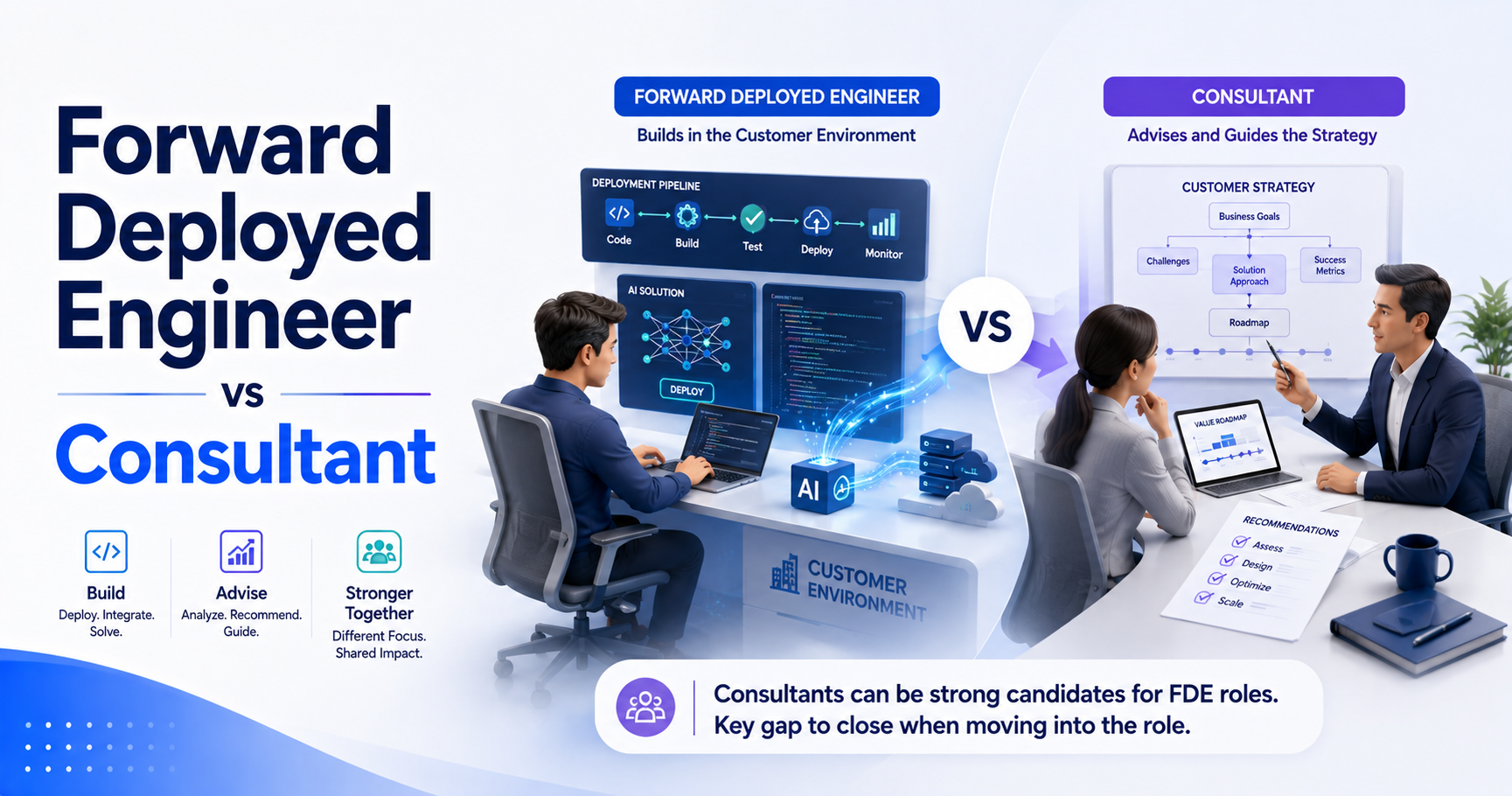
For the large population of people who come from consulting, this is the comparison that matters most, because it answers a practical question: is the forward deployed engineer role the same job I already do, a step away from it, or something genuinely different? The roles share real DNA. Both embed with clients, both work across many organisations, both have to understand a business deeply and quickly. But there is a decisive difference: the consultant advises and recommends, while the forward deployed engineer builds. This piece draws the line for the consultants weighing the move and for anyone trying to tell the two roles apart.
The distinction is worth getting right because it determines whether the move is a lateral shift or a real change in what you do all day. Consultants are among the most likely people to move successfully into forward deployed engineering, but only if they understand what changes, and the Forward Deployed Engineering Program is built to bridge exactly that gap from advising to building.
Key Highlights
- The consultant advises and recommends, while the forward deployed engineer builds the actual solution, which is the decisive difference between the roles.
- Both embed with clients and work across many organisations, which is why consultants are natural candidates for the forward deployed path.
- The move from consulting to forward deployed engineering is a shift from producing recommendations to producing working software, which is a real change, not a rebrand.
- Consultants bring genuine strengths to the role, including client empathy, business understanding, and comfort with ambiguity, that pure engineers often lack.
- The gap a consultant must close is the building itself, the ability to actually ship software rather than advise on what should be built.
Advise versus build
The core distinction between these roles is simple and decisive: the consultant's deliverable is advice, and the forward deployed engineer's deliverable is software. A consultant studies a client's situation, analyses it, and produces recommendations: a strategy, a plan, an assessment, a set of actions the client should take. The value is in the thinking and the guidance. The client then acts, or does not, on the recommendations.
The forward deployed engineer does not stop at recommendations. They embed with the client, understand the problem, and then actually build the solution themselves, delivering working software rather than a document describing what should be built. The value is in the delivery. This advise-versus-build distinction is the heart of the difference, and it is decisive because it changes what the role actually requires. Advising requires analysis, judgement, and communication. Building requires all of those plus the technical ability to produce working software against real constraints. A consultant can be excellent without writing a line of code. A forward deployed engineer cannot, because the deliverable is the code. This is the same line that separates the genuine forward deployed role from advisory work that merely borrows its embedded style.
What a consultant actually does
To understand the contrast, it helps to see the consulting role clearly, because it is a genuinely valuable profession rather than a lesser version of engineering. A consultant is brought in to help a client with a problem the client cannot fully solve alone, whether that is strategy, operations, technology, or organisation. They bring outside expertise, a fresh perspective, and dedicated analytical capacity that the client lacks internally.
The consultant's work centres on understanding and advising. They study the client's situation deeply, often embedding with the client's team for weeks or months, analyse the problem with rigour, and produce recommendations the client can act on. Their expertise is in frameworks, analysis, judgement, and the ability to make sense of a complex situation and chart a path through it. The best consultants are extraordinarily good at understanding a business quickly, seeing what matters, and communicating a clear way forward. This is real skill, and the embedded, work-across-many-clients, understand-a-business-fast nature of consulting is exactly what makes consultants strong candidates for the forward deployed path, because those capabilities transfer directly. What consulting does not require is building the solution, which is precisely where the forward deployed role diverges.
What the forward deployed engineer adds
The forward deployed engineer takes the consultant's embedded, business-understanding approach and adds the one thing consulting stops short of: building the solution. Where the consultant would produce a recommendation for what should be built, the forward deployed engineer builds it. Where the consultant hands over a plan, the forward deployed engineer hands over working software running in the client's environment.
This addition changes the nature of the work substantially. The forward deployed engineer still does the consultant-like work of embedding, understanding the business, and navigating ambiguity, but that work now serves building rather than advising. The discovery is not to inform a recommendation but to inform a solution the engineer will construct. The understanding of the client's systems is not to assess them but to build against them. The whole arc extends past where consulting ends, into scoping, building, debugging, and shipping. This is why the forward deployed engineer needs the consultant's soft skills plus real engineering capability, the ability to actually build inside the customer's environment rather than just understand it. The consultant's toolkit gets you most of the way through discovery and then stops; the forward deployed role continues into delivery.
Why consultants make strong forward deployed engineers
For consultants specifically, there is genuinely good news in this comparison, because the move plays to real strengths that pure engineers often lack. The hardest parts of forward deployed work for many engineers are the parts consultants already excel at. Embedding with a client and building a relationship quickly. Understanding a business fast and finding where the real value is. Navigating ambiguity and organisational politics. Communicating clearly with non-technical stakeholders. Consultants do these things for a living, and they transfer directly to forward deployed engineering.
This is why consultants are among the most natural candidates for the forward deployed path, provided they can build. A consultant who can also engineer combines the client-facing and business skills that pure engineers frequently struggle with and the building ability that the role requires, which is a rare and valuable combination. In fact, this is close to the profile that leading firms explicitly seek: people who can be both a strong consultant and a strong technologist, groomed for both. A consultant considering the move is not starting from scratch, they are adding one capability, building, to a set of strengths that already fit the role well. That is a much more encouraging position than starting cold, and it is why the move, while real, is very achievable for the right consultant.
The gap a consultant has to close
The honest part of this comparison is that the move is not automatic, and the gap a consultant must close is real: the building itself. A consultant who cannot yet build working software has to develop that capability, because it is the non-negotiable core of the forward deployed role. No amount of client skill and business understanding substitutes for the ability to actually ship the solution, since the solution is the deliverable.
This is a genuine gap, not a formality, and pretending otherwise sets consultants up to struggle. Building working software against real constraints is a hard skill that takes real learning, and a consultant moving into the role needs to acquire it deliberately rather than assuming their other strengths will carry them. The good news is that it is a learnable, bounded gap: the consultant already has the client-facing and business capabilities, so the task is to add the engineering, specifically the applied AI engineering the modern role centres on. This is exactly what a structured path like theForward Deployed Engineering Program, grounded in agentic AI foundations, is designed to provide: the building capability layered onto strengths the consultant already has. Closing that gap deliberately is the difference between a consultant who successfully makes the move and one who takes a forward deployed title without the building ability to hold it.
What consultants often get wrong about the move
Consultants weighing this move tend to make one of two opposite mistakes, and naming them helps a consultant approach the transition realistically. The first mistake is underestimating the building gap, assuming that because they are smart, analytical, and technically literate, the coding will come easily. It usually does not come as easily as they expect, because building working software against real constraints is a distinct, deep skill that takes genuine time to develop, and a consultant who treats it as a formality tends to struggle when the deliverable is actually the code rather than the analysis. Respecting the gap is the first step to closing it.
The second, opposite mistake is overestimating the gap and assuming they can never bridge it, that building is a mysterious skill reserved for people who studied computer science and started coding young. This is equally wrong, because building is learnable, and a consultant already has the harder-to-teach capabilities, the client skills, the business understanding, the comfort with ambiguity, that the role also requires. The building can be added deliberately to those foundations. The right attitude sits between these extremes: the building gap is real and deserves serious effort, and it is also bridgeable with deliberate learning. A consultant who approaches the move with that balanced view, respecting the gap without being intimidated by it, is well positioned to succeed, especially with a structured path like theForward Deployed Engineering Program that layers the building capability onto strengths they already have.
Why this move is increasingly common
It is worth noting that the consulting-to-forward-deployed move is becoming a well-trodden path rather than an unusual leap, which should reassure any consultant considering it. As the forward deployed role has exploded in demand, companies have increasingly looked to consulting backgrounds as a source of candidates, precisely because consultants bring the client-facing and business skills that are hard to teach and that pure engineers often lack. Leading firms have been explicit about wanting people who can be both strong consultants and strong technologists, which describes exactly the consultant who adds building capability.
This means a consultant making the move is not a curiosity but part of a recognised pattern, moving along a path that companies actively want to hire into. The demand for the role, combined with the shortage of people who combine business and building skills, makes the consultant-turned-forward-deployed-engineer a sought-after profile. For a consultant, this is encouraging on two fronts: the destination is in high demand, and the background is genuinely valued rather than something to overcome. The one requirement remains closing the building gap, but the market context makes that investment well worth it, since it turns an already-valuable consulting skill set into one of the most sought-after profiles in technology. Understanding the wider enterprise AI deployment problem that drives this demand helps a consultant see why their combination of skills is exactly what the market needs.
A side-by-side comparison
To make the distinction concrete, here is how the two roles line up across the dimensions that matter for a consultant weighing the move.
| Dimension | Forward deployed engineer | Consultant |
| Core deliverable | Working software in the client's environment | Recommendations and a plan |
| The decisive skill | Building, plus client and business skills | Analysis, judgement, and communication |
| Embeds with clients | Yes, to build | Yes, to advise |
| Works across many organisations | Yes | Yes |
| Where the work ends | Shipped, working solution | Delivered recommendation |
| Must be able to write code | Yes, it is the core | No |
| Natural move from | Consulting plus engineering ability | Many analytical backgrounds |
Read the table as a map of both the overlap and the gap. The shared rows, embedding, working across organisations, understanding the business, are why the move is natural. The diverging rows, the deliverable and the coding requirement, are what the consultant has to bridge. Seeing both clearly is what makes the move a deliberate decision rather than a leap in the dark.
Should a consultant make the move
For a consultant weighing this, the decision comes down to two questions: do you want to build, and are you willing to develop the capability to do it? If building appeals, if the idea of not just recommending a solution but actually creating it is exciting rather than daunting, then the forward deployed path offers a way to combine your existing strengths with a new and highly valued capability. The role is in strong demand, it pays well, and it plays to exactly the client-facing skills consulting built in you.
If building does not appeal, if you genuinely prefer advising to constructing, then the move may not be right, and there is no shame in that, because consulting is a fine career and forcing yourself into a build role you do not want is a mistake. But for the many consultants who are drawn to actually making the thing rather than just recommending it, the forward deployed role is one of the most natural and rewarding moves available, precisely because it builds on what they already do well. The one requirement is closing the building gap honestly, which is very achievable with deliberate learning. If that appeals, developing the capability through the Forward Deployed Engineering Program is the practical path from advising to building.
It is worth adding that the transition works best when a consultant treats the building capability as a serious, sustained investment rather than a weekend project, giving it the same rigour they would give a demanding client engagement. The consultants who move most successfully are the ones who commit to genuinely learning to build, through structured practice like the agentic AI practitioner path and applied engineering with agents, rather than assuming their intelligence will let them pick it up on the job. Respect the craft of building, invest in it properly, and the move becomes one of the strongest career transitions available.
For a consultant who is genuinely unsure whether they will enjoy building, a low-commitment way to find out is to hear how the work is actually done day to day, for instance through the forward deployed engineer webinar, before investing months in developing the capability.
The bottom line
The forward deployed engineer and the consultant share real DNA, both embed with clients, work across many organisations, and have to understand a business deeply and fast, but they differ decisively in the deliverable: the consultant advises and recommends, while the forward deployed engineer builds the actual solution. The move from consulting to forward deployed engineering is therefore a shift from producing recommendations to producing working software, which is a genuine change rather than a rebrand.
Consultants are among the most natural candidates for the role, because the client-facing, business-understanding, ambiguity-navigating skills that are hardest for pure engineers are exactly what consultants already excel at. The one gap they must close is the building itself, which is real but learnable. For a consultant who wants to build rather than only advise, the forward deployed path combines existing strengths with a highly valued new capability, and closing the building gap deliberately through the Forward Deployed Engineering Program is what turns a promising fit into a successful move.
Closing the building gap
For a consultant, the whole move hinges on closing the building gap, and doing it deliberately rather than hoping it comes easily is what separates a successful transition from a struggling one. Layering real engineering capability onto your existing client and business strengths, through agentic AI foundations and hands-on engineering with agents, is the practical path from advising to building. You already have the harder-to-teach half of the role, the ability to embed, understand a business, and navigate ambiguity, so the task is to add the building, which is a bounded and achievable goal that turns a strong consultant into one of the most sought-after profiles in technology.








 Lowest-Price Challenge











 Personalized Path


.webp)


 USA
USA  Canada
 India
India UK
UK Australia
 Singapore


