


 Call Us



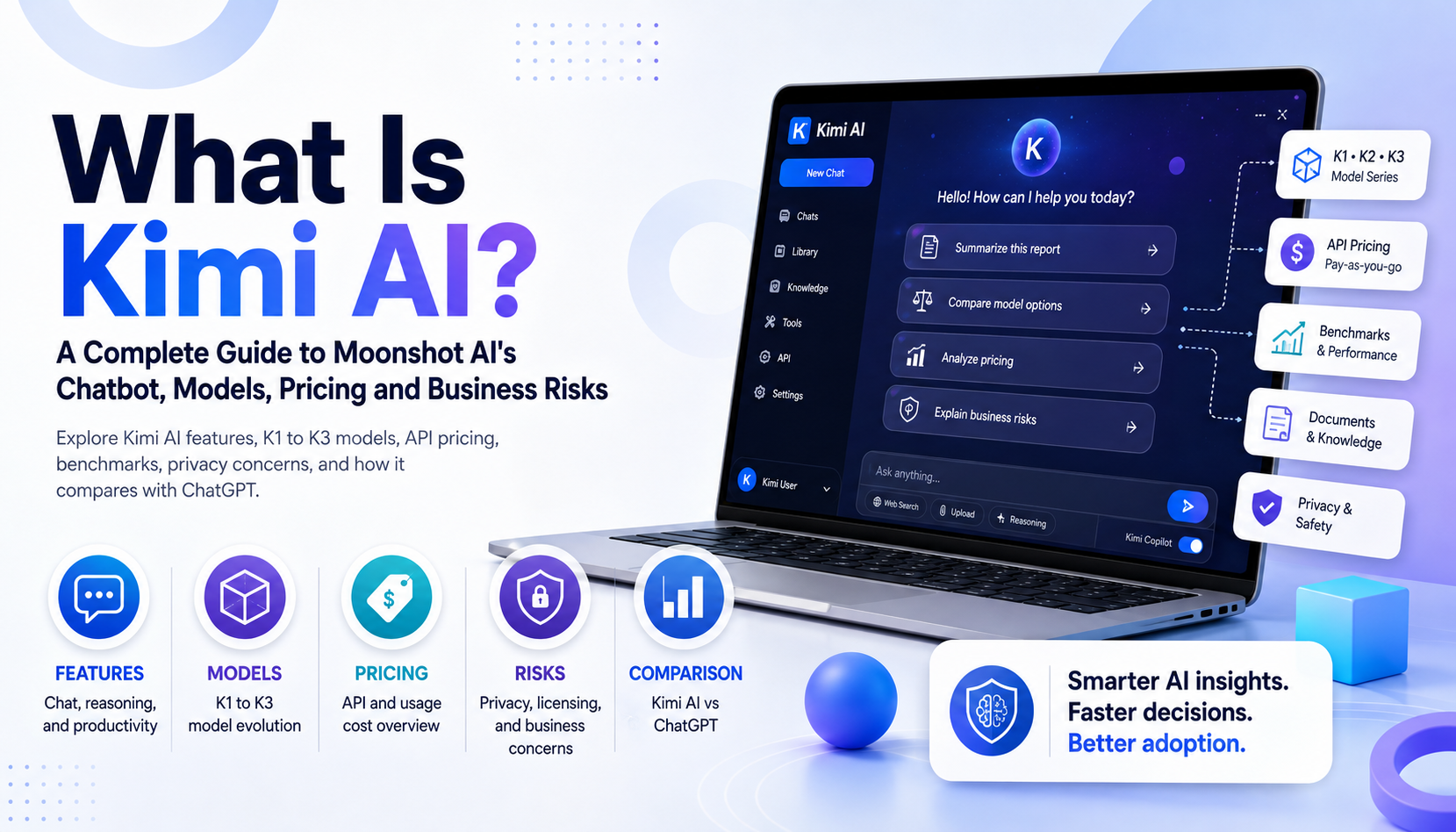
Kimi AI is the chatbot and family of large language models built by Moonshot AI, a Chinese startup founded in Beijing in March 2023 by former Carnegie Mellon researcher Yang Zhilin. Since its public launch in November 2023, Kimi has moved from a long-context chat assistant to an open-weight, agentic model line, most recently Kimi K3, a 2.8 trillion-parameter Mixture-of-Experts model released free for anyone to download in July 2026. Kimi is genuinely capable at coding, long-document analysis and agentic workflows at a fraction of the price of comparable Western models, but it also carries documented data-collection and privacy concerns tied to Chinese data law that professionals should weigh before feeding it sensitive work.
Key Highlights of Kimi AI
- Kimi AI is built by Moonshot AI, founded in March 2023 by Yang Zhilin along with Tsinghua classmates Zhou Xinyu and Wu Yuxin, and it went public in November 2023.
- The model line has moved through K1, K1.5, K2, K2 Thinking, K2.5, K2.6 and now Kimi K3, a 2.8-trillion-parameter open-weight model released in July 2026 with a 1 million token context window.
- Moonshot AI has raised well over $1 billion since late 2025, with Alibaba, Tencent, 5Y Capital, IDG Capital and HongShan among its backers, pushing its valuation to a reported $20 billion by May 2026.
- Kimi's model weights are released under a Modified MIT License, which is not the same as a standard open-source license and carries restrictions on large-scale commercial deployment.
- API pricing is aggressive: Kimi K2.5 runs roughly $0.60 per million input tokens and $3.00 per million output tokens, while flagship Kimi K3 costs $3.00 input and $15.00 output per million tokens, still undercutting several Western frontier models.
- Kimi has been named in Chinese regulatory findings over data collection and in at least one documented incident where user data was exposed to another user, which matters for any organization considering it for confidential work.
What Is Kimi AI and Who Built It
Kimi is the consumer-facing chatbot and the underlying family of large language models produced by Moonshot AI (officially Beijing Dark Side of the Moon Technology Co.), a Chinese AI lab founded in March 2023. The company was started by Yang Zhilin, who completed a computer science degree at Tsinghua University, a machine learning PhD at Carnegie Mellon University, and interned at both Google Brain and Meta AI before returning to China to build his own lab. Yang's earlier academic work included Transformer-XL and XLNet, two influential papers on how language models retain long-range context, published before GPT-3 existed, which explains why long-context handling became Kimi's earliest calling card. He co-founded Moonshot AI with two Tsinghua classmates, Zhou Xinyu and Wu Yuxin, and the startup reportedly raised around $60 million and assembled a team of roughly 40 AI researchers within its first three months.
Moonshot AI released the Kimi chatbot into closed beta in October 2023 and opened it to the general public on 16 November 2023. Kimi is one of a handful of Chinese labs, alongside DeepSeek, Zhipu AI and Alibaba's Qwen team, often referred to informally as part of China's "AI tigers," competing to build frontier-class models domestically. Kimi's name is a nod to a family nickname of Yang's, and the product is positioned as a general-purpose assistant with strong document handling, coding and, more recently, autonomous agent capabilities.
Kimi's Model Timeline: From K1 to K3
Kimi has shipped new model generations roughly every few months since its 2023 launch, with the pace accelerating sharply through 2025 and into 2026. The table below summarizes the major releases based on currently available reporting.
| Model | Release | Context Window | Notable Characteristics
|
|---|---|---|---|
| Kimi (v1) | 2023 | 128,000 tokens | First public release; long-context chat focus |
| Kimi K1.5 | January 25, 2025 | Long-context, multimodal | Free, unlimited access; real-time search across 100+ sites; reasoning benchmarks compared to OpenAI's o1 |
| Kimi K2 | July 2025 | Long-context MoE | First open-weight release; trillion-parameter Mixture-of-Experts architecture |
| Kimi K2 Thinking | November 2025 | 256,000 tokens | 32B activated parameters, 384 experts (8 active per token), agentic reasoning; strong on HLE, BrowseComp, SWE-Multilingual, LiveCodeBench |
| Kimi K2.5 | January 27, 2026 | 256,000 tokens | 1.04 trillion parameters, native multimodal (text, image, video), trained on approximately 15 trillion tokens, "Agent Swarm" coordinating up to 100 agents in parallel |
| Kimi K2.6 | Q1/Q2 2026 | Extends K2.5 architecture | Reported coding performance competitive with contemporary frontier coding models |
| Kimi K3 | July 2026 | 1,000,000 tokens | 2.8 trillion parameters; described by Moonshot as the largest open-weight model released to date; native vision support |
The strategic shift toward open-weight releases, starting with K2 in mid-2025, was in large part a response to competitive pressure. When DeepSeek released its low-cost R1 model in January 2025, it disrupted the Chinese AI market broadly, and Moonshot AI was reportedly among the hardest hit, with Kimi sliding from third to seventh place by monthly active users in China. Publishing open weights for K2, K2.5 and ultimately the 2.8-trillion-parameter K3 has been Moonshot's way of staying relevant against both DeepSeek at home and OpenAI, Anthropic and Google internationally, by making a highly capable model available to anyone willing to self-host it.
Key Features of Kimi AI
Beyond raw model quality, Kimi's product surface has expanded well past a simple chat window. According to Moonshot AI's own product pages, current Kimi features include:
- Long-context conversation and document handling, letting users upload and analyze dozens of files or lengthy reports in a single session without losing earlier context, aided by the 256K to 1M token context windows in the K2 and K3 lines.
- Deep Research agent, which takes a research question and returns an in-depth report complete with charts, traceable citations and multiple output formats rather than a single unsourced answer.
- Kimi Docs, a document agent built for long reports and contract review style workflows.
- Kimi Sheets, which builds functioning spreadsheets with formulas, pivot tables and charts from a natural-language description.
- Kimi Slides, for turning text, existing documents, images or templates into an editable presentation.
- Kimi Websites, which generates functional websites from a written description, image or video reference.
- Agent Swarm, introduced with K2.5, which can coordinate up to 100 specialized agents on a single task in parallel, which Moonshot reports cuts execution time by roughly 4.5 times versus sequential agent execution.
- Native multimodal reasoning, with K2.5 and later models trained jointly on text, image and video rather than bolting vision on afterward, improving performance on tasks like diagram interpretation and chart-based analysis.
- Coding support, including a dedicated Kimi Code product and specialized checkpoints such as Kimi K2.7-Code, aimed at repository-scale code generation, debugging and test writing.
For professionals evaluating whether these agentic capabilities are relevant to their own work, it's worth comparing them against structured training on agent design principles, such as the concepts covered in a course on building production-ready AI agents and multi-agent systems, since understanding how agent orchestration works in general makes it much easier to evaluate any specific vendor's claims, Kimi's included.
Kimi AI Pricing in 2026
Kimi is free to use as a consumer chatbot through its website and mobile app, which has been central to its growth strategy. For developers building on top of the models via Moonshot's API, pricing as of August 2026 is usage-based and billed per million tokens, split between input and output, with a discount for cached input tokens.
| Model | Input (per 1M tokens) | Output (per 1M tokens) | Cached Input |
| Kimi K2.5 | $0.60 | $3.00 | $0.10 |
| Kimi K2.6 | $0.95 | $4.00 | $0.16 |
| Kimi K3 | $3.00 | $15.00 | $0.30 |
Moonshot also offers a Batch API with roughly a 40% discount for workloads that can run asynchronously rather than in real time, which is a meaningful lever for teams processing large volumes of documents outside of live chat sessions. Output tokens generally cost about four to five times as much as input tokens across the lineup, so applications that generate long responses will see costs concentrated there rather than in the prompt itself. It's also worth noting that these figures apply to international billing in USD through Moonshot's api.moonshot.ai platform; billing for users inside Mainland China runs through a separate platform denominated in RMB with its own rate card, so figures can differ by region. Given how quickly usage-based AI pricing changes, teams should always confirm current rates directly against Moonshot AI's own published pricing before budgeting a project around them.
Is Kimi AI Open Source? Licensing Explained
Moonshot markets its K2-generation and K3 weights as "open," and it does publish them for download on Hugging Face under the moonshotai organization. However, the license attached to these weights is a Modified MIT License, not a standard MIT or Apache 2.0 license. The modification carries specific restrictions aimed at very large-scale commercial deployments, particularly Model-as-a-Service offerings that would let a third party resell access to the model at high volume. In practical terms, this means Kimi's weights are "open weight" in the sense that anyone can download, inspect and self-host them, but they are not unrestricted open source in the way that term is usually understood, and any organization planning to build a commercial product on top of Kimi's weights should read Moonshot's exact license terms rather than assuming Apache-style freedom of use.
How Kimi AI Performs: Benchmarks and Real-World Standing
On its own published benchmarks, Kimi K2 Thinking set new open-source results on HLE (Humanity's Last Exam), BrowseComp, SWE-Multilingual and LiveCodeBench, and Moonshot reports that it maintains stable multi-agent behavior across 200 to 300 sequential tool calls, which is a meaningful marker of reliability for anyone planning to use it in an autonomous agent pipeline rather than a single-turn chat. Kimi K2.5 posted an HLE score of 50.2% with tool use enabled, alongside strong results on coding and vision-specific benchmark suites.
Kimi K3, the newest flagship, performs well on independent benchmark aggregators against contemporary frontier models on tasks like autonomous coding (SWE-bench Verified), browsing-based research (BrowseComp) and front-end code generation, and Moonshot has publicly described it as the largest open-weight model released to date at 2.8 trillion total parameters. That said, third-party comparison sites currently reference several 2026-era competitor model names and exact benchmark percentages that this article was not able to independently confirm against OpenAI's, Anthropic's or Google's own official announcements at the time of writing, since some competing model version names in circulation appear to reflect informal or leaderboard-specific labels rather than confirmed public product names. Readers should treat head-to-head numeric benchmark comparisons against specific rival model versions as directional rather than exact, and verify against each lab's own release notes before citing a precise score in business-critical decisions.
Kimi AI vs ChatGPT vs DeepSeek: How It Compares
Kimi is most often compared against ChatGPT and DeepSeek, since all three are widely available, general-purpose assistants, though each has a different center of gravity.
| Dimension | Kimi AI | ChatGPT | DeepSeek |
| Developer | Moonshot AI (China) | OpenAI (United States) | DeepSeek (China) |
| Context window | Up to 1,000,000 tokens (K3) | Varies by model tier | Typically 128,000 tokens |
| Model weights | Modified MIT License (open weight) for K2 and later | Closed / proprietary | Open weight, MIT-style for several releases |
| Strongest at | Long-document analysis, agentic multi-step workflows, low-cost API access | General reasoning, broad ecosystem and plugin support, English-language polish | Coding and mathematical reasoning at very low cost |
| Notable weakness | Documented data-privacy findings; benchmark comparisons still catching up on some coding leaderboards | Higher API cost at flagship tiers | Smaller context window; similar data-jurisdiction questions as Kimi |
For teams already trained on prompt design, the practical differences between these tools tend to matter less than how well the user can direct any of them, which is why structured prompt engineering training pays off regardless of which specific model a company standardizes on.
Funding, Valuation and Moonshot AI's Business Strategy
Moonshot AI's financial trajectory has moved quickly. The company reportedly closed a round near a $4.3 billion valuation in late 2025, then Alibaba Group, Tencent Holdings, 5Y Capital, IDG Capital, Andon Health, Cathay Capital, Gaorong Capital and HongShan committed more than $700 million to a further round that closed in February 2026, with Moonshot targeting a $10 billion valuation at that stage. By May 2026, reporting indicated the company had raised a further $2 billion at a valuation of roughly $20 billion. Alibaba's continued backing is notable given Alibaba also develops its own competing Qwen model family, illustrating how concentrated the capital behind Chinese frontier AI labs has become.
Strategically, Moonshot's decision to give away K2, K2.5 and K3 as free, open-weight downloads, rather than keeping them behind a paid API only, reflects the same "sovereign AI" logic playing out globally: governments and enterprises increasingly want models they can run entirely on infrastructure they control, so that data never has to leave their own jurisdiction. By publishing K3's weights openly, Moonshot allows any government, company or individual to self-host a frontier-class model without paying for API access or routing data through a foreign cloud, which is a meaningfully different distribution strategy than OpenAI's, Anthropic's, or Google's closed-model approach.
Data Privacy, Security and Censorship Concerns
This is the area most generic explainers of Kimi AI skip over, and it is arguably the most important section for any business evaluating the tool. Several documented issues are worth knowing before feeding confidential work into Kimi:
- A data exposure incident: an OECD.AI-logged incident from April 2026 describes the Kimi model mistakenly disclosing one user's private resume, including their name, phone number and work history, to a different user during a routine task.
- Regulatory findings in China itself: a public-security-affiliated testing center in China flagged Kimi, alongside 35 other apps including Zhipu's, for collecting and using personal data beyond what its stated business functions required.
- Training data use: Moonshot AI's own privacy policy reportedly states that user prompts and uploaded content may be used to improve and train its models, and that personal information may be shared with service providers and affiliates. Unlike ChatGPT, Claude and even DeepSeek, Kimi's consumer product has been reported as lacking an in-product opt-out for model training as of mid-2026.
- Legal jurisdiction: as a Chinese company, Moonshot AI is subject to China's National Intelligence Law, whose Article 7 requires organizations to support, assist and cooperate with state intelligence work, which is the same legal backdrop that has driven scrutiny of other Chinese consumer technology platforms in Western markets.
None of this means Kimi is unsafe to experiment with for low-sensitivity tasks such as summarizing public documents or drafting generic content. It does mean that source code, contracts, personally identifiable customer data, unreleased financial figures or anything covered by a client NDA should not be pasted into Kimi, or into any externally hosted AI tool, without first confirming your organization's data-handling policy explicitly permits it. Teams that want a defensible internal policy on which AI tools are acceptable for which categories of data are often better served by first getting structured guidance on responsible generative AI use inside an organization rather than making ad hoc calls per project.
Enterprise Adoption: Why Companies Are Using, and Restricting, Kimi AI
Despite the concerns above, Kimi has seen real adoption inside Western workplaces. Security researchers at Harmonic reportedly tracked roughly 700,000 Kimi interactions inside UK and US enterprises, making it the most-used China-based AI tool in Western workplaces at that point, ahead of DeepSeek. The same reporting notes that employees were observed pasting in exactly the kind of material that raises the concerns above, including source code, contracts, financial models and customer data, often because Kimi is free, fast and unusually strong at handling very long documents in a single pass. This gap between what security teams recommend and what individual employees actually do in practice is precisely why organizations that operate under any kind of vendor risk or client confidentiality obligation need an explicit, written AI tool policy rather than relying on informal norms.
Practical Applications of Kimi AI for Working Professionals
Setting the risk factors aside, Kimi's genuine strengths map onto several roles relevant to certification-track professionals:
- Software developers and QA engineers can use Kimi's coding-focused checkpoints for repository-scale debugging, code review and test generation, similar in spirit to the workflows covered in a Generative AI course built specifically for software developers.
- Project managers and Scrum Masters can use Kimi's long-context handling to summarize lengthy status reports, contracts or requirement documents, a use case closely related to what's taught in Generative AI training built for project managers.
- Business analysts and researchers can lean on Kimi's Deep Research agent for first-pass literature or market scans that still need human verification of every citation before being used externally.
- Product and AI leaders evaluating whether to standardize on a given model family for their organization benefit from the structured career and decision frameworks in a guide to the AI Product Manager role, skills and responsibilities.
In every one of these cases, the tool is only as useful as the prompt behind it, which is the core argument for treating prompt design as a trainable skill rather than trial and error; Simpliaxis's own beginner's guide to prompt engineering is a reasonable starting point for teams new to structuring requests for any large language model, Kimi included.
How to Get Started With Kimi AI
- For casual use, visit Moonshot's official Moonshot AI website or the Kimi mobile app and start a free chat session; no payment is required for the consumer product.
- For developers, sign up for API access through Moonshot's developer platform, generate an API key, and consult the current model list and per-token pricing before committing to a production integration.
- For teams that want to self-host, download the relevant model weights from the moonshotai organization on Hugging Face, but read the Modified MIT License terms carefully first, especially if the deployment involves reselling access to others.
- Before routing any real company data through Kimi in any form, confirm with your security or compliance team whether Chinese-hosted AI tools are permitted under your existing data-handling policy, given the jurisdiction and privacy findings discussed above.
Key Takeaways
- Kimi AI is built by Moonshot AI, a Beijing startup founded in March 2023 by Yang Zhilin, and it has moved from a long-context chatbot to a frontier-class, open-weight agentic model line in under three years.
- Kimi K3, released in July 2026, is a 2.8 trillion-parameter model with roughly a 1 million token context window, described by Moonshot as the largest open-weight model released to date.
- API pricing is competitive, ranging from about $0.60 to $3.00 per million input tokens depending on the model tier, though flagship K3 output pricing reaches $15 per million tokens.
- Kimi's model weights use a Modified MIT License, meaning it is open weight rather than fully open source, with restrictions on large-scale commercial resale.
- Moonshot AI has raised well over $1 billion since late 2025 from investors including Alibaba and Tencent, reaching a reported $20 billion valuation by May 2026.
- Documented data-collection findings, a user-data exposure incident, and China's National Intelligence Law are real considerations that any business should weigh before using Kimi for confidential or regulated work.
- Teams gain the most practical value from Kimi, or any large language model, when paired with structured skills in prompt engineering and agentic AI design rather than ad hoc experimentation.
Frequently Asked Questions
1. Is Kimi AI free to use?
Yes, the consumer chatbot at Kimi's website and mobile app is free. Developers building on the API are billed per token, with current rates ranging from roughly $0.60 to $3.00 per million input tokens depending on the model, and open-weight versions can also be self-hosted at your own infrastructure cost.
2. Who owns Kimi AI?
Kimi is owned and developed by Moonshot AI, a Beijing-based company founded in March 2023 by Yang Zhilin along with co-founders Zhou Xinyu and Wu Yuxin. Major investors include Alibaba Group and Tencent Holdings, among others.
3. What is the difference between Kimi K2 and Kimi K3?
Kimi K2, released in July 2025, was Moonshot's first open-weight release and introduced trillion-parameter Mixture-of-Experts architecture. Kimi K3, released in July 2026, is substantially larger at 2.8 trillion total parameters, adds native vision support, and extends the context window to roughly 1 million tokens, and Moonshot describes it as the largest open-weight model released to date.
4. Is Kimi AI safe to use for business data?
Treat it with the same caution as any externally hosted AI tool, and more caution than most. Kimi has been named in Chinese regulatory findings over data collection practices and in at least one documented case of a user's personal data being exposed to another user. As a Chinese company, Moonshot AI is also subject to China's National Intelligence Law. Confidential source code, client data, or contractual information should not be entered into Kimi without explicit sign-off from your organization's security or legal team.
5. Is Kimi AI open source?
Kimi's K2-generation and K3 model weights are published for download, but under a Modified MIT License rather than a standard open-source license. This allows broad inspection and self-hosting but restricts certain high-volume commercial resale scenarios, so it is more accurately described as "open weight" than fully open source.
6. How does Kimi AI compare to ChatGPT and DeepSeek?
Kimi generally offers a larger context window and lower API pricing than ChatGPT, and it competes closely with DeepSeek on price, though DeepSeek has historically been viewed as stronger specifically on coding and math. ChatGPT tends to have a broader plugin and enterprise ecosystem. The right choice depends on the specific task, budget, and, importantly, your organization's data-jurisdiction requirements.
7. Why did Moonshot AI release Kimi K3 for free?
Moonshot's shift to free, open-weight releases starting with K2 was in large part a competitive response to DeepSeek's low-cost R1 model, which had disrupted the Chinese AI market in early 2025 and reportedly knocked Kimi from third to seventh place in monthly active users domestically. Releasing K3's weights for free lets any government, company or individual run a frontier-class model on their own infrastructure, which also supports the broader "sovereign AI" push by countries wanting to keep AI workloads and data within their own borders.
8. Can Kimi AI process very long documents?
Yes, this is one of Kimi's core strengths. Kimi K3 supports a context window of roughly 1 million tokens, and earlier K2-generation models supported up to 256,000 tokens, which allows uploading and cross-referencing dozens of files or very long reports in a single session without losing earlier context.








 Lowest-Price Challenge











 Personalized Path


.webp)


 USA
USA  Canada
  India
India  UK
UK  Australia
  Singapore


