


 Call Us



Quick Answer
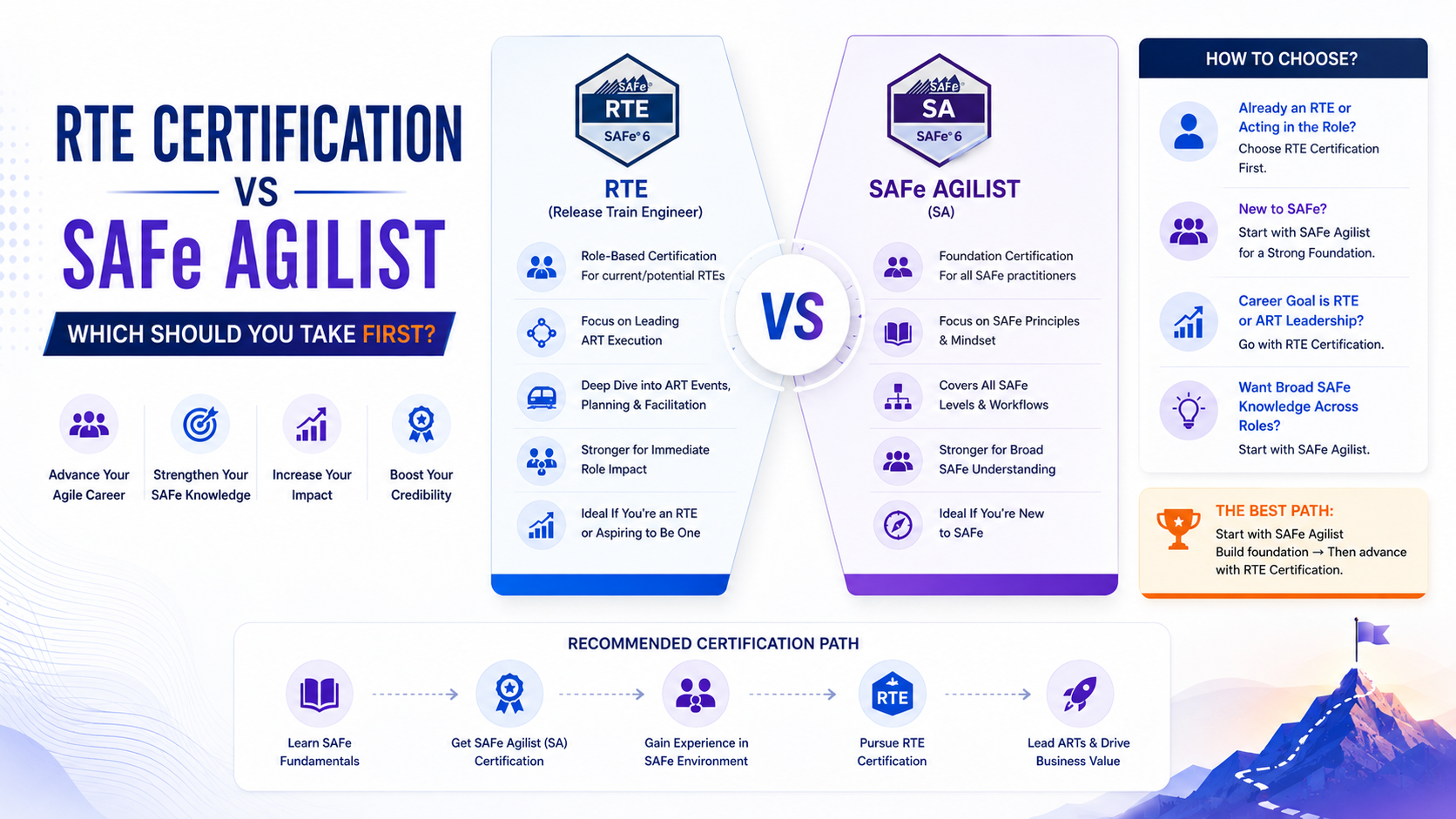
These are not really competing certifications, which is why most comparisons of them are misleading. SAFe Agilist (SA) is a leadership credential held by Executives, Directors, Product Managers, and Agile Coaches, not a job title of its own. RTE is both a certification and a specific job title with its own dedicated salary and hiring market. If you are new to SAFe entirely, take SA first, since it has no prerequisites and is the framework's foundational leadership certification. If you already have SAFe experience and a specific RTE role in view, you can go directly to RTE.
Key Highlights
- SAFe Agilist's own certification page lists it for "current or aspiring leaders," naming Executives, Directors, Product Managers, and Agile Coaches, not Release Train Engineers specifically as its target audience.
- Verified directly from Scaled Agile: SA is a 45-question, 90-minute exam requiring 80% to pass, with no prerequisites. RTE is a 60-question, 120-minute exam requiring 82% to pass.
- Because SA is not a distinct job title, there is no independent "SAFe Agilist salary" the way there is a Release Train Engineer salary. Comparing the two on pay alone is comparing a credential to a career.
- Most employers treat SA (via the Leading SAFe course) as foundational and RTE as advanced, so the typical sequencing is SA before RTE, not the reverse.
- Market research conducted for this guide found Leading SAFe (leading to SA) training commonly priced well below RTE training across providers, consistent with its role as the entry-level credential.
If you are trying to decide between RTE certification and SAFe Agilist, the question itself usually reveals a mismatch. They serve different purposes: one is a broad leadership credential, the other is a specific program-level role. This guide clarifies which one to pursue and in what order, based on facts verified directly from Scaled Agile rather than the market's blended pricing pages.
Why this is not a true either/or comparison
SAFe Agilist certifies leadership judgment and framework fluency across many possible roles. RTE certifies you for one specific, defined program-level role. Verified side by side:
| Certification | Exam format | Prerequisites | Who typically holds it |
|---|---|---|---|
| SAFe Agilist (SA) | 45 questions, 90 minutes, 80% to pass | None required | Executives, Directors, Product Managers, Agile Coaches, per Scaled Agile's own certification page |
| Release Train Engineer (RTE) | 60 questions, 120 minutes, 82% to pass | None required, but ART/PI experience recommended | Release Train Engineers specifically, an actual job title with its own hiring market |
The practical implication: if your goal is the RTE job title and the salary that comes with it, RTE certification is what you need. SAFe Agilist will not get you hired as an RTE on its own, but it is commonly the on-ramp employers expect before you reach that role.
Who should get SAFe Agilist first
- You are new to SAFe entirely, with no prior framework exposure at any level.
- Your current role is broader than one Agile team but not yet a defined program-level role, such as a Product Manager or Director exploring Lean-Agile leadership.
- You want the lowest-cost, lowest-prerequisite entry point into SAFe's certification track before committing to a specific role-based certification.
Who can skip straight to RTE
- You already have hands-on SAFe experience, ideally having participated in an Agile Release Train and at least one Program Increment.
- You have a specific RTE-track role already in view, whether an internal promotion or an external job search.
- You are coming from a Scrum Master background and are ready to move to program-level scope. See Scrum Master to Release Train Engineer for the full transition roadmap.
Neither certification has a hard prerequisite gate. Scaled Agile's own RTE page recommends prior ART and PI experience without requiring it, and its SA page states no prerequisites at all. The sequencing above is about what makes you a credible candidate, not a rule the exam system enforces.
Cost comparison
Market research conducted for this guide, reviewing multiple authorized training providers, found Leading SAFe training (leading to SA certification) commonly priced in the tens of thousands of rupees in India, well below the roughly ₹1,45,000 to ₹1,95,000 range typical for RTE training. That gap makes sense given the difference in scope: SA is a shorter, broader-audience course, while RTE is a specialized, role-specific one. For the full RTE cost breakdown, including renewal economics, see SAFe RTE certification cost: full breakdown.
The verdict
Stop thinking of this as a competition between two certifications and start thinking of it as a sequencing question. If you are early in your SAFe journey, SAFe Agilist is the lower-cost, no-prerequisite starting point. If you already have program-level exposure and a specific RTE role in your sights, go directly to SAFe RTE Certification Training. For the fuller sequencing map across all SAFe certifications, see SAFe certification path.





 Lowest-Price Challenge











 Personalized Path


.webp)


 USA
USA  Canada
 India
India UK
UK Australia
 Singapore


