


 Call Us



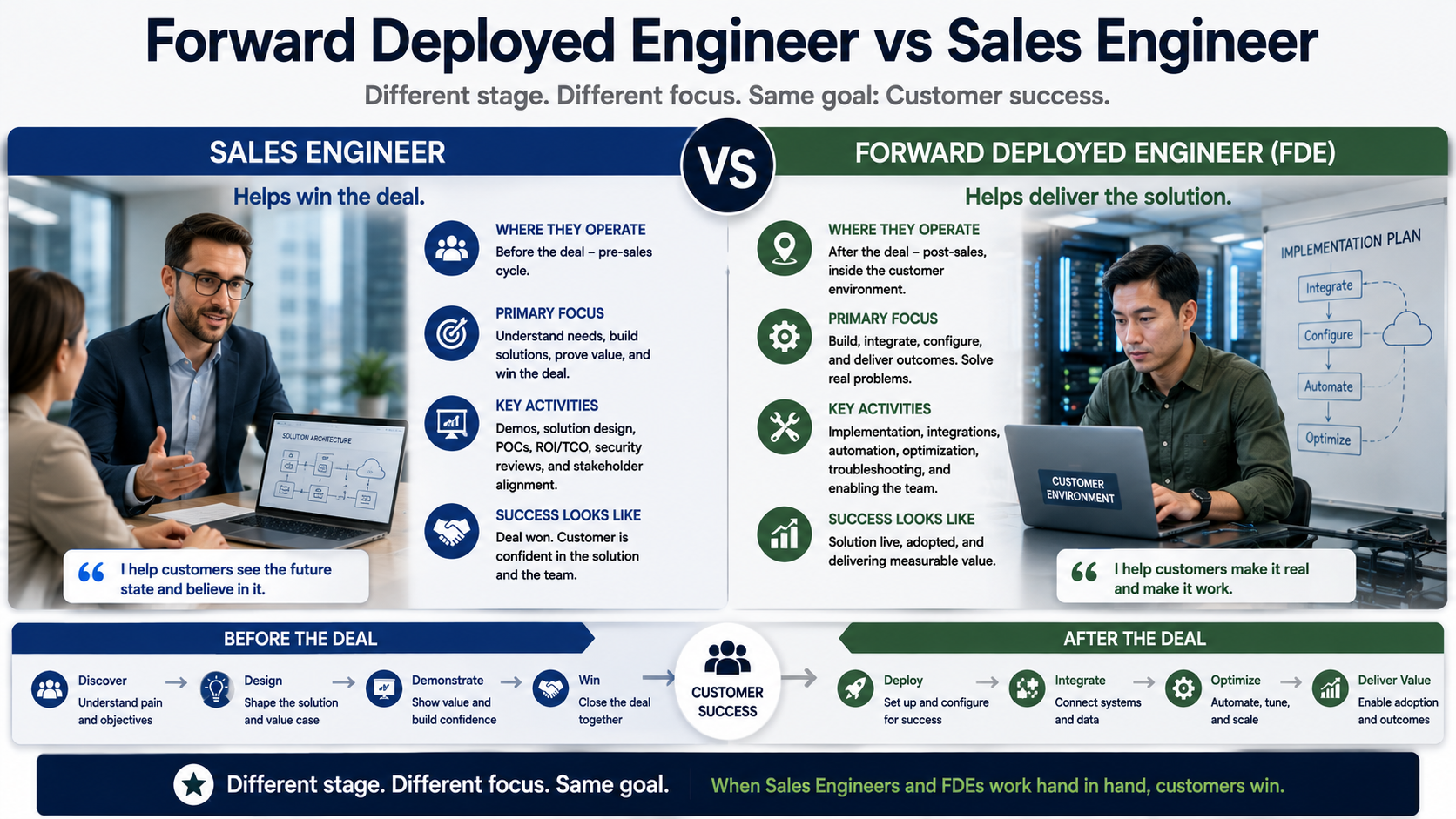
This is the comparison that carries the most status anxiety, and that anxiety is exactly why it deserves a clear answer. Engineers considering a forward deployed role often worry, quietly, that it is really a sales engineering job with a more impressive title, that they will end up doing demos and supporting deals rather than building. The worry is worth taking seriously, because the two roles do overlap, and some roles labelled forward deployed engineer really are closer to sales engineering. But at their cores the roles are genuinely different: the sales engineer helps close deals, the forward deployed engineer builds solutions after the deal is done. This piece draws the line clearly, so you can tell whether a role is the real thing or the sales-adjacent version.
The distinction matters because it determines whether your work stays genuinely technical or drifts toward pre-sales support, which is a very different career. If the build-centric version is what you want, the Forward Deployed Engineering Program builds exactly that, and knowing how to screen for it is the first defence against ending up in the wrong version.
Key Highlights
- The sales engineer helps close deals through demos and technical pre-sales, while the forward deployed engineer builds real solutions after the sale is made.
- The clearest divide is timing: the sales engineer works before the deal, the forward deployed engineer works after it.
- The status anxiety is real because some forward deployed roles are diluted toward sales support, so the concern is worth screening for rather than dismissing.
- The forward deployed engineer's deliverable is working software in the customer's environment, while the sales engineer's deliverable is a won deal.
- Screening a specific role for genuine build responsibility is how you avoid taking a sales engineering job dressed up as a forward deployed one.
Before the deal versus after the deal
The single cleanest way to separate these roles is by where they sit relative to the sale. The sales engineer works before the deal is closed, providing the technical expertise that helps win it: running demos, answering technical questions from the prospect, proving that the product can do what the buyer needs, and supporting the sales team through the technical parts of the buying process. Their job is to help turn a prospect into a customer.
The forward deployed engineer works after the deal is closed, building the actual solution for the customer who has already bought. By the time the forward deployed engineer is deeply involved, the sale is done, and the job is to deliver real value: embedding with the customer, understanding their problem, and building working software in their environment. This before-versus-after distinction resolves most of the confusion, because it points at fundamentally different purposes. The sales engineer exists to help sell. The forward deployed engineer exists to deliver what was sold. When you are evaluating a role, asking whether the work happens mainly before or after the deal tells you a great deal about which role it really is.
What a sales engineer actually does
To see the contrast clearly, it helps to understand the sales engineer role on its own terms, because it is a real and skilled job rather than a lesser one. A sales engineer is the technical member of a sales team, responsible for the technical dimension of winning deals. They understand the product deeply and can speak to its technical capabilities credibly, which is what lets them support the sales process where pure salespeople cannot.
Their work centres on the buying process. They run technical demonstrations that show the product solving the prospect's problem, answer the detailed technical questions that arise during evaluation, address concerns and objections on technical grounds, and sometimes build proofs of concept that demonstrate feasibility. Their success is measured, ultimately, by deals won, because their contribution is helping close sales that would not close without technical credibility on the selling side. A strong sales engineer is valuable and well compensated, and for people who enjoy the mix of technology and the energy of the sales process, it is a genuinely good career. It is simply a different job from building solutions after the sale, which is the forward deployed engineer's domain.
What a forward deployed engineer actually does
The forward deployed engineer, by contrast, is defined by delivery rather than sales. Once a customer has bought, the forward deployed engineer embeds with them and builds the real solution: understanding the actual problem through discovery, scoping the work against the customer's real systems, building software that runs in their environment, and making it work against the messy constraints of their reality. The deliverable is not a won deal but working software that solves the customer's problem.
This is deeply technical, hands-on delivery work, and it is where the forward deployed engineer spends the overwhelming majority of their time. The demos and technical conversations that dominate a sales engineer's week are, at most, a small part of the forward deployed engineer's job, because the forward deployed engineer's job is to build, not to sell. Where the sales engineer's technical work serves the goal of closing, the forward deployed engineer's technical work serves the goal of delivering. This is why the genuine forward deployed role stays genuinely technical: the entire purpose is to build the solution, which requires real and sustained engineering rather than the technical-but-sales-oriented work of pre-sales.
Why the status anxiety is understandable
The worry that a forward deployed role is really sales engineering in disguise is not paranoia, and it is worth validating rather than dismissing, because the concern has a real basis. The forward deployed engineer title has become fashionable and prestigious, which means some companies apply it to roles that are actually closer to sales engineering or technical support, because the more exciting title attracts stronger applicants. So a candidate is right to be cautious, and right to screen carefully.
The anxiety is also understandable because the two roles share a surface. Both are technical, both are customer-facing, both involve understanding customer needs and speaking to technical capability. From the outside, and especially from a job description written to sound appealing, a sales-oriented role can look like a build-oriented one. The result is that engineers who want to build can genuinely end up in roles that are mostly demos and deal support, discovering the mismatch only after they have started. This is a real risk, not an imagined one, which is why the honest response is not to reassure people that all forward deployed roles are genuine, but to equip them to tell the difference. This is part of the broader problem of the diluted forward deployed title, where the label covers a range of jobs from genuinely build-heavy to barely technical.
How to tell which role you are being offered
Because the anxiety is justified, the practical skill is screening a specific role to see whether it is genuinely build-focused or sales-adjacent, and a few pointed questions cut through the ambiguity. Ask what you would actually spend your time doing in a typical month, and listen for whether the answer centres on building software or on demos, presentations, and supporting deals. Ask whether you work mainly before the deal closes or after, since before points to sales engineering and after to genuine forward deployed work.
Ask specifically what you would build in the first months and whether you would be writing and deploying production code, or building proofs of concept and demos. Ask who owns the customer relationship and whether your success is measured by deals influenced or by solutions delivered. A genuine forward deployed role answers these in terms of building and delivering real software after the sale. A sales-adjacent role answers in terms of demos, deal support, and pre-sales technical work, however impressive the title. The answers, taken together, reveal which role you are really being offered, and asking these questions signals that you understand the distinction, which is itself valuable. This screening is the same discipline that distinguishes the genuine role across the whole family of adjacent roles it gets confused with.
The career trajectories diverge sharply
Beyond the daily work, these two roles build different careers over time, and understanding the divergence helps you choose the one whose future you want. The sales engineer develops along a sales-technical axis, deepening their ability to support and close deals, growing into senior sales engineering, sales engineering leadership, or broader go-to-market roles. Their trajectory is tied to the commercial side of technology, and for those who enjoy that world, it leads to well-compensated and influential positions in how companies sell.
The forward deployed engineer develops along a delivery-and-technical axis, deepening their ability to build and ship in real environments, growing toward senior forward deployed roles, technical leadership, architecture, or founding-engineer positions. Their trajectory stays closer to building and technical depth, which keeps more purely technical doors open over time. This divergence matters because the role you take now shapes the skills you build and therefore the futures available to you later. A few years in sales engineering builds sales-technical expertise, while a few years in forward deployed work builds delivery and technical depth, and these lead to genuinely different places. Neither is better, but they are different, and choosing with the long-term trajectory in mind, not just the current role, is part of choosing well. The forward deployed path's technical depth also connects to the broader career ladder that the role is still defining.
Why the anxiety usually resolves once you are honest
The status anxiety that drives so many engineers to worry about this comparison tends to dissolve the moment they are honest with themselves about what they actually want to do, which is worth naming because it reframes the whole question. The anxiety is usually a fear of ending up in a role that is beneath their technical ambition, of being a builder trapped in a selling job. But that fear is really a signal about what they want, and listening to it clarifies the choice rather than clouding it.
If the thought of a sales-oriented role provokes anxiety, that is useful information: it means you want to build, and you should therefore screen hard for genuinely build-focused forward deployed roles and avoid both sales engineering and the diluted forward deployed roles that are really sales support. If, on the other hand, the sales dimension appeals, then sales engineering is a fine career and the anxiety was misplaced. Either way, the resolution comes from honesty about your own preference rather than from external reassurance, and once you know what you want, the screening questions tell you whether a given role provides it. This is why the honest response to the anxiety is not blanket reassurance but the tools to tell genuine build roles apart, and to build the genuine technical capability that makes you a credible candidate for the real version of the role rather than the sales-adjacent one.
A side-by-side comparison
To fix the distinction, here is how the two roles compare across the dimensions that decide the question.
| Dimension | Forward deployed engineer | Sales engineer |
| Timing relative to the deal | After the sale, delivering | Before the sale, helping close |
| Core deliverable | Working software in the customer's environment | A won deal |
| Success measured by | Solutions delivered | Deals closed or influenced |
| Typical week | Discovery, building, debugging, handoff | Demos, technical questions, proofs of concept |
| Depth of building | Sustained production engineering | Demos and proofs of concept |
| Career trajectory | Delivery craft and technical depth | Sales-technical expertise and deal skill |
| Best fit for | People who want to build after the sale | People who enjoy technology plus the sales process |
Read the table to place a role and to place yourself. A role centred on building software after the deal, measured by solutions delivered, is a genuine forward deployed role. One centred on demos and deal support before the sale, measured by deals, is sales engineering whatever it is called. And your own preference across these rows tells you which you actually want.
Which one fits you
The choice comes down to what you genuinely enjoy, and there is no shame in either answer. If you are energised by the sales process, by demonstrating technology to win over a prospect, by the mix of technical skill and the momentum of closing deals, sales engineering is a real and rewarding career, and you should pursue it rather than forcing yourself into a build role for its prestige. If you are energised by building, by taking a real problem and shipping working software that solves it in the customer's environment, the forward deployed path is where you belong.
The status anxiety that drives so many people to worry about this comparison usually resolves once they are honest about what they want to do. If you want to build, then a sales engineering role, however well paid, will not satisfy you, and a diluted forward deployed role that is really sales support will not either, which is why screening matters. If the genuine build-focused forward deployed work is what you want, it is in strong demand, and developing the capability through the Forward Deployed Engineering Program equips you to win and hold the real version of the role rather than the sales-adjacent one.
One more practical signal is worth watching for as you evaluate a role: how the company measures the people in it. A team measured on pipeline influenced, deals supported, or win rates is a sales-engineering team whatever it is called, while a team measured on solutions shipped and customer outcomes delivered is doing genuine forward deployed work. Metrics reveal purpose more honestly than titles or descriptions, because they show what the organisation actually rewards, and asking how success is measured is one of the sharpest questions a candidate can pose.
The bottom line
The forward deployed engineer and the sales engineer are confused because both are technical and customer-facing, but they differ fundamentally in timing and purpose: the sales engineer works before the deal to help close it, while the forward deployed engineer works after the deal to build what was sold. The sales engineer's deliverable is a won deal, the forward deployed engineer's is working software in the customer's environment. The status anxiety around this comparison is justified, because some forward deployed roles are genuinely diluted toward sales support.
That is exactly why screening matters. Ask whether the work happens before or after the deal, what you would actually build, and whether success is measured by deals or by solutions delivered. The answers reveal whether a role is the genuine build-focused thing or sales engineering in a fashionable title. Choose based on what you truly want to do, and if it is building after the sale, develop the capability through the Forward Deployed Engineering Program so you can command the real role rather than settle for the diluted one.
Building toward the role you want
If the genuine build-focused forward deployed role is the one you want, the way to earn it is to develop real capability across discovery, building, and deployment, since that is what the demanding interviews actually test. Grounding yourself in agentic AI foundations and hands-on engineering with agents is what makes you a credible candidate for the real role rather than the sales-adjacent version. The sales engineer path rewards commercial and technical-presentation skills, while the forward deployed path rewards the ability to build and ship, so building that delivery capability is how you steer your career toward the version of the work you actually want.









 Lowest-Price Challenge











 Personalized Path


.webp)


 USA
USA  Canada
 India
India UK
UK Australia
 Singapore


