


 Call Us



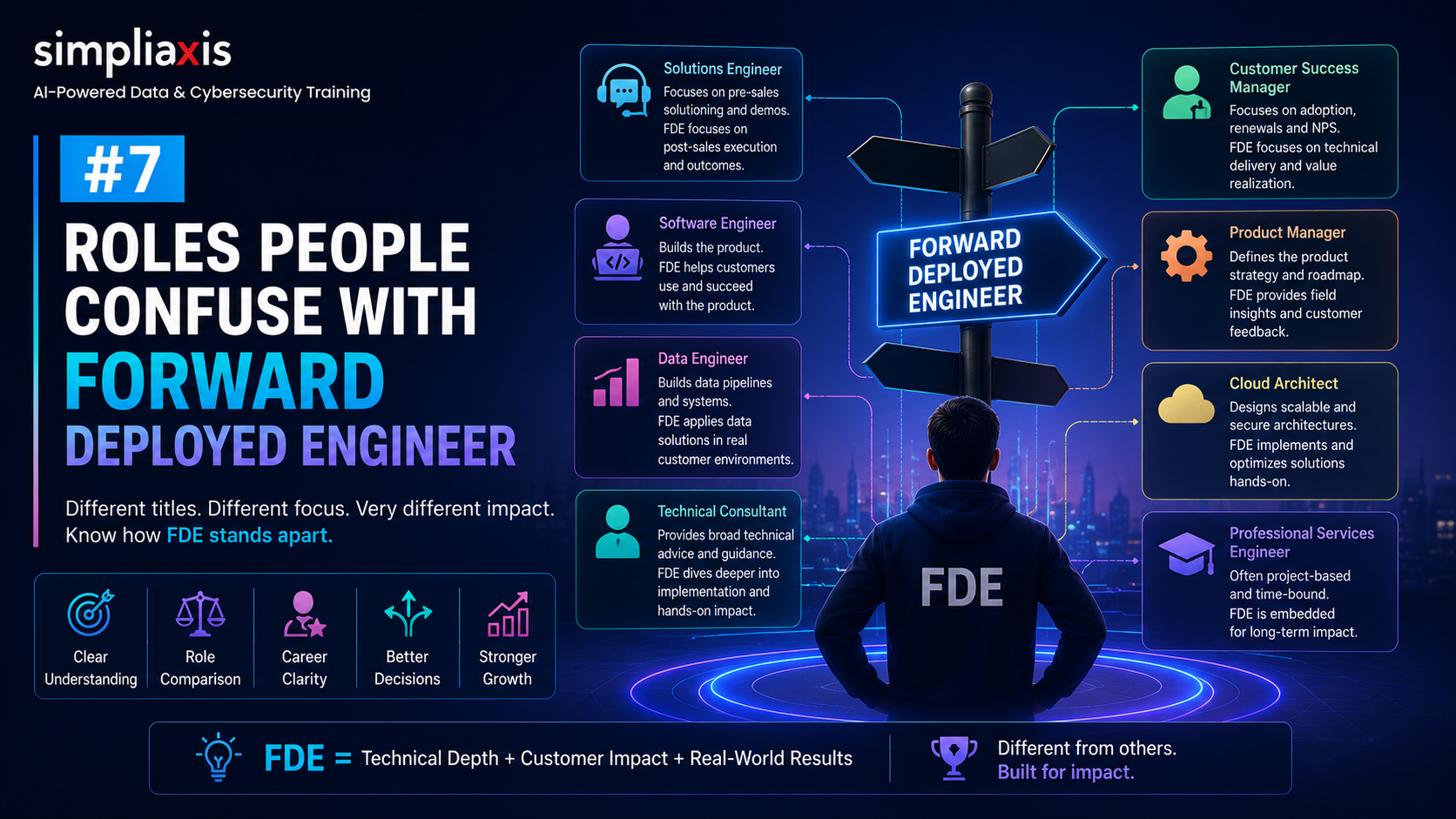
The forward deployed engineer title is confused with more adjacent roles than almost any other job in technology, and the confusion has real costs, sending people into jobs that do not match what they wanted and letting companies apply the fashionable label to work that is not really it. The confusion is understandable, because forward deployed engineering genuinely overlaps with a whole family of customer-facing technical roles. But the overlaps hide real differences, and being able to tell the roles apart is a practically useful skill. This piece maps the seven roles most often confused with forward deployed engineer, what distinguishes each, and how to tell which role you are actually looking at.
Getting this right matters because the title alone is unreliable, so the responsibility falls on you to determine what a given role really is. The one constant that identifies genuine forward deployed work across all the confusion is building real software inside the customer's environment, and building the capability to do that, through the Forward Deployed Engineering Program, is what lets you both recognise and command the real role.
Key Highlights
- The forward deployed engineer title overlaps with a family of customer-facing technical roles, which is why it is so often confused with them.
- The defining test across all the confusion is whether the role has you building real software inside the customer's environment.
- Roles like solutions architect and sales engineer are frequently mistaken for it but differ in whether they build and when they engage.
- Support-oriented roles like customer success engineer and technical account manager share the customer focus but not the deep building.
- Because the title is unreliable, the ability to screen a role against the building test is a practically valuable skill.
Solutions architect: designs rather than builds
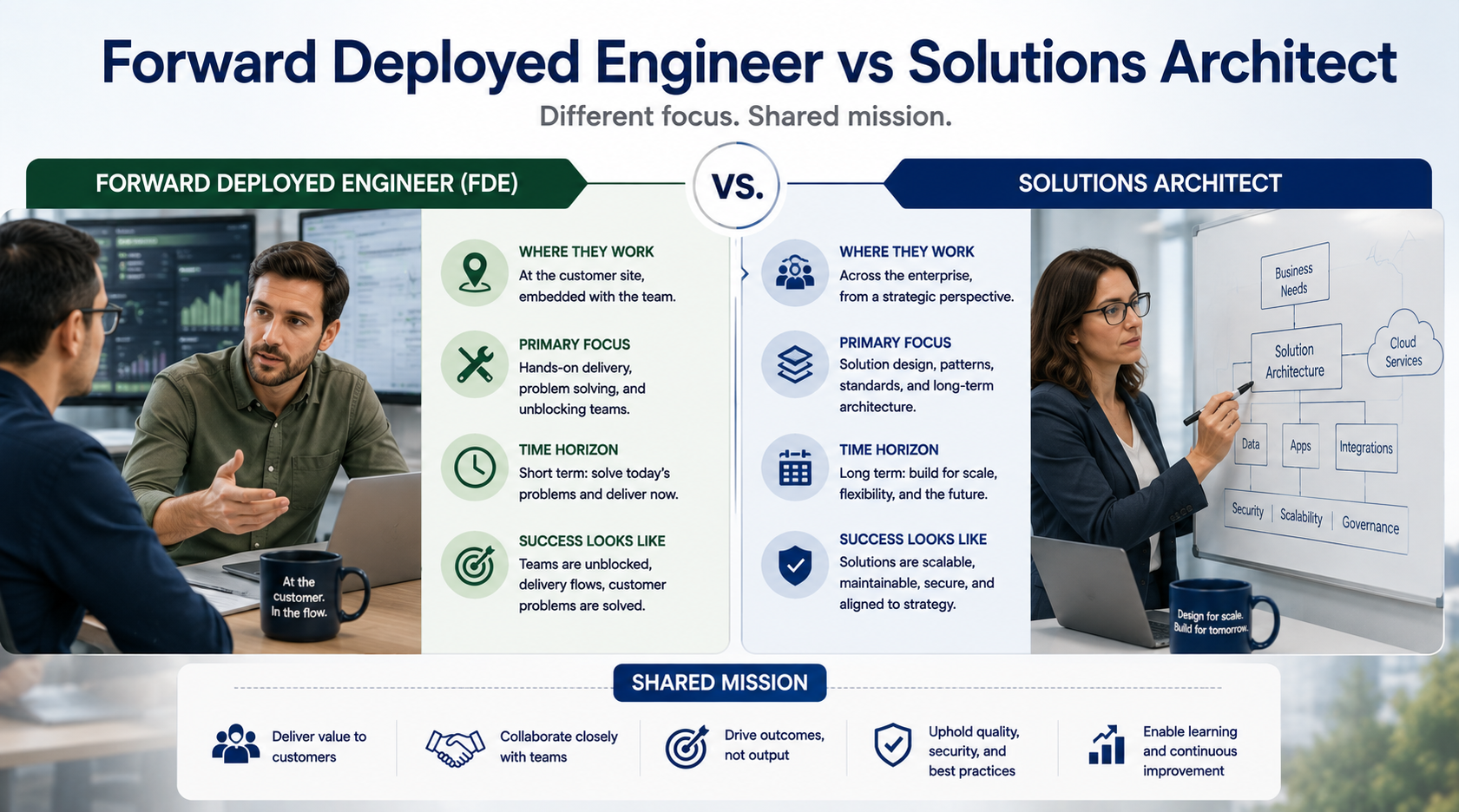
The solutions architect is perhaps the most common source of confusion, because both roles are customer-facing, technical, and sit between a product and the organisations using it. The distinction is that the solutions architect primarily designs solutions and advises on them, while the forward deployed engineer primarily builds them inside the customer's environment. The architect can succeed largely through design, diagrams, and guidance, producing an architecture that others then implement, whereas the forward deployed engineer's deliverable is working software they build themselves.
The clearest way to separate them is to ask who writes the production code, since the forward deployed engineer does as the main job while the solutions architect often does not. This one question resolves most of the confusion between these two roles, which the detailed comparison explores further. When a role has you designing and advising while others build, it is a solutions architect role whatever it is called, and when it has you building the software yourself, it is forward deployed work. The titles are not reliable, but the building test is, and applying it to any role labelled forward deployed engineer that sounds design-heavy is the way to tell which you are actually being offered.
Sales engineer: works before the deal
The sales engineer is confused with the forward deployed engineer especially often, and the confusion carries real anxiety, because engineers fear ending up in a sales role with a build-oriented title. The distinguishing factor is timing and purpose: the sales engineer works before the deal is closed, providing technical expertise to help win it through demos and pre-sales, while the forward deployed engineer works after the deal, building the solution for the customer who has already bought. The sales engineer's deliverable is a won deal, the forward deployed engineer's is working software.
This before-versus-after distinction, explored in the full comparison, cuts through most of the confusion. A role centred on demos, technical questions from prospects, and supporting the sales process is a sales engineering role, while one centred on building and delivering after the sale is genuine forward deployed work. The confusion matters because the fashionable forward deployed title is sometimes applied to what is really sales engineering, so a candidate who wants to build has to screen for whether the work happens before or after the deal and whether success is measured by deals or by solutions delivered. Asking those questions reveals which role you are really looking at, regardless of the title on the posting.
Consultant: advises rather than builds
The consultant is confused with the forward deployed engineer because both embed with clients, work across many organisations, and have to understand a business deeply and fast. The decisive difference is that the consultant advises and produces recommendations, while the forward deployed engineer builds the actual solution. The consultant's deliverable is a plan or an assessment, whereas the forward deployed engineer delivers working software running in the client's environment.
This advise-versus-build distinction, examined in the consultant comparison, is why the roles are close cousins but genuinely different. The confusion is especially relevant for the many people who come from consulting and wonder whether the forward deployed role is the same job, and the honest answer is that it shares much of the DNA but adds the building, which is a real change. A role that has you analysing and recommending is consulting whatever it is called, while one that has you building the solution is forward deployed work. Consultants make strong candidates precisely because so much overlaps, but the building requirement is the line that separates the two roles, and recognising it is what tells a consultant whether a given opportunity is genuinely the forward deployed role or just consulting under a newer name.
AI engineer: builds capability rather than deploying it
The AI engineer is increasingly confused with the forward deployed engineer as both work heavily on AI, and the two use much of the same technical toolkit. The difference is in focus and context: the AI engineer builds AI capability, often on a product used broadly, while the forward deployed engineer takes AI capability and makes it work inside a specific customer's environment. The AI engineer often works internally on the product, while the forward deployed engineer embeds with a customer and carries the customer relationship.
Because the technical core overlaps so heavily, as the comparison between the two shows, the distinction is not in the tools but in where and for whom they are applied, and in the customer-facing skills the forward deployed role adds. A role focused on building AI capability, often without a direct customer relationship, is an AI engineering role, while one focused on deploying AI into a specific customer's messy reality, with the customer relationship central, is forward deployed work. The confusion is natural given the shared toolkit, but the deployment-into-a-specific-customer dimension is what distinguishes the forward deployed role, and it is the customer relationship more than the technology that marks the difference between the two.
Customer success engineer and technical account manager: support rather than build
Two support-oriented roles are frequently confused with the forward deployed engineer because they share the customer focus, but they differ in the depth of building. The customer success engineer helps customers succeed with a product, often through guidance, configuration, and support, but typically does not build significant custom software inside the customer's environment. The role is more about helping customers use an existing product well than about building new solutions, which is the opposite of the forward deployed engineer's build-heavy work.
The technical account manager similarly focuses on managing the technical relationship with a customer, ensuring their success and serving as a technical point of contact, but again without the deep building that defines forward deployed work. Both roles are genuinely customer-facing and technical, which is why they are confused with the forward deployed engineer, but both centre on supporting and enabling rather than building. The distinguishing test is the same as always: whether the role has you building substantial software inside the customer's environment, or helping the customer use and succeed with a product. When the work is support, enablement, and relationship management rather than building, it is one of these roles rather than forward deployed engineering, however customer-facing and technical it may be.
Implementation consultant and professional services engineer: the closest cousins
The two roles closest to genuine forward deployed work, and therefore most easily confused with it, are the implementation consultant and the professional services engineer. Both do involve deploying and configuring software for customers, which brings them nearer to the forward deployed engineer than the other roles, and the line can genuinely blur. The distinction is in the depth and nature of the building: forward deployed engineers build substantial custom software against the customer's real constraints, while implementation and professional services roles often focus more on configuring, integrating, and deploying an existing product within its intended parameters.
The difference is real but subtle, and it is a matter of degree along a spectrum from configuring an existing product to building genuinely new software inside the customer. The more a role involves deep, custom building against the customer's specific reality, the more it is genuine forward deployed work, and the more it involves configuring and deploying an existing product within its designed flexibility, the more it is implementation or professional services. Because these are the closest cousins, they are where the title is most often stretched, and where a candidate has to look hardest at the actual work. Even here, the building test holds: the depth and customness of what you build is what places a role along the spectrum, and asking exactly what you would build, and how custom it would be, is how you tell the genuine forward deployed role from its nearest neighbours.
Why the confusion has real costs
It is worth being explicit about why this confusion matters, because it is not merely an academic tidiness problem, it has real costs for both engineers and companies. For engineers, the cost is taking a role that does not match what they wanted, discovering only after starting that the forward deployed title concealed a job that was really sales engineering, support, or configuration. An engineer who wanted to build and ended up in a coordination role has made an expensive mistake, losing time and sometimes skills to a job that was mislabelled, and the confusion is precisely what allowed the mistake.
For companies, the cost is different but real: applying the fashionable forward deployed title to work that is not really it attracts applicants who then leave disappointed, damaging the company's reputation and wasting hiring effort. And for the profession as a whole, the dilution of the title makes it less meaningful, so that saying you are a forward deployed engineer conveys less than it should, which harms everyone doing the genuine work. These costs are why the ability to tell the roles apart is practically valuable rather than pedantic, and why an honest assessment of what a role actually involves matters so much, as the broader evaluation of the role explores. Clarity about the distinctions protects engineers from mismatches, helps companies hire honestly, and preserves the meaning of the title, which serves everyone with a stake in the genuine role.
How the roles relate as a family
Rather than seeing these seven roles as isolated points of confusion, it helps to understand them as a family arranged along a couple of dimensions, because that structure makes the whole landscape clearer. One dimension is how much the role involves building versus not building, running from the deep custom building of genuine forward deployed work, through the lighter building of implementation and professional services, to the essentially non-building roles of sales engineering, customer success, and account management. Another dimension is when the role engages relative to the customer relationship, from pre-sales through delivery to ongoing support.
Placing the roles on these dimensions turns a confusing cluster into an organised map. The forward deployed engineer sits at the deep-building, post-sale-delivery corner, and each adjacent role differs by moving along one dimension or the other: the sales engineer by moving to pre-sale, the customer success engineer by moving to ongoing support and away from building, the solutions architect by moving toward design and away from building. Understanding the family this way, as a structured space rather than a list of separate confusions, makes it much easier to place any specific role, since you can ask where it sits on the building dimension and where it sits on the timing dimension. This structured view is exactly what the individual comparisons, from the solutions architect to the AI engineer, examine in depth, and together they map the whole family around the genuine forward deployed role at its centre. Building the capability to do the genuine deep-building work, through the Forward Deployed Engineering Program, is what places you firmly at that centre rather than adrift among the adjacent roles.
The seven roles at a glance
To pull the family together, here is how each role differs from the forward deployed engineer.
| Role | Shares with FDE | Differs in |
| Solutions architect | Customer-facing, technical | Designs and advises rather than builds |
| Sales engineer | Technical, customer-facing | Works before the deal to help close it |
| Consultant | Embeds, works across clients | Advises rather than builds |
| AI engineer | The AI technical toolkit | Builds capability rather than deploying it |
| Customer success engineer | Customer focus | Supports rather than builds |
| Technical account manager | Customer relationship | Manages rather than builds |
| Implementation or services engineer | Deploys for customers | Configures more than it custom-builds |
Read the table as a field guide to a confusing family of roles. The shared column shows why each is mistaken for the forward deployed engineer, and the differs column shows the real distinction. Across all seven, the recurring line is building: genuine forward deployed work has you building substantial custom software inside the customer's environment, and the degree to which a role does that is what places it relative to the forward deployed engineer.
The bottom line
The forward deployed engineer is confused with a whole family of customer-facing technical roles, from the solutions architect who designs rather than builds, to the sales engineer who works before the deal, to the consultant who advises, to the AI engineer who builds capability rather than deploying it, to the support-oriented customer success engineer and technical account manager, to the closest cousins in implementation and professional services. Each overlaps with the forward deployed engineer in a real way, which is why the confusion is so common, but each differs in a way that matters for your career.
The one test that cuts through all the confusion is building: genuine forward deployed work has you building substantial custom software inside the customer's environment, and the degree to which a role does that is what identifies it. Because the title is unreliable, the ability to screen any role against this building test is a practically valuable skill, one that protects you from taking a job that does not match what you wanted. Developing the capability to do the genuine building, through the Forward Deployed Engineering Program, is both how you recognise the real role and how you command it rather than settling for one of the adjacent roles under a borrowed title.
The practical takeaway is to become fluent in this whole family of roles, not just the forward deployed engineer, because understanding the neighbours is what lets you place any specific opportunity accurately. Building the genuine capability at the centre, through the agentic AI practitioner path and hands-on engineering with agents, is what lets you command the real role and recognise the imitations.
Clarity about this family of roles is, in the end, clarity about your own career, and it is worth the small effort to acquire.








 Lowest-Price Challenge











 Personalized Path


.webp)


 USA
USA  Canada
 India
India UK
UK Australia
 Singapore


